
Palantir Technologies Inc.

Search documents
TSLA, PLTR and SMCI Forecast – Tech Stocks Look Soft in Premarket Monday Trading
FX Empire· 2025-12-29 13:57
Core Viewpoint - The content emphasizes the importance of conducting personal due diligence and consulting with competent advisors before making any financial decisions, particularly in relation to investments in cryptocurrencies and CFDs [1]. Group 1 - The website provides general news, personal analysis, and third-party materials intended for educational and research purposes [1]. - It explicitly states that the information should not be interpreted as a recommendation or advice for investment actions [1]. - The accuracy and reliability of the information are not guaranteed, and users are cautioned against relying solely on the content provided [1]. Group 2 - The website discusses the complexities and high risks associated with cryptocurrencies and CFDs, highlighting the potential for significant financial loss [1]. - It encourages users to conduct their own research and fully understand the instruments and risks involved before making investment decisions [1].



An Actively Managed AI ETF Put 18% Into Two Chip Giants Just Ahead of Massive Infrastructure Buildout
Yahoo Finance· 2025-12-29 13:21
Core Insights - The iShares AI Innovation and Tech Active ETF (BAI) launched in October 2024, focusing on the AI infrastructure buildout with $8 billion in assets and a 0.55% expense ratio [2][3]. Investment Strategy - BAI employs a full-stack approach to AI exposure, with nearly 60% of its assets in information technology, primarily in companies like NVIDIA (9.5%) and Broadcom (8.8%) [3][4]. - The fund's concentrated holdings include major players in AI infrastructure such as Microsoft, Alphabet, Meta, Snowflake, and Palantir, covering a range from chips to cloud services [3][4]. Market Projections - Goldman Sachs forecasts that AI infrastructure spending will exceed $500 billion in 2026, up from approximately $400 billion in 2025, indicating strong growth potential for BAI's holdings [4][6]. - The spending is driven by hyperscalers like Microsoft, Google, and Amazon, which are significantly investing in data centers and advanced technologies [6]. Performance Monitoring - Investors should closely watch quarterly earnings and capital expenditure guidance from hyperscalers, as any upward revisions in infrastructure spending could signal sustained demand for BAI's semiconductor and hardware holdings [7]. - A slowdown in capex growth below 25% could lead to a rapid compression of valuation premiums on AI infrastructure stocks [7]. Portfolio Management - BAI's active management results in a turnover rate of 56%, allowing for flexibility in rotating between chip makers, cloud platforms, and emerging software as the AI landscape evolves [8]. - Investors can track changes in sector allocation and top holdings through the fund's monthly fact sheet available on iShares' website [8].


CB Insights:从“副驾驶”到“主司机”,2026年AI Agent的关键信号|Jinqiu Select
锦秋集· 2025-12-29 11:09
Core Insights - The article discusses the transition from AI agents functioning as "Copilots" to "Fully Autonomous Agents," emphasizing the importance of granting autonomy to these systems rather than just enhancing their model capabilities [4][10] - The report highlights the significant implications of this shift, including increased operational costs due to higher token consumption and the need for new business models in the SaaS industry [4][22] Group 1: AI Agent Evolution - AI agents are currently operating under constraints, primarily as "Copilots," but are expected to evolve into "Fully Autonomous Agents" by 2026, capable of independent decision-making and task execution [10] - The future AI agents will transform into "Supertools," actively collaborating and reshaping organizational structures and workflows [10][11] Group 2: Key Predictions for 2026 - Voice AI is predicted to lead the charge, with companies in this sector experiencing the fastest employee growth, indicating a shift from text-based to conversational interfaces [14][15] - A surge in mergers and acquisitions (M&A) is anticipated as large enterprises seek to build comprehensive AI solutions, particularly in sales and marketing sectors [18] - Profit margins are expected to be squeezed due to the rising costs associated with reasoning models, prompting companies to shift from seat-based pricing to usage-based or outcome-based billing [22] Group 3: AI Agent Ecosystem - The AI agent ecosystem is vast and fragmented, with over 500 companies involved, spanning infrastructure and application sectors [22] - The market is divided into two main categories: Infrastructure companies that provide foundational tools and Applications that address specific business challenges [22] Group 4: Coding Trends - The software development sector is experiencing intense competition as AI agents transition from "GitHub Copilot" to "AI Software Engineers," capable of autonomous task planning and bug fixing [36] - The emergence of reasoning models is increasing operational costs, necessitating that coding AI agents remain cost-competitive to ensure widespread adoption [37] Group 5: Vertical Applications - AI agents are moving beyond general office applications into vertical industries like e-commerce and heavy industry, fundamentally altering operational models [44] - In retail, AI is shifting from "human search" to "AI purchasing," driven by generative engine optimization, with brands needing to adapt to ensure visibility in AI-generated recommendations [45][47] - Industrial AI agents are expected to evolve from assisting human workers to fully autonomous operations, controlling machinery and managing supply chains independently [49]


“我可能早了,但没错!”大空头Burry再次逆市而为,做空AI双雄英伟达和Palantir
Hua Er Jie Jian Wen· 2025-12-29 08:59
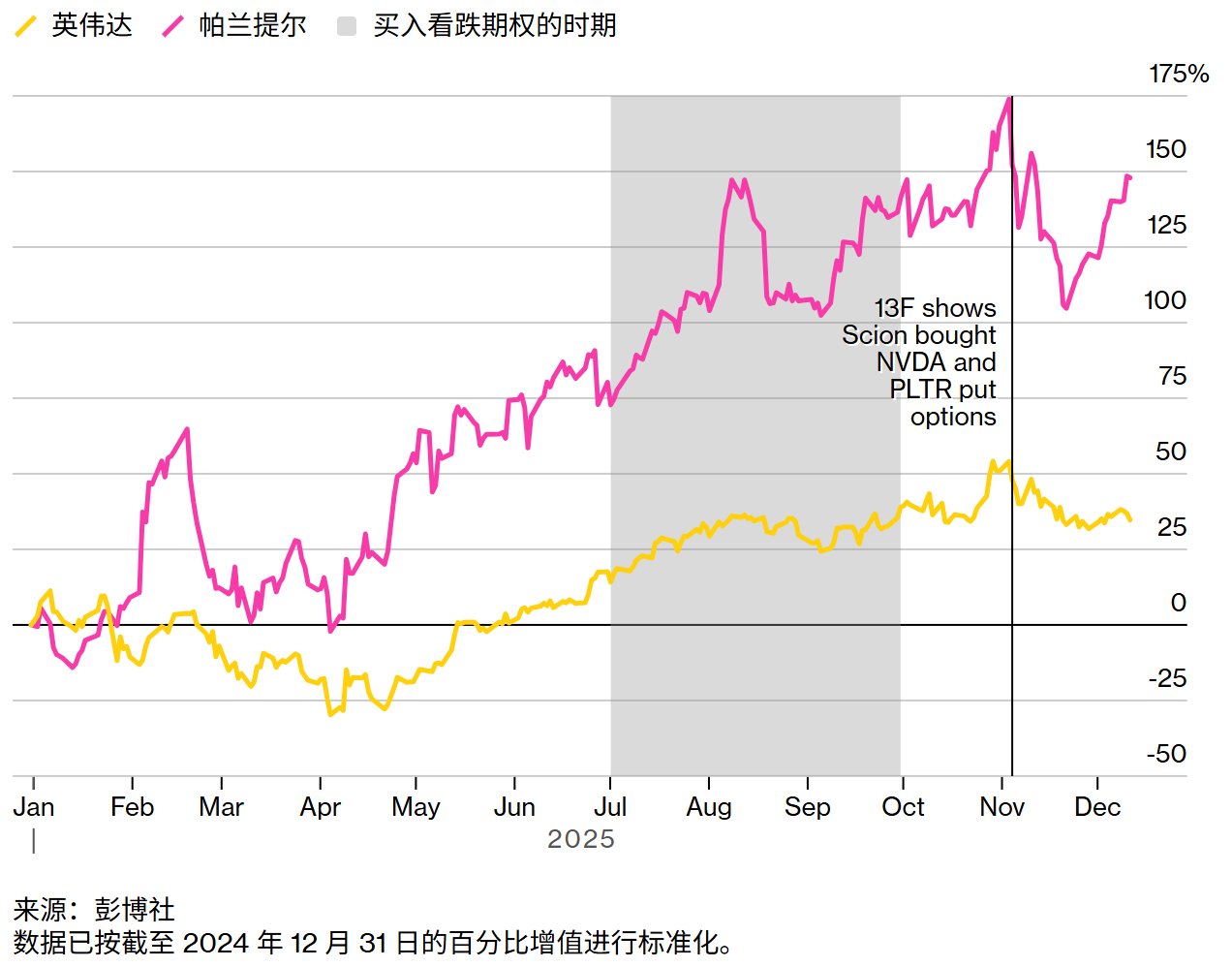
Core Viewpoint - Michael Burry, known for predicting the subprime mortgage crisis, believes that the AI sector, particularly companies like Nvidia and Palantir, is forming a bubble similar to the internet bubble, and he has taken short positions in these stocks through options trading [1]. Group 1: Market Position and Strategy - Burry has invested approximately $10 million in put options against Nvidia and Palantir, with potential returns exceeding $1 billion if a market crash occurs as he anticipates [1]. - He has publicly criticized Nvidia's internal memo, claiming it is filled with "straw man arguments" and suggests that the real risks are being obscured [1][5]. Group 2: Concerns about Nvidia - Burry's main concerns regarding Nvidia focus on the capital expenditures of its clients, which he believes are at risk of significant asset write-downs due to rapid technological advancements [1][5]. - He argues that Nvidia's clients, such as Microsoft and Meta, may extend the depreciation period of their GPUs to enhance short-term profits, which could lead to future financial issues as new technology renders existing hardware obsolete [5]. Group 3: Concerns about Palantir - Burry criticizes Palantir for its heavy reliance on government contracts and excessive executive compensation, as well as facing intense competition from companies like IBM [6]. Group 4: Historical Context and Market Reactions - Despite Burry's past successes, he has faced skepticism due to several failed predictions over the last 15 years, leading to a perception that he often enters positions too early [8]. - Burry's previous call to "sell" in early 2023 was followed by a significant market rally, which he later acknowledged as a mistake, but he defended his overall investment strategy [8].


2025年九大标志性交易:泡沫、蟑螂与367%的暴涨
Jin Rong Jie· 2025-12-29 06:26
Group 1: Market Trends and Dynamics - The year has been marked by high-stakes bets and rapid reversals, with significant volatility across various markets, including record highs in gold prices and fluctuations in mortgage giants [1] - Investors have heavily bet on changing political landscapes, inflated balance sheets, and fragile market narratives, leading to substantial stock market gains and crowded yield trades [1] - The geopolitical shift has significantly benefited European defense stocks, with companies like Rheinmetall AG and Leonardo SpA seeing stock price increases of approximately 150% and over 90% respectively [4][5] Group 2: AI and Technology Investments - Scion Asset Management disclosed protective put options on Nvidia and Palantir, raising concerns about the high valuations and spending plans of major AI players [2][3] - Nvidia's stock price fell significantly after the disclosure, reflecting the market's sensitivity to potential overvaluation in the AI sector [2] Group 3: Defense Sector Changes - The defense sector, previously avoided by asset managers due to ESG concerns, has seen a paradigm shift, with funds now focusing on defense-related investments [5] - A basket of European defense stocks has risen over 70% in 2025, indicating a strong market interest in this sector [5] Group 4: Currency and Alternative Assets - Concerns over heavy debt burdens in major economies have led investors to favor alternative assets like gold and cryptocurrencies, while showing reduced enthusiasm for government bonds and the dollar [6][7] - The narrative of "currency debasement" gained traction, particularly during periods of political instability, leading to record highs in both gold and Bitcoin [6][7] Group 5: South Korean Market Performance - The South Korean stock market has surged over 70% in 2025, driven by political efforts to boost the capital market and the global AI trend [8] - Despite the market's strong performance, local retail investors have been net sellers, indicating a lack of confidence in the domestic market [8] Group 6: Japanese Bond Market - The Japanese bond market has shifted from being a "widowmaker" trade to a favorable environment for short sellers, with benchmark yields rising significantly [10][11] - The 10-year Japanese government bond yield surpassed 2%, marking a significant change in the market dynamics [10] Group 7: Credit Market Developments - The credit market has seen substantial returns from strategic actions taken by funds like Pimco and King Street Capital Management, particularly in distressed situations [12] - A series of smaller but concerning events in the credit market have raised alarms about industry practices and borrower capabilities [17][18] Group 8: Fannie Mae and Freddie Mac - Fannie Mae and Freddie Mac have experienced a significant stock price increase of 367% from January to September 2025, driven by optimism regarding potential privatization [14][15] - The market remains speculative about the timing and feasibility of an IPO for these companies, despite the excitement surrounding their potential release from government control [14][15] Group 9: Turkish Lira and Emerging Markets - The Turkish lira has depreciated approximately 17% in 2025, highlighting the risks associated with high-yield investments in emerging markets amid political turmoil [16]

The 11 big trades of 2025: Bubbles, cockroaches and a 367% jump
BusinessLine· 2025-12-29 04:24
Market Overview - The year was characterized by high-conviction bets and rapid reversals across various markets, including bonds, currencies, and stocks [1] - Investors engaged in significant bets on political shifts, inflated balance sheets, and speculative narratives, leading to both substantial gains and losses [2][3] Cryptocurrency Trends - The Trump brand initially drove momentum in the cryptocurrency market, with various tokens launched by Trump family members experiencing significant but short-lived rallies [4][5] - By December 23, Trump's memecoin had dropped over 80% from its January high, while Melania Trump's token fell nearly 99% [6] - The volatility in crypto assets highlighted the speculative nature of the market, where political momentum could not shield investments from core market patterns [7] Defence Stocks Surge - A geopolitical shift led to a significant rise in European defence stocks, with companies like Rheinmetall AG and Leonardo SpA seeing year-to-date gains of approximately 150% and over 90%, respectively [10] - Asset managers, previously hesitant to invest in defence due to ESG concerns, began to redefine their mandates and invest heavily in the sector [11][12] - A Bloomberg basket of European defence stocks rose over 70% for the year, indicating a major shift in capital allocation towards defence as a public good [12] Debasement Trade Narrative - Heavy debt loads in major economies prompted investors to seek refuge in gold and alternative assets, leading to the emergence of the "debasement trade" narrative [13] - In October, both gold and Bitcoin reached record highs amid concerns over the US fiscal outlook and a prolonged government shutdown [14] - Despite the initial rise, Bitcoin later slumped, and the dollar stabilized, illustrating the complexities of the debasement trade [15][16] South Korean Stock Market - South Korea's benchmark equity index surged over 70% in 2025, driven by President Lee Jae Myung's efforts to enhance capital markets [18] - Foreign investment increased significantly, while local retail investors remained net sellers, indicating a disconnect between domestic sentiment and foreign capital inflows [20] Japanese Bonds - The "widowmaker" trade against Japanese bonds turned profitable in 2025 as yields surged, driven by interest rate hikes and increased government spending [26][27] - The benchmark 10-year JGB yields surpassed 2%, marking levels not seen in decades, while the overall bond market faced significant declines [28][29] Credit Market Dynamics - The credit market in 2025 experienced a series of smaller collapses, exposing poor lending practices and leading to significant losses for investors [40][41] - Companies like Saks Global and New Fortress Energy faced severe financial difficulties, prompting a reevaluation of credit risk and lending standards [41][42] Fannie Mae and Freddie Mac - Following Donald Trump's re-election, shares of Fannie Mae and Freddie Mac surged by 367% from the start of the year to their September high, driven by optimism regarding potential privatization [34][35] - The possibility of an IPO valuing the companies at around $500 billion further fueled investor interest, despite ongoing skepticism about the timeline for such a move [35][36] Turkish Carry Trade Collapse - The Turkish carry trade, initially favored by investors, collapsed following political unrest, leading to significant outflows from Turkish lira-denominated assets [37][39] - By December 23, the lira had weakened by 17% against the dollar, highlighting the risks associated with high-yield investments in politically unstable environments [39]

从加密狂潮到做空日债:复盘2025年令市场“心跳停止”的十一大押注
智通财经网· 2025-12-29 03:44
Group 1: Cryptocurrency and Political Influence - The year 2025 saw a surge in speculative trading linked to Donald Trump's brand, particularly in the cryptocurrency sector, with significant investments in assets associated with him [1][2] - Trump's family launched various tokens, including a meme coin and Melania Trump's own token, which experienced dramatic price declines by the end of the year, with some down nearly 99% [2][3] - Despite political momentum, these assets could not escape the fundamental volatility of the cryptocurrency market, highlighting the risks of speculative trading [1][3] Group 2: AI Stocks and Short Selling - Scion Asset Management disclosed protective put options on Nvidia and Palantir, signaling skepticism about their high valuations amid a market driven by AI hype [1][4] - The put options had strikingly low strike prices compared to the stocks' closing prices, indicating a bearish outlook from a well-known investor, Michael Burry [3][4] - This move reflects underlying doubts about the sustainability of AI-driven market gains, suggesting potential for significant market corrections [3][4] Group 3: European Defense Stocks - European defense stocks surged due to geopolitical shifts, with companies like Rheinmetall and Leonardo seeing year-to-date gains of approximately 150% and over 90%, respectively [6][8] - Investment managers, previously hesitant to engage with defense stocks, have now revised their strategies to include these assets, indicating a paradigm shift in investment focus [6][10] - The demand for defense-related investments has extended into the credit market, with new financial instruments being created to support military spending [6][10] Group 4: Gold and Inflation Hedge - The narrative of "devaluation trading" emerged as investors sought refuge in gold and cryptocurrencies amid concerns over national debts and inflation, leading to record highs for both assets [10][11] - This trend reflects a complex interplay between macroeconomic fears and the demand for safe-haven assets, with gold reaching unprecedented levels [10][11] - The market dynamics suggest that while fears of devaluation persist, strong demand for secure assets can coexist with broader economic uncertainties [10][11] Group 5: South Korean Stock Market - The South Korean stock market experienced a remarkable rise, with the Kospi index climbing over 70% in 2025, driven by government policies aimed at revitalizing the capital market [12][14] - Despite the impressive performance, local retail investors remained skeptical, opting to invest heavily in U.S. stocks instead, indicating a disconnect between foreign and domestic investor sentiment [12][18] - The government's ambitious target of reaching a Kospi index of 5000 has gained traction among major financial institutions, suggesting potential for continued growth [12][14] Group 6: Japanese Bonds - The Japanese bond market, once considered a "widowmaker," transformed into a profitable short-selling opportunity as yields surged, driven by government spending and interest rate hikes [22][25] - The Bloomberg Japan bond index recorded significant losses, marking it as the worst-performing major bond market globally [22][25] - Investor sentiment remains bearish, with expectations of further rate increases and ongoing fiscal challenges contributing to a negative outlook for Japanese bonds [22][25] Group 7: Credit Market Dynamics - The credit market in 2025 revealed vulnerabilities as several previously reliable borrowers faced significant financial distress, leading to a series of defaults and restructurings [30][31] - Notable cases included companies like Saxo Global and New Fortress Energy, which saw their bond values plummet, raising concerns about the overall health of the credit market [30][31] - The fragmentation of debt holders and the lack of transparency in borrowing practices have heightened risks for investors, prompting warnings from industry leaders [30][31]

AI泡沫何时破裂?《大空头》原型被质疑又一次“下手太早”
Jin Shi Shu Ju· 2025-12-29 02:52
伯里再启"预言家"模式,斥资1000万美元做空AI双雄。但问题在于他不确定泡沫何时会破。网友调 侃:"他过去预测20次衰退,只中2次"...... 由于过早地嗅到危机而成为人群中的异类,迈克尔·伯里(Michael Burry)对这类"剧情"并不陌生。 正如电影《大空头》(The Big Short)中的经典场景:克里斯蒂安·贝尔(Christian Bale)饰演的伯里, 向投资者说明他做空美国房地产市场的押注。若判断正确,市场崩盘后,这位对冲基金经理将通过类似 保险的合约斩获7亿美元巨额收益;若判断失误,他的基金将在几个季度内破产。 "等着瞧,一定会有回报的,"电影里的伯里说道,"我或许下手早了,但我没说错。" "又是 老一套!"一位投资者反驳道。 如今,现实中的伯里正试图说服华尔街:他能从人工智能(AI)企业英伟达(NVDA)和Palantir (PLTR)的股价下跌中获利。今年以来,AI行业一直是推动市场创下历史新高的核心动力,但过去十 年大多保持低调的伯里,近期再度现身,直言AI板块存在泡沫,且即将破裂。 但问题在于:他不确定泡沫何时会破。 伯里这种直言不讳的"异类",很适合成为迈克尔·刘易斯(Mi ...

4 Tech Stocks With More Potential Than Any Cryptocurrency
Yahoo Finance· 2025-12-28 22:43
Group 1: Cryptocurrency Market Insights - The cryptocurrency market has significant potential, with many cryptocurrencies experiencing over 100% gains in the last week [1] - However, the volatility of the market means that for every success story, there are many digital coins that quickly fade away, making it difficult to predict future winners [2] Group 2: Stock Market Opportunities - Investors do not need to chase cryptocurrencies to build wealth; there are promising companies in the stock market that can provide substantial gains [3] - Tech stocks have been highlighted as some of the best investments over the past year, with expectations for continued growth into 2026 [3] Group 3: Company Analysis - Palantir Technologies - Palantir Technologies (NASDAQ: PLTR) has a high forward price-to-earnings (P/E) ratio of 267 and a forward price-to-sales (P/S) ratio of 104, indicating potential overvaluation [5] - Despite valuation concerns, Palantir is experiencing rapid growth, with a 63% revenue increase in Q3 and 204 deals over $1 million [6] - The stock has risen 155% this year, following gains of 167% in 2023 and 340% in 2024, with expectations for further growth of 100% or more in 2026 [7][8] Group 4: Company Analysis - Nvidia - Nvidia (NASDAQ: NVDA) has seen a significant stock price increase of 819% from 2023 to 2024, followed by a 37% gain in 2025, although recent performance has shown signs of slowing down [10]
Every major analyst's S&P 500 price target for 2026
Yahoo Finance· 2025-12-28 17:07
When 2025 began, Wall Street was awash in excitement. A new President was about to take office — even if he'd been in the office once before. Most investment professionals expected interest rates to come down. That tax cuts were on the way was judged a certainty. Regulation might be reduced substantially. And what Wall Street certainly saw was a continuation of the 2024 bull market. What could possibly go wrong? Well, there was Donald Trump's decision in early April to impose massive tariffs on just a ...