贬值交易

Search documents
贵FOMO贵贵贵
Zi Jin Tian Feng Qi Huo· 2026-02-03 07:58
Report Industry Investment Rating - Not provided in the content Core Viewpoints - Last week, influenced by the reaffirmation of the strong - dollar stance by Baysent and the nomination of Kevin Warsh as the Fed Chair, the US dollar index strengthened, leading to a concentrated sell - off of precious metals. London spot gold fell nearly 20%, and silver dropped by as much as 40%. Global major stock markets were also under pressure [3]. - The sharp correction of precious metals is due to the structural fragility accumulated during the previous rapid - rise phase. However, the logic of global liquidity easing may not reverse, and the "depreciation trade" macro - theme is not likely to enter a head - wind period easily. The Fed Chair nominee's operation space on the balance sheet is restricted by fiscal realities, and shrinking the balance sheet may increase debt pressure, which may not be bearish for gold in the long - term [3]. - The current market panic may provide an opportunity for rational investors. After the panic subsides and the market structure stabilizes, investors can consider gradually deploying to seize the allocation opportunities [3]. Summary by Directory Overseas Main Interest Rates - The pricing of interest rate cuts remained stable last week. The money market still factored in the possibility of two 25 - bps interest rate cuts this year, despite the nomination of Kevin Warsh. His historical views are considered hawkish, but the market's pricing of him did not change substantially. He is expected to cut interest rates in the early stage of his tenure [5][7]. Yield Curve - Last week, the yields of US Treasury bonds at different maturities diverged. The 30 - year UST yield rose 4.8 bps to 4.87%, the 10 - year UST yield rose 1.43 bps to 4.24%, and the 2 - year UST yield fell 6.5 bps to 3.5%. The yield curve steepened, which is related to the market's digestion of Kevin Warsh's possible appointment [16]. Fed Reserves - The usage of ONRRP last week was $9.63 billion, up $8.14 billion from the previous value. The Fed's reserve balance on Wednesday last week was $2.883 trillion, down $74 billion from the previous week [21]. Long - and Short - Term US Treasury Bond Yield Positions - As of January 27, the positions of long - and short - term US Treasury bond yields were differentiated. The non - commercial net short positions of 2 - year UST futures increased by 6,123 lots to 1,218,999 lots, and the non - commercial net short positions of 10 - year UST futures increased by 70,511 lots to 726,151 lots. As of the week of January 26, the sentiment of JPM Treasury net - long investors was 5, slightly up from the previous week [25]. US Real Interest Rates - The yields of 5 - year and 10 - year TIPS diverged. The 5 - year TIPS yield closed at 1.26%, down 10 bps from the previous week, and the 10 - year TIPS yield closed at 1.9%, down 2 bps from the previous week [32]. US Dollar Index and Liquidity - Last week, the US dollar index and the gold price moved in the same direction. Gold fell 2%, and the US dollar index fell 0.4% to 97, with their rolling correlation decreasing. The US dollar depreciated 0.6% against the yen, 0.2% against the euro, and 0.3% against the pound [40]. - As of January 27, the total position of the US dollar index increased. The non - commercial long positions increased by 1,942 contracts to 18,000 contracts, and the non - commercial short positions decreased by 71 contracts to 22,000 contracts. The long - side power was dominant. In terms of position ratio, the non - commercial long - position ratio was 57%, up from the previous week, and the short - position ratio was 70%, down from the previous week [44]. - Last week, the 3 - month Basis Swap of the yen and the euro increased month - on - month, and the financing cost of offshore US dollar liquidity decreased [47]. Inflation High - Frequency Indicators - Last week, the copper - to - gold ratio rose to 2.67. The decline in copper prices was less than that of gold, indicating a marginal increase in global aggregate demand momentum [54]. Price Ratios and Volatility - The gold - to - silver ratio oscillated higher because the decline of gold was greater than that of silver last week; the gold - to - copper ratio decreased because the decline of gold was greater than that of copper; the gold - to - oil ratio decreased month - on - month because crude oil rose and gold fell last week [63]. - From the perspective of rolling correlation, the correlation between gold and crude oil increased, while the correlation between gold and the US dollar index and copper decreased [70][71]. - Last week, silver showed extreme internal - external premium, and the domestic buying was strong [76]. Inventory and Positions - In terms of inventory, last week, the COMEX gold inventory was 35.749 million ounces, a month - on - month decrease of 396,000 ounces, and the COMEX silver inventory was 405.887 million ounces, a month - on - month decrease of 10.538 million ounces. The SHFE gold inventory was about 103 tons, with no month - on - month change, and the SHFE silver inventory decreased by 111.2 tons to 462.6 tons [81]. - The SPDR gold ETF position increased by 0.57 tons to 1,087.1 tons, and the current position scale is near the lower median of the past 10 years; the SLV silver ETF position decreased by 566.6 tons to 15,523.4 tons, and it is currently at a medium - to - high level [87]. - The total COMEX gold position decreased by 39,541 lots to 488,000 lots. The non - commercial long positions decreased by 43,672 lots to 252,000 lots, and the short positions decreased by 4,298 lots to 48,000 lots, indicating an increase in the short - side power of gold allocation. In terms of position ratio, the non - commercial long - position ratio decreased to around 52%, and the non - commercial short - position ratio increased to around 10% [92]. - The total COMEX silver position increased by 4,617 lots to 157,000 lots. The non - commercial long positions increased by 510 lots to 44,000 lots, and the short positions increased by 2,021 lots to 19,000 lots, indicating an increase in the short - side power of silver allocation. In terms of position ratio, the non - commercial long - position ratio decreased to around 27.8%, and the non - commercial short - position ratio increased to around 12.6% [98]. Deferred Fees and Lease Rates - Information about gold and silver T + D deferred fee directions and implied lease rates is not summarized due to lack of detailed data analysis content.
华尔街日报:黄金和白银创1980年以来最大单日跌幅
美股IPO· 2026-01-31 01:39
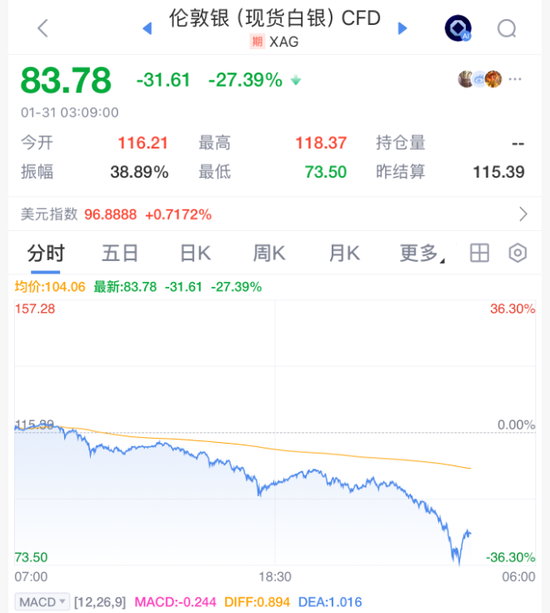
Core Viewpoint - The article discusses the significant drop in gold and silver prices, marking the worst day for these metals since 1980, driven by hawkish sentiments regarding inflation and the U.S. dollar following the nomination of Kevin Walsh as the Federal Reserve Chair by Trump [1][3]. Group 1: Market Reactions - Silver prices plummeted by 31%, while gold futures fell by 11%, marking the largest single-day dollar drop in history for gold [3][5]. - The sell-off began after reports of Trump's nomination of Walsh, who is known for his hawkish stance on inflation, which alleviated concerns on Wall Street regarding potential interest rate cuts [3][4]. - Following Walsh's confirmation, the U.S. dollar strengthened against other precious metals, leading to a rapid decline in the precious metals market [4]. Group 2: Price Movements - Silver futures dropped from over $114 per ounce to a settlement price of $78.29, a decline of $35.747, which is comparable to silver prices in June [4]. - Gold futures fell to $4,713.90 per ounce, the largest single-day drop since January 1980 [5]. - The declines in precious metals also negatively impacted mining stocks and contributed to a 0.4% drop in the S&P 500 index [5]. Group 3: Market Dynamics - Analysts suggest that the recent downturn may be a necessary correction after a period of rapid price increases, particularly for industrial users of these metals [5]. - There is speculation that short-term traders may have contributed to the sell-off as a protective measure against potential stock market declines [5]. - The article notes that the market for precious metals is relatively small, meaning that large investors can significantly influence price movements, adding to the volatility [7].

彻底崩盘!见证历史
Xin Lang Cai Jing· 2026-01-30 23:41
Core Viewpoint - The recent significant sell-off in gold and silver has been attributed to the nomination of Kevin Warsh as the next Federal Reserve Chairman, which has alleviated market concerns regarding central bank independence and led to a surge in the US dollar [3][9]. Group 1: Market Reactions - Gold and silver experienced a severe sell-off, with silver dropping over 35%, marking the worst single-day performance in history, while gold fell more than 10%, the largest single-day decline since 1983 [1][6]. - The initial drop was triggered by reports of Warsh's nomination, which accelerated as investors sought to take profits from their positions in precious metals [3][9]. Group 2: Analyst Insights - Analysts suggest that the sell-off may largely be due to "forced selling," particularly among day traders and short-term traders who had accumulated leverage in silver [5][11]. - The market is treating Warsh as a hawkish figure, which is expected to stabilize the dollar and reduce the asymmetric risks associated with a prolonged decline in the dollar's value, contributing to the drop in gold and silver prices [5][11]. - The speculation surrounding the nomination of the next Federal Reserve Chairman has been influencing precious metal prices, with the market pricing in risks associated with more dovish candidates [5][11].
黄金ETF持仓量报告解读(2026-1-30)全球投资者持续涌入避险资产
Sou Hu Cai Jing· 2026-01-30 08:42
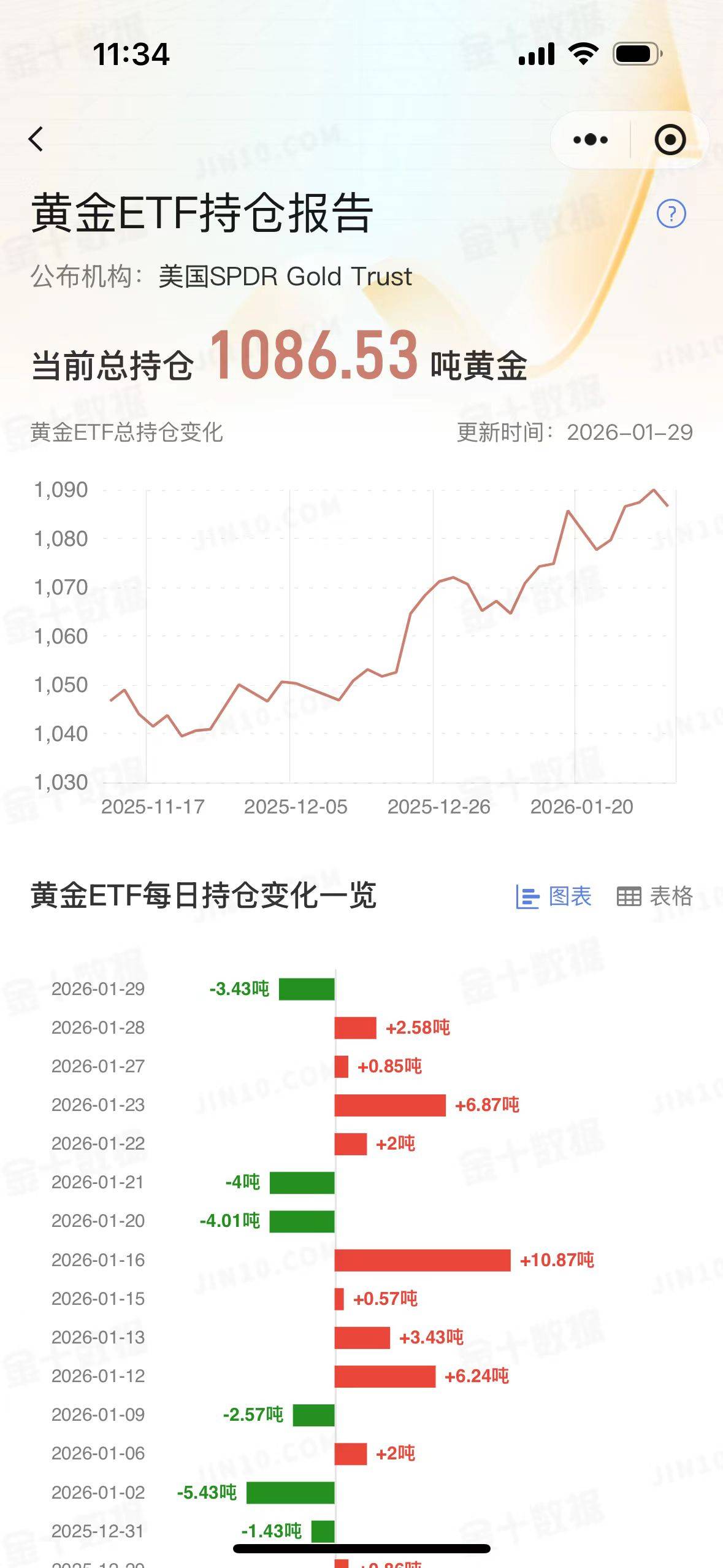
Core Viewpoint - The SPDR Gold Trust, the world's largest gold ETF, reported a total holding of 1,086.53 tons of gold, reflecting a decrease of 3.43 tons from the previous trading day, amidst significant fluctuations in gold prices [5]. Group 1: Gold Price Movements - On January 29, spot gold experienced extreme volatility, with a peak of $5,595.07 per ounce and a low of around $5,100, closing at $5,377.54, down $38.05 or 0.70% [5]. - The recent surge in gold prices, which has increased by approximately $400, is attributed to strong demand for traditional safe-haven assets amid geopolitical tensions and economic uncertainties [5][6]. - Analysts expect gold prices to continue rising, with forecasts suggesting potential levels of $6,000 or more in 2026, driven by sustained investment demand and diversification from dollar-denominated assets [7]. Group 2: Market Influences - The weakening of the US dollar and concerns regarding the independence of the Federal Reserve have provided additional support for gold prices [5][6]. - The Federal Reserve's decision to maintain interest rates, despite dissenting votes for a rate cut, reflects ongoing inflation concerns, which have not deterred investor interest in gold [6]. - Geopolitical tensions and domestic political issues in the US are contributing to a heightened demand for gold as a safe-haven asset [6]. Group 3: Technical Analysis - Technical indicators suggest a strong bullish trend for gold, with the MACD showing increasing upward momentum, although the RSI indicates overbought conditions that may limit immediate gains [7]. - Key resistance levels for gold are identified at $5,598, with potential further upside to the $5,670–$5,697 range if this level is breached [8]. - Initial support for gold is noted around the $5,100 level, indicating that any significant pullback may be viewed as a buying opportunity [8].
芝加哥小麦期货升至近两个月高点 因美元表现乏力
Xin Lang Cai Jing· 2026-01-29 11:25
Group 1 - Chicago wheat futures have risen to a nearly two-month high, driven by a weaker dollar which has boosted grain and oilseed futures [1] - The Bloomberg Dollar Spot Index is approaching a four-year low due to depreciation trades, putting pressure on the dollar as investors pull out of the currency and U.S. Treasuries [1] - The weaker dollar makes U.S. agricultural exports more attractive, contributing to a 1.3% increase in wheat futures, which are on track for a third consecutive day of gains, potentially marking the longest winning streak in a month [1] Group 2 - Corn and soybean futures have also increased in tandem with wheat prices, reflecting a broader trend in the agricultural commodities market [1]
涨疯了!黄金、白银创历史新高!有交易所发布紧急通知
Sou Hu Cai Jing· 2026-01-29 10:20
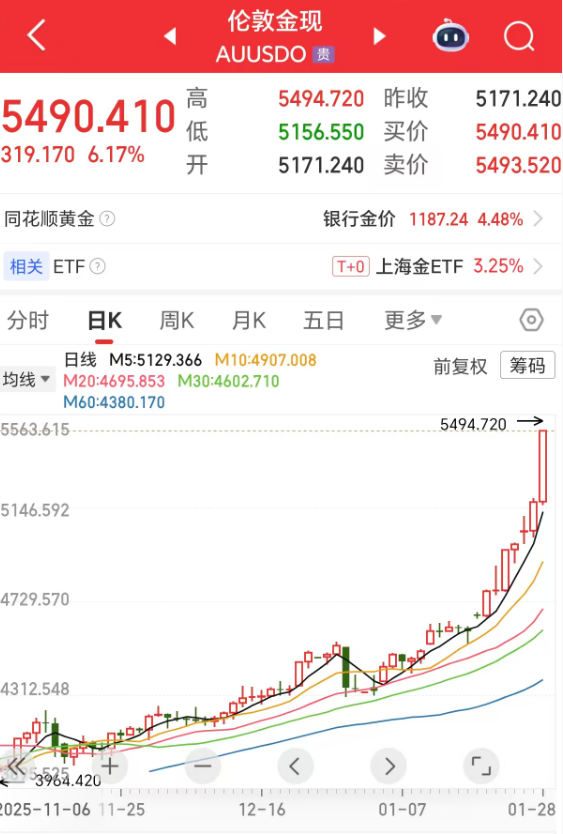
Group 1 - The core viewpoint of the articles highlights the significant surge in gold and silver prices, with spot gold reaching a record high of $5500 per ounce and silver touching $118 per ounce [1][3] - The Federal Reserve's decision to maintain the federal funds rate between 3.50% and 3.75% has contributed to the bullish trend in gold and silver prices, with gold breaking the $5400 mark and silver rising by 4% [3] - Analysts suggest that the current price increase in gold is driven by concerns over fiscal debt expansion, a weakening dollar, geopolitical uncertainties, and persistent inflation worries [9][10] Group 2 - The Shanghai Gold Exchange and the Shanghai Futures Exchange have announced adjustments to margin levels and price fluctuation limits for various futures contracts, including gold and silver [4][6] - The margin level for silver contracts has been raised from 19% to 20%, and the price fluctuation limit has been adjusted from 18% to 19% [4] - The adjustments in trading rules reflect the exchanges' efforts to manage risks amid the volatile market conditions [6] Group 3 - Analysts warn of the increasing risk of long-term consolidation in gold prices, despite the current upward momentum [8][11] - The overall structural logic supporting gold's rise remains intact, but there are concerns that a resilient global economy may pose headwinds for gold prices [8][11] - Speculative enthusiasm could push gold prices higher, but many of the underlying concerns have not yet materialized into significant market disruptions [9][10]
金价狂飙,历史首次!
Sou Hu Cai Jing· 2026-01-29 05:59
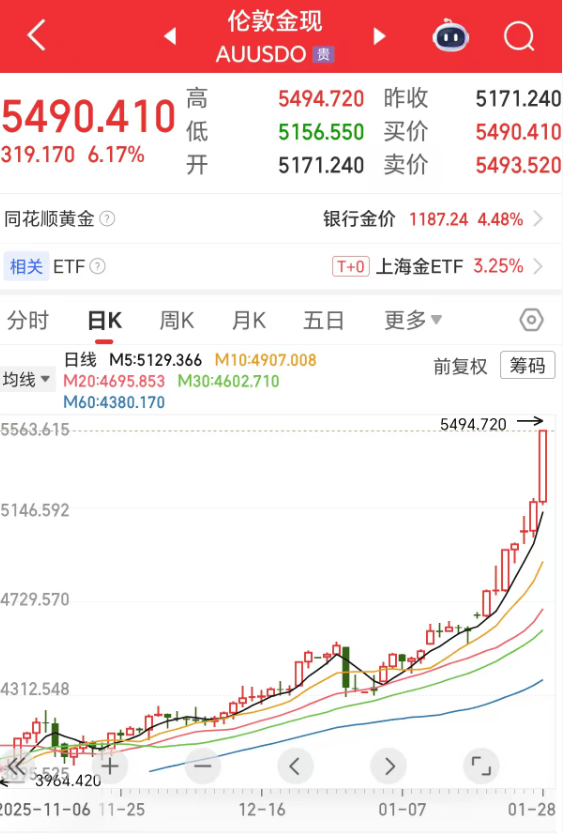
Group 1: Market Performance - Spot gold has surged to a record high of $5500 per ounce, marking a 1.74% increase in a single day [1] - Spot silver has also reached a historical peak of $118 per ounce, with a daily rise of 1.12% [1] - Following the Federal Reserve's decision to maintain interest rates between 3.50% and 3.75%, gold and silver prices experienced significant increases, with gold briefly surpassing $5450 and reaching a high of $5496 [3] Group 2: Regulatory Changes - The Shanghai Gold Exchange announced an increase in the margin requirement for silver deferred contracts from 19% to 20%, effective January 30, 2026, along with an adjustment in the price fluctuation limit from 18% to 19% [4] - The Shanghai Futures Exchange also updated its margin requirements and price fluctuation limits for various futures contracts, including gold and silver, effective January 30, 2026 [6] Group 3: Analyst Insights - Analysts indicate that while gold prices are currently supported by factors such as a weak dollar and geopolitical uncertainties, there is a rising risk of long-term consolidation rather than an imminent sharp correction [8][10] - Concerns regarding fiscal debt expansion, a weakening dollar, and geopolitical tensions are driving gold prices higher, but many of these concerns have not yet materialized into severe market reactions [9]
黄金、白银彻底爆了,有交易所发布紧急通知
Sou Hu Cai Jing· 2026-01-29 04:18
Group 1 - The core viewpoint of the articles indicates a significant increase in precious metals, particularly gold and silver, following the Federal Reserve's decision to maintain interest rates, which aligns with market expectations [4][5] - Spot gold prices surged to nearly $5600 per ounce before retracting to below $5500, while spot silver reached a historical high of $118 per ounce, reflecting a daily increase of 1.12% [3][5] - Analysts suggest that the driving factors for the rise in gold prices include concerns over fiscal debt expansion, a weakening dollar, geopolitical uncertainties, and persistent inflation worries [12] Group 2 - The Federal Reserve announced it would keep the federal funds rate unchanged at 3.50%-3.75%, which contributed to a 4.5% increase in gold prices, pushing it above $5400 per ounce [5] - The international oil prices also saw an increase, with WTI crude oil rising nearly 1.8% to $63.5 per barrel, influenced by escalating tensions in Iran [7] - The Shanghai Gold Exchange and Shanghai Futures Exchange announced adjustments to margin levels and price fluctuation limits for various futures contracts, including gold and silver, effective January 30, 2026 [9][10] Group 3 - Analysts warn of a rising risk of long-term consolidation in gold prices, despite current upward momentum, due to resilient global economic conditions [11][14] - The speculative frenzy could push gold prices to $5500 per ounce, but many concerns driving this speculation have not yet materialized [12][14] - There is a belief that while safe-haven demand may begin to cool, significant short-term corrections in gold prices are unlikely [13]
凌晨突发!金价狂飙,历史首次!交易所发布紧急通知
Sou Hu Cai Jing· 2026-01-29 02:56
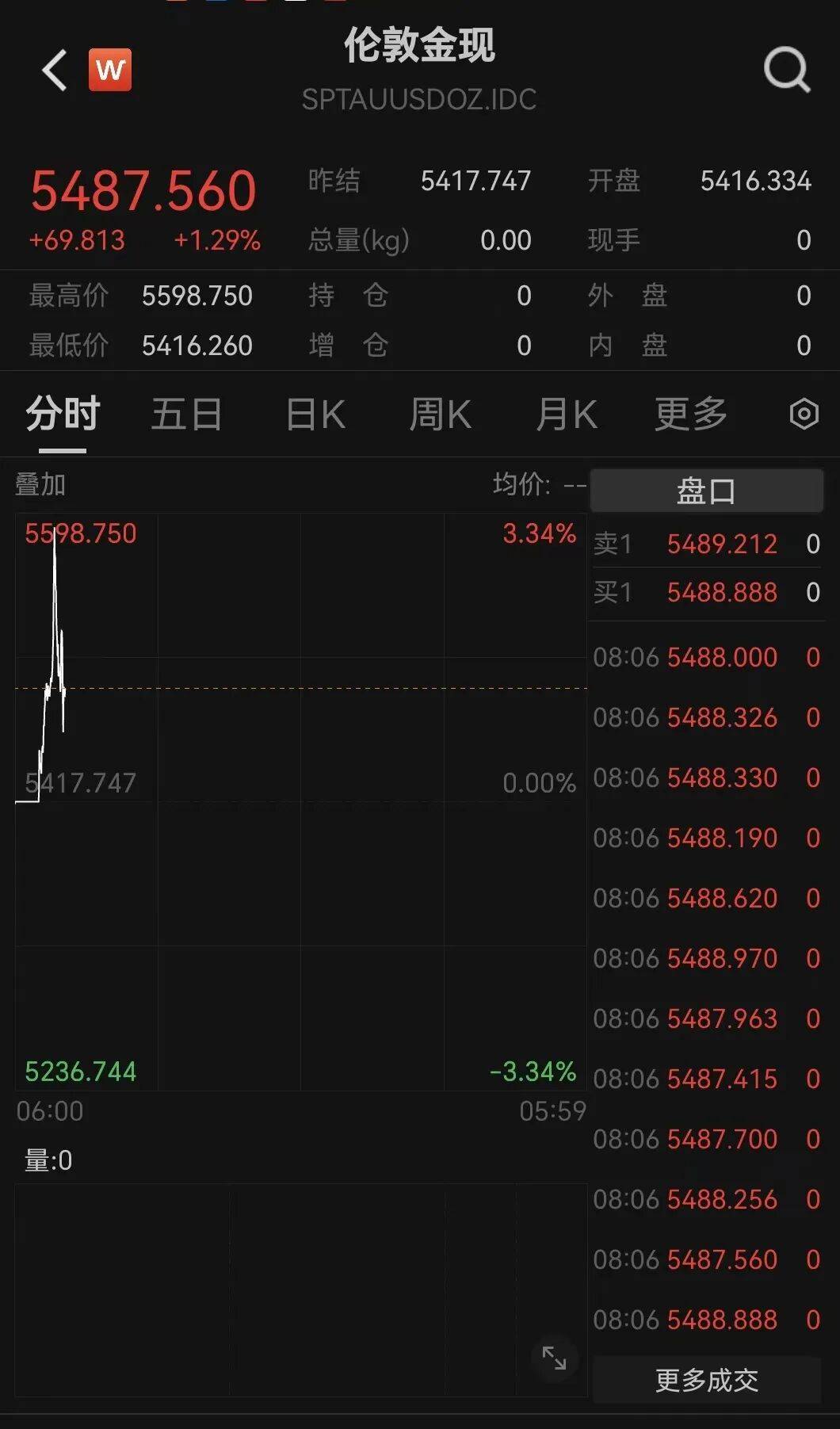
Group 1 - The core point of the news is the significant fluctuations in precious metals prices, particularly gold and silver, following the Federal Reserve's decision to maintain interest rates [3][4][10]. - Spot gold approached the $5600 per ounce mark but quickly fell below $5500, indicating volatility in the market [2][4]. - Spot silver reached a historical high of $118 per ounce, reflecting a daily increase of 1.12% [2]. Group 2 - The Federal Reserve announced it would keep the federal funds rate unchanged at 3.50%-3.75%, aligning with market expectations, which led to a surge in precious metals prices [4]. - Gold prices increased by 4.5%, surpassing $5400 per ounce, while silver rose by 4.2% to $116.6 per ounce following the Fed's announcement [4]. - Analysts suggest that the current market conditions, including concerns over fiscal debt expansion and geopolitical uncertainties, are driving gold prices higher, with speculation that prices could reach $5500 per ounce [11][12]. Group 3 - The Shanghai Gold Exchange and Shanghai Futures Exchange announced adjustments to margin levels and price fluctuation limits for various futures contracts, effective January 30, 2026 [6][8]. - The margin level for silver contracts was raised from 19% to 20%, and the fluctuation limit was adjusted from 18% to 19% [6]. - Similar adjustments were made for other commodities, including nickel and aluminum, indicating a tightening of trading conditions in response to market volatility [8]. Group 4 - Analysts warn of a rising risk of long-term consolidation in gold prices, although they believe that the overall structural logic supporting gold's rise remains intact [10][13]. - Despite the potential for a cooling demand for safe-haven assets, a significant price correction in gold is not anticipated in the short term [12][13].
凌晨突发!黄金、白银彻底爆了,有交易所发布紧急通知
Xin Lang Cai Jing· 2026-01-29 01:49
Group 1 - The core point of the article is that both gold and silver prices have reached historical highs, with gold surpassing $5500 per ounce and silver touching $118 per ounce [3][16] - On January 29, 2023, gold prices increased by 1.74% and silver by 1.12%, marking significant daily gains [3][16] - The Federal Reserve announced it would maintain the federal funds rate between 3.50% and 3.75%, which was in line with market expectations, leading to a surge in precious metal prices [4][16] Group 2 - Oil prices have also risen, with WTI crude oil increasing nearly 1.8% to $63.5 per barrel and ICE Brent crude oil rising over 1.6% to $67.68 per barrel, reaching the highest levels since September 2025 [6][18] - The Shanghai Gold Exchange and the Shanghai Futures Exchange have announced adjustments to margin levels and price fluctuation limits for various futures contracts, effective January 30, 2026 [8][20] - Analysts have indicated that while gold prices are supported by various factors, there is a rising risk of long-term consolidation rather than an imminent significant correction [10][22][25] Group 3 - According to Ole Hansen from Saxo Bank, speculative enthusiasm could push gold prices to $5500 per ounce, driven by concerns over fiscal debt expansion, a weakening dollar, geopolitical uncertainties, and persistent inflation worries [11][23] - Despite these concerns, many have not yet materialized into reality, as the U.S. fiscal debt continues to rise without causing a market collapse, and geopolitical tensions have not escalated significantly [11][23] - Hansen believes that while safe-haven demand may begin to cool, gold is unlikely to experience a substantial pullback in the short term [24]