
阿特斯

Search documents
行业周报:世界机器人大会超1500款机器人产品展出,光伏产业链价格持稳-20250812
Shanxi Securities· 2025-08-12 09:02
Investment Rating - The report maintains an investment rating of "Synchronize with the market - A" for the electric equipment and new energy industry [1]. Core Viewpoints - The World Robot Conference showcased over 1,500 robot products, indicating a growing interest and innovation in robotics [3]. - The photovoltaic industry chain prices remain stable, with expectations for continued price stability in the near term [6][7][8][9]. Summary by Relevant Sections Investment Recommendations - Preferred stocks include: - Aishuo Co., Ltd. (600732.SH) - Buy - B - Longi Green Energy (601012.SH) - Buy - B - Daqian Energy (688303.SH) - Buy - B - Fulete (601865.SH) - Buy - A - Hengdian East Magnetic (002056.SZ) - Buy - A - Sungrow Power Supply (300274.SZ) - Buy - A - Canadian Solar (688472.SH) - Buy - A - Deyang Co., Ltd. (605117.SH) - Buy - A - Langxin Group (300682.SZ) - Buy - B - Quartz Co., Ltd. (603688.SH) - Buy - A [2]. Market Trends - The multi-crystalline silicon price is stable at 44.0 CNY/kg, with a slight decrease in transaction volume compared to the previous week [6]. - The silicon wafer prices remain unchanged, with N-type silicon wafers priced at 1.20 CNY/piece for 182-183.75mm and 1.35 CNY/piece for 182*210mm [7]. - Battery cell prices are stable, with N-type battery cells priced at 0.290 CNY/W for 182-183.75mm and 0.285 CNY/W for 182*210mm [8]. - Module prices are also stable, with TOPCon double-glass modules priced at 0.685 CNY/W and N-type HJT modules at 0.830 CNY/W [9]. Policy and Regulatory Developments - The National Energy Administration is establishing a "green channel" for large-scale wind and photovoltaic bases to better meet the needs of new energy development [5]. - The China Photovoltaic Industry Association is soliciting opinions on the draft amendment to the Price Law, focusing on price behavior norms and regulatory mechanisms [4].





在吃力不讨好的反复博弈中寻求突破
Great Wall Securities· 2025-08-12 08:38
Investment Rating - The report maintains a "Buy" rating for the industry, indicating a positive outlook for selected companies within the electric power equipment and new energy sector [3]. Core Insights - The photovoltaic sector is experiencing demand front-loading, with supply-side reforms needing close observation. The report emphasizes that significant demand growth is essential for market expansion, but limited absorption capacity and mismatched demand in overseas markets complicate the situation. Policy intervention is deemed crucial for the industry's recovery [1][13]. - In the energy storage segment, demand remains robust, but market dynamics are shifting. The report expresses optimism about large-scale storage despite concerns that it may follow the path of photovoltaics. The focus is on high-quality products and integrated service solutions, with expectations for profit margins to stabilize around 20-25% [2][7]. - The lithium battery sector faces challenges due to weak pricing power in the materials segment, driven by supply-demand imbalances. The report notes that the industry's effective capacity utilization is projected to hover around 60-65%, with leading battery manufacturers exerting significant influence over pricing and production cycles [6][12]. Summary by Sections Photovoltaics - Demand has been front-loaded, leading to a significant increase in installations, with 212.21 GW added in the first half of 2025, a 107.1% year-on-year increase. However, the market saw a sharp decline in June, indicating potential overcapacity and absorption issues [13][16]. - The report highlights the need for supply-side reforms and policy support to stabilize the industry, as the current market dynamics are characterized by a mismatch between supply and demand [1][19]. Energy Storage - The report indicates a positive outlook for large-scale energy storage, with expectations for profit margins to stabilize at 20-25%. The competitive landscape is evolving, with a focus on high-quality integrated solutions [2][7]. - The report also notes that the distributed energy storage market is entering a new phase, with competition intensifying and previous easy profits becoming harder to achieve [5][12]. Lithium Batteries - The lithium battery sector is experiencing a lack of pricing power in the materials segment, with effective capacity utilization projected at 60-65%. The report suggests that leading manufacturers are likely to dominate pricing and production cycles, impacting smaller players [6][12]. - The report emphasizes the need for material suppliers to adapt through cost reduction and technological advancements to remain competitive in a challenging market [6][12]. Investment Recommendations - The report suggests that the electric new energy sector is in a phase of "repeated games," with expectations for growth and recovery being tempered by market realities. The priority for sector recovery is seen as energy storage, followed by power batteries and photovoltaics [7][8]. - Selected companies such as Tongwei Co., Longi Green Energy, and Aiko Solar are highlighted as potential investment opportunities due to their competitive advantages in management, cost, and technology [8].


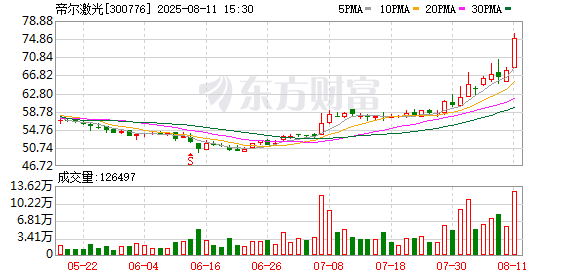
净利增长近四成,股价盘中跌近5%,帝尔激光欲将激光工艺延申至泛半导体领域
Di Yi Cai Jing· 2025-08-12 07:45
Core Viewpoint - The company reported a nearly 40% increase in net profit for the first half of 2025, but the market reacted negatively, with a stock price drop of 4.92% despite the strong financial results [1][2]. Financial Performance - In the first half of 2025, the company achieved revenue of 1.17 billion yuan, a year-on-year increase of 29.20%, and a net profit of 327 million yuan, up 38.27% year-on-year [1]. - For the second quarter of 2025, revenue reached 609 million yuan, reflecting a 33.81% year-on-year increase, while net profit was 164 million yuan, marking a 61.91% increase year-on-year [1]. - The gross margin for Q2 2025 was 47.4%, remaining stable quarter-on-quarter, while the net margin was 26.9%, down 2.2 percentage points [2]. - The operating cash flow for Q2 2025 was 37.02 million yuan, showing a positive turnaround [2]. - The company's debt-to-asset ratio was 44.3% at the end of the first half of 2025, a decrease of 3.3 percentage points from the end of 2024 [2]. Business Operations - The company operates under a "sales-driven production" model, allowing for flexible capacity utilization [2]. - The company is currently fulfilling orders normally, despite the overall losses in the photovoltaic industry [2]. Market Risks - The company has expressed concerns about potential market demand fluctuations, international procurement issues, and inventory risks [1][2]. - The solar cell production industry faces uncertainties that could impact the company's performance and accounts receivable if equipment purchases decrease or operational risks arise [2]. - The company relies heavily on international procurement for its main raw materials, and any disruptions in supply or changes in import/export policies could adversely affect operations [2]. Inventory Management - The company's inventory value was reported at 1.753 billion yuan, accounting for 26.29% of total assets, which is relatively high due to long product acceptance cycles [3]. - High inventory levels can tie up working capital and pose risks of inventory write-downs if products fail to meet acceptance standards [3]. Strategic Initiatives - To mitigate the impact of cyclical fluctuations in the photovoltaic industry, the company is expanding into new areas such as consumer electronics, new displays, and semiconductors [3]. - The company is actively developing laser processing equipment for these new sectors, which may open up a second growth curve [3].

科创板光伏公司业绩捷报频传 先进产能持续释放
Xin Hua Wang· 2025-08-12 05:49
Core Insights - Several photovoltaic companies listed on the Sci-Tech Innovation Board have reported positive performance forecasts for the first half of the year, showcasing strong growth and resilience in the sector [1][2] - The photovoltaic industry chain on the Sci-Tech Innovation Board is taking shape, with major global component manufacturers and hidden champions in niche segments contributing to the development of a robust ecosystem [1][3] Group 1: Financial Performance - JinkoSolar expects a net profit of 3.66 billion to 4.06 billion yuan for the first half of 2023, representing a year-on-year increase of 304.38% to 348.58% [2] - Trina Solar anticipates a net profit of 3.328 billion to 3.752 billion yuan for the same period, with a year-on-year growth of 162.14% to 195.61% [2] - In 2022, the 15 photovoltaic companies on the Sci-Tech Innovation Board achieved a total revenue of 276.18 billion yuan, a 96% increase year-on-year, and a net profit of 32.035 billion yuan, up 195% [2] - The three-year compound annual growth rate (CAGR) for revenue and net profit of these companies stands at 48% and 87%, respectively, outpacing the overall growth rate of the Sci-Tech Innovation Board [2] Group 2: Industry Development - As of August 1, the combined market value of the 15 photovoltaic companies on the Sci-Tech Innovation Board exceeded 530 billion yuan, indicating the emergence of a trillion-yuan industry cluster [3] - The presence of major global players like JinkoSolar, Trina Solar, and Canadian Solar on the board enhances competitive advantages and facilitates global supply chain integration [3] - The photovoltaic sector is experiencing rapid development driven by technological advancements, with a total R&D investment of 13.623 billion yuan in 2022, a 93% increase year-on-year [3] Group 3: Capital Investment - The 15 photovoltaic companies have raised a total of 43.079 billion yuan through initial public offerings, with 10 companies utilizing refinancing tools to raise an additional 60.803 billion yuan [4] - The strong demand in the downstream market is accelerating the expansion of advanced production capacity, contributing to a positive cycle of capital flow [4] - Canadian Solar announced a plan to invest 18 billion yuan in a new photovoltaic renewable energy project in Hohhot, further expanding its production capacity [4]




光伏行业一二级市场投融资火爆 产能过剩下掘金新技术
Xin Hua Wang· 2025-08-12 05:49
Core Insights - The photovoltaic industry has seen a surge in investment and expansion this year, with financing in the primary market reaching 90% of last year's total and over 130 billion yuan in refinancing plans from listed companies [1][2][4] - Despite the growth, concerns about overcapacity and declining prices across the supply chain persist, indicating a complex development stage for the industry [1][7] - The industry is experiencing a technological transformation, with a shift from P-type to N-type photovoltaic technologies, which is expected to drive new materials and processes [3][8] Financing and Investment - There have been 58 financing events in the photovoltaic sector this year, with major investments from top institutions and state-owned funds [2] - Notable unicorns in the industry include Yidao New Energy, valued at over 9 billion yuan after multiple funding rounds, and Zhengtai New Energy, valued at 13 billion yuan post-C round financing [2] - The total refinancing amount from 82 photovoltaic companies has exceeded 130 billion yuan, with significant contributions from companies like Tongwei Co. and Trina Solar [4][5] Market Demand and Production - The photovoltaic industry has achieved record production levels, with polysilicon, wafers, cells, and modules all seeing over 55% year-on-year growth in 2022 [2] - In the first quarter of this year, new installations reached 48.31 GW, and exports of photovoltaic modules grew by 40.11% year-on-year [2] - The industry is characterized by high demand and strong market expectations, driven by domestic and international market needs [3] Technological Advancements - The industry is at a critical juncture for technological innovation, with N-type technologies like TOPCon and HJT expected to dominate future developments [3][8] - Companies are under pressure to innovate and upgrade their technologies to remain competitive, as traditional P-type technologies approach their efficiency limits [8] - The need for new production capacity to meet demand for advanced technologies is driving significant capital investment [7][8] Challenges and Industry Dynamics - Overcapacity remains a significant concern, particularly in the context of traditional P-type cells, while the industry seeks to replace outdated capacities with new technologies [7] - The transition to a subsidy-free era for photovoltaic power generation necessitates continuous improvements in efficiency and cost reduction [8] - Companies are increasingly focused on expanding production capabilities to avoid being outpaced by competitors in a rapidly evolving market [8][9]
股价大跌近12%后 晶科能源紧急启动回购
Xin Hua Wang· 2025-08-12 05:49
Core Viewpoint - JinkoSolar's stock price has declined significantly despite a more than threefold increase in net profit in the first half of the year, leading to a market capitalization drop to 104.2 billion yuan [1] Financial Performance - In the first half of the year, JinkoSolar achieved operating revenue of 53.624 billion yuan, a year-on-year increase of 60.52% [1] - The net profit for the same period was 3.843 billion yuan, reflecting a year-on-year growth of 324.58% [1] - The non-recurring net profit was 3.536 billion yuan, up 340.34% year-on-year [1] Stock Market Reaction - On August 15, JinkoSolar's stock price fell by 11.99%, closing at 10.42 yuan per share, with a trading volume of 1.41 billion yuan and a turnover rate of 6.66% [1] - In response to the stock price drop, the company announced a share buyback plan of 300 million to 600 million yuan, with a maximum repurchase price of 18.85 yuan per share [1] Capital Raising and Asset Impairment - JinkoSolar is seeking additional funds through a new private placement plan to raise 9.7 billion yuan for expanding its integrated project capacity in Shanxi [2] - The company reported asset impairment losses totaling 1.32 billion yuan, with the largest portion being 1.246 billion yuan attributed to inventory, fixed assets, and contract asset impairments [2] Industry Context - The significant decline in silicon material prices since March has impacted JinkoSolar's financials, leading to potential inventory losses due to the long production cycle [3] - The price of silicon materials dropped from over 200,000 yuan per ton to around 70,000 yuan per ton by the end of June [3] - The entire photovoltaic sector experienced a downturn, with major companies like TCL Zhonghuan and JA Solar also reporting declines in stock prices [3][4]
阿特斯获融资买入0.28亿元,近三日累计买入0.80亿元
Jin Rong Jie· 2025-08-12 01:02
8月11日,沪深两融数据显示,阿特斯获融资买入额0.28亿元,居两市第737位,当日融资偿还额0.32亿 元,净卖出467.47万元。 最近三个交易日,7日-11日,阿特斯分别获融资买入0.32亿元、0.21亿元、0.28亿元。 融券方面,当日融券卖出0.08万股,净卖出0.08万股。 ...
包头市举行晶硅光伏产业政商恳谈会:企地合力推动晶硅光伏产业高质量发展
Ge Long Hui· 2025-08-11 16:44
Group 1 - The core viewpoint of the article highlights the collaboration between government and enterprises in Baotou to promote the high-quality development of the crystalline silicon photovoltaic industry [1] - The meeting included discussions among leaders from various crystalline silicon photovoltaic companies, indicating a strong confidence in the industry's future and development in Baotou [1] - Companies such as Meike Co., Daqo New Energy, Tongwei High Purity Silicon, and others participated in the dialogue, providing feedback and suggestions regarding their development and industry trends [1]


技术创新与大单支撑稳增长 帝尔激光上半年业绩双增
Zheng Quan Shi Bao Wang· 2025-08-11 15:16
Core Viewpoint - Despite losses in the main photovoltaic industry chain, the equipment manufacturer Dier Laser has maintained stable growth in performance, with significant revenue and profit increases in the first half of 2025 [2][3]. Financial Performance - In the first half of 2025, Dier Laser achieved revenue of 1.17 billion yuan, a year-on-year increase of 29.20% - The net profit attributable to shareholders was 327 million yuan, reflecting a year-on-year growth of 38.37% [2]. Technological Innovation - Dier Laser focuses on the innovative application of laser technology in high-efficiency solar cells, enhancing photoelectric conversion efficiency and optimizing production costs [2]. - The company has developed laser micro-etching technology to replace traditional photolithography in the BC battery sector, simplifying processes and reducing equipment costs [2]. - Laser welding solutions have improved welding quality and stability in the component segment, increasing production flexibility and efficiency [2]. - LIF equipment has effectively enhanced the photoelectric conversion efficiency of batteries, while TCP technology has stabilized improvements in conversion efficiency, component power, and bifacial rates [2]. Patent and R&D Investment - As of June 30, 2025, Dier Laser holds 439 domestic and international patents, with R&D investment reaching 120 million yuan in the first half of 2025 [3]. Client Base and Contracts - The company's main clients include major solar cell manufacturers such as Longi Green Energy, Tongwei Co., and JA Solar [3]. - Dier Laser signed significant contracts totaling approximately 1.229 billion yuan with leading photovoltaic companies, representing 76.36% of the company's 2023 annual revenue [3]. - The company has confirmed sales revenue of 323 million yuan from a contract worth 976 million yuan, with cumulative sales revenue of 491 million yuan recognized [3]. Accounts Receivable - As of the end of the reporting period, the net accounts receivable amounted to 993 million yuan, accounting for 14.89% of total assets [4]. Future Outlook - Dier Laser aims to continue technological upgrades and innovations while expanding into new fields such as new displays and semiconductors to enhance its product portfolio and risk resilience [4].
反内卷系列深度三:上涨之后,光伏下一步将落子何处?
Changjiang Securities· 2025-08-11 14:50
Investment Rating - The investment rating for the photovoltaic industry is "Positive" and is maintained [11] Core Viewpoints - The current round of anti-involution in the photovoltaic sector has shown initial effectiveness, with a clearer direction for supply-demand improvement and beta recovery. The market is expected to continue upward momentum due to low holdings and valuations, alongside subsequent catalysts [4][8][22] - The core drivers for the ongoing photovoltaic market are the strengthening and elevation of price expectations, which can be tracked through two main aspects: progress on production/sales restrictions and the transmission of terminal component prices [9][40] Summary by Sections Initial Effects of Anti-Involution - The anti-involution actions in the photovoltaic sector have begun to yield initial results, with significant price increases observed in silicon materials and wafers. The prices of batteries and components have also risen, although full transmission of these price increases will take time [7][18] Clear Direction and Low Valuations - This is the second round of anti-involution for the photovoltaic industry, with a more mature and pragmatic approach compared to the first round. The political backing is stronger, and the timeline for achieving goals is clearer, increasing the likelihood of successful implementation [8][25] Potential Production and Sales Restrictions - Future actions may include production and sales restrictions to further optimize supply-demand dynamics. The strictness of these measures is expected to exceed last year's quota system, with regulatory oversight mechanisms in place to ensure compliance [9][40] Component Price Trends - The price of components is a critical indicator to monitor. Price increases in components suggest successful price transmission within the industry, which is essential for the recovery of upstream profitability. The acceptance of price increases may vary between domestic and international markets [10][40] Market Sentiment and Valuation - The photovoltaic sector is currently at a relatively low valuation, with significant room for growth. The holdings in the sector have decreased, indicating a potential for upward movement in stock prices as the anti-involution measures take effect [29][34]