
龙湖集团

Search documents
2025年1-7月中国房地产企业新增货值TOP100排行榜
克而瑞地产研究· 2025-08-01 09:25
Core Viewpoint - The real estate market in China is expected to see an increase in the supply of high-quality residential land in the second half of 2025, with more transactions of premium land parcels anticipated across various regions [1][17]. Group 1: Land Market Trends - In July 2025, the total amount spent by 30 companies on land acquisition was 52.9 billion, a decrease of 16% month-on-month but an increase of over 50% year-on-year, indicating a recovery in land acquisition willingness among leading firms [16][29]. - The average premium rate for land in July reached 9.9%, the highest since the second quarter of 2025, driven by the sale of several high-quality residential plots in major cities like Shenzhen, Shanghai, and Suzhou [18]. - The total area of commercial and residential land sold nationwide as of July 25 was 41.94 million square meters, reflecting a seasonal decline of 13% in area and 18% in monetary value [18]. Group 2: New Land Value and Acquisition - The threshold for the top 100 companies in terms of new land value decreased by 10% year-on-year to 2.76 billion, while the total price threshold increased by 16% [20]. - The total new land value for the top 100 real estate companies reached 1.3295 trillion, with a year-on-year growth of 17% and a 33% increase in total price, although the growth rate has slowed compared to the first half of the year [24]. - The top five companies accounted for a significant portion of new land value, with a threshold of 73.7 billion, indicating a clear disparity in land acquisition among leading firms [20]. Group 3: Market Concentration and Investment Behavior - The top 10 real estate companies accounted for 70% of the new land value, showing a slight decrease of 3 percentage points from the previous month but an increase of 8 percentage points compared to the end of 2024 [25]. - The land acquisition-to-sales ratio for the top 100 companies remained at 0.3, reflecting an improvement in investment willingness compared to previous years [25]. - Despite the overall cautious approach, there is a notable focus on core cities and high-value land, with many companies still hesitant to invest heavily in less desirable areas [29][31]. Group 4: Future Outlook - The second half of 2025 is expected to see more high-quality residential land entering the market, with a continued focus on core urban areas, while lower-tier markets may remain subdued [31]. - Central state-owned enterprises are likely to dominate the land market, leveraging their financial strength and risk management capabilities to secure prime plots [31].






龙湖集团(00960) - 截至二零二五年七月三十一日止月份之股份发行人的证券变动月报表
2025-08-01 08:41
股份發行人及根據《上市規則》第十九B章上市的香港預託證券發行人的證券變動月報表 截至月份: 2025年7月31日 狀態: 新提交 致:香港交易及結算所有限公司 公司名稱: 龍湖集團控股有限公司 呈交日期: 2025年8月1日 I. 法定/註冊股本變動 FF301 II. 已發行股份及/或庫存股份變動 | 1. 股份分類 | 普通股 | | 股份類別 | 不適用 | | 於香港聯交所上市 (註1) | 是 | | | --- | --- | --- | --- | --- | --- | --- | --- | --- | | 證券代號 (如上市) | 00960 | 說明 | | | | | | | | | | 已發行股份(不包括庫存股份)數目 | | | 庫存股份數目 | | 已發行股份總數 | | | 上月底結存 | | | | 6,987,179,462 | | 0 | | 6,987,179,462 | | 增加 / 減少 (-) | | | | | | | | | | 本月底結存 | | | | 6,987,179,462 | | 0 | | 6,987,179,462 | 第 2 頁 共 10 頁 ...
产品差异化明显,下半年济南楼市供应主打“改善”
Qi Lu Wan Bao· 2025-08-01 08:00
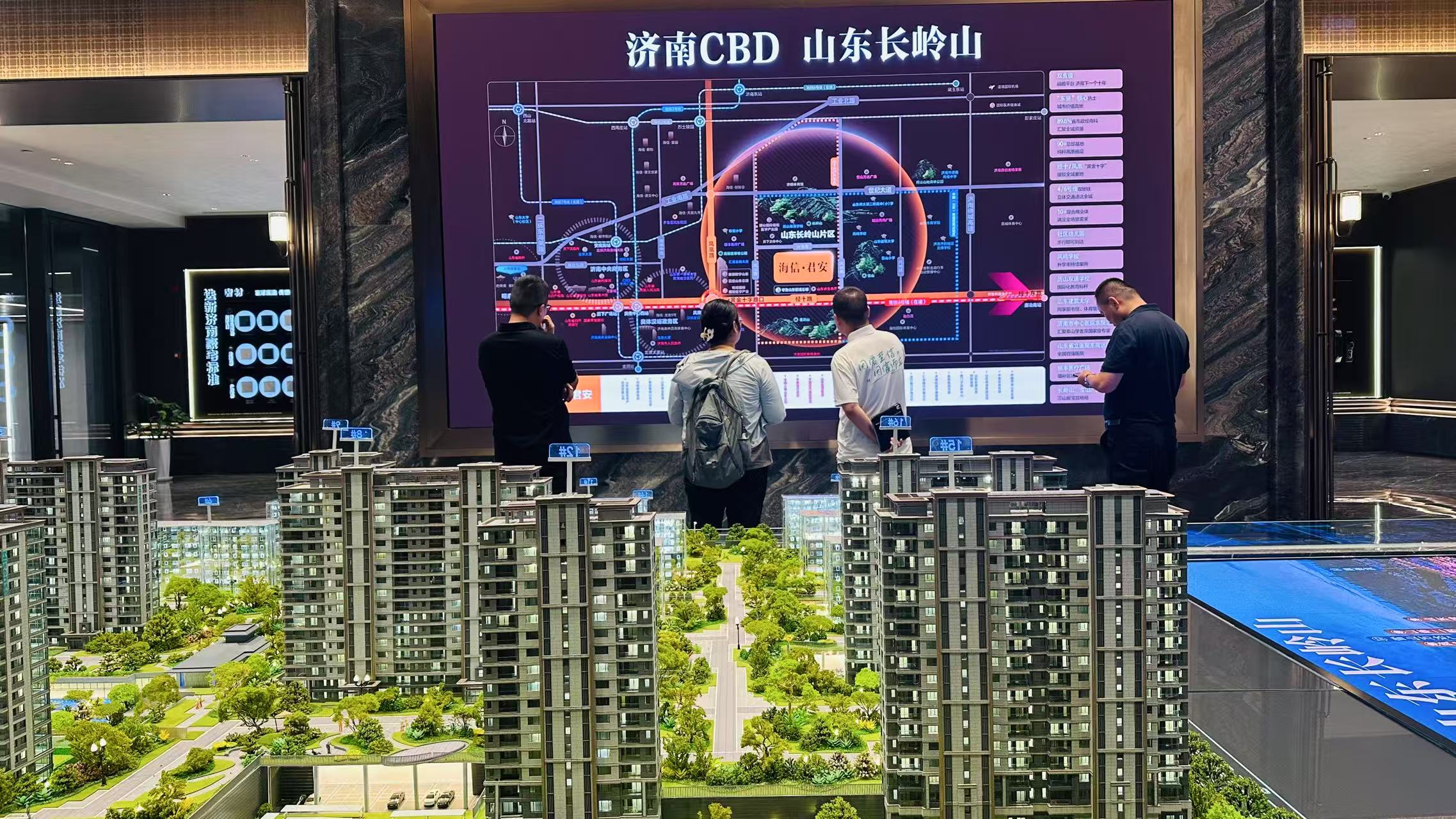
Core Viewpoint - The Jinan real estate market is in an adjustment phase in the first half of 2025, with a total of 15 residential land transactions, indicating a shift towards high-quality products in response to changing market demands [1][2][10]. Group 1: Market Performance - In the first half of 2025, Jinan's new residential market saw a slight decline in both transaction volume and prices, with 20,423 new residential units sold, covering an area of 2.7414 million square meters, reflecting a small decrease compared to the same period last year [2][10]. - The land market remained relatively quiet, with only 5 out of 15 land transactions being sold at a premium, while the rest were sold at base or low premiums [2][10]. Group 2: New Developments - A significant number of new projects are set to enter the market in the second half of 2025, with nearly 20 new developments focusing on high-end improvement products, including various types such as small high-rise buildings, villas, and "four-generation homes" [5][6][10]. - Notable new projects include Vanke's Guanshan Yinxiu, Hisense Jun'an, and Zhongjian Yunqi Fenghua, which emphasize differentiated positioning and high-quality design [2][4]. Group 3: Product Characteristics - The new developments primarily target improvement-type products, with unit sizes starting from 140 square meters and prices ranging from 15,500 to 34,000 yuan per square meter [5][7]. - The "four-generation homes" are a prominent feature, with projects like Zhonghai Shiguang Zhijing offering high efficiency in usable space, with some units achieving a usable area rate of approximately 100% [7][9]. Group 4: Market Dynamics - The market is experiencing a clear differentiation in supply and demand, with high-end improvement products dominating new listings, while the sales performance does not fully align with this trend [10][11]. - The supply of affordable housing remains tight, as core areas are increasingly developed into small high-end projects, leading to a decrease in the availability of larger affordable communities [11].
商业地产行业点评:大悦城地产拟私有化,优质商场迎价值重估
Shenwan Hongyuan Securities· 2025-08-01 07:38
Investment Rating - The industry investment rating is "Positive" [3] Core Viewpoints - The proposed privatization of Dayuecheng Real Estate is expected to lead to a significant revaluation of quality commercial properties, enhancing the ownership concentration of Dayuecheng in premium shopping centers [3][4] - The privatization transaction is valued at a price-to-book (PB) ratio of only 0.27 times, which is considered low, and is anticipated to increase Dayuecheng's net assets by approximately 25% [3][4] - The transaction is seen as a recognition of the value of quality commercial assets by industrial capital, potentially leading to a revaluation of premium consumer-related assets in the market [3][4] Summary by Sections Privatization Details - Dayuecheng's shareholding in Dayuecheng Real Estate will increase from 64% to 96.1% post-privatization, significantly enhancing its stake in quality commercial properties [3] - The total share capital of Dayuecheng Real Estate is 15.33 billion shares, with Dayuecheng holding 9.13 billion shares (64.2%) and market shareholders holding 4.73 billion shares (33.2%) [3] Financial Projections - Dayuecheng Real Estate's rental and related service income for 2024 is projected to be 4.18 billion RMB, primarily from shopping centers, with an average occupancy rate of 95% [3] - The privatization is expected to increase Dayuecheng's net assets by 2.62 billion RMB, representing 24.7% of the projected net assets for 2024 [3] Market Implications - The privatization is likely to attract attention to the valuation of quality commercial real estate assets in China, with potential implications for companies like China Resources Land, Longfor Group, and New Town Holdings [3] - The report maintains a "Positive" rating for the real estate and property management sectors, recommending companies with strong product capabilities and those with undervalued recovery potential [3][4]

国证国际港股晨报-20250801
Guosen International· 2025-08-01 06:51
Core Viewpoints - The market is adopting a wait-and-see attitude due to trade policy uncertainties, with the Hang Seng Index falling below 25,000 points, down 1.6% to 24,773.33 points [2] - Southbound funds have seen a net inflow of HKD 13.126 billion, maintaining a level above HKD 8 billion for five consecutive days [2] Market Performance - The major indices in the Hong Kong stock market continued to decline, with the Hang Seng Index, the Hang Seng China Enterprises Index, and the Hang Seng Technology Index all experiencing losses [2] - The total market turnover increased to HKD 320.633 billion, with the short-selling amount rising to HKD 51.314 billion, accounting for 17.607% of the total turnover [2] Sector Analysis - The luxury goods, Hong Kong retail, and local consumption sectors showed significant declines, indicating pressure on consumer spending and related company performance [4] - Prada's stock dropped 8% following its H1 2025 financial report, leading the sector's decline, while Chow Tai Fook and Samsonite fell 4.5% and 2.9%, respectively [4] - Other consumer-related stocks, including beer, home appliances, food, and automotive sectors, also performed poorly, reflecting a general decline in consumer confidence [4] Electricity Sector Insights - In June, the total electricity consumption in society grew by 5.4% year-on-year, with a notable increase in the third sector and residential electricity consumption [10] - The cumulative electricity consumption from January to June reached 48,418 billion kilowatt-hours, with a year-on-year growth of 3.7% [10] - High-tech industries showed a higher electricity consumption growth rate, with the new energy vehicle manufacturing sector growing by 28.7% year-on-year [11] Investment Recommendations - The report suggests that investors consider undervalued, high-dividend, and fast-growing electricity operators such as China Resources Power and China Power [13]
2025年7月房企销售数据点评:房企销售热度低位,优质企业跑赢市场
Shenwan Hongyuan Securities· 2025-08-01 03:44
Investment Rating - The report maintains an "Overweight" rating for the real estate sector, indicating a positive outlook for quality companies with strong product capabilities and inventory management [4][5]. Core Insights - The sales performance of real estate companies in July 2025 showed a significant decline, with a year-on-year decrease of 23% in sales amount and 26.6% in sales area. Cumulatively, the first seven months of 2025 saw an 18.4% decline in sales amount compared to the previous year [4][5]. - The report highlights a structural differentiation in the sales market, with first and second-tier cities performing better than third and fourth-tier cities. It suggests that the real estate market will exhibit a "structurally strong + overall weak" pattern moving forward [4][5]. - The report emphasizes that while the broad housing demand has bottomed out, the recovery of residents' balance sheets will take approximately two years, which will delay the expected positive cycle in price and volume [4][5]. Summary by Sections Sales Performance - In July 2025, the top three companies by sales were Poly Developments (18 billion), China Merchants Shekou (15.6 billion), and Vanke (13.5 billion). The threshold for the top three has decreased from 15.9 billion in the same month last year to 13.5 billion this year [4][5]. - The cumulative sales for the first seven months of 2025 were led by Poly Developments (163.2 billion), China Overseas (132 billion), and China Resources (123.6 billion), with significant year-on-year declines for most companies [4][5]. Investment Recommendations - The report recommends focusing on quality real estate companies with strong product capabilities and inventory management, such as Jianfa International, Binhai Group, China Resources Land, and Jianfa Holdings. It also suggests monitoring companies like Greentown China and China Jinmao [4][5]. - For undervalued recovery companies, the report highlights New Town Holdings, Yuexiu Property, China Merchants Shekou, Poly Developments, China Overseas, Longfor Group, and Huafa Group as potential investment opportunities [4][5].



7月百强房企业绩回落,千亿房企只剩4家
3 6 Ke· 2025-08-01 02:28
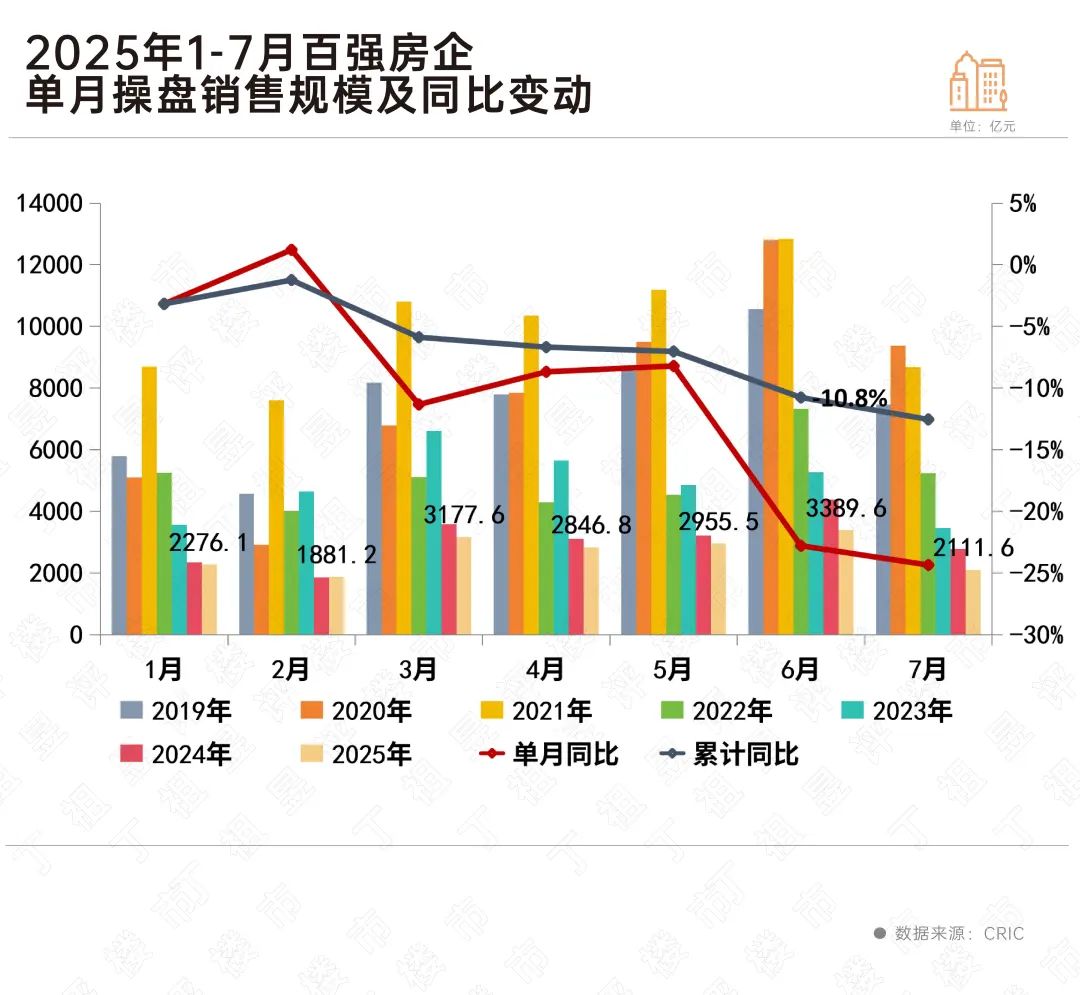
Core Viewpoint - The Chinese real estate market continues to operate at a low level, with significant declines in sales performance among the top 100 real estate companies in July, reflecting a seasonal downturn in supply and demand [1][2][11]. Group 1: Market Performance - In July, the transaction volume of new homes in 30 key cities was only 8.36 million square meters, with cumulative sales for the first seven months remaining flat compared to the previous year [1]. - The top 100 real estate companies achieved a monthly sales amount of 211.16 billion yuan, marking a return to historically low levels [2]. - Cumulative sales for the first seven months reached 1,863.84 billion yuan, representing a year-on-year decline of 12.5%, although this decline is 25 percentage points less than the same period last year [2]. Group 2: Company Performance - The number of companies achieving over 100 billion yuan in sales increased to four in the first seven months, although this is one less than the same period last year [1]. - The sales threshold for the top 100 companies decreased by 22.4% year-on-year to 3.19 billion yuan, down from 4.1 billion yuan last year [5]. - The cumulative sales for the top 10 companies fell by over 10%, with the top three companies reporting sales of 412.26 billion yuan, down 14.4% year-on-year [8]. Group 3: Future Outlook - It is anticipated that new home sales in August will continue to fluctuate at low levels, with a cumulative year-on-year decline expected to remain within 5% [11]. - The market is expected to see continued differentiation between cities and projects, with core first and second-tier cities facing supply constraints and potential short-term declines in transaction volume [11]. - Some second-tier cities, such as Tianjin, Wuhan, and Nanjing, may experience a temporary recovery, particularly with the introduction of new housing regulations and products [11].
越秀证券每日晨报-20250801
越秀证券· 2025-08-01 02:09
Market Performance - The Hang Seng Index closed at 24,773, down 1.60% for the day but up 23.50% year-to-date [1] - The Hang Seng Tech Index fell 0.69% to 5,453, with a year-to-date increase of 22.05% [1] - The Dow Jones Index decreased by 0.74% to 44,130, with a year-to-date rise of 3.73% [1] - The S&P 500 Index closed at 6,339, down 0.37% but up 7.78% year-to-date [1] Currency and Commodity Overview - The Renminbi Index stood at 95.710, down 0.22% over the past month and down 5.14% over six months [2] - Brent crude oil price increased by 9.42% in the last month, currently at $73.040 per barrel [2] - Gold prices rose by 0.25% over the past month, currently at $3,311.44 per ounce, with an 18.33% increase over six months [2] Retail Sector Insights - Hong Kong's retail sales value for June was estimated at HKD 301 billion, a 0.7% increase year-on-year, but a 3.3% decline for the first half of the year [10][13] - Jewelry and luxury goods saw a sales value increase of 6.8%, while clothing sales dropped by 4.3% [13] Technology Developments - Alibaba announced the open-source release of its video generation model Wan2.2, which significantly enhances creators' ability to produce high-quality videos [14] - The model's training data has expanded, with image data increasing by 65.6% and video data by 83.2%, improving its capability for complex scene generation [14] Financial Sector Updates - Standard Chartered reported a 41% increase in net profit for the first half of the year, although its stock price fell by over 1% [5] - The U.S. government is pressuring major pharmaceutical companies to reduce drug prices, which may impact their profit structures [18] IPO and Market Activity - Recent IPOs in Hong Kong include companies like维立志博 and FORTIOR, with significant first-day performance [26] - The upcoming IPOs include东阳光药 and中慧生物, indicating ongoing market activity in the biotech and pharmaceutical sectors [26][27]
“非居改租”助楼市盘活资产 业内期盼配套政策再进一步
Zheng Quan Shi Bao· 2025-07-31 21:46
Core Viewpoint - The newly released Housing Rental Regulations aim to increase the supply of rental housing through multiple channels, particularly by transforming idle non-residential properties into rental units, which has garnered significant market attention [1][2]. Group 1: Policy and Market Dynamics - The new regulations are expected to enhance the economic viability and convenience of converting idle non-residential properties into rental housing, thereby revitalizing existing assets and promoting healthy development in the real estate market [1][2]. - The regulations emphasize the need for market-oriented and professional housing rental enterprises, addressing the current issue of individual landlords dominating the rental market [2][3]. - A recent survey indicated that a significant portion of long-term rental tenants prefer professionally managed apartments, highlighting a shift in demand towards higher quality rental options [2]. Group 2: Implementation and Challenges - The implementation of the new regulations is anticipated to create opportunities for companies with asset management capabilities to thrive, especially as the market transitions to a focus on existing assets [2][3]. - Despite progress in converting idle properties, challenges remain, including high renovation costs and complex approval processes for converting non-residential buildings into rental housing [7][8]. - The industry is looking forward to streamlined compliance and approval processes to facilitate the conversion of old factories and commercial buildings into rental units [9]. Group 3: Case Studies and Innovations - Successful examples of property conversions include the transformation of office buildings into long-term rental apartments, which have been well-received by young professionals [4][6]. - Companies like Longfor and its subsidiary Longfor Crown have demonstrated effective models for revitalizing idle assets through innovative management and operational strategies [2][6]. - The modular design of rental units has been highlighted as a key feature that meets the needs of new urban residents, showcasing the potential for creative solutions in the rental market [6][7].
“非居改租”助楼市盘活资产业内期盼配套政策再进一步
Zheng Quan Shi Bao· 2025-07-31 18:21
Core Viewpoint - The newly released Housing Rental Regulations aim to increase the supply of rental housing through multiple channels, particularly focusing on the transformation of idle non-residential properties into rental housing, which has garnered significant market attention [1][2]. Group 1: Policy and Market Dynamics - The implementation of the new regulations is expected to enhance the economic viability and convenience of transforming idle non-residential properties into rental housing, thereby revitalizing existing assets and promoting healthy development in the real estate market [1][2]. - The regulations emphasize the need for market-oriented and professional housing rental enterprises, addressing the current issue of a rental market dominated by individual landlords [2][3]. - A recent survey indicated that a significant portion of long-term rental tenants prefer professionally managed apartments, highlighting a shift in demand towards higher quality rental options [2]. Group 2: Case Studies and Examples - The company "泊寓" has successfully transformed over 14,600 idle residential units in various cities, demonstrating effective models for revitalizing underutilized assets into affordable rental housing [3][4]. - The "环水泊寓·生态软件园" location in Shenzhen showcases a successful conversion of an office building into a fully rented long-term rental property, indicating the potential for similar transformations across the industry [4][6]. - The Dragon Lake Guan Yu brand has also adapted commercial spaces into long-term rental apartments, further illustrating the trend of repurposing existing properties to meet market demands [6][7]. Group 3: Challenges and Future Expectations - Despite the progress, challenges remain in the form of high renovation costs and complex approval processes for converting non-residential properties into rental housing [7][8]. - Industry experts anticipate that the new regulations will lead to streamlined compliance and approval processes, making it easier for companies to undertake such transformations [9]. - The expectation is that the government will provide clearer guidelines and support to facilitate the implementation of these regulations, enhancing the operational feasibility for housing rental enterprises [9].