
零跑汽车

Search documents
零跑A10纯电SUV内饰首秀:SA8295座舱芯片,“超级小零”接入通义千问
Feng Huang Wang· 2026-02-25 04:44
Core Viewpoint - Leap Motor officially unveiled the interior details of the Leap A10, positioning it as a "smart premium long-range SUV" with a claimed electric range exceeding 500 km [1] Group 1: Product Features - The Leap A10 features an 8.8-inch LCD instrument panel and a 14.6-inch 2.5K central control screen, powered by the SA8295 cockpit chip and the SA8650 auxiliary driving chip [1] - The vehicle includes wireless phone charging, dual cup holders in the front, and a unique gear shift design [1] - The dimensions of the Leap A10 are 4270mm in length, 1810mm in width, and 1635mm in height, with a wheelbase of 2605mm and a five-seat layout [1] Group 2: Technology and Options - The A10 is equipped with options for lidar, panoramic sunroof, cameras, and radar, enhancing its technological capabilities [1] - It is marketed as the "only" model in its class with an oil-cooled electric drive assembly [1] - The vehicle features six auxiliary driving indicator lights and comes with 18-inch wheels, available in six color options [1] Group 3: Market Position and Availability - Leap A10 has commenced blind booking and is expected to begin mass deliveries in the first half of 2026 [1]

中国汽车给欧洲市场普及插混
3 6 Ke· 2026-02-25 03:26
Core Insights - The article discusses the significant shift in the automotive trade dynamics between Germany and China, highlighting the decline of German car exports to China and the rise of Chinese automotive brands in the European market [1][7][11]. Group 1: Trade Dynamics - German car exports to China are projected to drop below €14 billion by 2025, a decrease of nearly 50% from nearly €30 billion three years ago [3][7]. - In January, Chinese automotive brands saw an 80% year-on-year increase in sales in Europe, capturing a market share of 7.4%, nearly double from a year prior [3][9]. - The demand structure in the Chinese market is changing, with local brands rapidly improving their product offerings in the new energy vehicle sector, which is squeezing the market share of German automakers [7][9]. Group 2: Market Performance - BYD has become the best-selling Chinese automotive brand in Germany, with January sales reaching 2,069 units, a 1000% increase year-on-year [9][12]. - The overall European market saw a 3.6% decline, while Chinese brands' sales surged, indicating a significant competitive shift [9][10]. - The sales of plug-in hybrid vehicles (PHEVs) from Chinese brands accounted for 29% of their total sales in Europe in January, up from 11% the previous year [12][18]. Group 3: Strategic Responses - German automakers are adapting by enhancing local R&D capabilities and forming partnerships, such as Volkswagen's investment in XPeng and collaborations with Horizon Robotics [18][20]. - The decision-making cycle for German car manufacturers is longer, typically taking 3-5 years for new models, while Chinese companies can iterate in about 18 months, creating a competitive disadvantage for German firms [20][21]. - German Chancellor Merz's visit to China aims to negotiate for more time for the German automotive industry to adjust to these changes [21][23]. Group 4: Future Outlook - The interaction between the Chinese and European automotive industries is evolving from a one-way technology transfer to a two-way technology flow, which could foster mutual technological advancements [23]. - The competitive landscape is shifting, with both sides needing to adapt to the changing market dynamics and consumer preferences [6][23].



零跑汽车市场竞争力分析报告(2026版)
腾易研究院· 2026-02-25 01:15
Investment Rating - The report assigns a positive investment rating to Leap Motor, indicating strong growth potential in the automotive market [3]. Core Insights - Leap Motor has rapidly approached 500,000 domestic sales within seven years, showcasing its competitive strength against traditional automotive brands [12][15]. - The company's strategic shift towards larger vehicles, particularly the C11 SUV, has significantly boosted its sales, with projections indicating a rise to 300,000 units in 2024 and 500,000 units by 2025 [15][22]. - Leap Motor's success is attributed to its focus on cost-effective pricing and self-research capabilities, allowing it to attract a substantial customer base from traditional brands like Honda and Toyota [15][22]. Summary by Sections Sales Performance - Leap Motor's sales trajectory has shown remarkable growth, with domestic sales surpassing 100,000 units in 2022 and nearing 130,000 units in 2023 [15]. - The company is projected to reach approximately 300,000 units in 2024 and 500,000 units in 2025, positioning it as a leader among new automotive enterprises [15][22]. Market Positioning - Leap Motor has successfully differentiated itself in the competitive landscape by focusing on the under-200,000 yuan market segment, where it has emerged as a key player [15][22]. - The brand's ability to attract users from established overseas brands, particularly in the compact vehicle segment, highlights its strategic advantage [22][25]. User Demographics - The majority of Leap Motor's customers are transitioning from overseas brands, with a significant portion being repeat buyers from brands like Honda and Volkswagen [22][32]. - The average age of Leap Motor's users is over 40, primarily consisting of middle-income earners who prioritize cost-effectiveness and practicality in their vehicle choices [43][57]. Competitive Landscape - The report notes that while Leap Motor has capitalized on the demand for economical vehicles, it will face intensified competition as other brands, including BYD and Geely, introduce similar products in the market [99][111]. - The anticipated launch of new models by competitors in 2026 is expected to challenge Leap Motor's market share, necessitating a robust response from the company [99][111].
汽车早报|小米诉汽车自媒体一审胜诉获赔500万 福特在美召回总计逾45万辆汽车
Xin Lang Cai Jing· 2026-02-25 00:39
Group 1: Automotive Sales and Market Trends - In January 2026, the top ten automotive companies sold 1.962 million vehicles, accounting for 83.6% of total sales, with notable growth from SAIC Group, Geely, Dongfeng, GAC Group, and Great Wall Motors compared to the previous year [1] - The top ten passenger car manufacturers sold 525,000 units in January 2026, representing 70.4% of total passenger car sales, with growth seen in Geely, FAW-Volkswagen, Dongfeng Limited, and SAIC Motor [1] - The pickup truck market showed strong growth in January 2026, with sales reaching 49,000 units, a year-on-year increase of 22.5%, and production at 52,000 units, up 29.3% [1] Group 2: New Energy Vehicles and Infrastructure - During the Spring Festival holiday from February 15 to February 23, 2026, electric vehicle charging sessions reached 6.021 million, with a total charging volume of 14,976.75 million kWh, marking a 52.01% increase in daily average charging compared to the previous year [2] - The National Energy Administration plans to implement a "three-year doubling" action to enhance electric vehicle charging infrastructure [2] Group 3: Corporate Developments and Investments - Wuhan Economic and Technological Development Zone aims to cultivate six automotive enterprises with a valuation of 100 billion RMB by 2030, promoting a competitive landscape among state-owned, private, and joint-venture companies [3] - CATL and Chery Automobile established a joint venture, Times Chery (Hefei) New Energy Technology Co., Ltd., with a registered capital of 2 billion RMB, focusing on battery manufacturing [4] - Leap Motor increased its registered capital from 4.708 billion RMB to 5.558 billion RMB, an increase of approximately 18% [10] - Weilai Battery increased its registered capital from approximately 2.24 billion RMB to approximately 2.64 billion RMB, also an increase of about 18% [11] Group 4: Company Performance and Financial Results - Lucid Group reported Q4 2025 revenue of $522.7 million, exceeding market expectations of $459.4 million, with an adjusted loss per share of $3.08, compared to the expected loss of $2.68 [12] - Ford is recalling over 450,000 vehicles in the U.S., including certain models from 2017-2019 and 2023-2026, due to safety concerns [13]
A股申购 | 固德电材(301680.SZ)开启申购 为知名整车制造商及电池生产商一级供应商
智通财经网· 2026-02-24 23:54
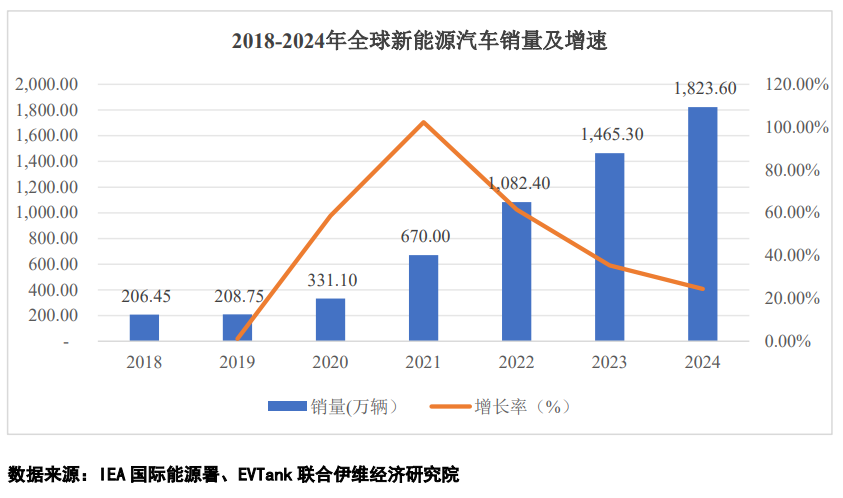
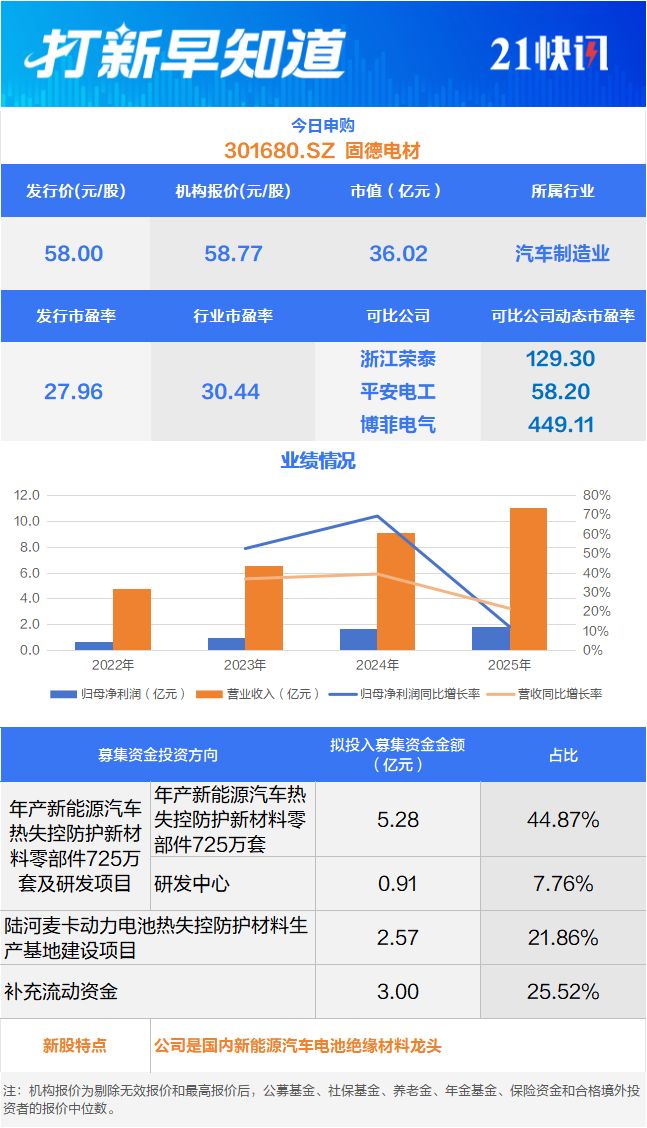
Core Viewpoint - The company Gude Electric Materials (301680.SZ) is focusing on the research, production, and sales of thermal runaway protection components for new energy vehicle power batteries and high-performance insulation products, with a strong emphasis on customized solutions for clients [1] Company Overview - Gude Electric Materials has established itself as a primary supplier for several global automotive manufacturers and battery producers, including General Motors, Ford, Stellantis, Tesla, Hyundai-Kia, Toyota, BMW, Geely, Li Auto, Xpeng, and FAW Group, as well as leading battery manufacturers like CATL, Sunwoda, and Hive Energy [1] - The company is set to issue shares at a price of 58 yuan per share, with a maximum subscription limit of 4,500 shares and a price-to-earnings ratio of 27.96 times [1] Market Analysis - The global battery system safety protection market is projected to grow from 1.75 billion yuan in 2020 to 11.54 billion yuan by 2024, with a compound annual growth rate (CAGR) of 60.25%, and is expected to reach 32.42 billion yuan by 2029 [2] - Mica materials are increasingly being utilized in thermal runaway protection for new energy vehicles, with the mica materials market expected to reach 3.35 billion yuan in 2024, accounting for approximately 29.03% of the global battery system safety protection market [2] Industry Growth - The global new energy vehicle sales are primarily concentrated in China, Europe, and the United States, with China accounting for over 50% of global sales. By 2024, new energy vehicle sales in Europe and the United States are projected to be 2.89 million and 1.57 million units, respectively [3] - The global new energy vehicle sales are expected to reach 22.40 million units by 2025, with China projected to account for 16.50 million units [3] Financial Performance - The company forecasts revenues of approximately 475 million yuan, 651 million yuan, and 908 million yuan for the years 2022, 2023, and 2024, respectively, with net profits of approximately 64.23 million yuan, 98.03 million yuan, and 166 million yuan for the same years [5] - For the fiscal year 2025, the company anticipates achieving revenues of 1.09 billion yuan, representing a growth of 20.05% year-over-year, and a net profit of 177.47 million yuan, reflecting a growth of 3.32% year-over-year [6]
政策暖风频吹 新能源车加速“下沉”
2 1 Shi Ji Jing Ji Bao Dao· 2026-02-24 23:06
Group 1 - The Spring Festival is a critical promotional period for automotive brands, with increased customer traffic and sales in the market due to the new "national subsidy" policy and traditional consumption peaks [1] - The shift of car dealerships from suburban areas to shopping malls indicates intensified competition among brands, with price being a decisive factor for consumers in lower-tier cities [2] - The popularity of models priced between 60,000 to 100,000 yuan is rising, with brands like Extreme Fox offering significant discounts and promotional offers to attract customers [2] Group 2 - The acceptance of new energy vehicles (NEVs) is growing in rural areas, with sales of NEVs in these markets expected to outpace urban markets, driven by government initiatives [4][5] - By 2024, the total sales of NEVs in rural areas are projected to reach nearly 760 million units, reflecting a steady increase from 397,000 units in 2020 [5] - The construction of charging infrastructure is crucial for the growth of NEVs, with a significant increase in the number of charging stations expected to alleviate consumer concerns about range anxiety [6] Group 3 - As of December 2025, the total number of electric vehicle charging facilities in China is expected to reach 20.09 million, marking a 49.7% year-on-year increase [6] - The government of Henan province plans to build 29,000 new public charging stations by 2025, significantly enhancing the charging network and improving convenience for NEV owners [6] - The future growth of the automotive market is anticipated to be concentrated in lower-tier cities and rural areas, supported by favorable policies and infrastructure development [6]
宁德时代“小伙伴”,新能源汽车细分领域龙头今日申购丨打新早知道
2 1 Shi Ji Jing Ji Bao Dao· 2026-02-24 23:03
热失控防护是保障新能源汽车安全的关键环节,固德电材作为较早进入新能源汽车动力电池热失控防护 领域的领先企业之一,经过多年技术积累和创新,获得了多项省级和国家级科技认定。2021年公司实验 室被认定为江苏省省级企业技术中心,2022年被工信部评定为国家级专精特新"小巨人"企业,2024年3 月被评定为江苏省省级工程技术研究中心。截至2025年上半年,公司已获得专利96项,其中发明专利36 项,实用新型60项。 客户方面,固德电材聚焦新能源汽车热失控防护领域,目前已成为多家全球知名整车制造商及电池生产 商的一级供应商,与通用汽车、福特、Stellantis、T公司、现代起亚、丰田、宝马、吉利、零跑、小 鹏、一汽集团等整车制造商,以及宁德时代、欣旺达、蜂巢等电池生产商在内的行业领军企业建立了长 期稳定的合作关系。同时,固德电材已获得多家下游客户的高度认可:荣获通用汽车"2024年度供应商 质量卓越奖"、吉利集团"24年度最佳服务供应商"、零跑汽车"卓越贡献供应商"、东方电气"战略供应 商"等荣誉。 值得注意的是,固德电材提醒投资者,公司面临贸易政策风险。2022年至2025年上半年,公司部分下游 客户为美国企业,公 ...

春节假期新能源汽车出行创新高 零跑汽车有限公司注册资本增至55.58亿元 | 汽车早参
Mei Ri Jing Ji Xin Wen· 2026-02-24 22:39
| 2026年2月25日星期三 | NO.1 春节假期新能源汽车出行创新高 2月24日,据央视新闻报道,国家能源局发布消息,通过对纳入国家充电设施监测服务平台的5.33万台 高速公路充电桩的统计分析,自腊月二十八(2月15日)至正月初七(2月23日),高速公路电动汽车充 电次数共计602.10万次,充电量达到14976.75万千瓦时,日均充电量1664.08万千瓦时,较去年春节日均 增长52.01%,创历史新高。国家税务局数据显示,春节假期机动车充电销售收入同比大幅增长 163.9%。 点评:春节假期充电市场供需两旺,核心数据印证绿色出行加速普及。国家能源局与税务总局的数据形 成呼应,高速公路日均充电量同比增长超五成,叠加充电销售收入激增163.9%,既体现出新能源汽车 保有量的持续提升,也反映出高速充电配套设施的完善成效。这一态势充分彰显了我国居民出行方式的 绿色转型,为新能源汽车产业与出行市场的高质量发展注入强劲动力。 NO.2 春节假期重点平台租车出行订单量增长51% 2月24日,据央视新闻报道,今年春节假期,新场景、新业态、新模式正在持续释放服务消费潜力。商 务大数据显示,春节假期,重点平台租车出行订 ...
东南亚见闻之二:出海的确定性来自产品和渠道
Shenwan Hongyuan Securities· 2026-02-24 13:24
Investment Rating - The report maintains a positive outlook on the Southeast Asian electric vehicle market, particularly for Chinese brands, suggesting a "Buy" rating for companies like BYD, Geely, XPeng, and Leapmotor [4][5]. Core Insights - The Southeast Asian electric vehicle market is expected to see steady growth, with monthly total sales increasing from 14,900 units to 23,400 units in 2025, and Chinese brands maintaining a market share of 72%-78% [4][14]. - The competitive landscape is shifting from price wars to value competition, with brands focusing on technology, brand strength, and ecosystem development [4][5][33]. - Consumer demand is evolving from a focus on technology to lifestyle needs, with a clear segmentation among brands targeting different consumer demographics [5][6]. Market Overview - In 2025, the total sales of electric vehicles in Southeast Asia showed a steady increase, with Chinese brands leading the market. Monthly sales rose from 14,900 units in January to 23,400 units in December, with Chinese brands' sales increasing from 12,800 units to 19,000 units [14][15]. - BYD's market share decreased from 41.8% to 28.7% due to increased competition, but it still led in total sales with 41,480 units sold in Thailand [15][20]. Price War Analysis - The price war in Thailand was characterized by significant discounts, with major brands like BYD and Chery engaging in aggressive pricing strategies to clear inventory as government subsidies were set to expire [27][28]. - The average price reduction for mainstream models ranged from 15% to 25%, with some models experiencing discounts as high as 36.43% [28][29]. Brand Competitiveness - The report highlights the importance of distribution channels, with local partners showing increased confidence in Chinese brands. The number of dealerships is expected to grow by 20%-50% in 2026 [6][42]. - Different Chinese brands are adopting varied strategies: BYD is focusing on mass-market appeal, while XPeng and Zeekr are targeting high-end consumers [5][6]. Consumer Insights - The consumer profile in Southeast Asia is diversifying, with brands like BYD appealing to working families and ride-hailing drivers, while XPeng and Zeekr attract business professionals and high-net-worth individuals [5][6]. - MG has successfully transitioned from a value proposition to brand recognition among middle-class consumers and corporate executives [5]. New Vehicle Plans - In 2026, brands are expected to increase their new vehicle launches in Southeast Asia, with predictions of significant sales growth for Chery (182% increase), Zeekr (76% increase), and BYD (35% increase) [5][6].
汽车行业春节假期点评:以旧换新政策优化提升购车均价,3月消费有望回暖
Yin He Zheng Quan· 2026-02-24 07:07
Investment Rating - The report maintains a "Recommended" investment rating for the automotive industry [1] Core Insights - The "Trade-in Policy" has shown initial effectiveness, driving automotive consumption exceeding 100 billion yuan, with the average purchase price for trade-in vehicles rising to over 164,000 yuan [4] - As of February 19, 2026, the trade-in policy has benefited 28.88 million people, generating sales of 198.02 billion yuan, with 612,000 vehicles traded in, leading to new car sales of 100.53 billion yuan [4] - The report anticipates a recovery in automotive market consumption post-Spring Festival, supported by the upcoming launch of several flagship new energy products [4] Summary by Sections Automotive Market Performance - In January 2026, China's automotive sales decreased by 3.2% year-on-year to 2.346 million units, with domestic sales down 14.8% to 1.665 million units [4] - Passenger vehicle sales saw a significant decline of 19.5% year-on-year, while commercial vehicle sales increased by 23.4% [4] - Exports of automobiles rose by 44.9% year-on-year to 681,000 units, with passenger vehicle exports increasing by 48.9% [4] New Energy Vehicle Insights - New energy vehicle sales in January 2026 were stable, with a slight increase of 0.1% year-on-year to 945,000 units, achieving a penetration rate of 40.3% [4] - The report highlights that the penetration rate for new energy passenger vehicles is 41.7%, while commercial vehicles stand at 22.6% [4] Investment Recommendations - The report recommends investing in leading passenger vehicle companies, the intelligent manufacturing supply chain, and the humanoid robot industry chain [4] - Specific recommendations include Geely Automobile and Great Wall Motors for vehicle manufacturing, and companies like Desay SV and Horizon Robotics for intelligent components [5]
