
南京银行

Search documents
资本市场丨“退市提速+追责加码” 退市不免责渐成常态
Sou Hu Cai Jing· 2025-09-15 04:33
Core Viewpoint - The A-share market is experiencing a bullish trend since August 2025, necessitating policy support and institutional improvements to foster a mature capital market. Key factors influencing the market include dividend policies, share buybacks, and strict delisting regulations, which are essential for stabilizing market valuations and attracting long-term capital [1][2][15]. Dividend Policies - The total dividend payout in A-shares reached 2.4 trillion yuan in 2024, with 810 companies planning to distribute 642.8 billion yuan in the first half of 2025, a 9.6% increase year-on-year. The banking sector accounted for 214.4 billion yuan, while the petrochemical sector contributed 93.4 billion yuan [9][10]. - Despite record-high dividends, the distribution is highly concentrated in five industries, indicating a lack of diversity and breadth in dividend payments. The establishment of a "profit equals dividend" mechanism is suggested to enhance transparency and encourage broader participation in dividend distribution [9][10][11]. Delisting Mechanism - As of September 7, 2025, 24 companies have been delisted from the A-share market, with over 80% due to severe violations, including financial fraud and regulatory non-compliance. This reflects a stricter and more standardized delisting mechanism being implemented by regulatory authorities [2][15][17]. - The trend of voluntary delisting has also increased, with five companies opting for this route in 2025, compared to previous years where the numbers were significantly lower [4][15]. Share Buybacks and Stake Increases - Since August 2025, there has been a notable increase in share buyback announcements and stake increases by major shareholders and executives, aimed at boosting market confidence. For instance, major shareholders of companies like Yangtze Power and Kweichow Moutai have announced substantial buyback plans [12][13]. - The increase in share buybacks is seen as a stabilizing factor for stock prices and a signal of confidence in the company's long-term value, especially following significant price increases in the banking sector [12][14]. Regulatory Environment - The regulatory environment is evolving towards a "delisting does not exempt from liability" principle, which emphasizes accountability for companies that are delisted due to misconduct. This includes potential penalties and legal actions against responsible parties, reinforcing the message that delisting does not absolve companies from their obligations [6][17][18]. - There is a call for improvements in investor compensation mechanisms and the establishment of a more robust framework for handling delisted companies, including civil, administrative, and criminal penalties [7][17].

26家公司重要股东开启增持模式 累计增持21.02亿元(附股)
Zheng Quan Shi Bao Wang· 2025-09-15 02:03
Core Insights - In the past five trading days (September 8 to September 12), 26 companies experienced significant shareholder increases, totaling 237 million shares and an aggregate increase amount of 2.102 billion yuan [1][2] - During the same period, 146 companies saw shareholder reductions, with a total reduction amount of 15.997 billion yuan [1] Summary by Category Shareholder Activity - The top three companies with the highest increase amounts were Nanjing Bank (6.39 million yuan), Hualing Steel (4.28 million yuan), and China Baowu (2.83 million yuan) [1] - Five companies had shareholders increase their holdings more than twice, including Changan Automobile (19 times), BYD (6 times), and Hubei Energy (5 times) [1] Market Performance - The average increase for stocks with shareholder increases was 3.43%, outperforming the Shanghai Composite Index during the same period [2] - Notable gainers included *ST Yatai (27.62%), Hualing Steel (12.03%), and Junsheng Electronics (10.86%) [2] Fund Flow - Among the stocks with shareholder increases, 11 saw net inflows of main funds, with Hualing Steel receiving the highest net inflow of 233 million yuan [2] - Conversely, BYD and Dongsheng Technology experienced the largest net outflows, amounting to 1.280 billion yuan and 578 million yuan, respectively [2]





中国银行业:2025 年宏观、金融与房地产调研要点-China Banks_ Takeaways from 2025 macro, financial and property tour
2025-09-15 01:49
Summary of Key Points from the Conference Call Industry Overview - **Industry**: Chinese Banking Sector - **Date of Conference**: September 3-5, 2025 - **Location**: Hangzhou and Beijing Core Insights 1. **Economic Support and Government Policies**: The Chinese government has prioritized economic support through various policies since September 2024, including rate cuts and consumption stimuli, leading to a recovering capital market and alleviation of local government financing vehicle (LGFV) debt issues [2][3][4] 2. **GDP Growth Outlook**: Despite recent weakening economic data, experts believe China is on track to meet its approximately 5% GDP growth target for 2025, aided by a favorable base effect in the second half of the year. However, 2026 presents heightened risks [3][12] 3. **Monetary and Fiscal Policies**: Further policy rate cuts are deemed unlikely for the remainder of 2025, with a preference for targeted fiscal subsidies. The potential introduction of a consumption tax reform in 2025 is also noted [3][4][12] 4. **Inflation and Economic Structure**: Weak inflation persists, attributed to structural issues and overcapacity in the investment-driven growth model, particularly in manufacturing. Experts emphasize the need for long-term structural reforms [11][13] 5. **Capital Market Recovery**: The capital market is showing signs of recovery, supported by easing US-China tensions and improved global liquidity. The upward momentum is expected to continue [15] Banking Sector Insights 1. **Net Interest Margin (NIM) Outlook**: Banks are less negative about NIM outlooks, with many indicating that NIM is near its bottom and may stabilize soon. However, loan demand remains lackluster, particularly from non-government corporates and retail sectors [5][24] 2. **Dividend Preferences**: In light of macroeconomic uncertainties, banks with higher dividend yields, such as ICBC, CCB, CITIC, and regional banks like BOCD and BOHZ, are preferred [5][24] 3. **Individual Bank Performance**: - **ICBC**: Expects improved earnings in H2 2025, driven by fee income growth and trading gains, despite a slight decline in NIM [25] - **CCB**: Anticipates NIM stabilization, with potential downward pressure from previous LPR cuts [26] - **BOC**: Expects NIM to bottom out and aims to prioritize wealth management and consumer finance [27] - **CITIC**: Predicts stable NIM and improvement in retail asset quality by early next year [28] - **SPDB**: Noted revenue and NPAT growth in H1, with a focus on technology finance and inclusive finance [30] Additional Considerations 1. **Consumption Trends**: Retail consumer goods sales growth has slowed, with services consumption becoming increasingly significant, accounting for approximately 46% of total consumption in 2024. Policies to boost consumption are expected to be emphasized [16][17] 2. **Property Market Dynamics**: The residential property market remains weak, but there is high demand for quality homes. Experts express skepticism about new property policies due to limited room for easing [22][18] 3. **Tariff and Trade Outlook**: Tariffs are expected to remain stable, with potential RMB appreciation driven by trade dynamics. The relationship between China and the US is characterized as tight, with full decoupling seen as unlikely [19][22] Conclusion The conference highlighted a cautious yet optimistic outlook for the Chinese banking sector, with a focus on stabilizing NIMs, improving asset quality, and navigating macroeconomic challenges. The emphasis on structural reforms and consumption growth indicates a strategic shift in policy direction moving forward.




8月新增信贷恢复较大规模正增长,居民存款搬家现象较明显
Huan Qiu Wang· 2025-09-15 00:59
Group 1 - The core viewpoint of the article highlights the significant growth in M2 and M1, with M2 increasing by 8.8% year-on-year and M1 by 6%, indicating a strong financial support for the real economy [1] - The M1-M2 spread has narrowed to -2.8%, the lowest since June 2021, suggesting a shift in the monetary landscape [1] - In the first eight months of the year, RMB loans increased by 13.46 trillion yuan, with a notable recovery in new credit in August, reflecting robust financial support for the economy [1] Group 2 - The article emphasizes the need for future monetary policy to focus on optimizing the structure of financial growth while maintaining reasonable total growth [1] - It is noted that the current low price levels in China provide ample space for moderately loose monetary policy, with expectations for new credit and social financing to see a year-on-year increase [1] - The stock market's significant rise in August coincided with a noticeable shift in resident deposits, with a year-on-year decrease of 600 billion yuan in resident deposits and an increase of 550 billion yuan in non-bank deposits [1] Group 3 - Investment recommendations from Zheshang Securities suggest focusing on improving and high-quality A-share banks, including Pudong Development Bank, Nanjing Bank, Shanghai Bank, China Merchants Bank, and Industrial Bank [4] - The report also advises paying attention to high-dividend H-shares with improving fundamentals [4]




江苏银行VS南京银行:江苏两家头部城商行对决
数说者· 2025-09-14 23:31
Core Viewpoint - The article provides a comparative analysis of Jiangsu Bank and Nanjing Bank, highlighting their strengths, market positions, and financial performance, indicating that Jiangsu Bank has outperformed Nanjing Bank in several key financial metrics and is positioned as the largest city commercial bank in China as of mid-2025 [2][45]. Group 1: Background and Structure - Jiangsu Bank was established in January 2007 through the merger of city commercial banks in ten cities in Jiangsu Province, excluding Nanjing [3]. - Nanjing Bank was founded in 1996, evolving from 39 city credit cooperatives and has undergone several name changes and ownership changes, including foreign investments [4][6]. Group 2: Shareholding Structure - Jiangsu Bank's top shareholders include Jiangsu International Trust Co., Ltd. (6.98%) and Jiangsu Phoenix Publishing & Media Group Co., Ltd. (6.93%), both state-owned enterprises [4]. - Nanjing Bank's major shareholders include BNP Paribas (12.93%) and Nanjing Zijin Investment Group Co., Ltd. (10.92%), with significant foreign investment [6]. Group 3: Capital Market - Both banks are listed on the Shanghai Stock Exchange, with Jiangsu Bank listed since August 2016 and Nanjing Bank since 2007 [7][8][9]. Group 4: Operational Coverage - Both banks have achieved full coverage across 13 cities in Jiangsu Province, with Jiangsu Bank having 17 branches and 522 sub-branches, while Nanjing Bank has 16 branches and 289 outlets [11]. Group 5: Subsidiaries - Jiangsu Bank has four subsidiaries, including Su Yin Financial Leasing Co., Ltd. and Su Yin Wealth Management Co., Ltd. [12]. - Nanjing Bank has three subsidiaries and also holds stakes in three other companies, indicating a broader business scope [13]. Group 6: Employee Situation - As of the end of 2024, Jiangsu Bank had 20,780 employees, with 20.70% holding master's degrees, while Nanjing Bank had 18,045 employees, with 30.13% holding master's degrees [14]. Group 7: Financial Performance - In 2024, Jiangsu Bank's total assets reached 395.20 billion, with a net profit of 318.43 billion, while Nanjing Bank's total assets were 259.14 billion, with a net profit of 201.77 billion [15]. - By mid-2025, Jiangsu Bank's total assets increased to 478.85 billion, while Nanjing Bank's reached 290.14 billion, indicating Jiangsu Bank's growth trajectory [15]. Group 8: Long-term Trends - Over the past decade, Jiangsu Bank's total assets have consistently been about 1.5 times larger than those of Nanjing Bank, with both banks showing growth [19]. - Jiangsu Bank's operating income has also consistently exceeded that of Nanjing Bank, with a growing margin from 1.18 times in 2016 to 1.61 times in 2024 [21]. Group 9: Asset Quality - Both banks maintain strong asset quality, with non-performing loan ratios below 0.9% and high provision coverage ratios exceeding 300% [18][34]. - Jiangsu Bank's provision coverage ratio has improved significantly from 192.06% to over 350% [35]. Group 10: Compensation and Benefits - Jiangsu Bank's employee costs have consistently been higher than those of Nanjing Bank, with average salaries of approximately 560,000 and 530,000 respectively [42][43].

南京银行派现459亿大股东密集增持 总资产2.9万亿不良贷款率仅0.84%
Chang Jiang Shang Bao· 2025-09-14 23:21
南京银行(601009.SH)再次获得重要股东增持。 日前,南京银行披露,该行第二大股东南京紫金投资集团有限责任公司(以下简称"紫金集团")的控股子公司紫 金信托有限责任公司(以下简称"紫金信托")于2025年7月18日至2025年9月10日期间,累计增持该行5677.98万 股,占该行总股本的0.46%。本次增持之后,紫金集团及紫金信托的合计持股比例提升至13.02%。 长江商报消息 ●长江商报记者 徐佳 长江商报记者注意到,近一年以来,南京银行已多次获得重要股东真金白银增持。特别是在2025年7月提前赎回可 转债导致总股本增加之后,包括紫金集团等在内的南京银行两大国资股东主动增持,提升持股比例。 国资大股东主动增持,体现了对南京银行未来发展的信心。2025年上半年,该行实现营业收入284.8亿元,同比增 长8.64%;归属于上市公司股东的净利润(以下简称"净利润")126.19亿元,同比增长8.84%。上市至今,南京银 行累计已派现459.39亿元。 截至2025年6月末,南京银行资产总额2.9万亿元,较上年末增长11.96%;不良贷款率0.84%,较上年末上升0.01个 百分点,仍保持在较低水平。 多名 ...
股东高管密集出手 银行股增持潮涌
Bei Jing Shang Bao· 2025-09-14 17:06
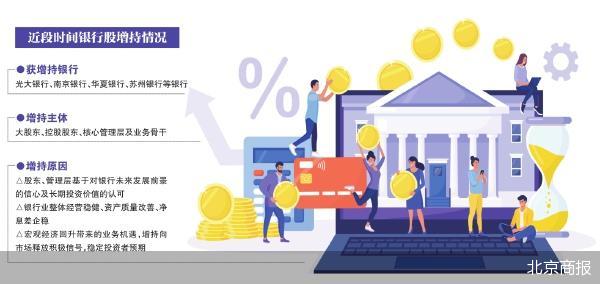
Core Viewpoint - The recent surge in share buybacks among A-share listed banks reflects confidence in their future development and the recognition of long-term investment value, supported by a stable banking industry fundamental and improved financial performance [1][5][6]. Group 1: Share Buyback Activities - Multiple listed banks, including Everbright Bank, Nanjing Bank, Huaxia Bank, and Suzhou Bank, have disclosed share buyback progress, involving major shareholders, core management, and key personnel [1][4]. - Everbright Bank's major shareholder plans to increase its stake by investing between 50 million to 100 million yuan, with a reported buyback of 13.97 million shares, amounting to approximately 51.66 million yuan [3]. - Nanjing Bank's major shareholder increased its stake by 5.68 million shares, raising its total holding from 12.56% to 13.02% [3]. Group 2: Financial Performance - In the first half of 2025, 42 listed banks in A-shares reported a total operating income of 2.92 trillion yuan and a net profit of approximately 1.1 trillion yuan, with over 60% of banks achieving growth in both metrics [1][7]. - The improvement in financial performance is accompanied by innovations in mid-term dividend mechanisms, enhancing the investment value of banks [7]. Group 3: Market Sentiment and Investment Value - The buybacks are seen as a positive signal to the market, reinforcing investor confidence in the banking sector's development [6]. - The banking sector is experiencing a valuation recovery, with banks previously trading at historical lows now showing signs of improvement in both valuation and performance [7][8]. - Long-term funds, including insurance and social security, are increasingly investing in bank stocks, further solidifying their investment value [8]. Group 4: Industry Transformation - The banking industry is undergoing a significant transformation, shifting from a scale-driven growth model to a more refined, quality-focused approach, which is expected to enhance capital efficiency and increase non-interest income [9]. - This transformation is crucial for investment strategies, as banks with low valuations, high dividends, and weak cyclical resilience will continue to play a vital role in asset allocation [9].



股东、高管密集“出手”,银行股增持潮涌动
Bei Jing Shang Bao· 2025-09-14 12:37
Core Viewpoint - The recent surge in share buybacks among A-share listed banks reflects confidence from major shareholders and management in the banks' future prospects and long-term investment value, supported by a stable banking industry fundamental and innovative mid-term dividend mechanisms [1][5][6]. Group 1: Share Buyback Activities - Multiple A-share listed banks, including Everbright Bank, Nanjing Bank, Huaxia Bank, and Suzhou Bank, have disclosed share buyback progress, with participation from major shareholders, core management, and key personnel [1][4]. - Everbright Bank's major shareholder plans to increase its stake by investing between 50 million to 100 million yuan, with a reported buyback of 13.97 million shares, accounting for 0.02% of total shares [3]. - Nanjing Bank's major shareholder increased its stake by 5.68 million shares, raising its total holding from 12.56% to 13.02% [3][4]. Group 2: Industry Fundamentals - The banking sector is experiencing a robust performance, with 42 listed banks reporting a combined operating income of 2.92 trillion yuan and a net profit of approximately 1.1 trillion yuan in the first half of 2025, with over 60% of banks achieving growth in both metrics [1][6]. - The banking industry's asset quality is improving, and net interest margins are stabilizing, contributing to a positive outlook for long-term investment in bank stocks [5][9]. Group 3: Dividend Mechanisms and Market Sentiment - The innovation and upgrade of mid-term dividend mechanisms among banks have further enhanced their investment value, with major banks announcing substantial dividend payouts [7]. - The introduction of new policies encouraging multiple dividend distributions is expected to strengthen value investment concepts and support the valuation recovery of bank stocks [7][8]. Group 4: Long-term Trends and Strategic Shifts - The valuation recovery of bank stocks is not a short-term trend but is closely linked to a deeper transformation in the banking industry's operating model, shifting from scale-driven growth to a focus on quality and resilience [9]. - This transformation is characterized by improved capital efficiency, deeper customer segmentation, and a steady increase in non-interest income, which will play a crucial role in investment strategies moving forward [9].

8月金融数据点评:社融增速年内首次回落,非银存款表现有所“降温”
Orient Securities· 2025-09-14 11:30
Investment Rating - The report maintains a "Positive" investment rating for the banking industry, indicating an expectation of returns exceeding the market benchmark by more than 5% [9][24]. Core Viewpoints - The growth rate of social financing (社融) has declined for the first time this year, primarily due to weak credit demand and a decrease in government bonds, with August's social financing year-on-year growth at 8.8% and a month-on-month decrease of 0.2 percentage points [9][10]. - The report highlights a significant drop in new loans, with a year-on-year decrease of 3,100 billion yuan in August, reflecting ongoing challenges in the credit market [14][20]. - M1 growth shows a trend of improvement, with a year-on-year increase of 6.0% in August, although non-bank deposits have cooled compared to previous months [20][21]. Summary by Sections Social Financing and Credit - In August 2025, social financing increased by 1.16 trillion yuan, which was higher than market expectations, but still represented a year-on-year decrease of 4,630 billion yuan [9][10]. - The report notes that the decline in social financing is largely driven by a reduction in both corporate loans and government bonds, with corporate direct financing also seeing a slight decrease [11][12]. Loan Dynamics - Total RMB loans grew by 6.8% year-on-year in August, with new loans amounting to 590 billion yuan, slightly above expectations but still reflecting a year-on-year decrease [14][15]. - The report identifies a "seesaw" effect between short-term corporate loans and bill discounting, indicating a strategic shift in bank lending practices [15][16]. Deposit Trends - In August, M1 and M2 growth rates were 6.0% and 8.8% respectively, with a narrowing gap between the two [20][21]. - New RMB deposits totaled 2.06 trillion yuan, with a year-on-year decrease of 1,600 billion yuan, indicating a shift in deposit behavior among residents and enterprises [22][23]. Investment Recommendations - The report suggests focusing on two main investment themes: high-dividend stocks due to insurance rate adjustments and fundamentally strong small to medium-sized banks [24]. - Specific stock recommendations include China Construction Bank, Industrial and Commercial Bank of China, and others, with some rated as "Buy" [24].
认股权及“海聚英才”优质企业路演暨“一卡通”服务活动在沪举办
Zhong Guo Jing Ji Wang· 2025-09-14 06:07
Group 1 - The event "Empowering New Journeys, Gathering Future" was held in Shanghai to promote the linkage between technology, industry, and finance, organized by the Shanghai Equity Custody Trading Center [1] - The Shanghai Equity Custody Trading Center aims to provide diversified and precise financial services to support innovation and the real economy, including a "green channel" for the New Third Board and a comprehensive service for stock options [1] - A stock option incentive policy was announced to enhance the attractiveness of stock option services for enterprises in industrial parks, along with awards for banks that excel in stock option innovation [1] Group 2 - A collective awarding ceremony was held for 17 stock option enterprises, with 12 of them recognized for their high-tech and specialized qualifications, demonstrating targeted support for tech innovation [2] - Since the pilot program was approved in November 2023, the platform has completed 72 transactions focused on cutting-edge fields such as medical devices and new energy, with a total financing scale of 352 million yuan [2] - The Shanghai Equity Custody Trading Center plans to continue enhancing its comprehensive financial service system to empower tech innovation and connect the real economy with financial resources [2]