蔚来

Search documents
蔚来汽车:2025年12月交付48,135辆汽车,同比增长54.6%。2025年第四季度交付124,807辆汽车,同比增长71.7%
Jin Rong Jie· 2026-01-01 08:17
本文源自:金融界AI电报 蔚来汽车:2025年12月交付48,135辆汽车,同比增长54.6%。2025年第四季度交付124,807辆汽车,同比 增长71.7% ...

蔚来汽车:2025年12月交付车辆为48135辆,同比增长54.6%
Mei Ri Jing Ji Xin Wen· 2026-01-01 08:13
Core Viewpoint - NIO Inc. achieved a record high in vehicle deliveries in December 2025, with a total of 48,135 vehicles delivered, marking a year-on-year increase of 54.6% [1] Group 1: December Deliveries - NIO brand delivered 31,897 vehicles in December 2025, also a record high, with a year-on-year increase of 54.8% and continuous growth for five consecutive months [1] - The Ladao brand delivered 9,154 vehicles in December 2025 [1] - The Firefly brand delivered 7,084 vehicles in December 2025, a record high with a month-on-month increase of 16.4%, also showing continuous growth for five consecutive months [1] Group 2: Annual Deliveries - In 2025, NIO Inc. delivered a total of 326,028 vehicles, setting a new historical record with a year-on-year increase of 46.9% [1] - The NIO brand accounted for 178,806 vehicles delivered in 2025 [1] - The Ladao brand delivered 107,808 vehicles in 2025 [1] - The Firefly brand delivered 39,414 vehicles in 2025 [1]
蔚来品牌换电体系一月份将新增超4200块长续航电池包
Zheng Quan Shi Bao Wang· 2026-01-01 06:45
人民财讯1月1日电,1月1日,蔚来创始人、董事长、CEO李斌在开年直播中宣布,一月份,蔚来品牌换 电体系将新增超4200块长续航电池包,其中包括1200块100kWh电池包和超3000块102kWh电池包。后 续,蔚来换电体系还将根据用户需要,持续补充长续航电池包。 ...
蔚来品牌换电体系一月将新增超 4200块长续航电池包
Jing Ji Guan Cha Wang· 2026-01-01 06:20
经济观察网1月1日,蔚来创始人、董事长、CEO李斌在开年直播中宣布,一月份,蔚来品牌换电体系将 新增超4200块长续航电池包,其中包括1200块100kWh电池包和超3000块102kWh电池包。后续,蔚来换 电体系还将根据用户需要,持续补充长续航电池包。 ...
白银大跌!95岁巴菲特,正式退休
Sou Hu Cai Jing· 2026-01-01 02:10
当地时间2025年12月31日,欧美股市集体收跌,美股三大股指四连跌。从2025年全年表现来看,道琼斯工业指数涨12.97%,标普500指数涨16.39%,纳斯 达克指数涨20.36%,均实现年线三连涨。 贵金属市场持续大幅波动,伦敦现货白银盘中一度跌超7%,COMEX白银期货盘中一度跌超11%。不过,从2025年全年来看,白银价格涨幅依然显著。伦 敦现货白银价格涨幅超147%,COMEX白银期货价格涨幅超142%。 当地时间2025年12月31日,美股三大指数全线收跌。Wind数据显示,截至收盘,道琼斯工业指数跌0.63%,纳斯达克指数跌0.76%,标普500指数跌 0.74%,均为四连跌。 大型科技股集体下跌,万得美国科技七巨头指数下跌0.61%。其中,特斯拉跌超1%。 | 亚马逊 | | | | --- | --- | --- | | (AMAZON) | 230.820 | -0.74% | | AMZN.O | | | | 英伟达(NVIDIA) | 186.490 | -0.56% | | NVDA.O | | | | 苹果(APPLE) | 271.840 | -0.45% | | AAPL.O ...

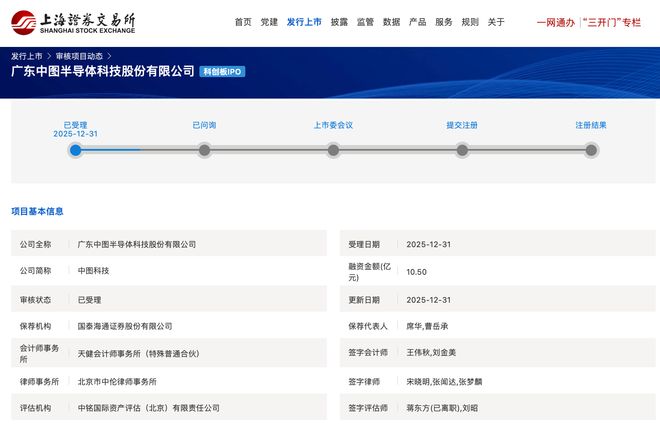
中图科技第二次闯关科创板 拟募资10.5亿元
Zhong Guo Jing Ying Bao· 2026-01-01 01:42
Core Viewpoint - Guangdong Zhongtu Semiconductor Technology Co., Ltd. (Zhongtu Technology) has received acceptance for its IPO on the Sci-Tech Innovation Board, aiming to raise approximately 1.05 billion yuan for various projects and working capital [1][2] Group 1: Company Overview - Zhongtu Technology is a leading global manufacturer of patterned substrate materials, with an annual production capacity exceeding 18 million pieces of 4-inch patterned substrates [1] - The company focuses on the research, production, and sales of patterned substrate materials required for Gallium Nitride (GaN) epitaxy, with key products including patterned sapphire substrates (PSS) and patterned composite material substrates (MMS) [1] - These materials are essential for upstream semiconductor applications, particularly in Mini/Micro LED, automotive lighting, and backlight displays [1] Group 2: Market Position and Clientele - According to industry research firm LEDinside, Zhongtu Technology holds approximately 32.76% of the global market share for patterned substrates in 2023 [1] - The company's direct clients include major LED chip enterprises such as Epistar, Seoul Viosys, Sanan Optoelectronics, and HC Semitek, indicating a strong presence in the market [2] - Zhongtu Technology's products are widely used in consumer electronics and new energy vehicles, with notable clients including Apple, Samsung, LG, Hisense, TCL, BYD, and NIO [2] Group 3: IPO Details - The funds raised from the IPO will be allocated to the industrialization of Mini/Micro LED and automotive LED chip patterned substrate projects, the establishment of a semiconductor substrate materials engineering research center, and to supplement working capital [1] - This marks Zhongtu Technology's second attempt to list on the Sci-Tech Innovation Board, having previously submitted an application in March 2020, which was voluntarily withdrawn in January 2022 [2]
刚刚,暴跌了!美联储,降息生变?
Qi Huo Ri Bao· 2025-12-31 23:49
Market Overview - Silver prices experienced a significant drop, with New York silver prices falling nearly 10% during trading, while both spot silver and gold prices, as well as international oil prices, declined across the board [2] - The Nasdaq China Golden Dragon Index fell by 1.13%, with NIO down over 7%, NetEase down 2%, and Baidu down over 1% [9] - The WTI crude oil futures price decreased by 0.91%, settling at $57.42 per barrel, marking a cumulative decline of approximately 20% for 2025 [9] - COMEX gold futures prices fell by 1.24%, closing at $4,332.1 per ounce, with a cumulative increase of about 55% for 2025 [10] Chinese Stocks Performance - The China concept stock index dropped by 1.4%, with notable declines in electric vehicle manufacturers: NIO fell by 9.45%, XPeng by 5.97%, and Li Auto by 4.81% [5][7][8] - The overall performance of the A-share non-ferrous metal sector was strong, with a 94.73% increase for the year, leading all sectors [12] Copper Market Insights - Copper prices are currently at historical highs, driven by expectations of Federal Reserve interest rate cuts and safe-haven demand, despite weak domestic consumption and rising inventories [12][14] - Analysts suggest that the current high copper prices reflect optimistic future expectations, with potential catalysts for further increases linked to the appointment of a new Federal Reserve chair and anticipated interest rate cuts [14] - The copper market is characterized by a "high copper price, low profit" scenario, which may persist into the first half of 2026 [13]

凌晨,全线跳水!美联储降息,大消息!
券商中国· 2025-12-31 23:39
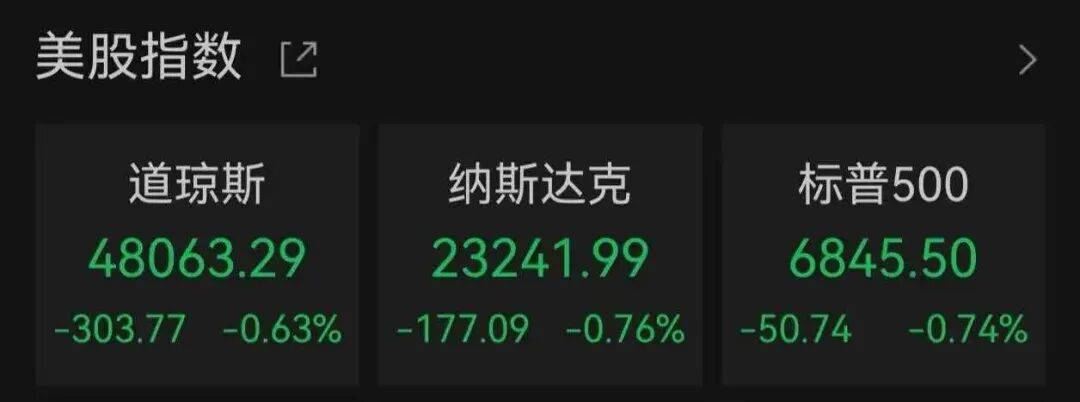
Market Overview - On January 1, 2026, U.S. stock indices experienced a significant decline, with the Nasdaq and S&P 500 both dropping over 0.7% [1] - The S&P 500 index closed down 0.74% with an annual gain of 16.39%, while the Nasdaq fell 0.76% with a yearly increase of 20.36% [3] - Major tech stocks, including Nvidia, Apple, Google, Microsoft, Amazon, Meta, and Tesla, all saw declines, with Tesla and Broadcom dropping over 1% [5] Employment Data Impact - Recent employment data showed a decrease in initial jobless claims, indicating a resilient labor market, which dampened expectations for further interest rate cuts by the Federal Reserve [11] - The probability of a 25 basis point rate cut in January dropped to 16.1%, while the likelihood of maintaining current rates rose to 83.9% [11] Stock Performance Insights - The Nasdaq China Golden Dragon Index fell by 1.13%, with notable declines in stocks like NIO and NetEase, while Alibaba and JD.com showed significant annual gains [5] - The performance of tech stocks varied, with Alibaba up over 75% and JD.com down nearly 15% for the year [5] Future Market Outlook - Wall Street analysts generally expect the bull market to continue into 2026, with UBS strategists predicting a 10% year-on-year growth in S&P 500 earnings, targeting a year-end index level of 7700 [7] - Sanctuary Wealth's chief investment strategist anticipates the S&P 500 could reach between 10,000 and 13,000 by 2030 [8] - Conversely, GMO's Ben Inker warns that concentrated investments in expensive AI stocks may lead to disappointing future returns, with a potential negative return in 2026 [9] Warren Buffett's Retirement - Warren Buffett officially retired as CEO of Berkshire Hathaway on December 31, 2025, at the age of 95, but will remain as chairman and retain a significant stake in the company [6]

新浪财经隔夜要闻大事汇总:2026年1月1日
Xin Lang Cai Jing· 2025-12-31 23:18
Market - US stock market closed slightly lower on January 1, with the S&P 500 index declining for four consecutive days, but all three major indices recorded gains for 2025, with the S&P 500 up 16.4%, Nasdaq benefiting from the AI boom up 20.36%, and Dow Jones up 12.97% [2][4] - Nvidia topped the trading volume on January 1 but fell 0.55%, with reports indicating significant price increases for GPUs starting in early 2026 due to rising memory costs [3][4] - Popular Chinese stocks saw a general decline, with XPeng down 4.65% and NIO down 7.27%, while the Nasdaq Golden Dragon China Index fell 1.13% [4][3] Commodities - International oil prices experienced their largest annual decline since 2020, with a drop of over 18% in 2025, attributed to OPEC+ production increases and concerns over tariff policies [5] - Gold prices fell slightly but still recorded a cumulative increase of over 60% for 2025, while silver saw an annual increase of approximately 148% [6][5] Company - Google achieved its best annual performance on Wall Street since 2009, with Alphabet's stock rising 65% in 2025, driven by strong momentum in its AI business [22] - Warren Buffett officially retired as CEO of Berkshire Hathaway on December 31, 2025, marking a significant transition in the investment community [24] - Michael Burry clarified that he is not shorting Tesla, despite previously expressing concerns about its high valuation [25] - Nvidia is investing in Brookfield's AI infrastructure fund, aiming to lower AI development costs and compete in the cloud computing market [28]

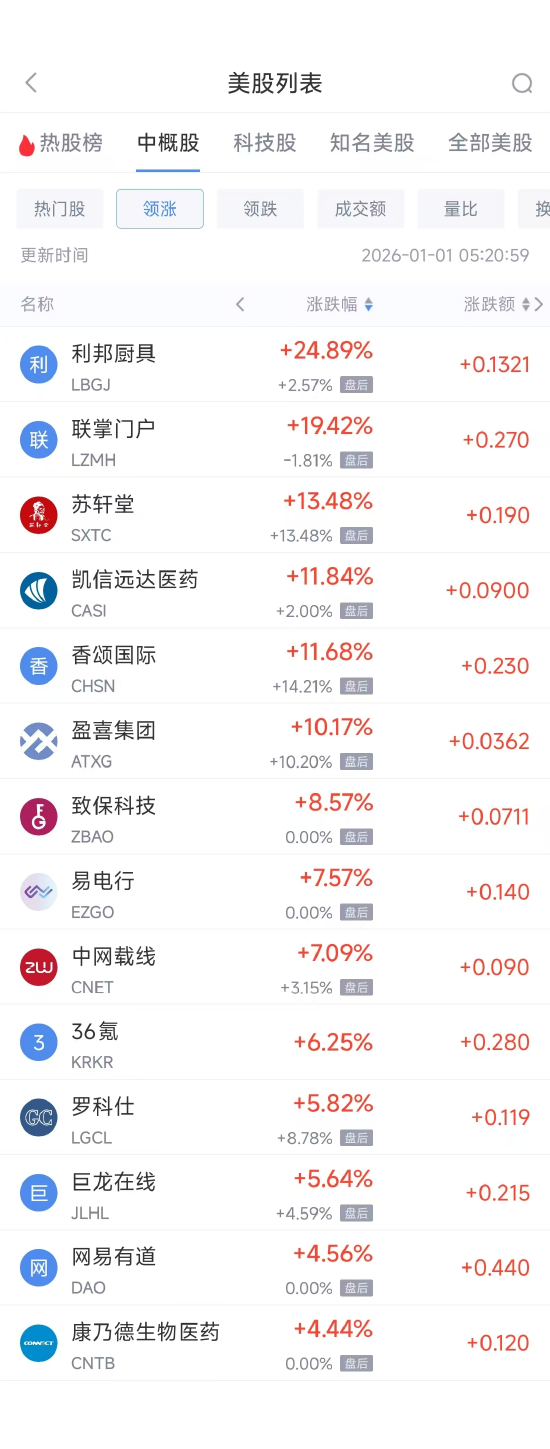
1月1日热门中概股普跌 小鹏汽车跌4.65%,蔚来跌7.27%
Xin Lang Cai Jing· 2025-12-31 21:25
Market Overview - The Nasdaq China Golden Dragon Index (HXC) fell by 1.13% on January 1, with notable declines in major Chinese stocks such as Alibaba, Pinduoduo, and NIO, which dropped by 0.52%, 0.39%, and 7.27% respectively [1][11] - The S&P 500 index recorded its fourth consecutive day of decline, despite achieving a yearly increase of 16.39%, marking its third consecutive year of double-digit annual growth [2][12] Stock Performance - Among the rising stocks, TSMC increased by 1.45%, while other notable gainers included ASE Technology (+0.44%) and Huazhu Hotels (+0.15%) [1][11] - Conversely, significant declines were observed in stocks such as Xpeng Motors (-4.65%), Li Auto (-1.97%), and Beike (-0.57%) [1][11] Index Performance - The Dow Jones Industrial Average decreased by 303.77 points, or 0.63%, closing at 48,063.29 points, while the Nasdaq Composite fell by 177.09 points, or 0.76%, to 23,241.99 points [12] - The Nasdaq Composite has benefited from the AI boom, with a cumulative increase of 20.36% in 2025 [3][13] - The Dow Jones has seen a 12.97% increase in 2025, lagging behind due to a lower weight of technology stocks [4][14]