
中信银行

Search documents
构建科技金融发展沃土 广州吸引百亿级AIC落地
Shang Hai Zheng Quan Bao· 2025-11-25 18:12
Core Insights - Xinyin Financial Asset Investment Co., Ltd. has been approved to operate and has established its presence in Guangzhou, marking it as the second financial asset investment company (AIC) approved among joint-stock banks [1] - The establishment of Xinyin Jin Investment in Guangzhou reflects the city's efforts to seize opportunities from the AIC pilot program and build a robust AIC ecosystem [1][2] Group 1: AIC Development in Guangzhou - Guangzhou has prioritized attracting AICs as a key financial strategy since the expansion of the AIC pilot program in 2024, with significant efforts to facilitate new AIC establishments [2] - The Guangzhou government signed a strategic cooperation agreement with CITIC Bank in June 2025, confirming Xinyin Jin Investment's establishment in the city, showcasing the city's support for financial innovation [1][2] - Guangzhou has implemented a comprehensive policy framework to support AIC development, including a 1.5 trillion yuan industrial investment mother fund and a 500 billion yuan venture capital mother fund [2] Group 2: Financial Ecosystem and Investment Opportunities - Guangzhou has successfully established 11 AIC funds with a total scale exceeding 16.8 billion yuan, attracting bank capital into key industries such as advanced manufacturing and new energy [2] - The city boasts nearly 400 licensed financial institutions, with total financial assets exceeding 13 trillion yuan, making finance the third-largest pillar industry in the city [2] - The efficient execution of policies in Guangzhou provides a predictable development environment for Xinyin Jin Investment, allowing for significant opportunities in market-oriented debt-to-equity swaps and equity investments in tech enterprises [2][3] Group 3: Role of AIC in Supporting Innovation - AICs are transitioning from debt risk mitigators to supporters of technological innovation, utilizing a model that combines equity investment, debt financing, and value-added services [3] - Xinyin Jin Investment aims to leverage its AIC license and CITIC Group's resources to serve local enterprises through a "debt-equity" model, focusing on the Guangzhou and Guangdong-Hong Kong-Macau Greater Bay Area [3][4] - The company plans to engage in major state-owned enterprise projects, assist in managing asset-liability ratios, and promote mergers and acquisitions within key industrial clusters [4] Group 4: Collaborative Ecosystem Development - Guangzhou is committed to supporting Xinyin Jin Investment's operations by integrating government investment funds and establishing a mechanism for ongoing project matching and funding needs [4] - The collaboration between Xinyin Jin Investment and Guangzhou is characterized by a model of "institutional establishment + policy support + ecological synergy," fostering a mutually beneficial development landscape [4][5] - The entry of AICs is expected to play a crucial role in the financing system for tech enterprises, enhancing the stability of returns while supporting the real economy [5]

AIC再开闸,老树新枝更需苦练内功
第一财经· 2025-11-25 15:38
Core Viewpoint - The establishment of Asset Investment Companies (AICs) by banks like Industrial Bank, CITIC Bank, and China Merchants Bank indicates a significant expansion of comprehensive financial operations in China, following regulatory approvals aimed at enhancing the financial ecosystem and supporting troubled enterprises [2][3]. Summary by Sections AIC Establishment and Regulatory Background - The first AIC pilot programs began in 2017 with five major state-owned banks, primarily focusing on debt-to-equity swaps to assist viable but struggling companies in reducing leverage and managing risks [2]. - In 2020, the regulatory framework was expanded to allow AICs to engage in direct equity investments beyond debt-to-equity swaps, with further relaxations announced in 2024 [2]. Performance and Investment Data - As of June 2024, the total assets of the five major AICs reached 586.99 billion yuan, with 156 investment cases completed in 2024, amounting to 57.604 billion yuan [3]. Challenges and Risks - AICs face significant challenges, including limited external financing channels, high risk weights from parent banks, and insufficient research and personnel capabilities [4]. - The banking sector's traditional focus on collateralized loans and scale efficiency may hinder effective risk management in equity investments, raising concerns about the success rates of rapid debt-to-equity transitions [5]. Recommendations for Improvement - To enhance the effectiveness of AICs, it is crucial to develop a governance framework based on direct investment risk characteristics and to improve market transparency [5]. - The establishment of a credit transfer market and the promotion of credit asset securitization are essential for revitalizing credit resources and enabling market-driven pricing of credit assets [6].




“AI+金融”系列专题研究(二):应用场景打开,AI助推金融机构内部效率与外部价值双升
Haitong Securities International· 2025-11-25 14:02
Investment Rating - The report suggests a positive investment outlook for the AI and financial services sector, highlighting the potential for significant advancements and cost reductions due to the release of DeepSeek R1 in 2025, which is expected to be a turning point for localized AI deployment in financial institutions [7]. Core Insights - AI applications are rapidly penetrating core business areas and back-office functions of various financial institutions, enhancing both internal efficiency and external value [1][7]. - The report identifies that most financial institutions are currently in the exploration and accumulation phase of AI application, with deep application being an inevitable trend [14]. - AI is expected to transform financial business processes and organizational structures, ushering in a new era of digital intelligence in finance [7]. Summary by Sections Investment Recommendations - The report recommends focusing on several sectors within the financial industry, including: 1. Financial information services with key stocks like Tonghuashun, Jiufang Zhitu Holdings, and Guiding Compass [8]. 2. Third-party payment services, recommending stocks such as Newland and Newguodu, with related stocks like Lakala [9]. 3. Banking IT, with recommended stocks including Yuxin Technology, Jingbeifang, and Guodian Yuntong [9]. 4. Securities IT, recommending stocks like Hengsheng Electronics and Jinzhen Shares [10]. 5. Insurance IT, with recommended stocks including Xinzhi Software and Zhongke Software [11]. Application Stages - Financial institutions' AI applications are categorized into three stages: 1. Initial exploration of large model applications. 2. Development of certain model application capabilities with data accumulation. 3. Achieving deep application of large models [14]. Application Value - AI applications provide value through: 1. Internal cost reduction and efficiency improvement, optimizing operational management and core business processes [21]. 2. External value extraction, enhancing marketing and customer service to improve sales conversion and customer value [21]. Application Pathways - Different types of financial institutions exhibit varied pathways for AI application deployment: 1. Large institutions leverage strong self-research capabilities for deep AI application penetration. 2. Smaller institutions focus on cost-effective solutions, utilizing lightweight models and integrated systems for agile development [26]. AI Empowerment in Banking - AI is enhancing front-office quality and efficiency, optimizing back-office processes across various banking functions [43]. - In credit risk management, AI models can analyze financial data to identify potential risks and improve decision-making processes [47]. AI Empowerment in Securities - The number of securities firms exploring large models is rapidly increasing, with applications extending across various business functions, including investment advisory and research [58][59].
AIC再开闸,老树新枝更需苦练内功
Di Yi Cai Jing· 2025-11-25 12:39
Core Viewpoint - The establishment of Asset Investment Companies (AICs) by banks such as Industrial Bank, CITIC Bank, and China Merchants Bank signifies a further implementation of pilot programs aimed at comprehensive financial operations, providing new tools for managing existing risk assets in the banking system [1][2]. Summary by Sections AIC Establishment and Expansion - The recent approvals for AICs by CITIC Bank and China Merchants Bank follow the earlier approval for Industrial Bank, indicating an expansion of comprehensive financial operations in Chinese financial institutions [1]. - The first AIC pilot programs began in 2017 with five major state-owned banks, primarily focusing on debt-to-equity swaps to assist viable but struggling enterprises in reducing leverage and managing risks [1][2]. Financial Performance and Impact - As of June 2024, the total assets of the five major AICs reached 586.99 billion yuan, with 156 investment cases completed in 2024, amounting to 57.604 billion yuan [2]. - The AICs are expected to enhance the liquidity of existing credit assets and improve the asset-liability structure of distressed enterprises, facilitating their recovery [3]. Challenges and Considerations - Current challenges for AICs include limited external financing channels, high risk weights from parent banks, insufficient research capabilities, and reliance on indirect financing paths [3]. - The banking system's traditional focus on collateralized loans and the need for improved credit management practices pose additional hurdles for effective risk management within AICs [3][4]. Governance and Market Development - To attract external funding and avoid misconceptions about AICs being mere tools for risk asset management, a governance framework based on direct investment characteristics and business processes is essential [4]. - The development of a credit transfer market and the relaxation of credit asset securitization are necessary for effectively revitalizing existing credit resources and enabling market-driven pricing of credit assets [5].
一财社论:AIC再开闸,老树新枝更需苦练内功
Di Yi Cai Jing· 2025-11-25 12:35
兴业银行、中信银行和招商银行AIC的设立,表明试点进一步落地,综合金融运营的尝试取得阶段性成 绩。数据显示,截至2024年6月末,五大AIC资产合计5869.9亿元。清科研究中心的不完全统计数据显 示,2024年全年五大AIC及附属投资机构共完成156起投资案例,投资金额576.04亿元。 银行AIC八年前的破茧,不仅有助于为正规金融机构试点混业综合金融业务提供试点窗口和经验积累, 而且有助于推动银行体系内部存量资产盘活。 长期以来,银行系统面临着存量信贷资产流动性不足和风险揭示不充分等问题,大量信贷资产一经形 成,就主要以银行系统内部估值定价和风险识别为主,其风险矩阵的迁移变动,风险类型和特征是否适 合银行传统的处理方式,都面临着复杂的风险敏感性适应问题。由于国内缺乏大型的信贷转让市场,导 致信贷资产的整个生命周期,要么全程在银行系统内部匹配,要么不良化后剥离出售,束缚了银行的能 动性,也不可避免导致许多本可以在不良化前获得救济的风险资产,未能得到有效的管理和交易。 AIC为银行系统管控存量风险资产提供了新的工具和配置空间,将适合债转股的资产转为股权,有助于 动态完善银行系统内部的风险资产结构;同时有助于改 ...
重磅发布!《中国居民养老财富管理发展报告(2025)》
新浪财经· 2025-11-25 09:43
Core Insights - The article discusses the "2025 China Resident Pension Wealth Management Development Report," which analyzes the behavior of residents regarding pension wealth management and identifies opportunities for the financial industry while referencing international best practices [5][3]. Group 1: Changes in Pension Planning Concepts - The perception of pension planning is shifting from "whether to do it" to "how to do it," with a significant decrease in the percentage of young respondents (ages 18-34) who feel they are "still young and not in a hurry" from 78% in 2023 to 47% in 2025 [6][8]. - The reasons for not having pension plans vary by age group, with 38% of respondents aged 35-39 citing reliance on children for financial support as a reason for not planning [9]. Group 2: Pension Savings and Investment Trends - The average age for initiating pension planning is projected to be 37 years in 2025, consistent with previous years, indicating that the middle-aged demographic is crucial for wealth accumulation and pension preparation [10]. - Among respondents under 50, 85% are actively saving for retirement each month, reflecting a growing awareness and willingness to take action regarding pension savings [11]. Group 3: Investment Preferences and Asset Allocation - There is a growing willingness to invest in pension financial products for longer durations, with the average investment period increasing from 3.3 years in 2023 to 4.5 years in 2025 [16]. - The preference for safe investments remains strong, with bank deposits and insurance products being the most popular, while the proportion of respondents willing to invest in funds has increased by 8 percentage points over four years [19]. Group 4: Demand for Non-Financial Pension Services - Respondents' focus has shifted from merely accumulating funds to seeking diverse services such as health management, care services, and cultural leisure activities, indicating a broader understanding of retirement needs [23]. - The demand for health management and medical services is particularly pronounced, with younger respondents showing interest in institutional services and older respondents prioritizing home care and health management [26]. Group 5: Innovations in Pension Financial Products - The report highlights the role of policy in creating new opportunities for pension wealth management, with a growing variety of personal pension products and an expanding market scale [27]. - Financial openness is driving innovation in pension financial products and services, with international experiences and capital being integrated into the Chinese market [32]. Group 6: Comprehensive Pension Financial Services - The report outlines the development of a comprehensive pension financial service ecosystem by CITIC Bank, which aims to meet diverse pension financial needs through a range of products [45][46]. - The integration of technology, such as big data and AI, is emphasized as a means to enhance the safety and transparency of pension financial products [39].

港股高股息ETF(159302)涨0.75%,成交额1399.51万元
Xin Lang Cai Jing· 2025-11-25 09:09
股票代码股票名称持仓占比持仓股数(股)持仓市值(元)01919中远海控7.63%77.70万859.07万03668 兖煤澳大利亚5.59%25.51万628.83万01308海丰国际5.05%20.80万568.94万02611国泰海通4.31%33.08万 485.03万00316东方海外国际4.00%3.90万449.71万01988民生银行3.86%115.80万434.52万00998中信银行 3.61%66.50万406.17万00857中国石油股份3.55%61.80万399.47万01088中国神华3.47%11.50万390.57万 01339中国人民保险集团3.44%62.30万387.34万 港股高股息ETF(159302)成立于2024年8月23日,基金全称为银华中证港股通高股息投资交易型开放 式指数证券投资基金,基金简称为港股高股息ETF。该基金管理费率每年0.50%,托管费率每年0.10%。 港股高股息ETF(159302)业绩比较基准为中证港股通高股息投资指数收益率(经估值汇率调整)。 风险提示:市场有风险,投资需谨慎。本文为AI大模型自动发布,任何在本文出现的信息(包括但不 限 ...
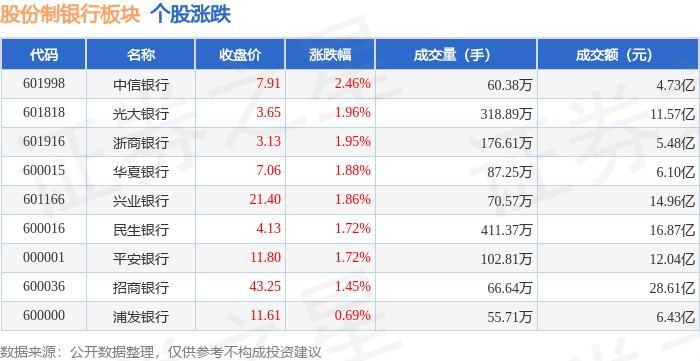
股份制银行板块11月25日涨1.62%,中信银行领涨,主力资金净流入4.23亿元
Zheng Xing Xing Ye Ri Bao· 2025-11-25 09:09
Market Performance - The banking sector saw an increase of 1.62% on November 25, with CITIC Bank leading the gains [1] - The Shanghai Composite Index closed at 3870.02, up 0.87%, while the Shenzhen Component Index closed at 12777.31, up 1.53% [1] Individual Bank Performance - CITIC Bank's closing price was 7.91, with a rise of 2.46% and a trading volume of 603,800 shares, amounting to a transaction value of 473 million [1] - Other notable banks included Everbright Bank, which closed at 3.65 with a 1.96% increase, and Zhejiang Commercial Bank, which closed at 3.13, up 1.95% [1] Fund Flow Analysis - The banking sector experienced a net inflow of 423 million from main funds, while retail funds saw a net outflow of 149 million [1] - Main fund inflows were led by Ping An Bank with 159 million, while CITIC Bank had a main fund inflow of 81.6 million [2] Detailed Fund Flow for Individual Banks - Ping An Bank had a main fund inflow of 159 million, but retail funds saw a net outflow of 23.58 million [2] - CITIC Bank's main fund inflow was 81.6 million, with retail funds experiencing a net outflow of 39.91 million [2] - Everbright Bank had a main fund inflow of 18.28 million, while retail funds saw a significant outflow of 78.13 million [2]


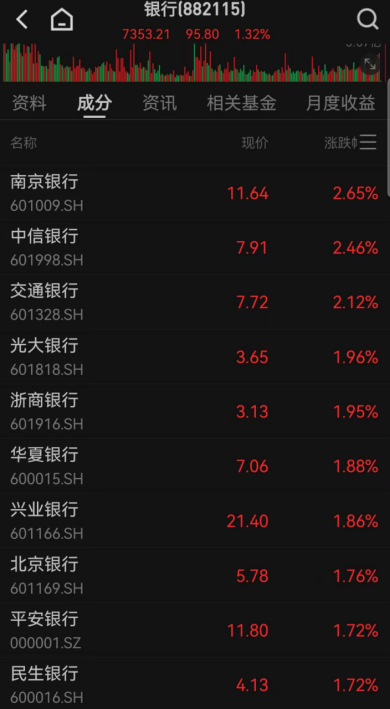
银行板块普涨,股东增持与中期分红提振市场信心
Huan Qiu Wang· 2025-11-25 07:52
| 序号 代码 | | 名称 | O | 最新 | 总市值 | 涨幅% 1 | 年初 | | --- | --- | --- | --- | --- | --- | --- | --- | | 1 | 601009 | 南京银行 | 1 | 11.64 | 1439亿 | 2.65 | | | 2 | 601998 | 中信银行 | 1 | 7.91 | 4402亿 | 246 | | | 3 | 601328 | 交通银行 | 1 | 7.72 | 6822亿 | 2.12 | | 农业银行此前走出"14连阳"行情,截至11月25日收盘,收盘价为8.07元/股。据东方财富choice数据,农行年初至今涨幅近58%,居板块首位。对于农业银行 本轮行情,资深金融监管政策专家周毅钦曾向记者分析谈到,其核心逻辑仍以估值修复为主,尚未切换为成长属性定价。一方面当前仍以低估值与高股息的 吸引力为主。农行股息率显著高于国债收益率,叠加市场避险情绪升温,险资、公募等长期资金持续加仓,推动估值向合理区间回归。 "另外一方面是基本面韧性提供支撑。农行上半年财报数据稳健,存款成本低、不良率可控的护城河优势强化了安全垫,但成长属性 ...


港股央企红利ETF(159333)涨0.61%,成交额1682.95万元
Xin Lang Cai Jing· 2025-11-25 07:13
来源:新浪基金∞工作室 11月25日,万家中证港股通央企红利ETF(159333)收盘涨0.61%,成交额1682.95万元。 港股央企红利ETF(159333)成立于2024年8月21日,基金全称为万家中证港股通央企红利交易型开放 式指数证券投资基金,基金简称为万家中证港股通央企红利ETF。该基金管理费率每年0.50%,托管费 率每年0.10%。港股央企红利ETF(159333)业绩比较基准为中证港股通央企红利指数收益率(经估值汇 率调整)。 规模方面,截止11月24日,港股央企红利ETF(159333)最新份额为3.34亿份,最新规模为4.89亿元。 回顾2024年12月31日,港股央企红利ETF(159333)份额为4.31亿份,规模为5.14亿元。即该基金今年 以来份额减少22.51%,规模减少4.83%。 流动性方面,截止11月25日,港股央企红利ETF(159333)近20个交易日累计成交金额4.19亿元,日均 成交金额2092.86万元;今年以来,217个交易日,累计成交金额81.86亿元,日均成交金额3772.52万 元。 港股央企红利ETF(159333)现任基金经理为杨坤。杨坤自2024年 ...