中国平安

Search documents
港股周观点 | 港股或迎三因素共振上行
Xin Lang Cai Jing· 2026-01-11 16:16
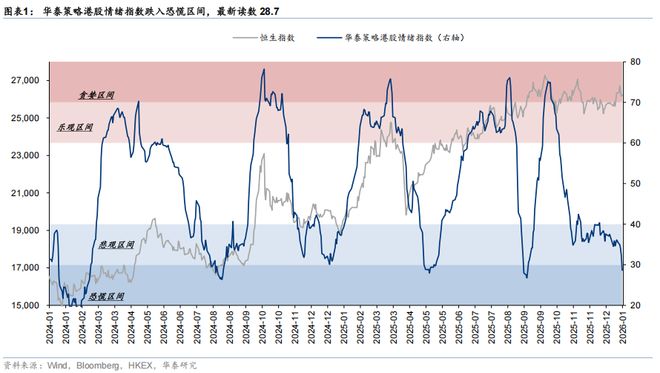
Core Viewpoint - The Hong Kong stock market sentiment index has entered a panic zone, historically indicating a high probability of price increases in the following month, with current factors such as overseas liquidity easing, accelerated capital inflows, and upward revisions in profit expectations contributing to a potential rally in the market [1][2][4]. Group 1: Market Sentiment and Performance - The Hong Kong stock sentiment index fell to 28.6, marking its return to the panic zone for the first time in four months, with a historical average increase probability of 76% for the Hang Seng Index (HSI) 30 days after entering this zone [2][4]. - Since October 2023, there have been seven signals indicating a 100% success rate, with an average HSI increase of 4% expected in the next month [2][4]. - The current implied probabilities for the HSI reaching 27,000 points by the end of January and February are only 25% and 39%, respectively, indicating a positive expectation gap [2]. Group 2: Liquidity and Capital Inflows - Expectations for overseas liquidity easing are rising, with U.S. Treasury Secretary indicating potential announcements regarding the next Federal Reserve chair around the World Economic Forum [4]. - Foreign capital inflows into Hong Kong stocks accelerated, with a record inflow of $1.54 billion in a week, the highest since February 1998, alongside significant southbound capital inflows of nearly 30 billion RMB [4]. - January typically sees a seasonal increase in southbound capital inflows, historically accounting for about 13% of the annual total [4]. Group 3: Profit Expectations and Sector Performance - The MSCI China Bloomberg profit expectations have been revised upward by 0.9% over the past four weeks, with expectations for major economic data in January and February lacking strong anchors due to seasonal effects [4][6]. - Sectors such as upstream resources, public industries, TMT, and essential consumer goods have shown significant improvements in sentiment over the past three months, while sectors like steel and real estate have seen downward revisions in profit expectations [6][40]. - The AH premium index has risen to a peak of 122.7, indicating that Hong Kong stocks may enter a relative yield period as A-shares have outperformed recently [5].

利率最高超4% 专属商业养老保险成绩单出炉
Bei Jing Shang Bao· 2026-01-11 15:21
Core Viewpoint - The exclusive commercial pension insurance has shown competitive settlement interest rates for 2025, ranging from 0.75% to 4.02%, with most products exceeding 3% despite a general downward trend in preset interest rates in the industry [1][3]. Group 1: Product Performance - A total of 37 exclusive commercial pension insurance products have disclosed their 2025 settlement interest rates, with the stable accounts averaging 3.2% and aggressive accounts averaging 3.12% [3]. - The majority of products have settlement interest rates above 3%, with 30 stable accounts and 34 aggressive accounts exceeding this threshold [3][4]. - Some products, such as those from Guomin Pension and Xinhua Pension, have settlement interest rates of 4.01% and 4% respectively [4]. Group 2: Investment Strategy - The steady returns of exclusive commercial pension insurance are attributed to rigorous investment strategies and unique policy positioning, utilizing a "fixed income base, equity enhancement" asset allocation model [4][6]. - Insurance companies focus on long-term government bonds and high-grade credit bonds to secure stable returns, while also investing in high-dividend, low-volatility blue-chip stocks [4][6]. - Active management capabilities of insurance companies have improved, allowing for dynamic adjustments in investment portfolios to capitalize on market opportunities [6]. Group 3: Market Trends and Future Outlook - The exclusive commercial pension insurance has evolved since its pilot in 2021, becoming a significant component of the multi-tiered pension system in China, with increasing demand due to aging population trends [1][7]. - Recent policy support has encouraged the development of third-pillar pension insurance, promoting the creation of new products that align with personal pension systems [7][8]. - To enhance market competitiveness, insurance companies are advised to improve investment management and service quality, innovate product designs, and expand sales channels [8].

非银金融行业周报:关注业绩预告,资金端扰动不改非银板块中期逻辑-20260111
KAIYUAN SECURITIES· 2026-01-11 13:44
Investment Rating - The industry investment rating is "Overweight" (maintained) [1] Core Views - The insurance and brokerage sectors have shown active performance at the beginning of the year, with insurance policy sales exceeding expectations and a notable rise in the stock market driving the insurance sector's growth. The brokerage sector benefits from increased market activity. The trend of "deposit migration" among residents is providing dual support for the non-bank financial sector, both in terms of liabilities (business growth) and assets (investment appreciation). The non-bank financial sector has been relatively stagnant in 2025, with valuations and institutional holdings still at low levels. Short-term funding disturbances are not a concern, and recent adjustments present good opportunities for positioning. The report remains optimistic about the non-bank sector's performance at the start of the year, with significant profit growth expected for brokerages and insurance companies in 2025, highlighting the importance of January's earnings forecasts and policy events as catalysts [5]. Summary by Sections Brokerage Sector - In the first week of 2026, the average daily trading volume of stock funds reached 3.37 trillion, a 33% increase month-on-month and a 150% increase year-on-year, indicating a significant rise in market activity. As of January 8, 2026, the margin trading balance reached 2.62 trillion, up 44.1% from January 10, 2025. The market's "opening red" has led to the Shanghai Composite Index and the Wind All A Index surpassing new highs for 2025, enhancing profitability for brokerages and securities IT companies. Regulatory policies are entering a "positive" cycle, with growth in investment banking, public funds, and overseas businesses expected to further expand, supporting the profitability of the securities industry in 2026. Current valuations and institutional holdings in the sector remain low, and the report recommends focusing on three main lines: undervalued leading brokerages such as Huatai Securities, Guotai Junan, and CICC; wealth management leaders like GF Securities and Dongfang Securities; and retail leaders benefiting from the Hainan cross-border asset management pilot, such as Guosen Securities. Beneficiary stocks include Tonghuashun [6]. Insurance Sector - The insurance sector's positive outlook is driven by both liabilities and assets. The "opening red" has catalyzed a significant rise in the insurance sector, with the individual insurance channel under pressure in 2025 but showing optimistic growth prospects for new policies in 2026 due to the transformation of dividend insurance and the integration of individual insurance reporting. The trend of deposit migration among residents is expected to sustain high growth in the bancassurance channel, while health insurance is likely to improve under policy guidance. On the asset side, stable long-term interest rates and a favorable equity market are expected to enhance net assets and profitability for insurance companies, with marginal improvements in liability costs. Over the medium to long term, the interest spread for insurance companies is expected to gradually improve, leading to a recovery in valuations. The report recommends China Pacific Insurance, Ping An Insurance, and China Life Insurance H [7]. Recommended and Beneficiary Stocks - The recommended stock portfolio includes Huatai Securities, GF Securities, Guotai Junan, CICC H, China Pacific Insurance, China Life Insurance H, Ping An Insurance, CITIC Securities, Guosen Securities, and Dongfang Securities H. Beneficiary stocks include Tonghuashun and Jiufang Zhitu Holdings [8].
最高超4%、部分产品收益回升,专属商业养老保险成绩单出炉
Bei Jing Shang Bao· 2026-01-11 13:40
Core Insights - The exclusive commercial pension insurance has shown competitive settlement interest rates for 2025, ranging from 0.75% to 4.02%, with most products exceeding 3% [1][3] - This insurance product is a crucial part of China's multi-tiered pension system, providing a significant supplement to residents' long-term retirement savings [1][8] - The demand for exclusive commercial pension insurance is increasing, particularly due to the aging population trend, indicating strong growth potential for this sector [1][8] Product Performance - A total of 37 exclusive commercial pension insurance products have disclosed their 2025 settlement interest rates, with the average rate for stable accounts at 3.2% and for aggressive accounts at 3.12% [3][6] - Most products have settlement interest rates above 3%, with 30 stable accounts and 34 aggressive accounts exceeding this threshold [3][6] - Some products, such as those from Guomin Pension and Xinhua Pension, have rates exceeding 4% [4][5] Investment Strategy - The steady returns of exclusive commercial pension insurance are attributed to rigorous investment strategies and unique policy positioning, utilizing a "fixed income base, equity enhancement" asset allocation model [5][7] - Insurance companies are focusing on long-term government bonds and high-grade credit bonds to secure stable returns, while also investing in high-dividend, low-volatility blue-chip stocks [5][7] - Active management capabilities of insurance companies have improved, allowing for dynamic adjustments in investment portfolios to capitalize on market opportunities [7][9] Market Trends - The exclusive commercial pension insurance has transitioned from a pilot program to a normalized business model, expanding its reach across the country [8] - Recent policies have favored the development of third-pillar pension insurance, encouraging the creation of products that align with personal pension systems [8][9] - To enhance market competitiveness, insurance companies are advised to improve investment management and service quality, innovate product designs, and expand sales channels [9][10]

非银金融行业周报(2026/1/5-2026/1/9):持续看好全年非银板块价值重估逻辑-20260111
Shenwan Hongyuan Securities· 2026-01-11 13:13
2026 年 01 月 11 日 《公募费率改革收官, 非银板块向上突破 动能充盈——非银金融行业周报 (2025/12/29-2025/12/31)》 2026/01/05 《高弹性标签助力板块"破圈",看好资负 两端改善趋势 -- 2026 年保险行业策略 报告》 2025/11/18 《证券行业 2026 年投资策略:权益浪潮 下的券商机遇:财富扩容,国际增效》 2025/11/17 证券分析师 罗钻辉 A0230523090004 luozh@swsresearch.com 孙冀齐 A0230523110001 sunjg@swsresearch.com 金黎丹 A0230525060004 jinld@swsresearch.com 联系人 罗钻辉 A0230523090004 luozh@swsresearch.com 万宏源研究微信服务 续看好全年非银板块价值重 非银金融行业周报(2026/1/5-2026/1/9) 本期投资提示: 时代人行业 相关研究 请务必仔细阅读正文之后的各项信息披露与声明 苏研究招 0 券商:本周申万券商 II 指数收跌 1.90%,跑输沪深 300 指数 0.89pc ...






金融行业周报(2026、01、11):开门红催化保险板块,看好配置策略下银行股中长线收益-20260111
Western Securities· 2026-01-11 13:11
Group 1: Core Conclusions - The financial industry saw a weekly increase of +2.60% in the non-bank financial index, underperforming the CSI 300 index by 0.19 percentage points [1] - The insurance sector outperformed with a weekly increase of +3.58%, benefiting from strong performance in listed insurance companies [1][9] - The banking sector experienced a decline of -1.90%, underperforming the CSI 300 index by 4.69 percentage points, with all types of banks showing negative performance [1][9] Group 2: Insurance Sector Insights - The insurance sector's strong performance is driven by high growth in "opening red" earnings, indicating a solid investment logic with improving fundamentals [1][13] - The sector benefits from a dual drive of asset under management (AUM) expansion and interest rate spread recovery, with a clear trend of increasing industry concentration [1][17] - Recommended companies in the insurance sector include China Pacific Insurance, China Ping An, China Life (H), and New China Life [3] Group 3: Brokerage Sector Insights - The brokerage sector saw a weekly increase of +1.90%, with a PB valuation of 1.41x, indicating potential for valuation recovery [2][18] - Notable developments include GF Securities' plan to raise funds through H-share placement to support international business expansion [2][18] - Recommended brokerages include Guotai Junan, Huatai Securities, and CITIC Securities, focusing on those with strong fundamentals and low valuations [3][19] Group 4: Banking Sector Insights - The banking sector's PB valuation stands at 0.53x, with expectations for interest margin recovery in 2026, driven by reduced re-pricing pressure on loans [2][21] - The People's Bank of China indicated a continuation of a moderately loose monetary policy, which is expected to support the banking sector's performance [2][21] - Recommended banks include Hangzhou Bank, with additional focus on Qingdao Bank and Ningbo Bank for potential recovery opportunities [3][22]
晓数点丨一周个股动向:沪指站上4100点 最牛股周涨近150%
Di Yi Cai Jing· 2026-01-11 12:46
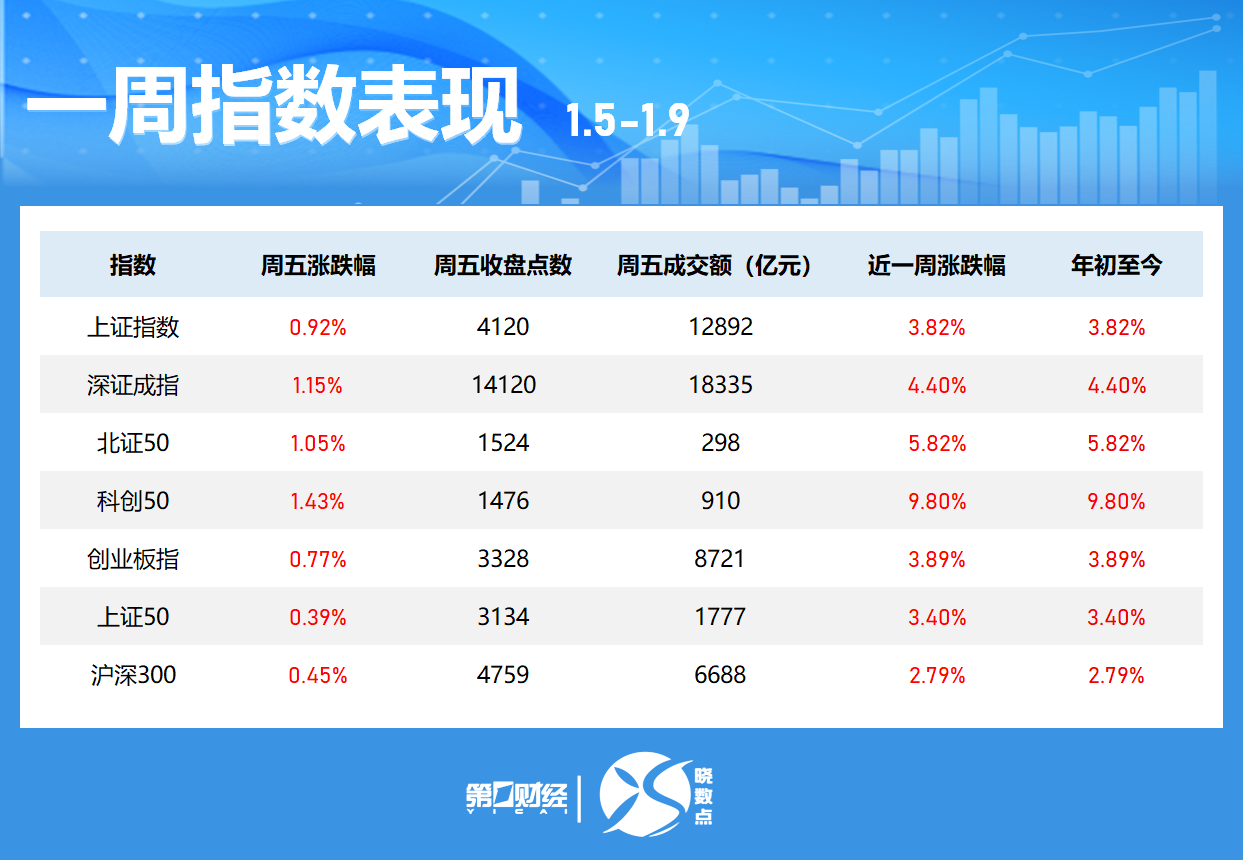
多图速览>> 本周(1月5日至9日)三大指数均累计上涨,沪指涨3.82%,深成指涨4.40%,创业板指涨3.89%。科创综指涨10.19%。 | 指数 | 周五涨跌幅 | 周五收盘点数 | 周五成交额(亿元) | 近一周涨跌幅 | स्ट | | --- | --- | --- | --- | --- | --- | | 上证指数 | 0.92% | 4120 | 12892 | 3.82% | | | 深证成指 | 1.15% | 14120 | 18335 | 4.40% | | | 北证50 | 1.05% | 1524 | 298 | 5.82% | 5 | | 科创50 | 1.43% | 1476 | 910 | 9.80% | | | 创业板指 | 0.77% | 3328 | 8721 | 3.89% | 3 | | 下证50 | 0.39% | 3134 | 1777 | 3.40% | | | 沪深300 | 0.45% | 4759 | ୧୧୫୫ | 2.79% | | ►牛熊股:7股涨超60%,最牛股周涨近150% Wind数据显示,本周(1月5日至1月9日)共有7只个股涨幅超60%, ...
资负两端全面改善,保险迎开年行情
HUAXI Securities· 2026-01-11 12:27
Investment Rating - The report rates the insurance industry as "Recommended" [1] Core Insights - The insurance sector has shown significant improvement, with the Insurance II index rising by 19.5% and the Hong Kong Insurance index by 13.5% from December 4, 2025, to January 9, 2026 [1] - Major insurance companies have reported strong new business growth, with some top firms seeing over 70% year-on-year growth in new policies during the first three days of 2026 [2] - The overall premium income for life insurance from January to November 2025 increased by 9.1% year-on-year, indicating a recovery in the liability side of the business [2] - The decline in deposit rates and the scarcity of large-denomination time deposits are expected to drive more funds into insurance products, which offer relatively higher returns [2] Summary by Sections Stock Performance - China Pacific Insurance led A-share gains with a 32.1% increase, followed by New China Life at 25.4%, China Life at 12.5%, and others [1][8] - In H-shares, New China Life also led with a 30.9% increase, while China Ping An and China Pacific Insurance followed with 23.6% and 21.7% respectively [1][8] Valuation and Earnings Forecast - The average Price to Embedded Value (PEV) for major A-share insurers ranges from 0.76 to 0.93, while H-share PEVs range from 0.54 to 0.76, indicating that valuations are still below historical averages [4] - The report forecasts earnings per share (EPS) growth for key companies, with China Ping An expected to reach an EPS of 8.08 in 2026, while China Pacific Insurance is projected at 4.80 [6][9] Investment Recommendations - The report suggests a positive outlook for leading insurers due to improved fundamentals and the potential for valuation recovery, particularly for China Ping An, China Pacific Insurance, and New China Life [4]





非银金融行业周报:持续看好全年非银板块价值重估逻辑-20260111
Shenwan Hongyuan Securities· 2026-01-11 11:45
Investment Rating - The report maintains a positive outlook on the non-bank financial sector, indicating a value reassessment logic for the year 2026 [2][4]. Core Insights - The non-bank financial sector is expected to benefit from a favorable market environment, with a significant increase in trading volumes and a recovery in investment banking activities. The average daily stock trading volume reached 28,519.51 billion yuan, up 65% year-on-year [4][20]. - The insurance sector is projected to experience a year of value reassessment in 2026, driven by declining liability costs and an increase in equity allocation ratios. The report highlights that the P/EV valuation model for leading insurance companies is expected to improve as the growth potential of liabilities becomes more apparent [4][17]. - The brokerage sector is currently in a phase of fundamental and valuation mismatch, with a recommendation to focus on firms with strong competitive positions and earnings elasticity [4][9]. Summary by Sections Market Review - The Shanghai Composite Index closed at 4,758.92 with a weekly increase of 2.79%, while the non-bank index rose by 2.60% to 2,107.56. The brokerage, insurance, and diversified financial sectors reported increases of 1.90%, 3.58%, and 4.44%, respectively [7][9]. Non-Bank Sector Key Data - As of January 9, 2026, the 10-year government bond yield was 1.88%, reflecting a weekly change of +1.98 basis points. The average daily stock trading volume for the week was 28,519.51 billion yuan, with a year-on-year increase of 65.07% [17][20]. Non-Bank Sector News and Key Announcements - The China Securities Regulatory Commission and the Ministry of Finance announced a reward program for whistleblowers in securities and futures violations, with potential rewards up to 1 million yuan for significant cases [21]. - Ping An Life increased its stake in China Merchants Bank H shares to 20.07%, crossing the threshold for mandatory disclosure [22]. Investment Analysis Recommendations - For brokerages, the report suggests focusing on firms with strong competitive advantages, such as Guotai Junan, GF Securities, and CITIC Securities. It also highlights firms with significant earnings elasticity like Huatai Securities and Dongfang Securities [4][9]. - In the insurance sector, the report recommends companies like China Life, China Pacific Insurance, and Ping An Insurance, anticipating improved performance due to favorable market conditions [4][9].
兴业证券:如何看待A股本轮开门红的结构与延续性?
智通财经网· 2026-01-11 10:36
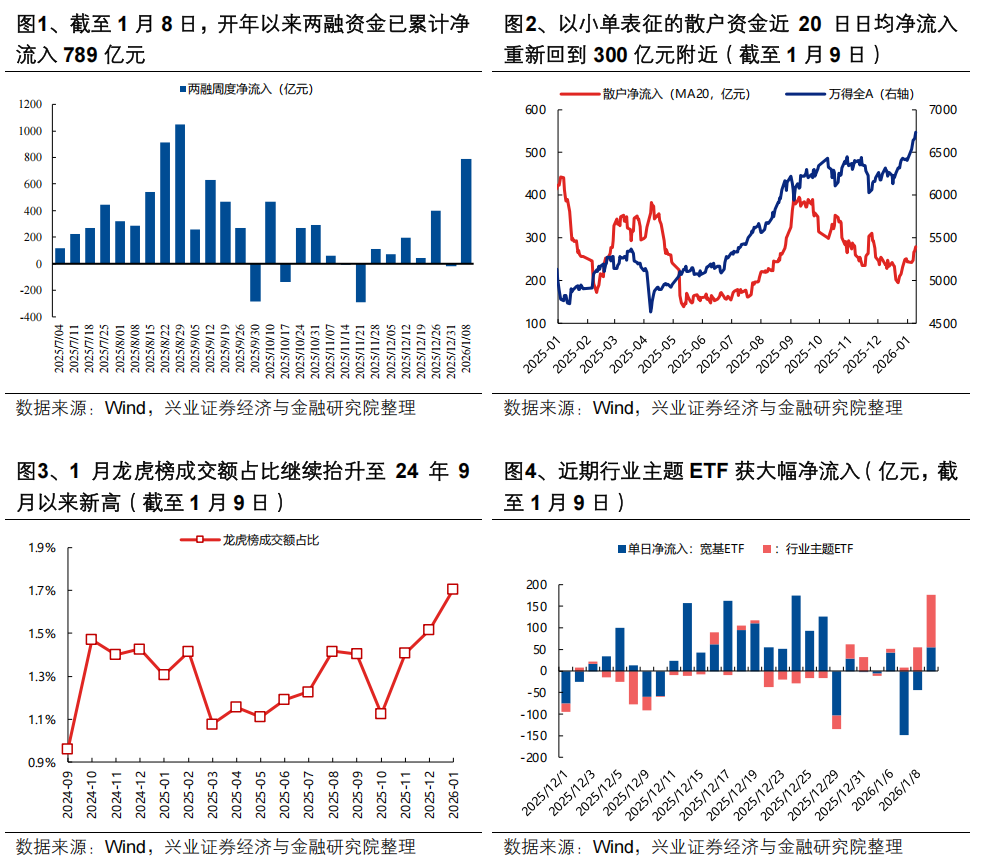
Core Viewpoint - The recent "opening red" in the A-share market reflects a favorable macroeconomic environment and abundant liquidity, which supports market risk appetite and attracts incremental capital inflow, creating a positive feedback loop between capital inflow and market rise [2][18]. Group 1: Market Dynamics - The A-share market has experienced a strong start with the Shanghai Composite Index breaking key levels and achieving a "sixteen consecutive days" rise, exceeding many investors' expectations [1][19]. - Historical data indicates that after a single-day trading volume exceeds 3 trillion yuan, there is typically at least a monthly-level market rally [19]. - Various types of trading funds have shown signs of accelerated entry, including a net inflow of 78.9 billion yuan in margin financing since the beginning of the year and a return of retail investor net inflow to around 30 billion yuan daily [2][5]. Group 2: Structural Characteristics - The inflow structure of different funds shows a strong consensus on key themes, primarily focusing on TMT (storage, AI applications), military industry (commercial aerospace), non-ferrous metals, new energy (controlled nuclear fusion), machinery (robots), and pharmaceuticals (innovative drugs, brain-machine interfaces) [5][36]. - The global stock market has also seen a strong start in 2026, driven by macroeconomic and industrial narratives, with A-shares reflecting similar trends [13][18]. Group 3: Future Directions - As companies begin to disclose annual reports, earnings will become a key factor driving market dynamics, leading to a structural adjustment where previously hot sectors face performance validation, while some low-performing sectors may attract new capital inflows [36]. - Industries with significant upward revisions in profit forecasts since November include technology (consumer electronics, computing), advanced manufacturing (new energy, military), cyclical sectors (building materials, non-ferrous metals), and consumer sectors (food processing, retail) [37][38].