天弘基金

Search documents
热门产品,限购
Zhong Guo Ji Jin Bao· 2025-07-29 05:20
Core Viewpoint - The recent surge in demand for dividend and high-yield theme funds has led to multiple fund companies implementing purchase limits to protect existing shareholders and ensure stable fund operations [1][2]. Group 1: Fund Purchase Limits - On July 29, several funds, including the Invesco Great Wall CSI Dividend Low Volatility 100 ETF and Tianhong CSI Central State-Owned Enterprises Dividend 50 Index, announced a suspension of large purchases exceeding 5 million yuan [2]. - The decision to limit purchases is attributed to a significant influx of funds, as the overall economic growth remains stable, but structural issues persist [2]. - The current bond market volatility and a nearly 4% yield spread have increased the attractiveness of dividend assets for both institutional and individual investors [2]. Group 2: Dividend Asset Appeal - The new "National Nine Articles" policy encourages and strengthens dividend requirements for listed companies, providing strong policy support for dividend assets [4]. - As of June 30, 2023, the dividend yield of the Hong Kong Stock Connect High Dividend Index reached 7.96%, significantly higher than the 5.57% yield of the CSI Dividend Index, highlighting the comparative advantage of Hong Kong dividend assets [4]. - With the anticipated trend of interest rate cuts by the Federal Reserve and a moderately loose domestic monetary policy, capital inflows into the Hong Kong stock market are expected to continue, enhancing the outlook for dividend investments [4]. Group 3: Investment Strategies - The past two years have seen a recovery in the valuation of dividend assets, indicating their effective value even as market risk appetite increases [5]. - Investors are advised to integrate dividend strategies into their investment frameworks rather than solely judging based on dividend yield [5]. - Different dividend indices may perform significantly differently under varying market conditions, suggesting the need for diversified investment strategies based on individual risk preferences and investment goals [6].
ETF融资榜 | 香港证券ETF(513090)杠杆资金加速流入,宽基板块遭连续卖出-20250728
Sou Hu Cai Jing· 2025-07-29 03:24
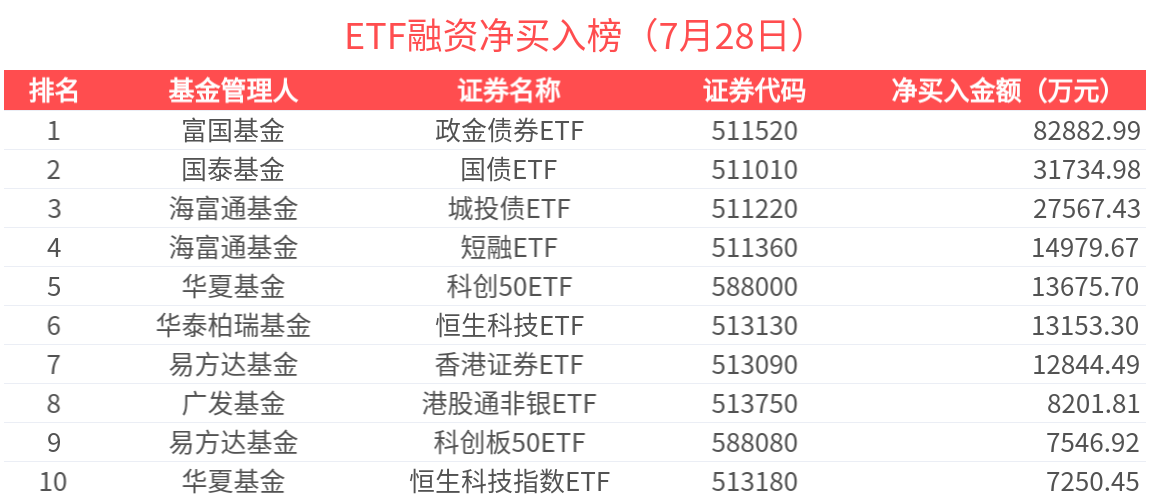
Core Insights - A total of 241 ETF funds experienced net inflows from financing, while 28 funds saw net outflows from securities lending [1] - Significant inflows were observed in specific ETFs, including the Government Bond ETF (511520.SH) and the National Debt ETF (511010.SH), with net inflows of 8.29 billion and 3.17 billion respectively [1][3] - Conversely, notable outflows were recorded in ETFs such as the CSI 500 ETF (510500.SH) and the CSI 1000 ETF (512100.SH), with net outflows of 1.24 billion and 1.05 billion respectively [1][5] Financing Inflows - 62 ETFs had financing net inflows exceeding 5 million, with the top five being: - Government Bond ETF: 8.29 billion - National Debt ETF: 3.17 billion - City Investment Bond ETF: 2.76 billion - Short-term Bond ETF: 1.50 billion - Sci-Tech 50 ETF: 1.37 billion [1][3][10] Securities Lending Outflows - 6 ETFs had securities lending net outflows exceeding 5 million, with the top five being: - CSI 500 ETF: 1.24 billion - CSI 1000 ETF: 1.05 billion - CSI 300 ETF: 1.055 billion - Shanghai Stock Exchange 50 ETF: 801.58 million - CSI 2000 ETF: 526.18 million [1][5][12] Recent Trends - 91 ETFs have seen continuous financing net inflows, with the Hong Kong Securities ETF leading with a net inflow of 6.11 billion over the past 7 days [1][7] - In terms of continuous securities lending net outflows, 4 ETFs were noted, with the Innovation Drug ETF experiencing a net outflow of 45.47 million over 3 days [1][8] Long-term Observations - Over the past 5 days, significant financing net inflows were recorded in: - Government Bond ETF: 4.48 billion - Hong Kong Securities ETF: 4.43 billion - Hang Seng Technology ETF: 2.12 billion [1][8][10] - Conversely, the top 5 ETFs with net outflows over the same period included: - CSI 500 ETF: 1.34 billion - CSI 1000 ETF: 1.22 billion [1][10][12]

公募基金Q2增配军工,“含航量”最高的航空航天ETF天弘盘中价格创上市以来新高,机构看好行业拐点已现
2 1 Shi Ji Jing Ji Bao Dao· 2025-07-29 03:11
Group 1 - The military industry sector remains active, with the Aerospace ETF Tianhong (159241) reaching a new high since its listing, showing a 0.59% increase and a turnover rate of nearly 5% [1] - The Aerospace ETF Tianhong (159241) has seen a net inflow of over 4.7 million yuan, with a total circulation scale of 415 million yuan and a share growth rate of 84.61% year-to-date, ranking first among similar products [1] - The Aerospace ETF closely tracks the Guozheng Aerospace Index, which has over 98% weight in the defense and military industry, making it the highest military content index in the market [1] Group 2 - Several brokerages have analyzed Q2 public fund holdings, indicating that institutions have begun to increase their allocation to the military sector, suggesting a potential turning point for the industry [2] - According to Minsheng Securities, after ten consecutive quarters of reducing military allocations, institutions started to increase their allocation in Q2 2025, indicating a recovery in industry demand [2] - Dongfang Securities noted a significant increase in the overweighting of military stocks by active funds in Q2 2025, with expectations for further expansion due to market perceptions and performance elasticity [2]


创新药ETF领涨,科创50ETF吸金近9亿元丨ETF基金日报
Sou Hu Cai Jing· 2025-07-29 02:55
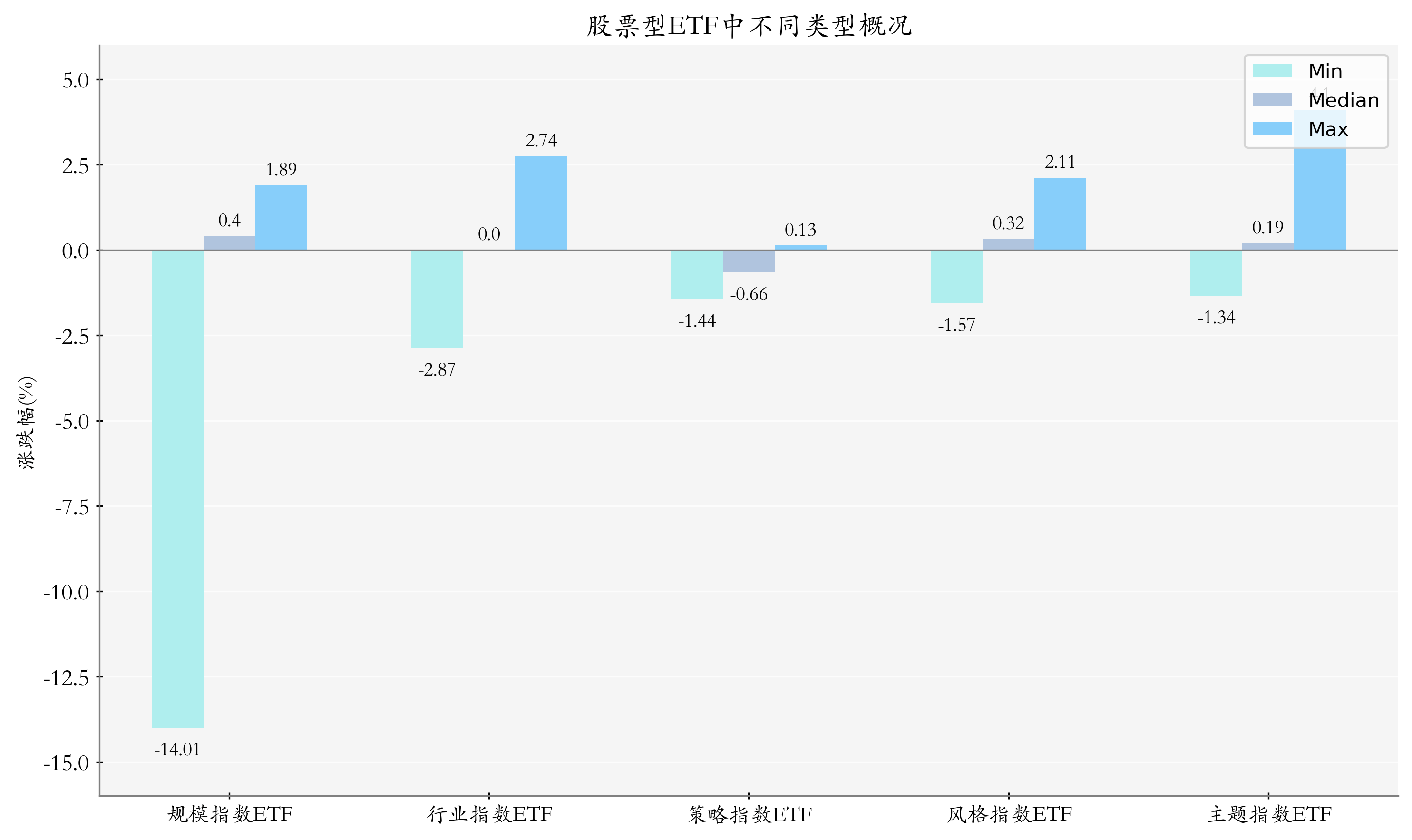
Market Overview - The Shanghai Composite Index rose by 0.12% to close at 3597.94 points, with a daily high of 3606.27 points [1] - The Shenzhen Component Index increased by 0.44% to close at 11217.58 points, reaching a high of 11226.18 points [1] - The ChiNext Index saw a rise of 0.96%, closing at 2362.6 points, with a peak of 2366.51 points [1] ETF Market Performance - The median return for stock ETFs was 0.27%, with the highest return from the Huaxia SSE Sci-Tech Innovation Board 200 ETF at 1.89% [2] - The top-performing industry ETF was the Huaxia SSE Medical Health ETF, yielding 2.74% [2] - The best-performing thematic ETF was the Tibet Dongcai CSI Hong Kong-Shanghai Innovation Drug Industry ETF, which achieved a return of 4.1% [2] ETF Gain and Loss Rankings - The top three ETFs by gain were: - Tibet Dongcai CSI Hong Kong-Shanghai Innovation Drug Industry ETF (4.1%) - Tianhong Hang Seng Hong Kong-Shanghai Innovative Drug Selected 50 ETF (3.95%) - Huatai-PB CSI Hong Kong-Shanghai Innovation Drug Industry ETF (3.56%) [5] - The top three ETFs by loss were: - Harvest SSE Sci-Tech Innovation Board Comprehensive ETF (-14.01%) - Guotai CSI Coal ETF (-2.87%) - GF CSI All-Index Energy ETF (-2.57%) [6] ETF Fund Flow - The top three ETFs by fund inflow were: - Huaxia SSE Sci-Tech Innovation Board 50 Component ETF (inflow of 883 million yuan) - Harvest SSE Sci-Tech Innovation Board Chip ETF (inflow of 653 million yuan) - Penghua CSI Wine ETF (inflow of 295 million yuan) [8] - The top three ETFs by fund outflow were: - Huaxia SSE 50 ETF (outflow of 883 million yuan) - Huatai-PB CSI 300 ETF (outflow of 855 million yuan) - Southern CSI 500 ETF (outflow of 704 million yuan) [9] ETF Margin Trading Overview - The top three ETFs by margin buying were: - Huaxia SSE Sci-Tech Innovation Board 50 Component ETF (906 million yuan) - Guotai CSI All-Index Securities Company ETF (324 million yuan) - Guolian An CSI All-Index Semiconductor Products and Equipment ETF (290 million yuan) [11] - The top three ETFs by margin selling were: - Southern CSI 500 ETF (127 million yuan) - Southern CSI 1000 ETF (106 million yuan) - Huatai-PB CSI 300 ETF (21.7 million yuan) [13] Institutional Insights - CITIC Securities noted that China's innovative drug assets are gaining global recognition, with increasing business development (BD) authorization amounts and numbers, indicating a valuation recovery in the innovative drug sector [14] - Jianghai Securities emphasized the long-term investment value of innovative drug companies with rich R&D pipelines, suggesting a focus on companies with deep technical accumulation and extensive pipeline layouts [14]
新手入门,第一只ETF选什么? 关注银行“攻守道”
申万宏源证券上海北京西路营业部· 2025-07-29 01:59
Core Viewpoint - The article emphasizes that investing in bank sector ETFs is an ideal starting point for investors in a low interest rate environment, providing a combination of high dividends, low valuations, and solid capital support [1]. Group 1: Reasons for Choosing Bank Sector ETFs - Reason 1: High Dividend Advantage - Bank sector ETFs offer a dynamic dividend yield of approximately 4%, significantly higher than the yield of ten-year government bonds, making them attractive for long-term institutional investors and wealth management [2]. - The ongoing low interest rate environment is expected to enhance this dividend advantage, reinforcing the defensive nature of bank stocks [2]. - Reason 2: Low Valuation and Defensive Characteristics - The bank sector is currently undervalued, with a price-to-book (PB) ratio of only 0.74, which is among the lowest in the industry, while maintaining a relatively high return on equity [3]. - The index of bank stocks is positioned at the 49.12% percentile of its ten-year historical PB valuation, indicating potential for long-term valuation recovery [3]. - Reason 3: Policy and Capital Support - The bank sector benefits from both policy support and capital inflows, creating a robust investment logic. Regulatory measures are aimed at alleviating net interest margin pressures and improving asset quality [6]. - Significant capital inflows into A-shares, totaling approximately 2.84 trillion yuan since 2024, have bolstered the bank sector, alongside increased weightings in major indices [6]. Group 2: Strategic Implications - The combination of high dividends, low valuations, and supportive policies positions bank sector ETFs as a balanced investment solution in the current low interest rate and asset scarcity environment [6]. - The strategic window for investing in bank sector ETFs has opened, allowing investors to seek stable returns while diversifying risks [6].

活跃行情下的基金投资基金投资众生相
Shang Hai Zheng Quan Bao· 2025-07-28 18:58
Group 1: Market Overview - The public fund scale has reached a new high of 34.39 trillion yuan as of the end of June, marking the first time it has surpassed this threshold [3][4] - The stock market is steadily rising, with the Shanghai Composite Index approaching 3600 points, indicating a vibrant market environment [2][12] Group 2: Public Fund Trends - The growth of public funds is driven by the acceleration of index investment, a surge in demand for "fixed income plus" products, and a restoration of trust in actively managed equity funds [3][9] - The number of public fund products has rapidly increased, reaching 12,905 by the end of June, with projections indicating it has surpassed 13,000 [5][6] Group 3: Fund Performance - Bond funds have emerged as the main attraction, with a monthly scale increase of 507.87 billion yuan in June, while equity funds also saw significant growth due to market rebounds [5][6] - The top fund companies are expanding their market share, with E Fund leading at 2.16 trillion yuan in management scale, followed by Huaxia Fund surpassing 2 trillion yuan [6][7] Group 4: ETF Development - ETFs are becoming a competitive advantage for leading fund companies, with several achieving substantial growth in management scale [7][8] - New players are entering the ETF market, indicating a competitive landscape with ongoing innovation and product development [9][10] Group 5: Private Fund Strategies - Private funds are adopting offensive strategies focused on new trends in consumption, technology, and economic changes while maintaining defensive measures [12][18] - Optimism among large private funds is growing, with many increasing their positions significantly in the current market [13][17] Group 6: Investor Behavior - Investor behavior is showing signs of divergence, with some actively buying into rising funds while others remain cautious due to past experiences of losses [22][23] - Frequent trading and chasing high returns are identified as detrimental behaviors that can erode long-term returns for investors [24][25] Group 7: Future Outlook - The future growth of public funds is expected to be driven by index investment, the rise of "fixed income plus" products, and a potential rebound in actively managed equity funds [10][11] - The industry is encouraged to innovate in product offerings and focus on performance to meet investor demands and enhance competitiveness [11][26]

中文播客领域动作不断商业化难题何解?
Zheng Quan Shi Bao· 2025-07-28 18:06
Core Insights - The recent turmoil in the executive team of the leading podcast platform, Xiaoyuzhou, has raised concerns about its future commercialization efforts [1][2] - The podcast industry in China is experiencing rapid growth, with over 100 million listeners, but struggles to monetize effectively compared to short video platforms [1][5] - Competition among platforms is intensifying, with major players like Bilibili, Xiaohongshu, and Ximalaya launching initiatives to attract users and creators [2][3] Industry Growth - According to the CPA Chinese Podcast Community, the number of podcast listeners in China is expected to exceed 150 million this year, with a growth rate of 43.6% in 2024, the highest globally [3] - The number of podcast creators is also increasing rapidly, with Xiaoyuzhou's podcast programs expected to rise from 75,000 to over 130,000 between May 2023 and September 2024 [3] - The global podcast market is projected to reach $35.09 billion by 2025, with significant growth expected in the Asia-Pacific region [4] Commercialization Challenges - Despite the growth in audience size, the podcast industry in China faces significant commercialization challenges, with the advertising market size estimated at around 3.3 billion yuan in 2024, which is still small compared to other media [8] - The average income for podcast creators remains low, with many struggling to monetize their content effectively, as highlighted by the case of a popular podcast generating only 130,000 yuan in annual revenue despite having 500,000 followers [6][7] - The primary monetization methods for podcasts include advertising, paid subscriptions, and IP derivatives, with advertising being the most common but still limited in scope [7][8] AI Integration - AI is emerging as a new variable in the podcast industry, with platforms like Hongsong APP and Ximalaya introducing AI-generated audio content to enhance user experience [9][10] - A survey indicated that 58% of podcast creators are using AI tools to improve efficiency in content creation, with AI expected to play a larger role as technology evolves [10] - However, there is a debate within the industry regarding the use of AI, with some creators emphasizing the irreplaceable human element in podcasting [10] Financial Sector Engagement - Financial institutions are increasingly entering the podcast space, using it as a medium for deeper communication with users rather than direct monetization [11][12] - The rise of financial podcasts has prompted greater attention to content compliance and regulatory oversight, ensuring that creators adhere to industry standards [12]
基金产品周报:周期行业基金表现靠前,资金流入债券型ETF速度放缓-20250728
Shanghai Aijian Securities· 2025-07-28 10:37
1. Report Industry Investment Rating No relevant content provided. 2. Core Viewpoints of the Report - In the week from July 21 - July 25, 2025, ETF funds had the highest average weekly increase of 2.40%. Other types of funds ranked by average weekly returns from high to low were: quantitative funds (2.25%), active equity funds (1.76%), QDII funds (1.12%), FOF funds (0.65%), bond funds (-0.04%), and REITs funds (-1.87%) [2][8]. - Year - to - date, QDII funds led with an average return of 18.73%, followed by REITs funds (16.80%), active equity funds (13.86%), quantitative funds (12.69%), ETF funds (12.46%), FOF funds (6.94%), and bond funds (1.68%) [8]. 3. Summary According to the Table of Contents 3.1 Cross - Category Fund Product Return Overview - This week, ETF funds had the highest average weekly increase of 2.40%, followed by quantitative funds (2.25%), active equity funds (1.76%), QDII funds (1.12%), FOF funds (0.65%), bond funds (-0.04%), and REITs funds (-1.87%) [2][8]. - Year - to - date, QDII funds had an average return of 18.73%, REITs funds 16.80%, active equity funds 13.86%, quantitative funds 12.69%, ETF funds 12.46%, FOF funds 6.94%, and bond funds 1.68% [8]. 3.2 Active Equity Funds - **Performance of Major Broad - based Indexes in A - share and Hong Kong Markets**: This week, all major broad - based indexes in the A - share market rose, with the overall increase lower than last week. The Science and Technology Innovation 50 Index had the best performance with a 4.63% increase, followed by the CSI 500 Index (3.28%), and the SSE 50 Index had the smallest increase of 1.12%. In the Hong Kong market, major broad - based indexes also rose, with the increase lower than last week. The Hang Seng Index and Hang Seng Tech Index increased by 2.27% and 2.51% respectively [12]. - **Performance of Shenwan Primary Industry Indexes**: Most Shenwan primary industry indexes rose this week. The building materials, coal, and steel industry indexes performed relatively well, with weekly increases of 8.20%, 7.98%, and 7.67% respectively. The public utilities, communication, and banking industry indexes performed weakly, with weekly increases of - 0.27%, - 0.77%, and - 2.87% respectively [15]. - **Overview of High - performing Active Equity Funds**: The average weekly return of active equity funds was 1.76%. Jinxin Industry Preferred Hybrid A had the best performance with a weekly return of 11.66%. High - performing funds mostly held stocks in the electronics, non - ferrous metals, and coal industries [17]. - **Overview of Industry - specific Active Equity Funds**: The average weekly return of industry - specific active equity funds was 1.51%, slightly weaker than the overall level of active equity funds. Cyclical industry funds performed brightly this week, with an average return of 4.86%. TMT industry funds had an average weekly return of 2.12%, ranking second. Pharmaceutical industry funds had a relatively weak performance with an average weekly return of - 0.15%. The average returns of other three types of industry funds were: mid - stream manufacturing (1.87%), consumption (1.56%), and financial real estate (1.35%) [19]. - **Overview of Non - industry Active Equity Funds**: The average weekly return of non - industry funds was 1.78%, slightly better than the overall level of active equity funds. The value - style funds significantly outperformed this week, with an average weekly return of 2.43%. The average returns of the other two styles were: growth (1.33%) and balanced (1.80%) [22]. 3.3 Quantitative Funds - **Overview of Quantitative Fund Returns**: The average weekly return of quantitative funds was 2.25%. Huabao CSI Rare Metals Theme A had the highest weekly return of 10.92%. In terms of strategy types, index - enhanced funds had the best performance with an average weekly return of 2.47%. The average weekly returns of the other two types were: active quantitative (2.21%) and stock long - short (0.10%) [24]. - **Overview of Returns of Major Index - enhanced Quantitative Funds**: Among index - enhanced quantitative funds this week, funds tracking the CSI 500 Index performed best, with an average return of 3.18%. The average weekly returns of funds tracking the CSI 300, CSI 1000, and Guozheng 2000 Indexes were 1.75%, 2.42%, and 2.31% respectively. In terms of excess returns, the proportion of funds achieving positive excess returns was 54.13%, similar to last week. Funds tracking the Guozheng 2000 Index had the highest average excess return of 0.19%. The average weekly excess returns of funds tracking the other three indexes were: CSI 300 Index (0.06%), CSI 500 Index (- 0.10%), and CSI 1000 Index (0.06%) [26]. 3.4 Bond Funds - **Performance of Major Bond Indexes**: This week, major bond market indexes declined overall. The CSI Aggregate Bond Index fell 0.49% to close at 260.12, the CSI Treasury Bond Index fell 0.59% to 246.44, and the CSI Credit Bond Index fell 0.37% to 213.20 [28]. - **Performance of Convertible Bond Indexes**: This week, the CSI Convertible Bond Index rose 2.14% to close at 463.57, with the weekly trading volume increasing by 14.16%. The median convertible bond price rose 1.66% to 129.66, and the median conversion premium rate rose 0.93% to 26.77% [30]. - **Overview of Bond Fund Returns**: The average weekly return of bond funds was - 0.04%. Galaxy Zhaoyi 6 - month Holding Hybrid A had the best performance with a weekly return of 9.26%. High - performing bond funds were mostly hybrid bond - type, convertible bond - type, and partial - debt hybrid - type [32]. - **Overview of Pure - bond Fund Returns**: The average weekly return of pure - bond funds was - 0.27%. The returns of short - term and medium - long - term pure - bond funds were - 0.10% and - 0.30% respectively. Fullgoal Dingli Pure Bond Three - month Regular Open Bond - type Initiated Fund performed relatively best, with an average weekly return of 1.43% [34]. - **Overview of Hybrid Bond Fund Returns**: The average weekly return of hybrid bond funds was 0.16%. The return of hybrid bond - type first - level funds was - 0.06%, and that of hybrid bond - type second - level funds was 0.32%. Hongta Hongtu Shengshang One - year Regular Open Bond A performed best, with an average weekly return of 5.92% [36]. - **Overview of Partial - debt Hybrid and Flexible Allocation Bond Fund Returns**: The average weekly return of partial - debt hybrid bond funds was 0.33%, and that of flexible allocation bond funds was 0.19%. Galaxy Zhaoyi 6 - month Holding Hybrid A performed best, with a weekly return of 9.26% [38]. - **Overview of Convertible Bond Fund Returns**: The average weekly return of convertible bond funds was 2.37%. Huashang Convertible Bond A performed best, with an average weekly return of 5.69% [41]. 3.5 ETF Funds - **Overview of ETF Fund Fund Flows**: This week, ETF funds had a net inflow of 2.007 billion yuan, a 96.43% decline from the previous week. Except for bond - type and cross - border ETFs, which had net inflows, other types of ETFs had net outflows. Bond - type ETFs had a net inflow of 9.969 billion yuan, a 86.41% decline from the previous week. Commodity - type ETFs had a net outflow of 5.544 billion yuan, about 3.5 times the change from the previous week. Stock - type ETFs had a net outflow of 4.496 billion yuan. Among them, scale - index ETFs had the largest outflow of 14.341 billion yuan, with a 49.48% change from the previous week [43]. - **Overview of ETF Funds with Top Net Inflows by Index**: Among the tracked indexes, ETFs tracking the Shanghai 30 - year Treasury Bond, CSI 30 - year Treasury Bond Wealth Index, and AAA Sci - tech Innovation Bonds had the top net inflows, with 5.272 billion yuan, 3.673 billion yuan, and 3.483 billion yuan respectively. Among equity indexes, ETFs tracking the Hong Kong Securities and Hong Kong Stock Connect Internet Index had the top total net inflows, with 3.762 billion yuan and 3.705 billion yuan respectively [47]. - **Overview of ETF Funds with Top Net Outflows by Index**: This week, the tracked indexes with top net outflows included bond - type, equity - type, and commodity - type indexes. ETFs tracking the Shanghai Market - made Corporate Bonds had a total net outflow of 2.717 billion yuan. Among equity indexes, ETFs tracking the CSI A500, Science and Technology Innovation Composite Index, and Science and Technology Innovation 50 Index had total net outflows of 6.737 billion yuan, 1.583 billion yuan, and 1.512 billion yuan respectively. ETFs tracking the SGE Gold 9999 Index had a total net outflow of 4.777 billion yuan [48]. - **Overview of ETF Funds with Top Net Inflows**: This week, the ETFs with top net inflows were mostly bond - type ETFs. The 30 - year Treasury Bond ETF Boshi had the largest net inflow of 5.272 billion yuan, followed by the Hong Kong Securities ETF with a net inflow of 3.762 billion yuan. Among theme - index ETFs, the Steel ETF and Chemical ETF also had top net inflows [51]. - **Overview of ETF Funds with Top Net Outflows**: This week, the Yinhuari ETF had the largest net outflow of 3.798 billion yuan. Among scale - index ETFs, the CSI A500ETF Invesco had a relatively large net outflow of 3.252 billion yuan. Among bond - type ETFs, the Short - term Financing ETF had a net outflow of 1.266 billion yuan [53]. - **Overview of High - performing ETF Fund Returns**: This week, the average change of ETF funds was 2.40%. The Rare Metals ETF Fund had the highest weekly increase of 11.80%, mainly driven by the tightening global supply of rare metals and increased demand in the new energy field, which pushed up the sector price. High - performing ETF funds were mostly theme - index ETFs, with investment themes such as rare metals and rare earths. In addition, among industry - index ETFs, the Rare Metals ETF Fund also had a top increase of 9.74% [55]. 3.6 FOF Funds This week, the average return of FOF funds was 0.65%. Guotai Industry Rotation Stock (FOF - LOF) A had the best performance with a weekly return of 7.97%. In terms of types, stock - type FOF funds performed best, with an average return of 2.91%. The average returns of the other two types were: hybrid FOF (0.69%) and bond - type FOF (0.01%) [57]. 3.7 QDII Funds This week, the overall average return of QDII funds was 1.12%. Huaxia Nomura Nikkei 225ETF had the highest weekly return of 5.02%. The average returns of different types of QDII funds were: stock - type (1.39%), hybrid (0.79%), bond - type (0.07%), and other types (0.55%) [59]. 3.8 REITs Funds This week, the average change of REITs funds was - 1.87%. Boshi Jinkai Science and Industry Park REIT had the best performance with a weekly change of 8.49% [61].
中证1000指数ETF今日合计成交额28.86亿元,环比增加51.18%
Zheng Quan Shi Bao Wang· 2025-07-28 08:41
Core Viewpoint - The trading volume of the CSI 1000 Index ETF reached 2.886 billion yuan today, marking a 51.18% increase compared to the previous trading day [1] Trading Volume Summary - The Southern CSI 1000 ETF (512100) had a trading volume of 1.726 billion yuan, up 608 million yuan, with a growth rate of 54.39% [1] - The Huaxia CSI 1000 ETF (159845) recorded a trading volume of 476 million yuan, an increase of 173 million yuan, reflecting a growth rate of 57.43% [1] - The Fortune CSI 1000 ETF (159629) saw a trading volume of 262 million yuan, up 109 million yuan, with a growth rate of 70.87% [1] - The CSI 1000 (516300) and CSI 1000 ETF Enhanced (561280) had significant increases in trading volume, with growth rates of 592.25% and 207.24% respectively [1] Market Performance Summary - As of market close, the CSI 1000 Index (000852) rose by 0.35%, while the average increase for related ETFs tracking the CSI 1000 Index was 0.30% [1] - The top performers among the ETFs included the CSI 1000 ETF Enhanced (561280) and 1000 Enhanced (561590), which increased by 0.77% and 0.51% respectively [1]
公募“新基”发行明显加快 市场突破3600点成重要推手
Xin Hua Cai Jing· 2025-07-28 06:42
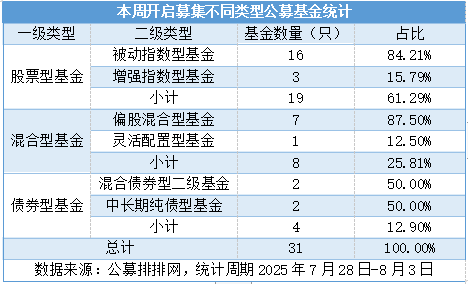
Group 1 - This week, 31 new public funds were launched for subscription, a 34.78% increase from the previous week's 23 funds, indicating a return to a high level of activity in the market [1][2] - The average subscription period for the new funds this week was 14.97 days, reflecting a noticeable acceleration in the issuance pace of public funds [1] - The increase in new fund issuance is attributed to the A-share market surpassing 3600 points, creating an optimistic market atmosphere and enhancing investor risk appetite [2][3] Group 2 - Among the new funds, 26 were equity funds, accounting for 83.87% of the total, including 19 stock funds and 7 equity hybrid funds, representing an 85.71% increase from the previous week [3] - Passive index funds dominated the stock funds, with 16 out of 19 stock funds being passive index funds, making up 84.21% of the stock fund total [3] - In contrast, the issuance of bond funds saw a decline, with only 4 bond funds launched this week, a 55.56% decrease from the previous week's 9 funds [3]