
博时基金

Search documents
ETF百亿俱乐部迎新 增量资金有望持续涌入
Zhong Guo Zheng Quan Bao· 2025-09-21 20:17
Group 1 - The equity market is experiencing a strong inflow of funds into popular ETFs, with new members joining the "100 billion club" such as E Fund's National Robot Industry ETF and Yongying's CSI Hong Kong and Shanghai Gold Industry ETF [1] - As of September 19, there are five gold-themed ETFs in the domestic market with assets exceeding 10 billion yuan, including Huaan Gold ETF, which has returned to a scale of 60 billion yuan [1] - The recent rise in gold prices is linked to the inflow of funds from European and American investors, driven by expectations of interest rate cuts by the Federal Reserve [2][3] Group 2 - The E Fund's Robot ETF has seen significant growth, with a net inflow of 8.76 billion yuan this year, reflecting high investor confidence in the humanoid robot industry's development prospects [2][3] - The humanoid robot industry is experiencing technological breakthroughs and increased commercialization, with companies like Tesla and UBTECH receiving substantial orders [3] - Fund managers suggest that the market is likely to continue its upward trend in the second half of the year, encouraging investors to hold onto their positions rather than sell prematurely [3][4]
增量资金持续涌入 多只ESG主题基金回报率可圈可点
Zhong Guo Zheng Quan Bao· 2025-09-21 20:17
Group 1 - The total scale of domestic ESG funds is projected to reach 10,223 billion yuan by September 1, 2025, an increase of 314 billion yuan compared to the end of 2024 [1][3] - Approximately 87% of the 107 ESG-themed funds have positive returns this year, with the highest return exceeding 65% [1][2] - In August, six new ESG funds were launched, including the Rongtong Zhongzheng Chengtong Central Enterprise ESG ETF, which became the largest initial scale of an off-market ESG index fund in China's public fund history at 9.6 billion yuan [2][3] Group 2 - The highest return among ESG funds this year is from the Caitong Sustainable Mixed Fund, achieving a return rate of 65.77%, focusing on sectors like AI, high-end manufacturing, and healthcare [2][3] - Other notable ESG funds include Huatai-PB ESG Sustainable Growth Stock A with over 50% return, and several funds with returns exceeding 30% [2][3] - Fund managers express optimism about the investment value in the AI industry, emphasizing a long-term perspective to capture related investment opportunities [3][4] Group 3 - The fund managers are focusing on sectors such as AI computing power, medical CRDMO companies, and global leaders in white goods and energy storage batteries [4][5] - The investment strategy includes a balanced allocation across various industries, with a focus on companies with strong cash flow and solid balance sheets to mitigate macroeconomic uncertainties [5]
中证A500ETF一周年:冷热不均渐显
Bei Jing Shang Bao· 2025-09-21 15:57
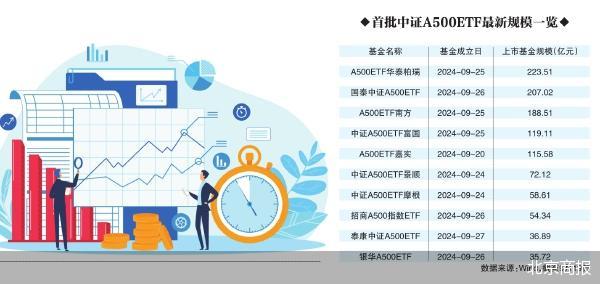
Core Insights - The China Securities A500 ETF has experienced significant growth and market presence since its launch, but it is now facing challenges with scale and differentiation in a competitive environment [1][3][10] Group 1: Market Performance - As of September 19, the total scale of the China Securities A500 ETF reached 1899.26 billion yuan, with the first batch of 10 funds accounting for 1111.41 billion yuan, or 58.52% of the total [3][4] - Five public funds have products exceeding 100 billion yuan, with Huatai-PineBridge and Guotai Asset leading at 223.51 billion yuan and 207.02 billion yuan respectively [4] - The average return of the 24 A500 ETFs launched in 2024 since 2025 has reached 21.71% [10] Group 2: Competitive Landscape - The market is witnessing a "winner-takes-all" scenario, where larger public funds are gaining a significant advantage over smaller ones, with some products from smaller firms struggling to exceed 30 billion yuan [7][9] - The first batch of A500 ETFs has shown a decline in scale for most products, with only Huatai-PineBridge's product showing a growth of 28.1% [7][8] Group 3: Strategic Adjustments - Companies are shifting their strategies from aggressive marketing to focusing on market outlook analysis and guiding investment strategies such as grid and regular investment [4][5] - There is an emphasis on building trust with institutional investors while also expanding outreach to individual investors [5][11] Group 4: Future Outlook - The A500 ETF is expected to require time to grow its market presence and attract stable, long-term capital [11][12] - The introduction of related derivatives is anticipated to enhance the attractiveness of the A500 index and draw in more diverse investors, including insurance funds and pension plans [12]

5万亿市场高歌猛进!这些隐忧,不可轻忽
券商中国· 2025-09-21 15:55
Core Viewpoint - The rapid growth of ETFs is accompanied by emerging risks and concerns that should not be overlooked, indicating shortcomings in the current ETF ecosystem regarding risk management and detail optimization [2][3][6]. Group 1: ETF Growth and Market Dynamics - The ETF market has experienced explosive growth, surpassing 30 trillion yuan in 2024 and reaching milestones of 40 trillion and 50 trillion yuan this year, with a total market size of 5.31 trillion yuan as of now, reflecting a year-to-date increase of 1.58 trillion yuan, or 42.4% year-on-year [2][3][4]. - The number of ETFs has increased to 1,306, with significant inflows into the market, including 407.86 billion yuan raised from the recent issuance of 14 new science and technology bond ETFs [3][4]. - Major fund companies have capitalized on this growth, with several managing over 8 trillion yuan in ETF assets, including Huaxia Fund and E Fund [3][4]. Group 2: Emerging Risks and Concerns - Recent volatility in ETF component stocks has raised concerns, with significant price fluctuations observed in stocks like Shankai Holdings and Yaojie Ankang, which are part of major ETFs [6][8]. - Issues such as poor liquidity of component stocks, mismatched risk ratings, and high volatility have been highlighted, indicating a lack of adequate risk assessment by fund managers [8][9]. - The phenomenon of "passive crowding" has led to excessive capital allocation to large-cap stocks, creating potential risks for sudden liquidity withdrawals [9]. Group 3: Product Homogeneity and Innovation Deficiency - The ETF market is facing challenges of product homogeneity, with many funds lacking differentiation in underlying assets and strategies, leading to a proliferation of similar products [11][12]. - The introduction of multiple science and technology bond ETFs has not resulted in significant innovation, as many funds are competing in the same narrow space without unique offerings [11][12]. - The lack of innovative products has forced investors to flock to thematic ETFs, while broad-based index ETFs are experiencing capital outflows, indicating a shift in investment preferences [15][16].

公募基金经理已突破4000人
Zheng Quan Ri Bao· 2025-09-21 15:47
在业内人士看来,基金经理数量增长或与公募产品数量扩容、市场管理规模提升有关。这需要更多专业 人才支撑。 数据显示,目前公募基金经理数量已达4072人,相较去年同期的3856人增加了216人,增幅为5.6%。拥 有基金经理超100人的有6家公募机构,包括华夏基金、易方达基金、南方基金和嘉实基金等,而去年同 期仅有3家公募机构基金经理超100人。 资讯数据显示,截至9月21日,月内全市场增聘公募基金经理48人,基金经理总数已突破4000人。其 中,6家公募机构分别拥有基金经理超百人。 从离任角度来看,9月份以来有33名基金经理离任,相较去年同期的19人有所增长。从离任原因来看, 包括个人原因和公司内部调整等。例如,9月20日国联基金发布基金经理变更公告称,国联成长优选混 合基金经理王可汉因个人原因目前已离任;同日,财通智慧成长混合公告称,原基金经理金梓才因"投 资管理需要"已离任。 9月份以来,中小型公募机构离任基金经理数量较多。数据显示,国联基金本月已有4名基金经理离任, 西部利得基金、太平基金、创金合信基金等均有2名基金经理离任。此外,摩根基金、贝莱德基金、博 时基金和中银基金等多家机构,也都有不同数量的基金 ...
公募国际化多维发力 做好中国资产价值“翻译者”
Shang Hai Zheng Quan Bao· 2025-09-21 15:28
Group 1: Industry Trends - The Chinese public fund industry is accelerating its internationalization process, showcasing a trend of "multiple breakthroughs and deep cooperation" [1] - The industry is expected to demonstrate the long-term investment value of Chinese assets to the world as high-level opening-up continues [1] Group 2: Developments in Overseas Subsidiaries - Huatai-PB Asset Management (International) Limited, a subsidiary of Huatai-PB Fund, has obtained licenses for securities trading, providing advice on securities, and asset management in Hong Kong [2] - E Fund has received approval from the China Securities Regulatory Commission to establish a company in Macau, aiming to provide asset management services to investors in the region [2] - Xingsheng Global Asset Management (Singapore) Limited has been approved to expand its business capabilities in overseas markets [2] - Bosera International has established a business network across Asia, North America, Europe, and Africa, with asset management scale exceeding 100 billion HKD [2] - Southern Fund's subsidiary has launched over 60 ETFs and leveraged inverse products in Hong Kong and Singapore, serving as a bridge for overseas investors to access Chinese assets [2] Group 3: Collaborations with Overseas Institutions - Huaxia Fund signed a memorandum of cooperation with representatives from Oman, expanding its collaboration with the Oman government and local investors [3] - E Fund has established a strategic cooperation memorandum with Thailand's leading asset management firm, enhancing local investors' access to Chinese investment opportunities [3] - In May, a memorandum of cooperation was signed between a subsidiary of Fuguo Fund and the Malaysian stock exchange, indicating ongoing international partnerships [4] Group 4: Industry Representation and Events - The Chinese public fund industry showcased its internationalization at the 25th China International Investment and Trade Fair, emphasizing its role in high-level opening-up and supporting various economic sectors [5][6] - The China Securities Investment Fund Industry Association held its first internationalization exchange meeting, facilitating discussions on global resource integration and enhancing the global appeal of Chinese assets [6] - Schroders' CEO expressed strong confidence in the long-term investment value of China, indicating ongoing support for the development of China's financial market [6]
中证A500ETF面市一周年:总规模近1900亿,冷热不均现象渐显
Bei Jing Shang Bao· 2025-09-21 14:32
Core Insights - The China Securities A500 ETF has experienced significant growth and market attention since its launch, but recent trends indicate a divergence in performance among different funds within the A500 ETF family [1][10] - Despite a reduction in overall scale, the long-term growth potential of the A500 ETF remains significant, with expectations for increased institutional investment and product diversification [10][11] Group 1: Market Performance - As of September 19, the total scale of the A500 ETF reached 1899.26 billion yuan, with the first batch of 10 funds accounting for 1111.41 billion yuan, or 58.52% of the total [3][4] - Five public funds have products exceeding 100 billion yuan in scale, with Huatai-PineBridge and Guotai Asset leading at 223.51 billion yuan and 207.02 billion yuan, respectively [4] - The A500 ETF family has expanded from 10 to 43 products within a year, indicating strong market interest and participation [3][4] Group 2: Marketing and Strategy - Initial marketing strategies focused heavily on product promotion, but have shifted towards market outlook analysis and investment strategies like grid and regular investment [4][8] - Companies are enhancing their engagement with institutional investors while also expanding outreach to individual investors to build trust and increase product liquidity [5][8] Group 3: Challenges and Competition - The competitive landscape has intensified, with larger public funds outperforming smaller ones, leading to a "winner-takes-all" scenario in the ETF market [6][9] - Many smaller public funds are struggling to maintain market presence and profitability, with some funds experiencing significant scale declines [6][7] Group 4: Future Outlook - The A500 ETF is expected to require time to cultivate a stable investor base, with potential for growth as market conditions improve and investor recognition increases [10][11] - The introduction of derivative products related to the A500 index is anticipated to attract more institutional investors and enhance the overall market appeal [11]

5万亿元规模ETF的370名基金经理薪酬揭秘
Sou Hu Cai Jing· 2025-09-21 13:32
Core Insights - The article highlights the daily routines and responsibilities of ETF fund managers, emphasizing that their roles extend beyond simple index tracking to include active market monitoring and strategic decision-making [4][5][9]. Group 1: Daily Operations of ETF Fund Managers - ETF fund managers start their day by reviewing global market trends and economic data, followed by team discussions to analyze market dynamics [4][5]. - During trading hours, they closely monitor ETF transactions, manage risks, and make real-time decisions based on market conditions [4][5]. - Post-market hours involve further analysis, client communications, and preparation for the next trading day, often extending their work into late hours [5][6]. Group 2: Market Size and Structure - As of September 17, 2025, there are 1,311 ETF products in China, with a total market size of approximately 5.35 trillion yuan, managed by 370 ETF fund managers across 55 fund companies [6][7]. - Major players in the non-monetary ETF market include Huaxia Fund and E Fund, each managing over 800 billion yuan, while 14 public funds have non-monetary ETF sizes exceeding 1 trillion yuan, collectively managing about 4.55 trillion yuan [6][7]. Group 3: Managerial Challenges and Skills - ETF fund managers must balance risk and return stability, ensuring their portfolios align closely with target indices while managing liquidity and trading costs [9][10]. - Continuous research and understanding of market trends are crucial, as managers need to articulate the rationale behind their investment strategies to clients [9][10]. - The role requires participation in numerous roadshows and client interactions, with some managers attending around 100 events annually to promote their products [11][12]. Group 4: Compensation and Performance Metrics - ETF fund managers typically receive compensation based on a fixed salary and performance bonuses, with a focus on long-term performance metrics rather than short-term gains [13][14]. - The performance evaluation includes factors such as market position, client engagement, and the overall competitiveness of the fund management team [15][16]. - Despite the growth of the ETF market, compensation for ETF managers is generally lower than that of active equity fund managers, reflecting the industry's cost-cutting trends [16][17].

回归基本面逻辑,中国债市独立走势凸显,30年国债ETF博时(511130)小幅上涨
Sou Hu Cai Jing· 2025-09-21 12:07
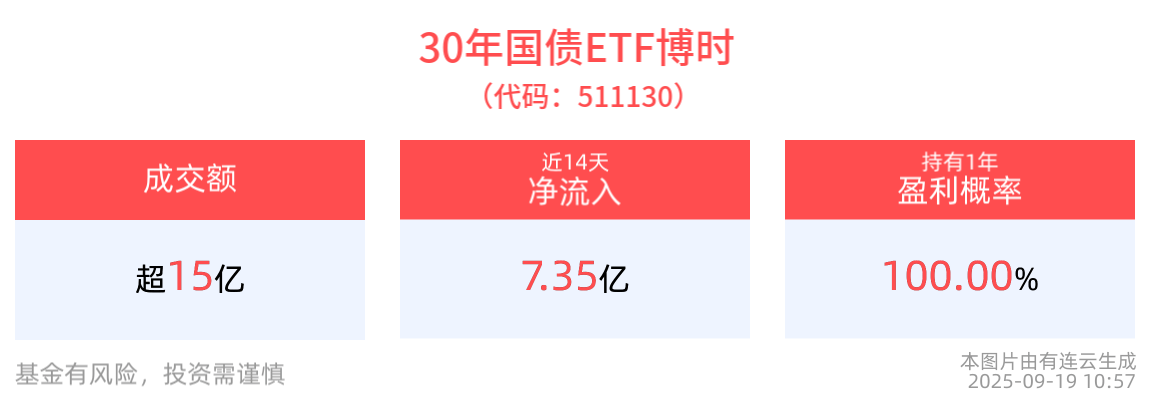
Core Viewpoint - The 30-year government bond ETF from Bosera has shown a slight increase, reflecting market dynamics influenced by government bond issuance and central bank policies [2][3]. Group 1: Market Performance - As of September 19, 2025, the 30-year government bond ETF from Bosera rose by 0.11%, with a latest price of 107.46 yuan [2]. - Over the past week, the ETF has accumulated a rise of 0.65% [2]. - The ETF recorded a turnover of 8.01% during the trading session, with a transaction volume of 1.589 billion yuan [2]. - The average daily transaction volume over the past month was 4.496 billion yuan [2]. Group 2: Government Bond Issuance - The Ministry of Finance plans to auction 157 billion yuan of 3-year government bonds on September 26, 2025, using a modified multi-price bidding method [2]. - This issuance is expected to attract additional bids from Class A members [2]. Group 3: Central Bank Influence - There is an increasing market expectation for the central bank to resume government bond purchases, which is providing some support to market interest rates [2]. - Earlier in the year, the 10-year government bond yield fell below 1.6%, prompting the central bank to pause bond purchases to avoid impacting investor allocations [2]. Group 4: Market Trends - The yield curve for interest rate bonds is widening, indicating a market response to long-term inflation expectations and short-term liquidity conditions [3]. - The 30-year government bond ETF has a current scale of 19.835 billion yuan [3]. - Recent data shows a net outflow of 713 million yuan from the ETF, although there have been net inflows on 8 out of the last 14 trading days, totaling 735 million yuan [3].
量化周报:市场仍处高位高换手状态-20250921
Minsheng Securities· 2025-09-21 10:34
Quantitative Models and Construction Methods Model Name: Three-Dimensional Timing Model - **Model Construction Idea**: The model uses three dimensions: liquidity, divergence, and prosperity to judge market trends[8] - **Model Construction Process**: - The model evaluates the current liquidity trend, market divergence, and prosperity level - It uses technical indicators to assess the market status, such as the overbought condition of the CSI 300 index[8] - The model's historical performance is visualized to validate its effectiveness[17] - **Model Evaluation**: The model indicates a downward trend in a high turnover market, suggesting a low probability of short-term upward movement[8] Model Name: ETF Hot Trend Strategy - **Model Construction Idea**: The strategy selects ETFs based on their price trends and market attention[28] - **Model Construction Process**: - Identify ETFs with both highest and lowest price trends using K-line highest and lowest price shapes - Construct support and resistance factors based on the relative steepness of the regression coefficients of the highest and lowest prices over the past 20 days - Select the top 10 ETFs with the highest turnover rate in the past 5 and 20 days to form a risk parity portfolio[28] - **Model Evaluation**: The strategy includes ETFs from semiconductor, non-ferrous metals, 5G communication, battery industries, and growth styles[29] Model Name: Capital Flow Resonance Strategy - **Model Construction Idea**: The strategy monitors the resonance of margin trading and large order funds to select favored industries[32] - **Model Construction Process**: - Define the margin trading capital factor as the net buying of financing minus the net selling of securities lending, neutralized by the Barra market value factor - Define the active large order capital factor as the net inflow of the industry, neutralized by the time series of trading volume over the past year - Combine the two factors to construct the strategy, excluding extreme industries and large financial sectors to improve stability[35] - **Model Evaluation**: The strategy has shown stable positive excess returns since 2018, with an annualized excess return of 13.5% and an IR of 1.7[35] Model Backtesting Results - **Three-Dimensional Timing Model**: Historical performance shows a consistent downward trend in high turnover markets[17] - **ETF Hot Trend Strategy**: The strategy has achieved cumulative excess returns over the CSI 300 index this year[30] - **Capital Flow Resonance Strategy**: The strategy recorded a negative excess return last week, with an absolute return of -2.4% and an excess return of -2.0% relative to the industry equal weight[35] Quantitative Factors and Construction Methods Factor Name: Beta Factor - **Factor Construction Idea**: Measures the sensitivity of a stock's returns to market returns[40] - **Factor Construction Process**: - Calculate the beta coefficient of each stock based on its historical returns relative to the market index - Form portfolios of high and low beta stocks to compare their performance[40] - **Factor Evaluation**: High beta stocks significantly outperformed low beta stocks, recording a positive return of 2.19% last week[40] Factor Name: Growth Factor - **Factor Construction Idea**: Measures the growth potential of stocks based on their earnings and revenue growth[40] - **Factor Construction Process**: - Calculate the growth rate of earnings and revenue for each stock - Form portfolios of high and low growth stocks to compare their performance[40] - **Factor Evaluation**: Growth stocks continued to outperform value stocks, with the growth factor achieving a return of 1.51% last week[40] Factor Backtesting Results - **Beta Factor**: - Year-to-date: 26.61% - Last month: 2.39% - Last week: 2.19%[41] - **Growth Factor**: - Year-to-date: -0.44% - Last month: 4.74% - Last week: 1.51%[41]