吉利汽车

Search documents
《TopBrand 2025中国品牌人物500强》榜单发布
Xin Lang Cai Jing· 2026-01-09 10:57
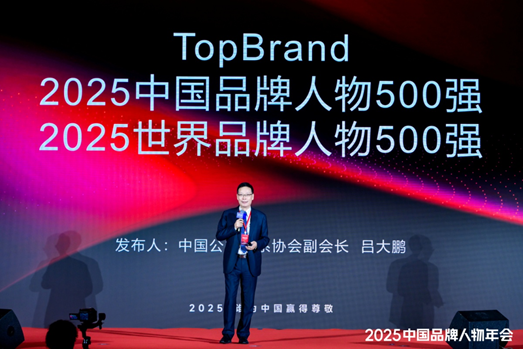
Group 1 - The 2025 China Brand Person Annual Conference will be held from December 28 to 30 in Shenzhen, focusing on the theme "Who Earns Respect for China" [1][10] - The event will include a series of activities such as an opening ceremony, main forum, honor ceremony, and closed-door discussions to review the history of Chinese brand development and explore new trends and opportunities in brand building [1][10] Group 2 - The "Top Brand 2025 China Brand Person 500" list was released by Lv Dapeng, Vice President of the China Public Relations Association, highlighting the overall characteristics and industry trends of the listed individuals [10][12] - This list has been publicly released for the seventh consecutive year, continuously recording and promoting the growth and influence of Chinese brand figures [10][12] Group 3 - The top three individuals in the 2025 China Brand Person 500 are Ren Zhengfei, Liu Qiangdong, and Yu Chengdong, with Dong Mingzhu, He Xiaopeng, Li Shufu, Wang Chuanfu, Jack Ma, Liang Wenfeng, and Wang Ning following in positions 4 to 10 [3][12] - The selection process involved analyzing over 5,000 influential brand figures based on criteria such as industry authority, social influence, sense of social responsibility, public image, and attention [3][12]




2025车企目标达成率透视:巨头稳健、新势力分化,新能源与出口双引擎驱动
Ju Chao Zi Xun· 2026-01-09 10:11
Core Insights - The Chinese automotive market has undergone significant changes in 2025, moving away from broad high growth to a more structured competitive landscape, with increasing penetration of new energy vehicles (NEVs) and a shift in the importance of overseas markets from a strategic option to a core pillar for survival and development [2] Group 1: Annual Goals and Performance - BYD demonstrated strong resilience, achieving a sales target of 460.24 million units, which is a 100.05% target achievement rate after a pragmatic adjustment from an initial goal of 550 million units [3] - Other traditional automakers like Geely (302.46 million units), SAIC Motor (450.75 million units), and Chery (280.64 million units) also met or closely approached their annual targets, indicating stability during their transformation [3] - In contrast, Li Auto's sales of 40.63 million units fell significantly short of its adjusted target of 64 million units, achieving only about 58% of its goal, highlighting challenges in product iteration and market expansion [5] Group 2: Growth Dynamics - The growth drivers for the automotive industry are clearly identified as internal growth in the NEV sector and expansion into overseas markets [9] - BYD maintained its leading position in the NEV market with sales of 460.24 million units, while new entrants like Leap Motor and Xpeng Motors achieved impressive growth rates of 103.13% and 125.88%, respectively [10] - Traditional automakers like Chery and Geely have made positive strides in transitioning to NEVs, but companies like Dongfeng and GAC face significant growth pressures due to slower transitions [12] Group 3: Export Performance - Exports have become a critical variable in determining industry rankings, with BYD's exports skyrocketing from 416,000 units in 2024 to 1,046,000 units in 2025, a growth of over 150% [12] - Chery led exports with 1,344,000 units, while SAIC Motor also surpassed 1,070,000 units in overseas sales, contributing to a total export of 4,386,800 units among the top five Chinese automakers [12] - Tesla's export growth in China was weak, with only 222,700 units exported from January to November 2025, indicating increasing competition from local brands in the international market [13] Group 4: Future Outlook - The market performance in 2025 indicates a shift from relying solely on domestic market growth to a comprehensive capability competition among automakers [15] - Strategic resilience and operational rationality are crucial, with companies like BYD successfully adjusting targets based on market feedback, while others like Xiaomi and Leap Motor are breaking through by precisely targeting niche markets [15] - The competition has evolved from mere sales volume expansion to a comprehensive comparison of technological depth, product ecosystem breadth, user operation precision, and sustainable profitability [16]

吉利汽车(00175.HK)1月9日耗资2662.3万港元回购154.7万股
Ge Long Hui· 2026-01-09 09:36
相关事件 吉利汽车(00175.HK)1月9日耗资2662.3万港元回购154.7万股 吉利汽车(00175.HK)1月8日耗资6762.08万 港元回购392.5万股 格隆汇1月9日丨吉利汽车(00175.HK)发布公告,2026年1月9日耗资2662.3万港元回购154.7万股,回购价 格每股17.17-17.25港元。 ...
吉利汽车1月9日斥资2662.29万港元回购154.7万股
Zhi Tong Cai Jing· 2026-01-09 09:36
Core Viewpoint - Geely Automobile (00175) announced a share buyback plan, indicating a strategic move to enhance shareholder value and manage capital effectively [1] Group 1: Share Buyback Details - The company will repurchase 1.547 million shares at a total cost of HKD 26.6229 million, with each share priced between HKD 17.17 and HKD 17.25 [1] - The buyback is scheduled for January 9, 2026, reflecting the company's commitment to returning capital to shareholders [1] Group 2: Employee Stock Options - The company issued 33,000 ordinary shares due to employees exercising stock options under a plan adopted on April 28, 2023 [1]
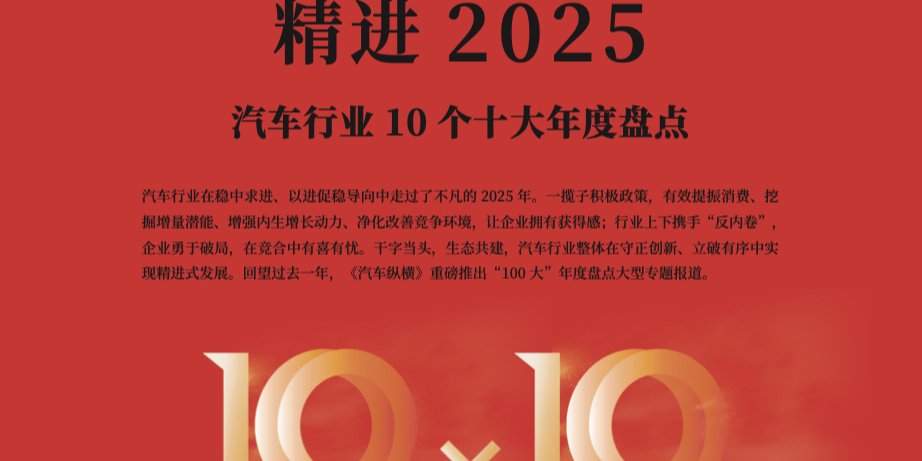
2025中国汽车行业十大年度品牌热点 | 精进2025——汽车行业10个十大年度盘点
Jing Ji Guan Cha Wang· 2026-01-09 09:33
Core Insights - The automotive industry in China experienced significant changes in 2025, characterized by a mix of opportunities and challenges, with a focus on innovation and collaboration among companies [2][4] - The report highlights the "Top Ten" annual reviews across various categories, reflecting the industry's evolving landscape [2] Group 1: Market Dynamics - The Chinese automotive market is undergoing accelerated differentiation and reshuffling, with leading companies expanding their ecosystems while some brands face pressure [4] - The competition has intensified, leading to a survival-of-the-fittest scenario, where some brands are on the brink of elimination [4][22] Group 2: Brand Influence - Chinese automotive brands are gaining global influence, with eight companies making it to the Fortune Global 500 list, marking a significant increase from previous years [5] - BYD, Geely, and Chery have notably improved their rankings, reflecting the rising global presence of Chinese brands [5] Group 3: Brand Strategy and Integration - Many automotive brands are restructuring their business architectures, with notable mergers and acquisitions, such as Geely's acquisition of Lynk & Co [7][8] - The trend of integrating brand operations is seen as a response to market pressures and a strategy to enhance competitiveness [9] Group 4: Technological Advancements - Companies are launching unique smart technology brands to keep pace with rapid advancements in intelligent technology, with several brands unveiling new systems and platforms [10] - The establishment of these technology brands is aimed at enhancing market perception and showcasing core competencies in smart mobility [11] Group 5: Foreign Brand Strategies - Foreign joint venture brands are initiating a "Localization 2.0" strategy, enhancing collaboration with local suppliers and adapting to the Chinese market [12] - This shift includes a focus on electric and intelligent vehicle development, indicating a more proactive approach to market integration [13] Group 6: Reputation Management - In response to negative online narratives, many automotive companies are taking legal action to protect their brand reputations, indicating a shift towards more aggressive reputation management strategies [19][20] - The industry is witnessing a rise in legal actions against misinformation, reflecting the importance of brand integrity in the digital age [21] Group 7: Market Exit and Brand Survival - Weaker automotive brands are facing significant challenges, with some declaring bankruptcy or undergoing restructuring to survive [22] - The industry is experiencing a natural selection process, where only the most adaptable brands are likely to thrive [23] Group 8: Sales Channel Evolution - The once-popular "supermarket store" model for car sales is losing traction, with many brands reassessing their sales strategies in favor of more traditional dealership models [24] - This shift indicates a move towards more sustainable and efficient sales practices in the automotive sector [25] Group 9: Luxury Brand Performance - The ultra-luxury automotive segment is facing declining sales in China, with several brands reporting significant drops in their sales figures [26] - The overall market conditions and changing consumer preferences are contributing to the challenges faced by these high-end brands [27]
吉利汽车(00175)1月9日斥资2662.29万港元回购154.7万股
智通财经网· 2026-01-09 09:33
智通财经APP讯,吉利汽车(00175)发布公告,于2026年1月9日,该公司斥资2662.29万港元回购154.7万 股股份,每股回购价格为17.17-17.25港元;因集团雇员根据认股权计划(于2023年4月28日获采纳)行使认 股权而发行3.3万股普通股股份。 ...
吉利汽车(00175) - 翌日披露报表
2026-01-09 09:26
翌日披露報表 (股份發行人 ── 已發行股份或庫存股份變動、股份購回及/或在場内出售庫存股份) 表格類別: 股票 狀態: 新提交 公司名稱: 吉利汽車控股有限公司 FF305 呈交日期: 2026年1月9日 如上市發行人的已發行股份或庫存股份出現變動而須根據《香港聯合交易所有限公司(「香港聯交所」)證券上市規則》(「《主板上市規則》」)第13.25A條 / 《香港聯合交易所有限公司GEM證券 上市規則》(「《GEM上市規則》」)第17.27A條作出披露,必須填妥第一章節 。 | 第一章節 | | | | | | | | | | --- | --- | --- | --- | --- | --- | --- | --- | --- | | 1. 股份分類 | 普通股 | | 股份類別 不適用 | | 於香港聯交所上市 | | 是 | | | 證券代號 (如上市) | 00175 | | 說明 | | | | | | | 多櫃檯證券代號 | 80175 | RMB 說明 | | | | | | | | A. 已發行股份或庫存股份變動 | | | | | | | | | | | | | 已發行股份(不包括庫存股份) ...
403批新车公告 | 比亚迪车型升级,均可选装激光雷达
数说新能源· 2026-01-09 08:35
Group 1 - The article discusses the specifications and upgrades of various electric vehicles (EVs) and plug-in hybrid electric vehicles (PHEVs) from different manufacturers, highlighting significant improvements in motor power and battery capacity [2][3][4]. - BYD's models, such as the Song Ultra and Dolphin, showcase competitive dimensions and motor power, with the Song Ultra featuring a motor power of 270 kW and a top speed of 210 km/h [1]. - The article notes that many models are now offering optional features like laser radar, indicating a trend towards enhanced safety and automation in the EV market [2][3]. Group 2 - The Tengshi Z9 GT EV has introduced a new single motor version with a power increase from 240 kW to 310 kW, along with a new PHEV version that includes a 63.8 kWh battery and a pure electric range of 301 km [2]. - The article mentions the increase in motor power for the Fangcheng Leopard Titanium 3 from 110 kW to 135 kW for the front motor and from 160 kW to 240 kW for the rear motor [2]. - The Haima 06 EV has upgraded its motor power from 170/180 kW to 240 kW, reflecting the industry's push for higher performance [2]. Group 3 - The article provides a comparison of various models, including the Zhijie V9 and Lantu Dreamer, with specifications such as length, wheelbase, battery capacity, and pure electric range [3]. - The Geely Automotive section highlights a model with a battery capacity of 55.1 kWh and a pure electric range of 257 km, showcasing the competitive landscape in battery technology [3]. - The article also mentions the introduction of new versions of existing models, such as the Xingyao 7 EMI and Galaxy A7 EMI, which have increased battery capacities and electric ranges [3]. Group 4 - Leap Motor's D19 model features dimensions of 5252*1995*1800 mm and a battery capacity of 80.3 kWh, with a pure electric range of 370 km [4]. - The article notes that the Leap A10 BEV has a maximum speed of 160 km/h, indicating the performance capabilities of newer models [4]. - The article also discusses the introduction of new models from various manufacturers, emphasizing the ongoing innovation in the EV sector [4]. Group 5 - The article mentions the introduction of the Xiaomi SU7, which has a maximum speed of 265 km/h, showcasing advancements in performance among electric vehicles [5]. - GAC Group's HA800 model features a 1.5T engine with a power output of 118 kW and a top speed of 185 km/h, indicating the integration of traditional and electric powertrains [5]. - The article highlights the trend of manufacturers offering laser radar options in their vehicles, reflecting a growing focus on safety and advanced driver-assistance systems [5].

乘联分会:12月全国乘用车市场零售226.1万辆 同比下降14.0%
智通财经网· 2026-01-09 08:31
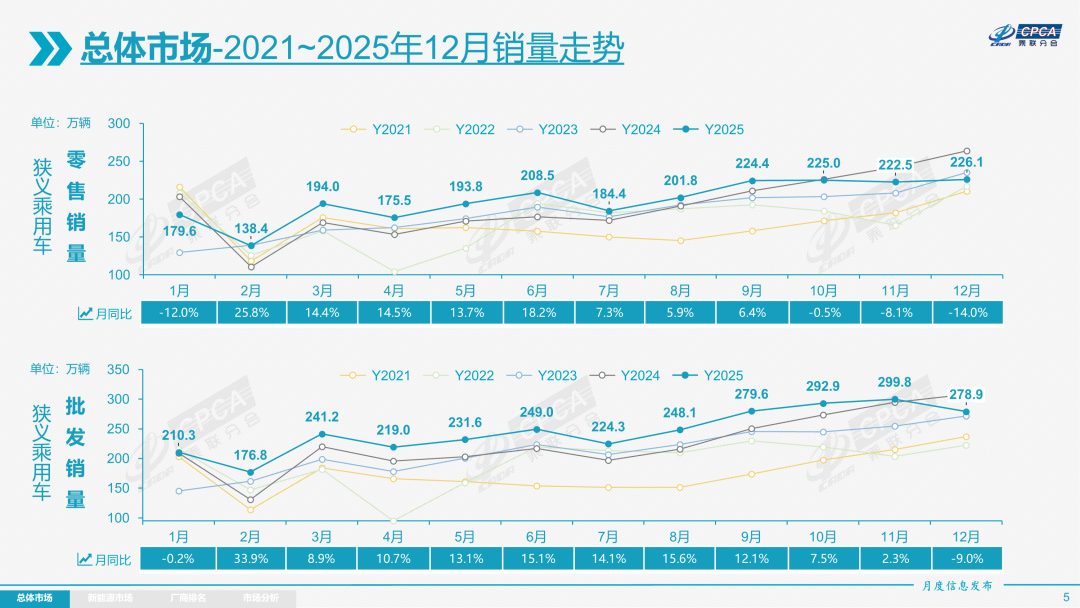
Core Insights - The overall retail sales of passenger cars in December 2025 reached 2.261 million units, a year-on-year decrease of 14.0% but a month-on-month increase of 1.6% [1] - Cumulative retail sales for the year amounted to 23.744 million units, reflecting a year-on-year growth of 3.8% [1] - The wholesale growth rate for passenger cars in 2025 is projected at 8.8%, with new energy vehicles (NEVs) expected to grow at 25.2%, meeting the growth expectations set for the "14th Five-Year Plan" [1] Market Performance - December's passenger car retail sales showed a significant decline in fuel vehicles, down 30% year-on-year, while pure electric vehicle sales increased by 2.5% [2] - The penetration rate of new energy vehicles in December reached 59.1%, indicating a shift towards a "new energy-dominated" market [2][11] - The retail share of domestic brands in December was 64.3%, a year-on-year increase of 2.2 percentage points [3] Production and Wholesale - Passenger car production in December was 2.791 million units, a year-on-year decrease of 4.6% [4] - December's wholesale volume for passenger cars was 2.789 million units, down 9.0% year-on-year [5] - The production of new energy vehicles in December reached 1.560 million units, a year-on-year increase of 7.6% [7] Export Trends - In December, the export of passenger cars (including complete vehicles and CKD) was 588,000 units, a year-on-year increase of 46.2% [4] - New energy vehicles accounted for 46.4% of total exports in December, up 15.6 percentage points from the previous year [4][13] - Cumulative exports of new energy vehicles for the year reached 2.422 million units, a growth of 86.2% [7] Inventory and Market Dynamics - The overall inventory in December decreased by 60,000 units, indicating proactive inventory reduction by manufacturers [6] - The market is experiencing a significant adjustment in consumer sentiment due to changes in trade-in policies and the expiration of tax exemptions for new energy vehicles [1][2] - The competitive landscape is shifting, with traditional manufacturers like Geely, Changan, and Great Wall showing improved market shares [3] Future Outlook - The January 2026 market is expected to benefit from a favorable production and sales environment, with a focus on the upcoming Spring Festival driving consumer demand [18] - The implementation of new policies aimed at promoting vehicle upgrades and trade-ins is anticipated to support market stability and growth in early 2026 [20] - The overall passenger car market is projected to maintain a stable trajectory, with a forecasted wholesale growth of 1% for 2026 [20]




通讯丨“中国智造”在美消费电子展舞台逐浪前行
Xin Hua Wang· 2026-01-09 08:28
Core Insights - "Chinese manufacturing" is making significant strides at the CES, showcasing higher innovation density and clearer technological pathways, positioning itself at the forefront of international competition [1] Group 1: Industry Participation - Over a thousand Chinese companies participated in CES, including industry leaders like TCL, Hisense, BOE, and Lenovo, as well as numerous startups [1] - Several Chinese companies received "CES Innovation Awards," highlighting global recognition of their innovative capabilities [1] Group 2: Display Technology - Chinese companies are leading in the display technology sector, shifting focus from single product parameters to AI-supported full-scene application revolutions [2] - TCL had the largest and most diverse exhibition space, showcasing innovations in television screens, electronic writing pads, and AR glasses [2] - Hisense presented next-generation large-screen display solutions, emphasizing color space enhancement and system optimization for eye protection [2] - The Chinese display industry has evolved from a technology follower to a global leader, particularly in LCD and OLED technologies [2] Group 3: Robotics Innovation - AI and robotics were major highlights at CES, with Chinese companies dominating the humanoid robot and related sectors, demonstrating rapid iteration and scalability [3] - Various robots showcased capabilities such as emotional companionship, autonomous lawn maintenance, and advanced coffee-making, emphasizing real-world application [3] - The focus has shifted from conceptual displays to tangible intelligent products that adapt to real environments [3] Group 4: Smart Home Solutions - Smart home technology has become a key area for Chinese companies to demonstrate systemic innovation and lifestyle solutions [4] - Solutions showcased include AI and IoT applications that create intelligent systems capable of perceiving, learning, and interacting [4][5] - Products like smart air conditioners and refrigerators exhibit advanced features such as dynamic energy management and food preservation [5] Group 5: Intelligent Mobility - Intelligent mobility was a focal point, with Chinese automotive companies showcasing innovations in smart cockpits and AI integration [6] - Geely's WAM model enhances understanding of complex driving scenarios, improving overall driving experiences [6] - Chinese companies are transitioning from cost and scale advantages to focusing on user experience, system integration, and technological maturity in the smart mobility sector [6] Group 6: Global Impact - CES serves as a platform for international collaboration and industry dialogue, with China recognized as a key driver of global technological advancement [6] - Chinese consumer electronics companies are accelerating their smart upgrades, becoming pioneers in global AI development [6] - "Chinese manufacturing" continues to navigate the waves of global technological change, contributing to the formation of a new international tech landscape through innovation and application [6]