
汤姆猫

Search documents
游戏板块10月23日涨0.34%,*ST大晟领涨,主力资金净流出5.14亿元
Zheng Xing Xing Ye Ri Bao· 2025-10-23 08:20
Core Insights - The gaming sector experienced a slight increase of 0.34% on October 23, with *ST Dazheng leading the gains [1] - The Shanghai Composite Index closed at 3922.41, up 0.22%, while the Shenzhen Component Index closed at 13025.45, also up 0.22% [1] Stock Performance - *ST Dazheng (600892) closed at 4.29, with a rise of 3.12% and a trading volume of 121,600 shares, amounting to a transaction value of 51.48 million yuan [1] - Other notable performers included: - Sanqi Interactive Entertainment (002555) at 20.45, up 2.76%, with a trading volume of 512,400 shares and a transaction value of 1.028 billion yuan [1] - ST Huaton (002602) at 19.51, up 2.15%, with a trading volume of 1,290,300 shares and a transaction value of 2.469 billion yuan [1] Capital Flow - The gaming sector saw a net outflow of 514 million yuan from major funds, while retail investors contributed a net inflow of 336 million yuan [2] - Notable capital flows included: - Sanqi Interactive Entertainment (002555) had a net inflow of 51.41 million yuan from major funds, but a net outflow of 4.35 million yuan from retail investors [3] - Giant Network (002558) experienced a net inflow of 14.78 million yuan from major funds, while retail investors contributed a net inflow of 0.56 million yuan [3]




汤姆猫10月22日获融资买入1585.02万元,融资余额8.05亿元
Xin Lang Cai Jing· 2025-10-23 01:36
Group 1 - The core viewpoint of the news is that Tom Cat's stock performance and financial metrics indicate a challenging period, with significant declines in revenue and net profit, alongside low financing and margin trading levels [1][2]. Group 2 - As of October 22, Tom Cat's stock price remained unchanged at 0.00%, with a trading volume of 262 million yuan. The financing buy amount was 15.85 million yuan, while the financing repayment was 25.41 million yuan, resulting in a net financing outflow of 9.56 million yuan [1]. - The total financing and margin trading balance for Tom Cat reached 808 million yuan, with the financing balance accounting for 5.06% of the circulating market value, which is below the 10% percentile level over the past year [1]. - On the margin trading side, Tom Cat repaid 38,200 shares and sold 28,200 shares on October 22, with a selling amount of 127,700 yuan. The remaining margin trading volume was 523,200 shares, with a margin balance of 2.37 million yuan, also below the 20% percentile level over the past year [1]. - For the first half of 2025, Tom Cat reported operating revenue of 463 million yuan, a year-on-year decrease of 19.62%, and a net profit attributable to shareholders of -30.33 million yuan, a year-on-year decrease of 141.34% [2]. - Since its A-share listing, Tom Cat has distributed a total of 248 million yuan in dividends, with no dividends paid in the last three years [2]. - As of June 30, 2025, the number of shareholders for Tom Cat was 268,400, an increase of 1.21% from the previous period, while the average circulating shares per person decreased by 1.19% to 12,245 shares [2]. - The top ten circulating shareholders include significant institutional investors, with notable increases in holdings from Southern CSI 1000 ETF, Hong Kong Central Clearing Limited, and others [2].
板块指数一年涨超102% 宠物经济迎国产崛起、出海增长热点持续发酵丨黄金眼
Quan Jing Wang· 2025-10-21 12:08
Market Overview - The pet industry in China is experiencing significant growth, with the market size projected to increase from 102.2 billion yuan in 2016 to 309.6 billion yuan by 2024, reflecting a compound annual growth rate (CAGR) of 21.6% from 2016 to 2020 and a projected CAGR of 7.6% from 2020 to 2025 [1][2] - The post-pandemic era has led to a stable growth trajectory for the pet market, with the number of pet cats and dogs returning to low single-digit growth rates [1][2] Segment Analysis - The pet cat market is growing faster than the dog market, with a projected market size of 300.2 billion yuan for both cats and dogs in 2024, and a CAGR of 9.9% from 2018 to 2024. The CAGR for pet cats is 14.3%, while for dogs it is 6.7% [2][3] - Pet food remains the core expenditure, accounting for 52.8% of overall spending on pets in 2024, with staple food having a penetration rate exceeding 95% [3][4] Consumer Trends - There is a noticeable shift in consumer preferences towards domestic brands, with an increase in acceptance of local pet food brands. The proportion of dog owners choosing domestic brands rose from 27.1% in 2023 to 32.9% in 2024, while cat owners' preference increased from 28.3% to 34.8% [6][7] - The demand for pet hygiene, care, and smart pet products is rapidly increasing, with the retail compound growth rate for pet grooming products projected at 10.9% from 2023 to 2025 [5][6] Export Market - The Southeast Asian pet market is experiencing explosive growth, with a pet ownership rate of 50%. Indonesia and Thailand are key markets, with pet industry sizes of approximately 3 billion and 2.29 billion USD, respectively [9] - China's pet food exports are on the rise, with export volumes expected to grow from 26.9 thousand tons in 2022 to 33.5 thousand tons in 2024, and export values increasing from 8.26 billion yuan to 10.53 billion yuan during the same period [9][10] Industry Players - Leading companies in the pet food sector include Guobao, Zhongchong, and others, with Guobao expected to surpass Mars in market share. The market is seeing a trend towards rational decision-making among consumers, favoring domestic brands [6][8] - Various companies are innovating in the pet care space, including those focusing on smart pet products and health care, such as Yiyuan, Yuanfei, and others [10][11]

AI玩具 开启产业“黄金时代”
Zheng Quan Ri Bao· 2025-10-20 23:43
Core Insights - The AI toy industry is experiencing rapid transformation, becoming a new consumer hotspot across all age groups and entering a "golden era" of development [1][9] - AI toys cater to the dual needs of education and entertainment for children, provide emotional companionship for Generation Z, and serve as memory aids for the elderly, leveraging advanced technologies like multimodal interaction and emotional computing [1][2] Market Trends - AI toys are perceived as "screen-free educational tools" by parents, significantly enhancing children's learning experiences through interactive and engaging methods [2] - Sales of AI toys surged dramatically, with a reported sixfold increase in sales in the first half of 2025 compared to the previous period, and over 200% year-on-year growth [2] - The global AI toy market is projected to grow from $18.1 billion in 2024 to $60 billion by 2033, with a compound annual growth rate (CAGR) of approximately 14% [1] Consumer Demographics - The target audience for AI toys has expanded beyond children to include the Z generation and older adults, indicating a broadening market appeal [2][3] - AI toys are designed to provide emotional support and companionship, particularly for young professionals and the elderly, enhancing their quality of life [2][3] Capital Investment - The AI toy sector has seen a significant increase in the number of companies and investment activities, with nearly a hundred investment institutions entering the market [4] - The market size for AI toys in China is expected to reach 29 billion yuan in 2025 and further grow to 85 billion yuan by 2030 [4] Competitive Landscape - The AI toy market is characterized by low industry concentration and diverse competition, with traditional toy companies beginning to integrate AI technologies into their products [6] - Companies are focusing on developing high-value products that emphasize emotional companionship and personalized growth, moving beyond basic entertainment functions [6] Challenges and Innovations - The industry faces challenges such as product homogenization and reliance on similar AI service providers, necessitating innovation to differentiate offerings [7][8] - Companies are encouraged to invest in research and development to create unique features and enhance user experience, thereby improving product competitiveness [9] Conclusion - The rise of AI toys represents a fusion of technology and human emotion, reshaping the toy industry and addressing societal emotional needs, marking the beginning of a new era in consumer products [9]
AI玩具开启产业“黄金时代”
Zheng Quan Ri Bao· 2025-10-20 17:09
Core Insights - The AI toy market is rapidly transforming the industry landscape, catering to various age groups and creating a "golden era" for development, driven by products that meet the dual needs of education and entertainment for children, emotional companionship for Generation Z, and memory assistance for the elderly [1][2][3] Market Trends - AI toys are perceived as "screen-free educational tools" by parents, significantly enhancing children's learning experiences through interactive and engaging methods, leading to a remarkable sales increase of 600% in the first half of 2025 compared to the previous year [2][3] - The target audience for AI toys has expanded beyond children to include Generation Z, with products being valued for their emotional support and companionship, indicating a shift in consumer behavior [2][3] Market Size and Growth - The global AI toy market is projected to grow from $18.1 billion in 2024 to $60 billion by 2033, with a compound annual growth rate (CAGR) of approximately 14% from 2024 to 2033, highlighting the potential for significant market expansion [1][4] Capital Investment - The AI toy sector has seen a surge in investment, with nearly a hundred investment firms entering the market and numerous startups securing multiple rounds of funding, indicating strong capital interest and growth potential [4][5] Competitive Landscape - The AI toy industry currently has low participant concentration and a diverse competitive landscape, with traditional toy companies beginning to integrate AI technologies into their products, thus accelerating the transition to smart toys [6][7] - Companies are focusing on enhancing user experience through emotional companionship and personalized growth advisory features, moving beyond basic entertainment functions [6][7] Challenges and Innovations - The industry faces challenges such as product homogenization and reliance on similar AI service providers, necessitating innovation to differentiate offerings and enhance user interaction [7][8] - Companies are encouraged to invest in research and development to create unique products tailored to specific age groups or scenarios, emphasizing the importance of user experience and brand differentiation [9]
游戏板块10月20日跌0.27%,ST华通领跌,主力资金净流出4.21亿元
Zheng Xing Xing Ye Ri Bao· 2025-10-20 08:37
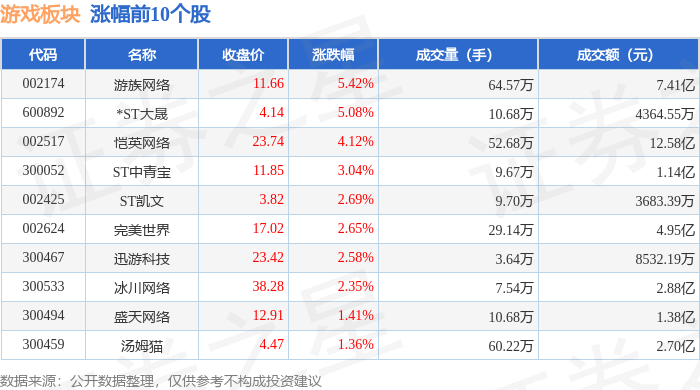
Market Overview - The gaming sector experienced a decline of 0.27% on October 20, with ST Huatuo leading the drop [1] - The Shanghai Composite Index closed at 3863.89, up 0.63%, while the Shenzhen Component Index closed at 12813.21, up 0.98% [1] Top Gainers in Gaming Sector - The top gainers included: - Youzu Network (002174) with a closing price of 11.66, up 5.42% and a trading volume of 645,700 shares, totaling 741 million yuan [1] - ST Dazheng (600892) at 4.14, up 5.08% with a trading volume of 106,800 shares, totaling 43.65 million yuan [1] - Kaiying Network (002517) at 23.74, up 4.12% with a trading volume of 526,800 shares, totaling 1.258 billion yuan [1] Top Losers in Gaming Sector - The top losers included: - ST Huadao (002602) at 17.32, down 4.94% with a trading volume of 2,259,200 shares, totaling 3.996 billion yuan [2] - Yaoji Technology (002605) at 25.21, down 2.17% with a trading volume of 85,200 shares, totaling 21.7 million yuan [2] - Shunwang Technology (300113) at 23.75, down 1.86% with a trading volume of 231,900 shares, totaling 559 million yuan [2] Capital Flow in Gaming Sector - The gaming sector saw a net outflow of 421 million yuan from main funds, while retail investors contributed a net inflow of 492 million yuan [2][3] - Notable capital flows included: - Kaiying Network (002517) with a main fund net outflow of 64.59 million yuan [3] - Youzu Network (002174) with a main fund net inflow of 46.51 million yuan [3] - Perfect World (002624) with a main fund net inflow of 24.05 million yuan [3] ETF Performance - The Gaming ETF (159869) tracking the China Animation and Gaming Index saw a decline of 7.55% over the past five days, with a net outflow of 64.67 million yuan [5]





汤姆猫涨2.04%,成交额1.27亿元,主力资金净流入605.97万元
Xin Lang Zheng Quan· 2025-10-20 02:45
Core Insights - Tom Cat's stock price increased by 2.04% to 4.50 CNY per share, with a total market capitalization of 15.821 billion CNY as of October 20 [1] - The company has experienced a year-to-date stock price decline of 21.60% and a 15.41% drop over the past 20 trading days [1] - For the first half of 2025, Tom Cat reported a revenue of 463 million CNY, a year-on-year decrease of 19.62%, and a net profit loss of 30.33 million CNY, down 141.34% [2] Financial Performance - The main revenue sources for Tom Cat include advertising (72.41%), new commercial services (11.19%), mobile application distribution (10.70%), and others [1] - Cumulative cash dividends since the A-share listing amount to 248 million CNY, with no dividends paid in the last three years [3] Shareholder Information - As of June 30, 2025, the number of shareholders increased to 268,400, with an average of 12,245 circulating shares per person, a decrease of 1.19% [2] - Major shareholders include Southern CSI 1000 ETF, Hong Kong Central Clearing Limited, and others, with significant increases in their holdings compared to the previous period [3]
26岁天才股神坦言:换手率一旦大于7%,证明该股即将开启主升浪!
Sou Hu Cai Jing· 2025-10-19 16:43
我炒股17年,从稳定亏损到小赚小亏,再到稳定盈利炒股养家,基本上所有的技术和方法我都用过了, 要说真正帮助我走出亏损泥潭的,还是身经百战的一条条的市场实战经验,每一条都是真金白银堆出来 的经验,无论是新手还是老股民,读懂少走几年弯路! 在股市想实现炒股养家,其实是破茧成蝶的一个过程,我发现在股市亏损的大部分散户原因就是习惯不 好,心态不好,没有一套规则约束自己,靠运气和感觉炒股,虽然运气好的时候能选出好股,但是大多 时候选出的个股都让自己陷入困境,牢牢套住。人非圣贤,孰能无过,但是很多散户朋友一旦操作失误 后,心态就会崩,之后开始恶性循环,难以翻身。 投资不易,第一个不易是因为学识和专业素养的门槛,第二不易是因为知行合一的障碍,第三个不易是 品性的缺陷。长期的超额收益却要求这3者的结合,投资之不易正在于此。 (5)行情初始阶段,某只股票连续3天以上换手率较大,平均在10%以上,股价连续飙升,这时候就要 注意,可能是板块中领涨的股票。 一般来说,当股价处于低位时,当日换手率达到2%左右时应引起散户的关注,而上升途中换手率达到 20%左右时则应引起警惕。操作中可以利用以下几个辅助规则结合换手率来进行判断: 要找换 ...

银行利好竟是烟雾弹?机构直言:下周反弹是逃命机会,不是抄底信号!
Sou Hu Cai Jing· 2025-10-19 00:41
Market Overview - Over 4,700 stocks declined with a trading volume of 19.5 trillion, indicating a significant capital outflow from major players, leading to a "mini stock disaster" in the A-share market [1] - Mysterious funds entered the market towards the end of trading, purchasing 230 million in stocks like BYD and Tom Cat, suggesting a potential setup for a rebound next week [1] Policy and External Factors - The central bank's sudden call to "attract foreign investment" combined with signals of tariff easing led to a surge in A50 and Hong Kong futures [3] - This policy shift appears to be a strategy by major players to create a false rebound to attract retail investors [3] Market Sentiment and Historical Context - Historical data indicates that over 80% of rebounds during periods of declining sentiment are opportunities for major players to offload stocks [5] - The "fishing" tactic of major players is likely to repeat next week, with retail investors warned to be cautious of three traps: high-tech stocks' rebounds, sudden late-session stock surges, and low-volume rebounds [6] Defensive Assets and Sector Performance - Defensive assets have become a safe haven, with the precious metals sector rising against the trend, and bank stocks attracting 200 billion from insurance funds due to dividend yields exceeding 4% [8] - The previously hot AI sector, despite favorable news, lacks performance support from the application end [8] Technical Analysis and Trading Strategies - Key technical levels to watch include the 3,885-point support for the Shanghai Composite Index and the 3,000-point level for the ChiNext Index [8] - Analysts suggest that if the index fails to break through the 5-day moving average during a rebound, selling is the best option [9] Market Dynamics and Trading Behavior - Quantitative trading has intensified market volatility, with a trading volume of 1.1 trillion being a "hunting zone" for quant funds [11] - The behavior of foreign capital, which tends to sell before buying back, contrasts sharply with domestic major players [8] Investment Opportunities and Risks - The innovative drug sector is gaining traction due to the ESMO annual meeting, while low-valuation blue chips are seen as defensive choices [13] - The upcoming third-quarter reports are expected to reveal underperforming stocks, particularly those that have seen significant price increases [14] Global Market Interconnections - Increased interconnectivity in global markets is noted, with the impact of the Federal Reserve's balance sheet reduction affecting foreign capital flows [15][16] - The A-share market's rebound on October 15 coincided with a rise in Hong Kong stocks, although such correlations are often short-lived [17]

国信证券:持续看好游戏板块新品周期 把握影视内容及AI应用底部机会
Zhi Tong Cai Jing· 2025-10-17 01:44
Group 1: Media Sector Performance - In September 2025, the media sector (Shenwan Media Index) rose by 4.96%, outperforming the CSI 300 Index by 1.76 percentage points, ranking 5th among 31 industries [1] - Notable gainers included Giant Network, Mango Excellent Media, ST Huatong, and Happiness Blue Sea, while losers included Youzu Interactive, Jishi Media, Shandong Publishing, and Tom Cat [1] - The current TTM-PE for the Shenwan Media Index is 46.5x, positioned at the 95.9th percentile over the past five years [1] Group 2: Gaming Market Insights - In September, 145 domestic games and 11 imported games were approved, with a total of 1,275 game licenses issued from January to September, marking a year-on-year increase of 23.2% [1] - The Chinese gaming market revenue in August was 29.3 billion yuan, with year-on-year and month-on-month changes of -13.0% and +0.6% respectively; mobile gaming revenue was 21.5 billion yuan, with year-on-year and month-on-month changes of -4.2% and +0.8% [1] - The sector is expected to have medium to long-term upward potential driven by new product cycles, regulatory policy shifts, and AI applications [1] Group 3: National Day Box Office Performance - The total box office for the National Day period was 1.866 billion yuan, a year-on-year decline of 12.8%, primarily due to a lack of compelling new releases [2] - In September 2025, the total box office reached 2.661 billion yuan, reflecting a year-on-year increase of 82.8% [2] Group 4: AI Applications and Technological Advances - Meta's Super Intelligent Lab has overcome RAG technology bottlenecks, innovating a lightweight model to compress lengthy contextual content into concise summaries [3] - Google introduced the "Inference Memory" framework, enabling AI agents to achieve "self-evolution" [3] - OpenAI launched Sora2, which supports the generation of high-quality video and audio, while Kuaishou released Kegong 2.5 Turbo, reducing video generation costs by 30% [3]
