赛力斯

Search documents
1-10月中国新能源汽车产量1267.2万辆,同比增长28.1%
Bei Jing Ri Bao Ke Hu Duan· 2025-11-20 09:42
Core Insights - The Chinese new energy vehicle (NEV) market continues to experience rapid growth, with a production volume of 12.672 million units from January to October 2025, representing a year-on-year increase of 28.1% and a cumulative penetration rate of 46.4% [2] Market Trends - The NEV market is driven by policy support, product innovation, and export growth, contributing to a high-quality development trajectory [2] - As of September 2025, the market share of cars (CAR) is 45.1%, down 1.7 percentage points year-on-year, while SUVs and MPVs account for 43.9% and 3.6%, respectively [3] Battery Installation Trends - The installed capacity of power batteries for NEVs reached 73.7 GWh in September 2025, marking a year-on-year growth of 39.9% [4] - The average battery capacity per vehicle is 53.0 kWh, up 17.3% year-on-year [4] Battery Market Structure - In the battery cell shape distribution, square cells dominate with a 98.6% share, while cylindrical and pouch cells account for 1.0% and 0.4%, respectively [5] - Lithium iron phosphate (LFP) continues to gain market share due to its safety, cost, and longevity advantages [5] Battery Supplier Dynamics - The top three battery manufacturers hold a market share of 72.2%, with CATL leading at 42.1% [6] - Companies like Contemporary Amperex Technology Co., Limited (CATL) and others have shown significant year-on-year growth, with increases of 102.0% and 143.2% for specific firms [6] Electric Motor Supplier Trends - The top ten electric motor suppliers account for 62.7% of the market share, with all companies in this group showing a month-on-month increase in supply [7] - Notable growth has been observed for companies like Saike Technology and Grebo, attributed to high sales volumes from brands like Wuling and Geely [7] Control System Supplier Insights - The top ten electronic control suppliers hold a combined market share of 67.8%, with some companies experiencing a decline in supply [8] - Huawei's supply is concentrated, with a significant share coming from the Seres brand [8] Sodium-Ion Battery Development - Sodium-ion battery technology is rapidly advancing, with key advantages in low-temperature performance, fast charging, and safety [9] - Applications for sodium-ion batteries include home energy storage, large-scale power stations, and electric vehicles, although challenges remain in energy density and lifecycle [9]

乘用车板块11月20日跌1.48%,赛力斯领跌,主力资金净流出15.85亿元
Zheng Xing Xing Ye Ri Bao· 2025-11-20 09:09
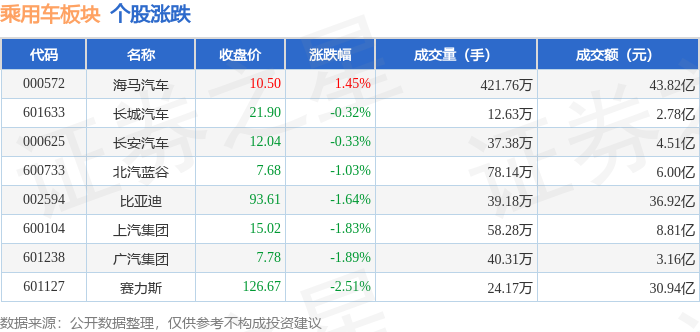
Core Points - The passenger car sector experienced a decline of 1.48% on November 20, with Seres leading the drop [1] - The Shanghai Composite Index closed at 3931.05, down 0.4%, while the Shenzhen Component Index closed at 12980.82, down 0.76% [1] Passenger Car Sector Performance - The closing prices and changes for key companies in the passenger car sector include: - Haima Automobile: 10.50, +1.45% - Great Wall Motors: 21.90, -0.32% - Changan Automobile: 12.04, -0.33% - BAIC Blue Valley: 7.68, -1.03% - BYD: 93.61, -1.64% - SAIC Group: 15.02, -1.83% - GAC Group: 7.78, -1.89% - Seres: 126.67, -2.51% [1] Capital Flow Analysis - The passenger car sector saw a net outflow of 1.585 billion yuan from institutional investors, while retail investors contributed a net inflow of 1.453 billion yuan [1] - The capital flow for specific companies indicates: - Great Wall Motors: Institutional net inflow of 7.4341 million yuan, retail net inflow of 5.4436 million yuan - GAC Group: Institutional net outflow of 32.0352 million yuan, retail net inflow of 5.4416 million yuan - SAIC Group: Institutional net outflow of 41.5678 million yuan, retail net inflow of 96.6030 million yuan - Changan Automobile: Institutional net outflow of 43.4795 million yuan, retail net inflow of 59.3332 million yuan - BAIC Blue Valley: Institutional net outflow of 68.5522 million yuan, retail net inflow of 47.5268 million yuan - Seres: Institutional net outflow of 634 million yuan, retail net inflow of 523 million yuan - BYD: Institutional net outflow of 69.47 million yuan, retail net inflow of 644.1 million yuan [2]







问界M8电吸门夹伤手指车主质疑使用风险 售后称已处理
Zhong Guo Jing Ji Wang· 2025-11-20 08:09
中国经济网北京11月20日讯(记者 马先震) 江西电视台《都市现场》栏目报道《手指遭电吸门夹 伤 问界M8车主质疑存在使用风险》显示,九江车主张先生反映,10月份他买了一辆问界M8纯电 SUV,该车车门具有电吸功能,这个功能让他意外受伤,手指造成了严重的软组织损害。 (责任编辑:徐自立) 中国经济网记者致电问界与鸿蒙智行了解详情,问界用户关怀中心工作人员回应称,已经跟车主协 商处理完成。但对于技术细节,工作人员没有具体说明。 九江市濂溪区的AITO授权用户中心九江华东国际汽车城店售后工作人员回应称,电吸门是正常的 功能,车主未及时抽手才造成受伤,它不属于质量问题。关于该功能是否存在安全隐患,对方表示,只 要给的反作用力足够大,就能在吸合过程中制止吸力。店内工作人员还表示,他们事发之后也第一时间 上门关怀、探望,并且提供了2000元的关怀方案,但是双方并未谈妥。 ...
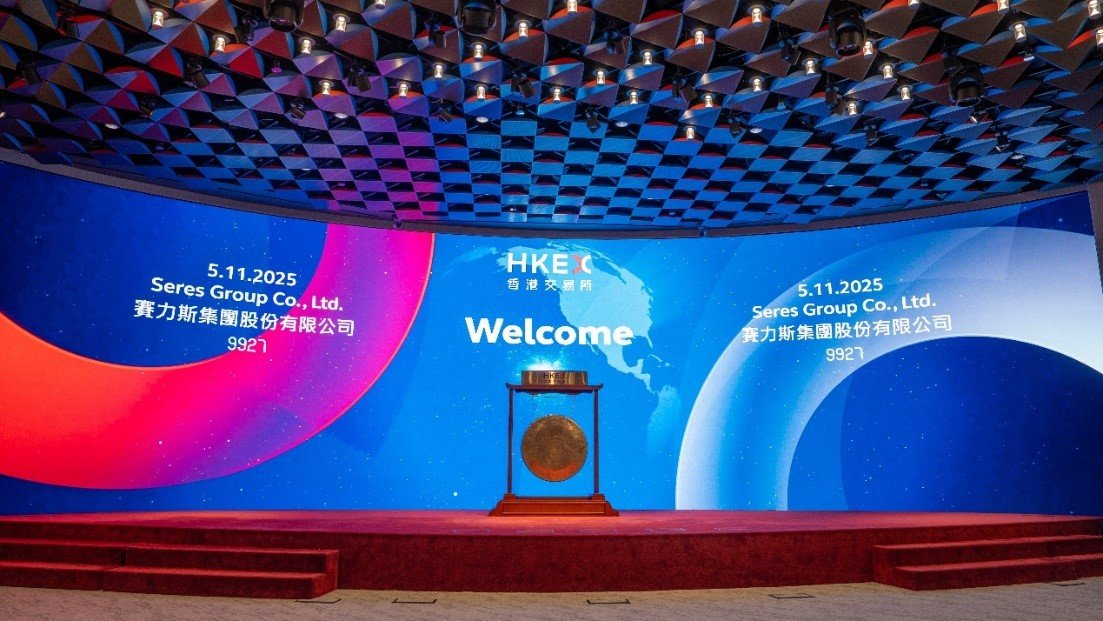
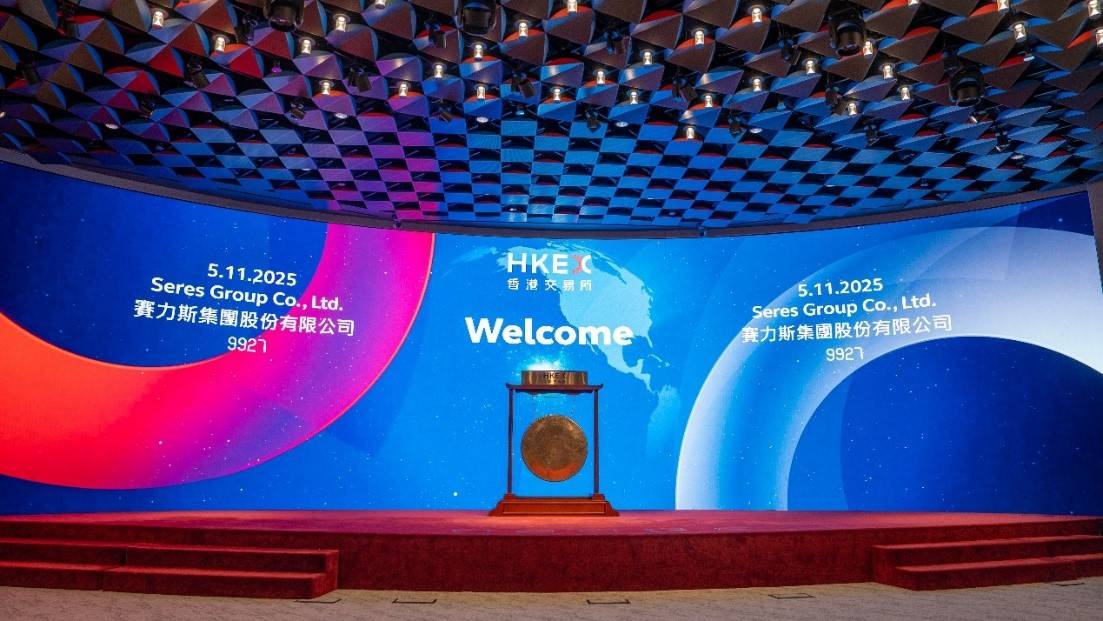
赛力斯增长动能获资本市场看好港股上市开启高质量发展新征程
Xin Lang Cai Jing· 2025-11-20 06:07
业绩层面,赛力斯正处于高质量发展的上升通道。中信建投证券指出,得益于问界品牌的强劲产品周期,全系车型销量持续攀升,推动公司业绩再上新台阶。数据显示,赛力斯前三季度实现营业 来源:@证券市场周刊微博 自11月5日成功登陆港股以来,赛力斯(601127.SH;09927.HK)凭借稳步提升的业绩表现与面向未来的成长潜力,赢得长江证券、中信建投证券、国泰海通证券等多家机构持续看好。长江证 在明确的发展战略指引下,公司对港股IPO所募资金进行了清晰规划,约70%用于研发投入,提高核心技术能力和创新能力,20%用于新车型研发,进一步丰富产品矩阵,10%用于海外车型的适配 在拓展全球业务的同时,赛力斯也积极布局前沿技术领域。公司已携手火山引擎进军"人工智能+"方向,通过优势互补打造"技术+场景"的融合新模式。据悉,赛力斯将港股融资金额的5%用于未 2025年以来,包括长江证券在内的多家机构密集发声,一致看好赛力斯在高端市场的领先地位与长期成长潜力。在"A+H"双平台的资本助力下,赛力斯已步入"技术投入—产品迭代—全球扩张—利 — 证券市场周刊 广告 — ...
赛力斯港股上市全球战略加速长江证券看好后市维持“买入”评级
Xin Lang Cai Jing· 2025-11-20 06:07
Core Insights - Company Saisir has successfully listed on the Hong Kong stock market since November 5, attracting positive attention from multiple institutions such as Changjiang Securities and CITIC Construction Investment Securities due to its steady performance and growth potential [1] Funding Allocation - Approximately 70% of the funds raised from the IPO will be allocated to research and development to enhance core technology and innovation capabilities [1] - 20% of the funds will be used for the development of new vehicle models to further enrich the product matrix [1] - 10% of the funds will be dedicated to adapting overseas models as part of the global business expansion strategy [1] Technological Advancements - The company is actively engaging in cutting-edge technology fields, partnering with Volcano Engine to enter the "AI+" sector, creating a new model that integrates technology and scenarios [1] - 5% of the IPO financing amount will be utilized for this technological initiative [1] Performance and Market Position - Saisir is currently on an upward trajectory of high-quality development, with strong product cycles from the Aion brand driving continuous sales growth [1] - The company achieved significant revenue in the first three quarters of the year, reflecting its strong market position [1] - Multiple institutions, including Changjiang Securities, have expressed optimism about Saisir's leading position in the high-end market and its long-term growth potential [1] Capital Strategy - With the support of the "A+H" dual-platform capital strategy, Saisir is positioned for a cycle of technology investment, product iteration, global expansion, and profit generation [1]
“A+H”加速全球化,赛力斯(09927)估值重构释放长期价值
智通财经网· 2025-11-20 05:52
Core Viewpoint - The recent valuation pullback of Seres (09927) presents a buying opportunity for long-term investors, despite the initial market reaction to its IPO being the largest for a Chinese car company and the largest globally this year [1] Group 1: Company Performance - Seres is a leading luxury new energy vehicle (NEV) manufacturer, with its Aito brand ranking among the top three in the new forces segment, featuring models such as M5, M7, M8, and M9 [1] - The M8 model has an average price exceeding 400,000 yuan, while the M9 exceeds 500,000 yuan, both leading in their price segments [1] - The company has shown strong performance, with a compound annual growth rate (CAGR) of 123.46% in Aito brand sales from 2022 to 2024, driving overall revenue growth at a CAGR of 106.42% [1] - For the first three quarters of 2025, Seres achieved revenue of 110.53 billion yuan and a net profit of 5.31 billion yuan, marking a year-on-year increase of 31.56% [1] Group 2: Strategic Partnerships and Innovations - The success of Seres is attributed to strategic decisions made by its founder, Zhang Xinghai, who has transitioned through various industries, culminating in a partnership with Huawei in 2021 to establish a new business model for high-end NEVs [2] - The collaboration with Huawei has allowed Seres to leverage technological advantages, positioning itself as a benchmark in the NEV industry [2] - The company emphasizes self-research and development, leading in four core technologies, which enhances its product competitiveness [2] Group 3: Market Expansion and Investment - Seres is committed to an overseas expansion strategy, recognizing the high growth potential in the global NEV market, with projections indicating significant penetration rates in China, Europe, and North America by 2030 [3] - The company has attracted diverse capital support, including investments from state-owned enterprises and major investment institutions, enhancing its financial backing [3] - The H-share listing is seen as a strategic move to globalize capital and establish a high-end NEV brand presence internationally [3] Group 4: Long-term Investment Value - Overall, Seres is viewed as a long-term investment opportunity, with its strong position in the high-end NEV market and potential for future growth despite short-term market fluctuations [4]
“A+H”加速全球化,赛力斯估值重构释放长期价值
Zhi Tong Cai Jing· 2025-11-20 05:52
Core Insights - The recent IPO of Seres (09927) marks the largest IPO of a Chinese car company in history and the largest global car company IPO of the year, despite facing a market pullback shortly after listing [1][2] - Seres is a leading luxury electric vehicle manufacturer, with its Aito brand ranking among the top three in the new energy vehicle sector, showcasing strong sales performance [1][2] - The company has a robust growth trajectory, with a projected compound annual growth rate (CAGR) of 123.46% in sales from 2022 to 2024, and a revenue CAGR of 106.42% [1][3] Company Performance - The Aito brand's models, including M5, M7, M8, and M9, have achieved significant sales, with the M8 model delivering over 100,000 units within five months of launch and maintaining monthly sales above 20,000 units [1][2] - For the first three quarters of 2025, Seres reported a revenue of 110.53 billion yuan and a net profit of 5.31 billion yuan, reflecting a year-on-year growth of 31.56% [1][3] Strategic Partnerships - The success of Seres is attributed to strategic decisions made by Chairman Zhang Xinghai, including a partnership with Huawei that has enabled the company to leverage advanced technology in the high-end electric vehicle market [2][3] - The collaboration with Huawei has established a new business model that serves as a benchmark for the industry, enhancing Seres' competitive edge through self-research and development [2][3] Market Expansion - Seres is committed to an aggressive international expansion strategy, targeting high growth in the global electric vehicle market, with significant penetration expected in China, Europe, and North America by 2030 [3][4] - The company's recent H-share listing has attracted various institutional investors, enhancing its capital base and supporting its global expansion efforts [3][4] Investment Outlook - Despite short-term market fluctuations, Seres is positioned as a long-term investment opportunity due to its strong market position and growth potential in the high-end electric vehicle sector [4]
赛力斯增长动能获资本市场看好 港股上市开启高质量发展新征程
Sou Hu Cai Jing· 2025-11-20 05:20
Core Viewpoint - Company Saisir has gained positive attention from multiple institutions following its successful listing on the Hong Kong stock market on November 5, driven by steady performance and future growth potential [1] Group 1: Financial Performance - In the first three quarters, Saisir achieved a revenue of 1,105.34 billion and a net profit attributable to shareholders of 53.12 billion, marking a year-on-year growth of 31.56% [5] - The strong product cycle of the Aito brand has led to continuous sales growth across all models, pushing the company's performance to new heights [5] Group 2: Strategic Planning - Approximately 70% of the funds raised from the Hong Kong IPO will be allocated to R&D to enhance core technology and innovation capabilities, 20% for new model development, and 10% for adapting overseas models and expanding marketing channels [3] - The company is focusing on the Middle East and Europe as strategic entry points for its global expansion, with overseas business expected to become a significant growth pillar [3] Group 3: Technological Advancements - Saisir is actively exploring cutting-edge technology fields, partnering with Volcano Engine to enter the "AI+" sector, aiming to create a new model that integrates technology and application scenarios [3] - 5% of the funds from the Hong Kong financing will be used for future industrial exploration, which is expected to lead to breakthroughs in embodied intelligent manufacturing and industrialization [3] Group 4: Market Position and Valuation - Multiple institutions, including Changjiang Securities, have expressed optimism about Saisir's leading position in the high-end market and its long-term growth potential, with a target price of 166.19 yuan based on a 24x PE valuation for 2026 [5] - The company is on a virtuous development path characterized by "technology investment—product iteration—global expansion—profit release," supported by the dual-platform capital strategy [5]
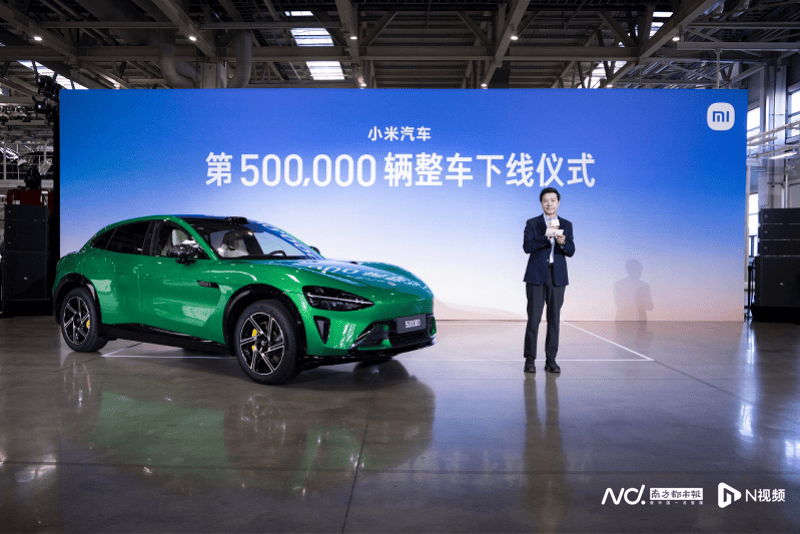
小米第50万辆汽车下线,雷军:下一步推进安全、科技创新
Sou Hu Cai Jing· 2025-11-20 04:48
11月18日,小米集团发布三季度财报显示,该季度交付汽车超10万辆,创单季度历史新高,同比增长173.4%。今 年前三季度,小米汽车累计交付量超26万辆,9月、10月连续2月交付量超4万辆,预计本周将提前完成35万台的交 付目标。值得注意的是,三季度,小米汽车业务首次实现单季度盈利,智能电动汽车收入为283亿元。 另外,第三方统计数据显示,截至今年10月,小米SU7位列2025国内中大型轿车销量第一;小米YU7连续3个月位 列中大型SUV销量第一,其中10月登顶国内全品类SUV销量第一。 小米汽车副总裁于立国在现场透露,汽车工厂共有98个质量检测工位和143台质量高精检测设备,坚持用严苛的检 测标准保证质量;坚持用先进的工艺和自动化的设备,目前工厂内的生产机器人超过1100台;坚持技术创新,超 级大压铸等技术不断升级,工厂2025年取得先进制造专利近百项。于立国说,截至目前,小米汽车工厂已完成35 次技术改造升级,生产效率大幅提升,向用户交车的时间越来越短。 11月20日,小米集团创始人、董事长兼CEO雷军宣布,第50万辆小米汽车在位于北京经济技术开发区(北京亦 庄)的小米汽车超级工厂下线。雷军表示,"从第1 ...
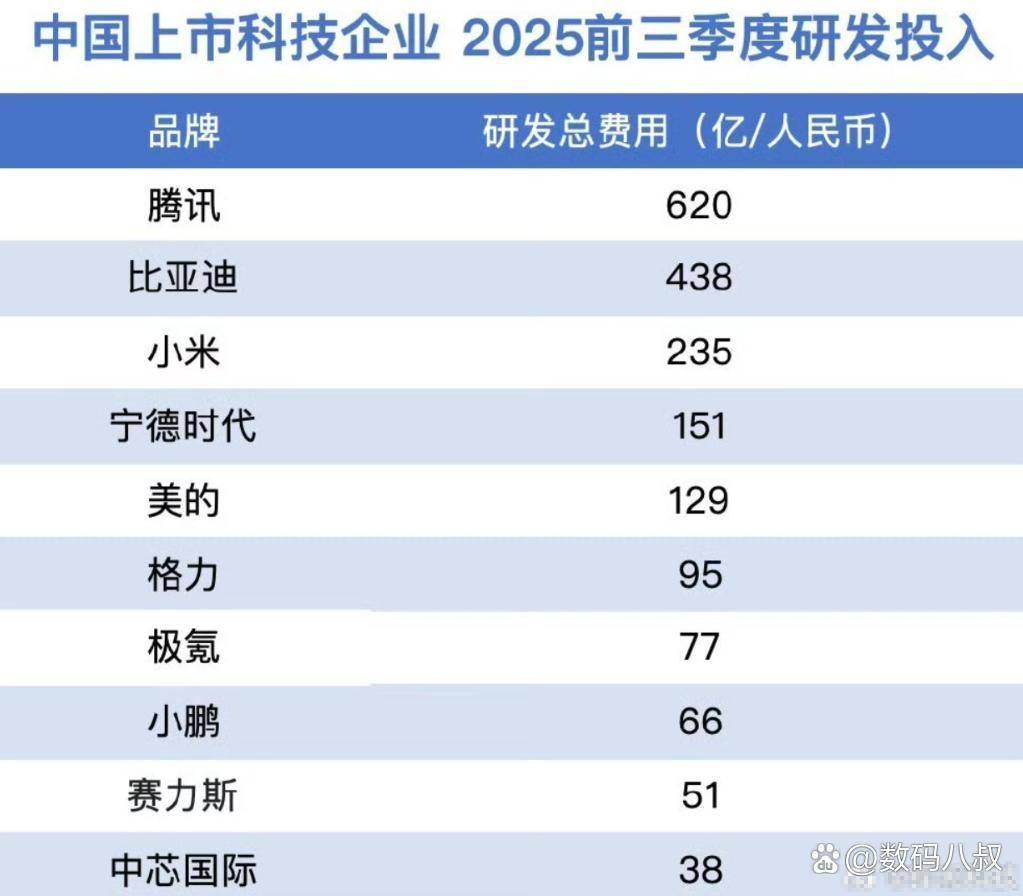
中国上市科技企业 2025前三季度研发投入前十的公司出炉,分别是:腾讯、比亚迪、小米、宁德时代、美的、格力、极氪、小鹏、赛力斯、中芯国际。所以,本人投资得多,收获就多,这个眼红不了的。
Sou Hu Cai Jing· 2025-11-20 04:31
Core Insights - The top ten Chinese listed technology companies in terms of R&D investment for the first three quarters of 2025 have been identified, highlighting significant players in the industry [1] Group 1: R&D Investment Rankings - Tencent leads the list with a total R&D expenditure of 62 billion RMB [2] - BYD follows with 43.8 billion RMB in R&D spending [2] - Xiaomi ranks third with 23.5 billion RMB allocated for R&D [2] - CATL (宁德时代) is fourth with 15.1 billion RMB in R&D investment [2] - Midea (美的) and Gree (格力) have R&D expenditures of 12.9 billion RMB and 9.5 billion RMB, respectively [2] - Zeekr (极氪) invests 7.7 billion RMB in R&D [2] - XPeng (小鹏) has an R&D budget of 6.6 billion RMB [2] - Seres (赛力斯) spends 5.1 billion RMB on R&D [2] - Semiconductor Manufacturing International Corporation (中芯国际) rounds out the list with 3.8 billion RMB in R&D investment [2]