
奔驰

Search documents
行业组织三度致函车企!豪华车经销商“稳赚不赔”时代终结
第一财经· 2026-01-29 15:00
近日,全联汽车经销商商会(下称"商会")发布信息称,2025年年末,商会陆续收到部分奔驰品牌 授权经销商反映,企业在经营中普遍面临库存过高、价格倒挂严重、返利兑现周期过长、商务考核压 力过大以及缺乏退网补偿机制等问题,企业经营持续承压。 2025年12月,商会首次致函北京梅赛德斯-奔驰销售服务有限公司,提出了将库存系数控制在1以 内、优化返利兑现机制、合理设定商务考核目标等具体整改建议。此后,商会又在今年先后两次致函 奔驰全球管理团队。1月23日,奔驰全球及中国团队均回复称,将梳理问题症结、尽快推出整改措 施。 北京梅赛德斯-奔驰销售服务有限公司总裁兼首席执行官段建军在1月13日表示,2025年汽车市场 挑战较多,奔驰销售公司与经销商合作伙伴共同调整了8次销售目标。新车销售需平衡市场挑战与份 额获取,销量并非唯一工作目标,在取舍上需具备定力与勇气;同时要客观冷静看待市场变化、克制 务实预期市场份额、敏捷灵活调整业务结构,并抓住政策利好的市场机会。 面临经营压力的不只奔驰经销商。2025年以来,已有多个豪华品牌4S店出现经营危机。今年1月, 河南开封金奥奥迪4S店闭店停业,导致多名消费者预付的保养套餐无法兑现且 ...

行业组织三度致函车企!豪华车经销商“稳赚不赔”时代终结
Di Yi Cai Jing· 2026-01-29 13:13
越来越多的豪华车经销商干不下去了。 面临经营压力的不只奔驰经销商。2025年以来,已有多个豪华品牌4S店出现经营危机。今年1月,河南 开封金奥奥迪4S店闭店停业,导致多名消费者预付的保养套餐无法兑现且维权无门。一汽奥迪官网显 示,该店目前已从授权经销商网络中移除。此外,北京、浙江、江苏等多地的部分奥迪4S店也出现了 闭店情况。 目前,多家豪华车企正在对销售渠道进行优化调整,部分4S店的授权已被取消。 昔日,豪华车品牌的高溢价让经销商们赚得盆满钵满。但随着中国车市格局变化,代理豪华品牌销售不 再"稳赚不赔"。市场竞争加剧导致豪华车企销量承压,终端不得不大幅让利,即便是一些热销车型,终 端优惠也动辄高达10万元。2025年,豪华车企三强宝马、奥迪和奔驰的在华销量分别为62.6万辆、61.8 万辆和57.5万辆,同比分别下跌12.5%、5%和19%。 某汽车销售公司管理层人士在接受记者采访时表示,在亏钱卖车的情况下,4S店通常需依靠售后、厂 家返点等方式来实现盈利。同时,主机厂会给经销商设定多种商务政策,包括销售返利、金融贴息、月 度及季度促销等,这些政策因经销商而异。主机厂的目的在于完成销售任务,促使经销商批售更 ...
进口车去年猛降32%,雷克萨斯却逆势上涨
3 6 Ke· 2026-01-29 10:56
Core Insights - The import car market in China has been under pressure, with a projected decline of 32% in imports for 2025, totaling 480,000 units, marking four consecutive years of negative growth [2][4] - Luxury vehicles are the mainstay of the import market, while non-luxury imports are experiencing significant shrinkage [3][5] - Lexus stands out with a 2% increase in sales for 2025, reaching 184,000 units, marking a four-year high [6][8] Import Market Trends - The import car volume has seen a consistent decline from 2014's peak of 1.43 million units, with 2024 imports down 12% to 700,000 units [2][4] - Monthly data for 2025 indicates a sharp decline in early months due to price observation, followed by a brief recovery in July, but continued weakness from August to November [4] Sales Performance - Total retail sales of imported cars for 2025 are expected to be 540,000 units, down 33% year-on-year [5] - Luxury brands dominate the import market, accounting for 90.7% of total sales, with significant declines in brands like BMW (down 62% to 64,400 units) and Mercedes-Benz (down 37% to 94,800 units) [5][6] Luxury Segment Analysis - Lexus's sales growth is attributed to timely product adjustments and strong performance of hybrid models, with the ES series and RX series contributing significantly to overall sales [8] - The super-luxury segment has faced declines, with brands like Bentley, Ferrari, and Lamborghini experiencing three consecutive years of sales drops [8][9] Regional Insights - Shanghai has become the leading market for super-luxury imports in 2025, surpassing Tianjin, while traditional affluent areas face significant market pressure [9] Domestic Competition - Domestic brands are increasingly targeting the luxury segment, with models like the Huawei-backed ZunJie S800 and NIO ET9 entering the market, challenging traditional luxury brands [10][12] - The shift in consumer preferences indicates a growing acceptance of domestic luxury vehicles, driven by technological advancements and changing consumer habits [10][12]
外资豪华品牌的繁荣或将一去不返
Zhong Guo Qi Che Bao Wang· 2026-01-29 08:11
2026年的中国豪华车市场,正经历前所未有的格局洗牌。宝马开年官方降价,保时捷持续精简经销 商网络以应对连续四年的销量下滑,捷豹、沃尔沃等二线豪华面临终端价格崩盘,部分车型价格与合资 同级持平。这一系列事件,正式宣告外资豪华品牌迈入战略收缩元年。曾独霸中国高端市场数十年的外 资品牌正由盛转衰。这并非短期波动,而是产业、竞争、消费三重变革叠加的系统性变化,其独领风骚 的时代或将一去不返。 回望2016年,中国豪华车市场还是外资品牌的独角戏。笔者至今记得某德系豪华品牌发布会的场 景:主办方未配齐同声传译,负责人用英语畅谈"全球统一标准",台下中国媒体和经销商只能凭荧幕画 面揣摩内容。彼时BBA合计占据94.03%的豪华车市场份额,其余不足6%的空间由其他进口豪华品牌角 逐。中国本土品牌则是"边缘人",整体市场份额不足40%,仅能在15万元以下低端市场挣扎,尝试冲击 20万元价位的品牌,多被贴上"不自量力"的标签。 外资的技术封锁与市场傲慢,倒逼中国汽车人走上自主研发之路。2017年春,笔者走访某自主品牌 研发中心,工程师们围着拆解的外资发动机逐件测量参数,泡面桶、咖啡罐堆满角落,灯光亮至凌晨两 三点是常态。一位工 ...
雷军发文祝奔驰140岁生日快乐:致敬行业先行者
Feng Huang Wang· 2026-01-29 03:18
官方称,"奔驰140年"旨在纪念1886年1月29日卡尔.本茨递交奔驰一号专利申请这一历史时刻。 同时,鸿蒙智行、吉利汽车、蔚来汽车、理想汽车等同行也纷纷向奔驰发出了生日祝福。 凤凰网科技讯1月29日,小米创办人,董事长兼CEO雷军转发"小米汽车"的文章并称:致敬行业先行 者,祝奔驰140岁生日快乐。"小米汽车"称,奔驰140年,就是汽车工业的140年。 ...

中国人一年少买了10万辆进口宝马
第一财经· 2026-01-29 02:55
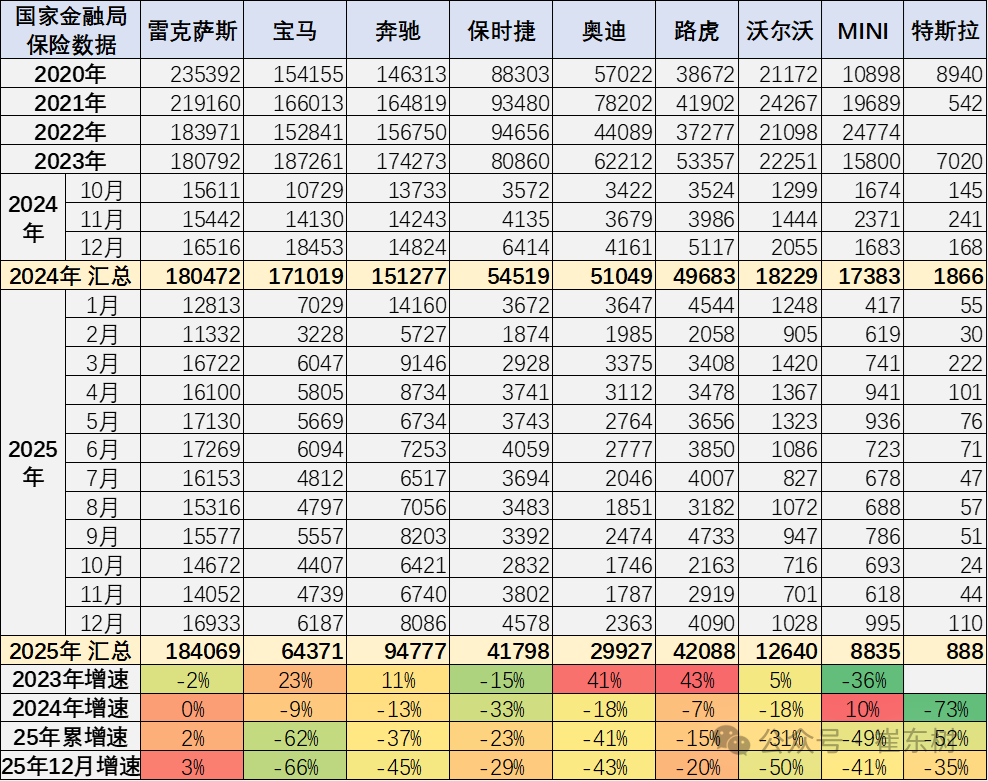
Core Viewpoint - The Chinese automobile import market has experienced a continuous decline for seven consecutive years, with a significant drop in 2025, marking a 32% decrease compared to the previous year [3][4]. Group 1: Import Volume and Trends - In 2025, China's automobile import volume was recorded at 475,700 units, a decrease of approximately 32% year-on-year and a reduction of about 228,000 units from 2024's 704,100 units [3]. - Over the past 12 years, the import market has shrunk by nearly two-thirds from 1.43 million units in 2014 to 475,700 units in 2025 [3]. - Japan remains the largest source of imported vehicles, contributing 203,100 units in 2025, which accounts for 42.7% of total imports [3]. Group 2: Brand Performance - Lexus has been a significant contributor to Japan's import figures, with sales reaching 184,100 units in 2025, a 3% increase year-on-year, although still below 2021 levels [3]. - Lexus accounted for over 90% (90.63%) of all Japanese imports and more than one-third (38.69%) of total imported vehicles in China [3]. - German luxury brands, particularly the "Big Three" (BBA: Benz, BMW, Audi), are facing severe declines, with BMW experiencing a 62% drop in imports, the most significant among them [4][5]. Group 3: Specific Brand Data - In 2025, BMW's imports fell to 64,371 units from 171,019 units in 2024, a decrease of 106,648 units [5]. - Mercedes-Benz's imports dropped below 100,000 units, totaling 94,777 units, a decline of 56,500 units [5]. - Audi's imports fell to below 30,000 units, reaching 29,927 units, a reduction of 21,122 units [5]. - Porsche's imports also declined by 23% to 41,798 units, marking three consecutive years of decline in the Chinese market [6].
中国人一年少买了10万辆进口宝马
Di Yi Cai Jing· 2026-01-29 02:36
Core Insights - In 2025, China's automobile imports fell to 475,700 units, marking a 32% year-on-year decline and a reduction of approximately 228,000 units compared to 2024 [1][2] - The import of BMW vehicles plummeted by 62%, with only 64,371 units imported in 2025, down from 171,019 units in 2024 [2][3] - The overall trend shows a continuous decline in the Chinese imported car market for seven consecutive years, with a significant reduction of nearly two-thirds from 1.43 million units in 2014 to 475,700 units in 2025 [1] Import Sources - Japan remains the largest source of imported cars to China, with 203,100 units in 2025, accounting for 42.7% of total imports [1] - Germany ranks second with 104,400 units, followed by Slovakia, the United States, and the United Kingdom with 51,200, 48,500, and 36,400 units respectively [1] Brand Performance - Lexus was a standout performer, with 184,100 units sold in 2025, achieving a 3% increase year-on-year and accounting for over 90% of Japanese imports and more than one-third of all imported vehicles [2] - The German luxury brands, particularly the "Big Three" (BBA: BMW, Mercedes-Benz, Audi), are experiencing significant declines, with BMW's imports dropping by 62%, Mercedes-Benz by 37%, and Audi by 41% [2][3] - Porsche also faced challenges, with a 23% decline in imports to 41,798 units, marking three consecutive years of decline in the Chinese market [4]
近六成受访美资企业计划增加在华投资
Ren Min Ri Bao· 2026-01-28 22:51
Group 1 - Nearly 60% of surveyed US-funded enterprises plan to increase investment in China [1] - Over half of the surveyed US-funded enterprises expect to achieve profitability or significant profits in 2025 [1] - More than 70% of surveyed enterprises have not considered relocating production or procurement outside of China [1] Group 2 - Nearly 80% of surveyed Chinese enterprises intend to expand or maintain their foreign investment [2] - About 90% of surveyed enterprises have a positive outlook on the prospects of China's foreign investment [2] - 60% of surveyed enterprises report that their foreign investment profit margins have increased or remained stable [2]
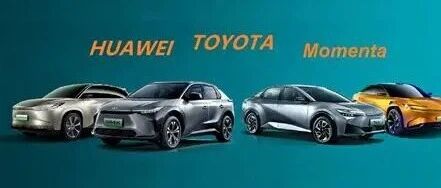
华为Momenta合计占第三方城市NOA市场八成,月搭载量均达 8-10 万量级
凤凰网财经· 2026-01-28 14:15
Core Insights - The report indicates that by November 2025, the cumulative sales of passenger cars equipped with urban NOA functionality in China reached 3.129 million units, highlighting rapid industry growth [1] - Momenta and Huawei's HI model dominate the market, collectively accounting for approximately 80% of the third-party supplier market share, with both companies achieving monthly installation volumes in the range of 80,000 to 100,000 units, establishing a strong "dual strong pattern" [1] Group 1 - The urban NOA market is characterized by a "dual-wheel drive" model, where car manufacturers either develop the technology in-house or collaborate with third-party suppliers to seize market opportunities [3] - In the period from January to November 2025, Momenta's urban NOA installation volume reached 414,400 units, representing about 61.06% of the third-party supplier market share, and it collaborates with 8 out of the top 10 global automotive manufacturers [3] - Huawei's HI model achieved an installation volume of approximately 134,100 units, accounting for about 19.76% of the third-party supplier market share, with a notable increase in installations by November 2025 [3] Group 2 - Domestic brands sold 2.5373 million units equipped with urban NOA functionality, making up 81.1% of the total, showcasing the innovation and competitiveness of domestic brands in the smart connected vehicle sector [3] - Global automotive brands such as Mercedes-Benz, BMW, Audi, Cadillac, Buick, and Toyota are actively collaborating with leading Chinese smart driving suppliers to implement urban NOA functionality and enhance technology [4] - The report emphasizes that third-party technology suppliers like Huawei and Momenta provide a "Chinese solution" for the global smart driving industry, attracting renowned automotive brands from Germany, the United States, Japan, and South Korea to collaborate deeply with Chinese tech companies [6]
一把手访谈⎜北京顺义国际新城建设中
Bei Jing Ri Bao Ke Hu Duan· 2026-01-28 14:02
Core Viewpoint - The construction of the Shunyi International New City is a strategic breakthrough period for high-quality development during the 14th Five-Year Plan, focusing on the integration of industry and city, and enhancing the capital's development [1] Group 1: Infrastructure Development - Shunyi District plans to accelerate the construction of an international air city and support the development of the Beijing Capital International Airport as a world-class aviation hub [1] - The district will implement a plan to expand 315 flight slots, reinforcing its leading position in the national air economy [1] - Key infrastructure projects include the second and third phases of the Jingmi Expressway and the New National Exhibition Liaison Line, with the goal of starting construction on the Shunping Expressway and the first phase of the R4 line [1] Group 2: Industrial Growth - Shunyi has established a "5+4" modern industrial system to support the successful launch of new models such as the Mercedes-Benz GLE and the Li Auto pure electric i9 [1] - The district aims to strengthen its aviation service ecosystem, leveraging the Rolls-Royce engine maintenance project [1] - The area plans to host exhibitions with a total area of no less than 3.3 million square meters throughout the year, focusing on the "exhibition+" strategy [1] Group 3: Governance and Community Development - Shunyi District will continue to deepen grassroots governance innovation practices to foster a positive community atmosphere [1]