
歌尔股份

Search documents
米哈游双公司港股上市!揭秘游戏巨头的资本版图,青岛学到什么?
Sou Hu Cai Jing· 2026-01-16 14:37
Group 1 - The core focus of the article is on miHoYo's strategic investments and its dual role as both an investor and a client in the gaming and technology sectors [2][3] - miHoYo holds 7.34% of MiniMax, an AI company that provides technology for intelligent NPCs and scene generation in games, showcasing its investment and client relationship [5] - miHoYo also owns 11.86% of Suplay, which sells merchandise related to miHoYo's IP, indicating a strategy of leveraging investments to enhance its own product distribution [5][7] Group 2 - miHoYo has expanded its investment portfolio beyond gaming, venturing into AI, XR, nuclear fusion, and brain-computer interfaces, reflecting a significant shift in its business model [7][9] - The company was founded in 2011 by Cai Haoyu and has grown to become the highest-grossing game company globally (excluding the Chinese market) by 2021, with a valuation of 1.75 trillion [9][12] - The article highlights the collaboration between miHoYo and Qingdao through the "Qingdao Tongge Phase I" fund, which focuses on investing in hard technology sectors like integrated circuits and virtual reality [12][14] Group 3 - Qingdao's VR industry has lagged behind other cities, despite its historical prominence, with only one company making it to the top 50 VR companies in 2025 [14][16] - The article suggests that Qingdao can learn from miHoYo's success by fostering professional investment institutions and attracting talent to enhance its industrial development [16][20] - It emphasizes the importance of aligning investment strategies with emerging sectors and ensuring a robust supply chain to retain businesses [22][24]

三倍牛股,三年连亏,科森科技没能讲出市场爱听的故事
Tai Mei Ti A P P· 2026-01-16 12:12
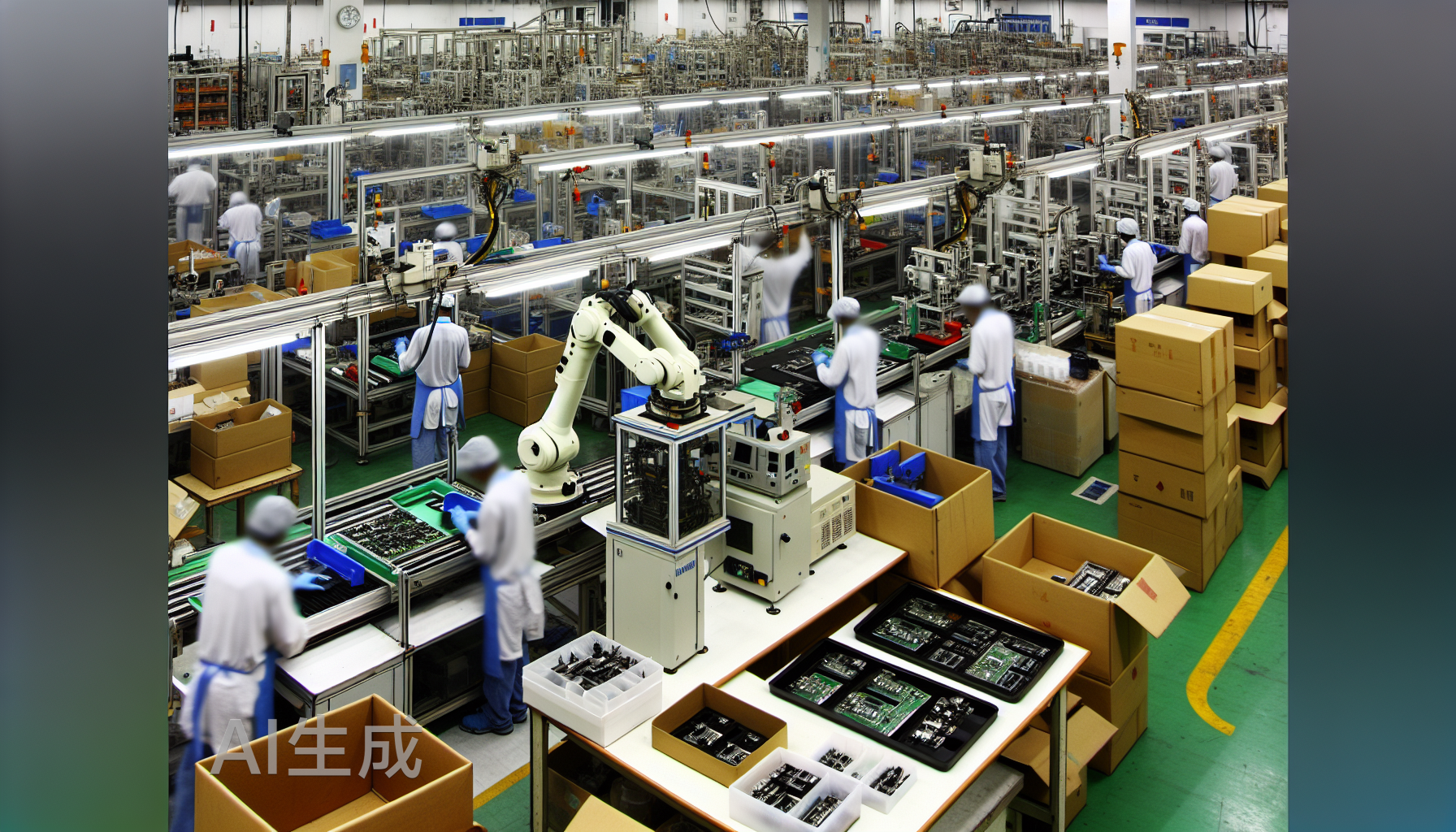
Core Viewpoint - Kosen Technology (603626.SH) is expected to report a loss of between 330 million yuan and 245 million yuan for the entire year of 2025, marking its third consecutive year of losses, indicating significant challenges in the consumer electronics sector [2][4]. Group 1: Financial Performance - The company anticipates a net profit attributable to shareholders of -330 million yuan to -245 million yuan for 2025, with a net profit excluding non-recurring gains and losses expected to be between -393 million yuan and -308 million yuan [7]. - Kosen Technology's net profit has shown a drastic decline over recent years, with year-on-year changes of -76.48%, -424.29%, and -69.44% from 2022 to 2024, while gross margins have decreased from 14% to 5.34% during the same period [10]. Group 2: Market Position and Challenges - Kosen Technology is a second-tier supplier in the precision structural components sector for consumer electronics, with a market share of less than 3% globally and ranking between fifth and eighth in its domestic niche, generating approximately 3 billion yuan in revenue [4][8]. - The company faces significant pressure from both upstream and downstream in the supply chain, particularly as major clients like Huawei and Apple impose stricter cost controls and cultivate new suppliers to enhance their bargaining power [8]. Group 3: Strategic Adjustments and R&D - The anticipated losses for 2025 are attributed to several factors, including fluctuating market demand, low capacity utilization, strategic adjustments leading to inventory write-offs, and high R&D expenditures impacting net profits [6][18]. - Kosen Technology has maintained a high level of R&D investment, with 167 million yuan allocated in the first three quarters of 2025, representing 6.81% of revenue, although this is significantly lower than industry leaders [19]. Group 4: Market Perception and Speculation - The company has been associated with various high-tech concepts, such as solid-state batteries and foldable screens, which have led to speculative trading despite the weak fundamentals of its core business [11][12]. - Kosen Technology's management has attempted to pivot through strategic adjustments, including the sale of its high-margin medical device business to focus on its core consumer electronics operations, although the effectiveness of these measures remains uncertain [18].

未来五年复合增速有望达50%,AI眼镜有望成为AI应用落地的重要场景之一
Mei Ri Jing Ji Xin Wen· 2026-01-16 09:49
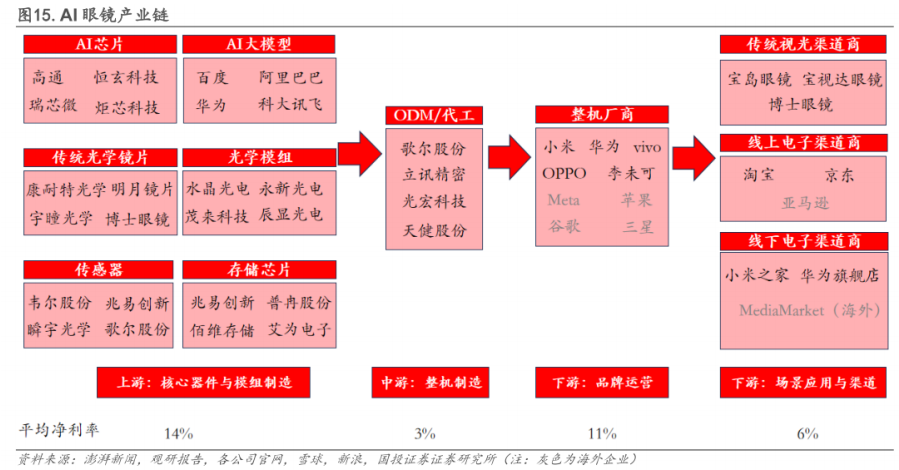
Core Insights - Meta has suggested that EssilorLuxottica SA increase the annual production capacity of its AI glasses, Ray-Ban, to 20 million units or more by the end of 2026, with discussions for further expansion to over 30 million units if demand is strong [1] - The AI glasses industry is seen as a key area for the application of AI technology, integrating features like voice assistance, real-time translation, and navigation reminders [2] Industry Overview - AI glasses are categorized into three types: 1. Non-camera AI glasses focusing on audio and communication features 2. Camera-equipped AI glasses that offer image capture and recognition capabilities 3. Display-equipped AI glasses (AI+AR) that integrate AR optical display technology for real-time output and gesture recognition [3] - The market penetration of AI glasses is currently very low, with a projected sales distribution in 2024 showing 96% for camera AI glasses, 3% for AR+AI glasses, and 1% for audio AI glasses [3] Market Potential - The AI glasses industry is expected to evolve into an AI+AR ultimate form, potentially replacing smartphones as the next generation of smart platforms, offering advantages such as enhanced user experience and immersive interaction [4] - The global market for AI glasses is projected to grow significantly, with shipments expected to rise from 9.93 million units in 2025 to 86.9 million units by 2030, corresponding to a market size increase from 19.7 billion yuan to 161.2 billion yuan, reflecting a compound annual growth rate of 50% [10] Competitive Landscape - Major companies are entering the AI glasses market, with notable product launches including: - Baidu's Xiaodu AI glasses, featuring first-person perspective photography and various smart functions [5] - Huawei's Smart Glasses 2, designed with a stylish aesthetic and advanced translation capabilities [5] - Xiaomi's AI glasses, which support video calls and live streaming [5] - Meta's new AR+AI glasses, marking a significant breakthrough in the field [6] Investment and Development Trends - The AI glasses sector is experiencing rapid investment, with state-owned capital leading the way, and 14 financing events reported in 2024, with nearly 80% from state-owned sources [7] - The industry is characterized by a value chain that includes upstream core components, midstream manufacturing, and downstream branding, with a "smile curve" distribution of value [8] - Companies like Songyuan Technology and Mingyue Lens are positioned to benefit from the growth in AI glasses, with advancements in chip design and optical components [11][12]

7个方面攻坚!青岛科创大走廊激活创新发展“新磁场”
Qi Lu Wan Bao· 2026-01-15 14:28
Core Viewpoint - The Qingdao Science and Technology Innovation Corridor aims to become a competitive innovation development hub both nationally and globally, focusing on integrating technology innovation with economic growth and enhancing the region's innovation ecosystem [1][4]. Group 1: Corridor Overview - The Qingdao Science and Technology Innovation Corridor officially started construction on November 7, 2025, stretching 53 kilometers along the coastal road and covering an area of approximately 190 square kilometers, connecting Laoshan District, Licang District, and Qingdao Blue Valley [1][2]. - The corridor is designed to highlight the natural features of mountains, seas, bays, rivers, islands, springs, and beaches, with a well-developed road network and metro connectivity [2]. Group 2: Innovation Resources - The corridor will leverage the Laoshan Laboratory as a leading entity, concentrating on marine science initiatives such as the "Transparent Ocean" project, and boasts the highest number of marine academicians in the country [2]. - It will gather eight universities, including Ocean University of China and Shandong University (Qingdao), along with eight national key laboratories, two national manufacturing innovation centers, 14 provincial-level research institutes, and 21 provincial-level new R&D institutions [2]. Group 3: Strategic Focus Areas - The construction plan includes seven focus areas and 24 specific tasks, such as establishing a global marine technology innovation source, building a high-level innovation platform system, and accelerating the integration of innovation chains and industrial chains [3]. - The corridor will also emphasize attracting high-level global innovation talent through the "Talent Strong Qingdao" initiative, enhancing the environment for talent development and entrepreneurship [3]. Group 4: Industry Development - The corridor will focus on four major industry directions: marine, digital intelligence, life sciences, and future technologies, creating an industry system referred to as "242N" [3]. - This includes high-end marine equipment, artificial intelligence, new generation information technology, and various advanced fields such as quantum information and satellite internet [3]. Group 5: Regional Cooperation and Environment - The initiative aims to foster regional innovation cooperation, engaging in international collaborations and integrating with advanced domestic innovation corridors [3]. - Efforts will be made to enhance the quality of the living and working environment, including smart city development and improving urban service facilities [3][4].
ETF复盘资讯|A股缩量震荡!顺周期起舞,有色ETF华宝、化工ETF逆市创新高!热门赛道遇冷,通用航空ETF华宝跌超3%
Sou Hu Cai Jing· 2026-01-15 14:01
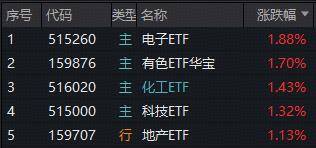
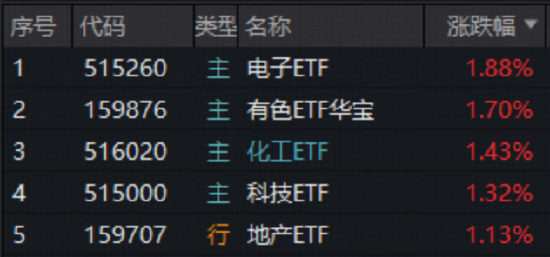
Market Overview - The A-share market experienced fluctuations on January 15, with the Shanghai Composite Index briefly falling below 4100 points before recovering at the close. The Shanghai Composite Index fell by 0.33%, while the Shenzhen Component Index rose by 0.41%, and the ChiNext Index increased by 0.56% [1] - The total trading volume in the Shanghai and Shenzhen markets was 29.388 billion yuan, significantly down by over 10 billion yuan compared to the previous day [1] Sector Performance Electronics Sector - The electronics sector saw a strong rally in the afternoon, with the electronic ETF (515260) rising by 1.88%, recovering its 5-day moving average. The sector attracted a net inflow of 16.862 billion yuan from institutional investors, leading all 31 primary industries [3][6] - Key stocks in the electronics sector included Unigroup Guowei, which hit a daily limit up of 10%, and Huazhong Microelectronics, which rose by 7.58% [4][5] Chemical Sector - The chemical sector also performed well, with the chemical ETF (516020) reaching a peak increase of 2.42% during the day and closing up by 1.43%, marking a new three-year high. The sector attracted 14.7 billion yuan in net inflows, leading the market [9][11] - Notable stocks included Tongcheng New Materials, which hit the daily limit up, and Hongda Co., which surged by 6.25% [9][13] AI and Robotics Sector - The AI and robotics sectors faced some challenges, with the general aviation ETF (159231) dropping by 3.56%. However, the ChiNext AI ETF (159363) and the Sci-Tech AI ETF (589520) also saw declines, indicating a mixed performance in this area [1][15] Investment Insights - Analysts from Huajin Securities believe that the recent adjustment of financing margin ratios will have a limited impact on A-share trends, as the market is currently in a slow bull phase supported by structural recovery in profits and low credit levels [2] - The electronics sector is expected to benefit from the U.S. government's recent imposition of tariffs on certain semiconductors, which may enhance domestic substitution sentiment [6] - The chemical industry is anticipated to experience a rebound in profitability as supply-demand dynamics stabilize, with AI-driven production capabilities expected to lead to new growth opportunities [13][14]



A股缩量震荡!顺周期起舞,有色ETF华宝、化工ETF逆市创新高!热门赛道遇冷,通用航空ETF华宝跌超3%
Xin Lang Cai Jing· 2026-01-15 11:31
Market Overview - The A-share market experienced fluctuations on January 15, with the Shanghai Composite Index briefly falling below 4100 points before recovering at the close. The Shanghai Composite Index fell by 0.33%, while the Shenzhen Component Index rose by 0.41%, and the ChiNext Index increased by 0.56%. The total trading volume in the Shanghai and Shenzhen markets was 29.388 trillion yuan, a significant decrease of over 1 trillion yuan compared to the previous day [1][20]. Electronic Sector - The electronic sector saw a strong rally in the afternoon, with the electronic ETF (515260) rising by 1.88%. This ETF is heavily weighted in semiconductor and consumer electronics industries, and it recovered its 5-day moving average [3][23]. - The electronic sector attracted a net inflow of 16.862 billion yuan, leading all 31 primary industries in terms of capital inflow [3][23]. - Key stocks in the semiconductor sector, such as Unisoc and Huazhong Microelectronics, saw significant gains, with Unisoc hitting the daily limit of 10% [25][26]. Chemical Sector - The chemical sector also performed well, with the chemical ETF (516020) reaching a peak increase of 2.42% during the day, closing up 1.43%, marking a new three-year high [8][29]. - The basic chemical sector attracted a net inflow of 14.694 billion yuan, the highest among 30 primary industries, and has seen a cumulative net inflow of 254.049 billion yuan over the past 60 days [10][31]. - The chemical ETF has outperformed major indices since the beginning of 2025, with a cumulative increase of 48.29%, significantly higher than the Shanghai Composite Index's 22.7% and the CSI 300 Index's 20.75% [29][30]. AI and Semiconductor Trends - The U.S. government announced a 25% tariff on specific semiconductors, which may enhance domestic substitution sentiment in the market [25][27]. - The demand for AI computing power is expected to drive significant price increases in storage chips, with projections indicating a rise of up to 1800% for certain DDR chips by 2025 [27]. - The trend of "self-controllable" and AI synergy is anticipated to strengthen in the electronics industry, with a focus on domestic computing power and semiconductor equipment [27]. Investment Tools - The electronic ETF (515260) and its linked funds are effective tools for investors looking to gain exposure to core assets in the electronic sector, particularly in AI chips, automotive electronics, and 5G technologies [27]. - The chemical ETF (516020) is also highlighted as a strategic investment vehicle, covering various segments within the chemical industry, including AI computing and robotics [13][29].
涉及英伟达和超威!美国对部分半导体加征关税!紫光国微复牌一字涨停!电子ETF(515260)逆市劲涨1.88%
Xin Lang Cai Jing· 2026-01-15 11:25
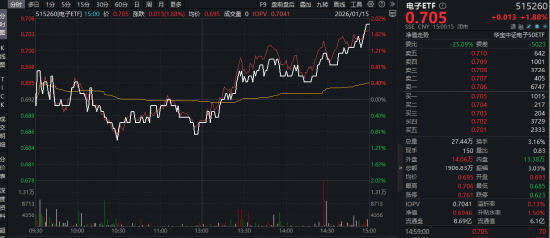
Core Viewpoint - The electronic sector experienced a significant surge, leading the market with a net inflow of 16.862 billion yuan, marking the highest absorption among 31 primary industries in the Shenwan classification [1][9]. Group 1: Macro Factors - On January 14, the U.S. White House announced a 25% tariff on specific semiconductors, including Nvidia's H200 chip and AMD's MI325X AI accelerator chip, which may enhance market sentiment for domestic alternatives [2][10]. Group 2: Industry Trends - The explosive growth in global AI computing power demand has led to a strong market for storage chips, with prices reportedly increasing by 18 times over the past year. Projections indicate that by 2025, prices for DDR4 16Gb chips could rise by 1800%, DDR5 16Gb by 500%, and 512Gb NAND flash by 300% [3][11]. Group 3: Company Developments - On January 14, chip giant Unisoc announced plans for a private placement to acquire Ruineng Semiconductor, aiming to integrate its power semiconductor product matrix and enhance its competitive position in the semiconductor industry [3][11]. Group 4: ETF and Investment Tools - The electronic ETF (515260) saw a price increase of 1.88%, recovering its 5-day moving average, and serves as an efficient tool for investors looking to gain exposure to core assets in the electronic sector, including semiconductors and consumer electronics [1][9][12].
消费电子板块1月15日涨1.73%,环旭电子领涨,主力资金净流入21.48亿元
Zheng Xing Xing Ye Ri Bao· 2026-01-15 08:53
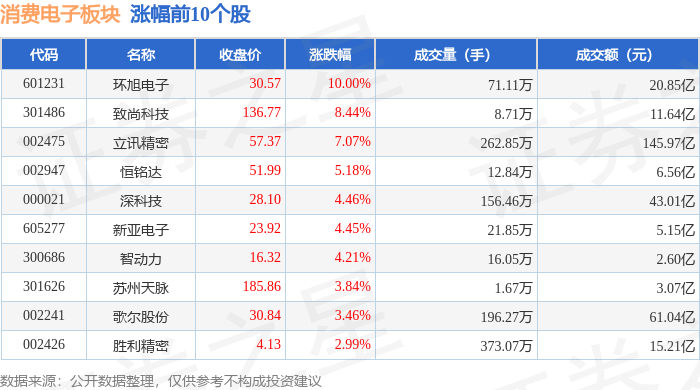
Group 1: Market Performance - The consumer electronics sector rose by 1.73% on January 15, with Huanxu Electronics leading the gains [1] - The Shanghai Composite Index closed at 4112.6, down 0.33%, while the Shenzhen Component Index closed at 14306.73, up 0.41% [1] Group 2: Individual Stock Performance - Huanxu Electronics (601231) closed at 30.57, up 10.00%, with a trading volume of 711,100 shares and a transaction value of 2.085 billion [1] - Zhishang Technology (301486) closed at 136.77, up 8.44%, with a trading volume of 87,100 shares and a transaction value of 1.164 billion [1] - Luxshare Precision (002475) closed at 57.37, up 7.07%, with a trading volume of 2,628,500 shares and a transaction value of 14.597 billion [1] - Other notable performers include Hengmingda (002947) up 5.18%, and Shentech (000021) up 4.46% [1] Group 3: Capital Flow Analysis - The consumer electronics sector saw a net inflow of 2.148 billion from main funds, while retail funds experienced a net outflow of 1.297 billion [2] - The main funds' net inflow for Luxshare Precision was 2.623 billion, while it faced a net outflow of 1.551 billion from speculative funds [3] - Shentech had a net inflow of 503 million from main funds, with a net outflow of 173 million from speculative funds [3]





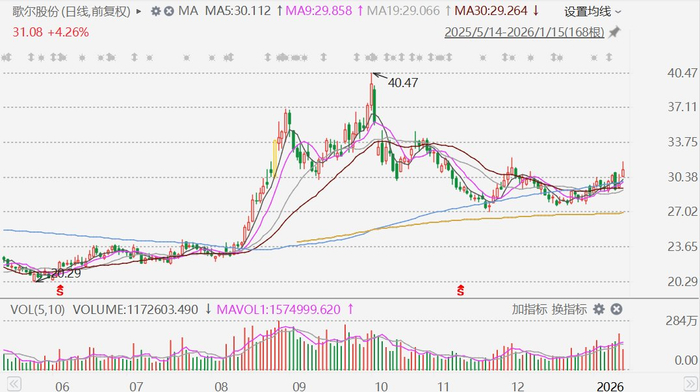
A股异动丨歌尔股份一度涨近7%,据报将代工字节正研发的新一代豆包AI耳机
Ge Long Hui A P P· 2026-01-15 03:47
Core Viewpoint - GoerTek Inc. (002241.SZ) experienced a significant stock increase of nearly 7%, reaching 31.86 yuan, following reports that ByteDance is developing a new generation of AI headphones, which will be manufactured by GoerTek [1] Company Developments - GoerTek has established a dedicated business group (BG) to manage and oversee operations related to ByteDance [1]
Meta拟将AI智能眼镜产能翻倍,消费电子ETF(561600)备受关注
Xin Lang Cai Jing· 2026-01-15 02:48
Group 1 - The core viewpoint of the news highlights the performance of the China Securities Consumer Electronics Theme Index, with notable gains from stocks like Unisoc and Xiamen Tungsten, while the ETF tracking this index is priced at 1.25 yuan [1] - Meta Platforms is in discussions with EssilorLuxottica to double the production capacity of AI smart glasses by the end of 2026, aiming for an annual output of 20 million units or more [1] - CITIC Securities reports that the convergence of self-control and AI will drive significant performance in related sectors by 2025, with expectations for further strengthening in 2026, particularly in domestic computing power and semiconductor equipment [1] Group 2 - As of December 31, 2025, the top ten weighted stocks in the China Securities Consumer Electronics Theme Index account for 54.35% of the index, including companies like Luxshare Precision and Semiconductor Manufacturing International Corporation [2] - The Consumer Electronics ETF closely tracks the China Securities Consumer Electronics Theme Index, which includes 50 listed companies involved in component production and electronic brand design [2]