Arm Holdings plc

Search documents
高盛表示DRAM合约价格不跌反升;台积电2nm产能已被预订一空
Mei Ri Jing Ji Xin Wen· 2026-02-03 02:21
Market Performance - The Shanghai Composite Index fell by 2.48% to close at 4015.75 points, while the Shenzhen Component Index dropped by 2.69% to 14128.87 points, and the ChiNext Index decreased by 2.46% to 3264.11 points [1] - The Kweichow Moutai Semiconductor ETF (588170) declined by 5.49%, and the Huaxia Semiconductor Equipment ETF (562590) fell by 5.02% [1] - In contrast, the overnight U.S. market saw the Dow Jones Industrial Average rise by 1.05%, the Nasdaq Composite increase by 0.56%, and the S&P 500 gain 0.54% [1] Industry Insights - Goldman Sachs indicated that despite fluctuations in the spot market, DRAM contract prices are expected to rise significantly, with global storage supply-demand imbalance worsening in Q1, leading to increased forecasts for DRAM and NAND products [2] - TSMC's 2nm capacity has been fully booked by global tech giants, with AMD planning to produce 2nm CPUs starting in 2026, and Google and AWS expected to adopt this technology in Q3 and Q4 of 2027, respectively [2] - PRAM's recent institutional research highlighted that the overall capacity of NOR Flash is linked, with high-value large-capacity products experiencing early price increases due to supply shortages and demand stimulation, leading to a gradual price increase for medium and small-capacity products [2] Company Performance - According to Citic Securities, the global wafer foundry industry remains robust due to the rapid growth in AI computing demand, with TSMC's revenue expected to reach NT$1.05 trillion in Q4 2025, marking a 20.45% year-on-year increase and setting a quarterly record [3] - TSMC's annual revenue is projected to grow by 31.60% to NT$3.81 trillion, indicating significant growth potential compared to mainland China's wafer foundry companies [3] - The Kweichow Moutai Semiconductor ETF (588170) and its linked funds focus on semiconductor equipment and materials, benefiting from the AI revolution and domestic substitution trends in the semiconductor industry [3]

“热钱”寻找新叙事点,昨夜存储巨头暴涨!
证券时报· 2026-02-03 00:16
Core Viewpoint - The article highlights the significant movements in the U.S. stock market, particularly focusing on the performance of major companies and the implications of recent economic data. Group 1: Stock Market Performance - On February 2, U.S. stock indices closed higher, with the Dow Jones up 1.05%, S&P 500 up 0.54%, and Nasdaq up 0.56% [1][3] - Major tech companies are set to report earnings this week, including Google, Amazon, and others across various sectors [1] Group 2: Technology Sector Insights - Micron Technology rose over 5%, while other tech stocks like Texas Instruments, Dell Technologies, and Apple saw gains exceeding 4% [5] - Apple is expected to launch a new MacBook Pro with an M6 chip, which will not utilize TSMC's latest 2nm N2P process, potentially saving costs and ensuring supply [5] - Nvidia's stock fell 2.89% amid stalled negotiations with OpenAI regarding a $100 billion investment, highlighting risks associated with reliance on a single client [6] Group 3: Semiconductor and Memory Market - SanDisk shares surged 15.44% following reports of a 35% increase in average NAND flash prices by Q4 2025, attracting investment from funds moving away from precious metals and cryptocurrencies [6] Group 4: Economic Indicators - The U.S. manufacturing PMI unexpectedly rose from 47.9 to 52.6 in January, marking the highest level since February 2022 and indicating a shift towards expansion [9][11] - The U.S. government shutdown has delayed the release of the January non-farm payroll report, affecting data collection and publication by the Bureau of Labor Statistics [10]






Stocks Set to Open Lower as Risk Sentiment Weakens, U.S. Jobs Data and Earnings in Focus
Yahoo Finance· 2026-02-02 11:29
Economic Data - The U.S. producer price index (PPI) for final demand increased by +0.5% month-over-month (m/m) and +3.0% year-over-year (y/y) in December, surpassing expectations of +0.2% m/m and +2.7% y/y [1] - The core PPI, excluding food and energy, rose by +0.7% m/m and +3.3% y/y in December, also exceeding expectations of +0.2% m/m and +2.9% y/y [1] - The Chicago PMI for January rose to 54.0, significantly above the expected 43.5 [1] Stock Market Performance - Major equity averages on Wall Street ended lower, with chip stocks like KLA Corp. (KLAC) dropping over -15% and Advanced Micro Devices (AMD) falling more than -6% [2] - Mining stocks also declined sharply, with Coeur Mining (CDE) down over -16% and Hecla Mining (HL) sliding more than -14% [2] - PennyMac Financial Services (PFSI) plummeted over -33% after reporting disappointing Q4 results [2] - Conversely, Deckers Outdoor (DECK) surged more than +19% after better-than-expected FQ3 results and an increase in full-year guidance [2] Corporate Earnings and Economic Outlook - Investors are anticipating a new round of corporate earnings reports from major companies including Alphabet (GOOGL), Amazon.com (AMZN), and others, with S&P 500 companies expected to report an average +8.4% increase in Q4 earnings compared to the previous year [8][9] - The U.S. January Nonfarm Payrolls report is awaited for insights into the labor market and its implications for monetary policy, with revisions expected to show a significant markdown in hiring pace [10] - Several Federal Reserve officials are scheduled to speak this week, with discussions likely focusing on the current inflationary environment and interest rate policies [11] Global Market Trends - The Euro Stoxx 50 Index is down -0.07%, with mining stocks declining due to falling metal prices [14] - In Japan, the Nikkei 225 Index closed lower as risk sentiment soured, despite initial gains from a weaker yen and positive election polls [19] - China's Shanghai Composite Index experienced a significant drop, influenced by disappointing economic data and geopolitical concerns [16][17] Company-Specific Developments - Oracle (ORCL) announced plans to raise $45 billion to $50 billion for cloud infrastructure expansion, raising concerns about its debt burden [4][21] - Nvidia (NVDA) shares fell about -2% after CEO Jensen Huang clarified that the proposed $100 billion investment in OpenAI was not a commitment [4][22] - Palantir Technologies (PLTR) rose over +2% in pre-market trading following an upgrade from William Blair [22]


Commodity Volatility, Earnings and Other Key Things to Watch
Yahoo Finance· 2026-02-01 18:00
Employment Data and Economic Indicators - The January employment report is crucial for assessing labor market health amid a new Fed chair nominee, with nonfarm payrolls, unemployment rate, and wage growth data being key indicators [1] - The ADP employment report and JOLTS job openings will provide insights into private sector employment and labor demand trends, while initial jobless claims will complete the employment picture [1] - Strong employment numbers could complicate the new Fed chair's policy stance, suggesting persistent economic strength, while significant weakness could allow for a dovish approach [1] Market Reactions and Economic Context - February begins with a volatile market following January's trading, influenced by unexpected inflation data and the new Federal Reserve chair nominee [2] - Precious metals, particularly silver, experienced significant selloffs, with silver dropping over 27% after a rally, indicating market turbulence [2] - The upcoming week features critical employment data and earnings reports from major companies, creating a complex backdrop for market positioning [2] Technology Sector Insights - Earnings reports from Alphabet and Amazon are critical for evaluating the health of digital advertising and cloud infrastructure investments [3] - Alphabet's performance will be analyzed for trends in search advertising and YouTube, while Amazon's results will provide insights into e-commerce margins and AWS performance [3] - Both companies' commentary on AI integration and enterprise cloud spending will be vital for technology sector sentiment [3] Pharmaceutical Sector Developments - Earnings from Eli Lilly and Novo Nordisk will shed light on the GLP-1 weight loss drug market, which has significantly impacted their market capitalizations [4] - Key metrics such as patient demand, production capacity, and insurance coverage trends will be scrutinized to assess market sustainability [4] - Broader pharmaceutical earnings from Pfizer and Merck will provide context on drug pricing and healthcare spending trends [4] Semiconductor Sector Analysis - Earnings from AMD, Qualcomm, and Arm Holdings will offer insights into the semiconductor sector following recent volatility in AI infrastructure [5] - AMD's results will be critical for understanding its competitive position against Nvidia in the data center GPU market [5] - The earnings will also provide perspectives on consumer electronics demand through smartphone and mobile computing trends [6] Manufacturing and Services Sector Data - The ISM Manufacturing PMI and Manufacturing PMI will provide initial economic data for February, focusing on industrial sector health and pricing pressures [7] - Services sector assessments through Services PMI and ISM Non-Manufacturing PMI will offer insights into the economy's largest sector [7] - The convergence of manufacturing and services data will help determine the economic momentum entering 2026, influencing Fed policy considerations [7]
“电力克苏鲁”赢得AI竞争? 中国发电增量已达美国7倍
虎嗅APP· 2026-01-31 09:38
Core Viewpoint - The article discusses the escalating competition among global tech giants for electricity supply, driven by the increasing energy demands of AI development, highlighting China's significant advantage in power generation capacity compared to the U.S. [5][6][12] Group 1: Electricity Demand and Supply Challenges - Tech giants are entering a "power grab" as AI's energy needs surge, with Meta, Microsoft, and Google forming partnerships with nuclear power companies to secure long-term electricity contracts [8][9][11]. - The U.S. energy consumption is projected to reach a historical high of 29,000 terawatt-hours by 2026, while AI data centers are expected to consume 20%-25% of U.S. electricity by 2030 [5][12]. - The average annual electricity growth rate is only 2%-4%, creating a significant supply-demand gap as AI's energy requirements grow exponentially [12][14]. Group 2: U.S. Energy Infrastructure Issues - The lengthy approval process for new energy projects in the U.S. can take 7-10 years, with over 50% of projects being rejected, leading to delays in meeting energy demands [19][20]. - Aging infrastructure, with over 70% of transmission lines built before the 1970s, exacerbates the energy supply issues, particularly in tech-heavy regions like California and Texas [20][21]. - The conflict between tech companies' energy consumption and local residents' electricity costs has led to significant price increases, with some areas seeing a 200% rise in electricity bills [22][24]. Group 3: China's Energy Advantage - China is projected to add approximately 470 gigawatts of new power generation capacity by 2025, seven times that of the U.S., which is only expected to add 64 gigawatts [26][28]. - The establishment of a nationwide power grid in China allows for efficient energy distribution, overcoming geographical limitations and ensuring a stable supply for AI development [29][30]. - The cost of electricity in China's western regions is significantly lower than in the U.S., providing a competitive edge for Chinese AI companies in terms of operational costs [31][32]. Group 4: Strategic Importance of Energy in AI Competition - The article emphasizes that energy supply is becoming a strategic resource in the AI competition, with countries needing robust energy systems to support technological advancements [37][38]. - The geopolitical implications of energy resources are highlighted, with the U.S. engaging in actions to secure energy supplies globally, reflecting the critical role of energy in future technological competition [40].


Warsh speaks as a dove, but might be more hawkish on inflation, investment strategist says
Youtube· 2026-01-31 04:45
Market Performance - The Dow closed January with a gain for the ninth consecutive month, marking its longest winning streak since January 2018 [1] - The S&P and NASDAQ also showed positive performance for the month [1] Stock Highlights - Notable winners in the S&P this month included Micron, Moderna, and Seagate, which experienced significant gains [2] - Conversely, Apple, Inuit, and Humana were identified as laggards, losing altitude during the same period [2] Earnings Reports - The fourth quarter earnings reports contributed significantly to the market's rise this month, with a busy earnings calendar ahead [2] - Approximately 25% of the S&P companies are set to report earnings next week, including major names like Palantir, Disney, AMD, and Alphabet [3][4] Market Sentiment - The market experienced volatility, with the Dow down 611 points at one point before recovering [5] - The nomination of Kevin Worsh to the Fed has created confusion in the market regarding future interest rate policies [6][8] Commodity Insights - Gold and silver prices dropped, indicating market expectations of taming inflation, which aligns with a potentially hawkish Fed stance [7] - Energy prices have been resilient, with oil rising to $65 per barrel amid geopolitical tensions in the Middle East [9][10]

Stocks Settle Lower on Weakness in Chip Stocks and Miners
Yahoo Finance· 2026-01-30 21:32
Economic Indicators - The US January MNI Chicago PMI rose by +11.3 to 54.0, exceeding expectations of 43.7, marking the strongest pace of expansion in over two years [1] - US December producer prices (PPI) increased by +0.5% month-over-month and +3.0% year-over-year, surpassing expectations of +0.2% month-over-month and +2.8% year-over-year [3] - Eurozone Q4 GDP grew by +0.3% quarter-over-quarter and +1.3% year-over-year, slightly above expectations of +0.2% quarter-over-quarter and +1.3% year-over-year [12] Stock Market Performance - The S&P 500 Index closed down -0.43%, the Dow Jones Industrials Index down -0.36%, and the Nasdaq 100 Index down -1.28% on Friday [5] - Mining stocks experienced significant declines, with gold prices dropping more than -11% and silver prices plunging more than -31% [14] - Chip makers and AI infrastructure stocks also fell, with KLA Corp down more than -15% and Western Digital down more than -11% [13] Company Earnings and Forecasts - 77% of the 143 S&P 500 companies that reported earnings exceeded expectations, with S&P earnings growth projected to rise by +8.4% in Q4 [7] - Deckers Outdoor reported Q3 net sales of $1.96 billion, better than the consensus of $1.87 billion, and raised its full-year net sales forecast to $5.40 billion-$5.43 billion [17] - Verizon Communications added 616,000 new subscribers in Q4 and announced a share buyback program of up to $25 billion [18] Interest Rates and Monetary Policy - The markets are pricing in a 17% chance of a -25 basis point rate cut at the next policy meeting on March 17-18 [8] - The 10-year T-note yield rose to a 1-week high of 4.277% following the announcement of Kevin Warsh as the new Fed Chair, who is perceived as more hawkish [9]
This AI Chip Stock Could Power the Next Decade. Is It a Buy Ahead of Its Next Earnings Report?
Yahoo Finance· 2026-01-30 17:46
While most investors are chasing artificial intelligence (AI) chipmakers, the real backbone of the AI revolution may be chip designer Arm Holdings (ARM). Its chip designs power everything from smartphones to hyperscale data centers, positioning it as a key player of the next decade of AI. After delivering its strongest quarter ever, Arm is set to report its third quarter fiscal 2026 earnings on Feb. 4 after the market closes. Is this a good opportunity to grab this AI chip stock now? More News from Barc ...

Susquehanna Sees Over $1B Annual Royalties From Arm’s (ARM) AI XPU
Yahoo Finance· 2026-01-30 14:10
Core Viewpoint - Arm Holdings plc (NASDAQ:ARM) is recognized as a promising stock by hedge funds, with a recent upgrade from Susquehanna from Neutral to Positive, setting a price target of $150 due to significant initiatives in AI and custom server CPU development [1] Group 1: Company Initiatives - Arm is collaborating with SoftBank and Broadcom to produce an AI XPU ASIC for OpenAI, which is considered a transformative initiative for the company [1] - The development of a custom server CPU, potentially for Meta, marks Arm's first full silicon product, further enhancing its product offerings [1] Group 2: Financial Projections - Susquehanna estimates that the AI XPU program could generate over $1 billion in annual royalty revenue, contrasting with the projected total company royalties of $2.5 billion for the current year [2] - Despite anticipated challenges in the Mobile and PC markets leading to a royalty default for 2026 models, the stock's recent 40% drop is viewed in light of potential growth opportunities that could exceed Arm's current modest royalty contribution of approximately 10% [3] Group 3: Market Position - Arm Holdings designs and licenses CPU architectures, system IP, and software utilized across various sectors, including automotive, computing, consumer, and IoT applications [3]
黄金白银,价格大跳水
Sou Hu Cai Jing· 2026-01-30 05:51
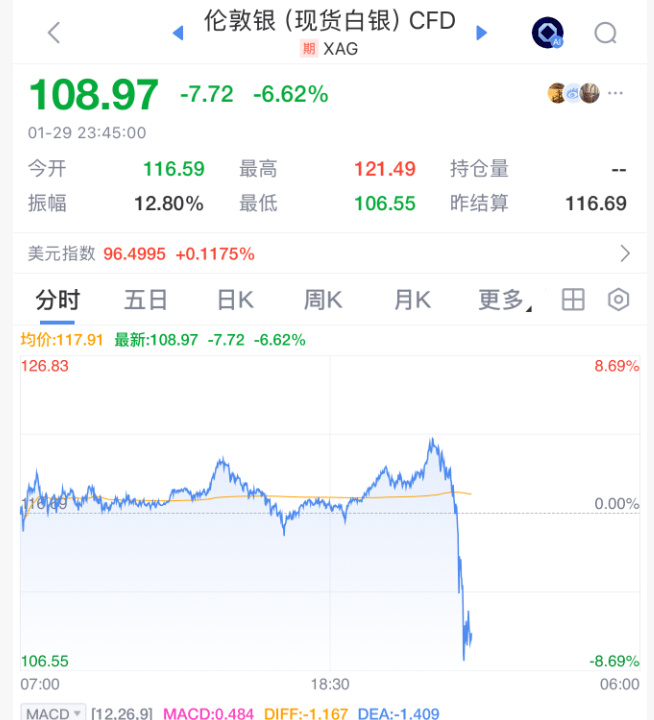
Group 1: Precious Metals - Gold and silver experienced significant declines, with silver dropping by 8% and gold falling below $5,200 per ounce [1] Group 2: Stock Market - U.S. tech stocks faced a sharp decline, with Microsoft experiencing an unprecedented drop of over 10% in a single day, potentially marking the largest daily decline since March 16, 2020 [4] - The Nasdaq index fell by more than 2% [4] - Major tech companies such as Salesforce, Oracle, and Tesla also saw declines of 8.33%, 5.73%, and 3.63% respectively [6] Group 3: Market Sentiment and Future Outlook - The market is questioning the sustainability of AI spending by major tech firms, which has driven stock prices higher over the past three years [7] - Microsoft reported a slowdown in cloud business growth for Q2 of fiscal year 2026 and provided a weak guidance for operating profit margins for Q3 [7] - Bitcoin fell below $86,000, marking its lowest point in about six weeks amid a broader risk asset pullback [7]