DeepSeek

Search documents
US expected to add Alibaba and others to list of firms allegedly aiding China's military, sources say
Reuters· 2026-02-13 13:08
Core Viewpoint - The Trump administration is expected to add Alibaba and other Chinese firms to a list of companies allegedly aiding China's military, which could impact their future contracts with the U.S. government [1]. Group 1: Companies Involved - Alibaba is among the companies expected to be added to the Pentagon's 1260H list, which includes major firms like Tencent Holdings and CATL [1]. - Other firms mentioned for potential inclusion are AI firm DeepSeek, smartphone maker Xiaomi, and electronic display maker BOE Technology [1]. Group 2: Implications of the List - Being added to the list does not impose formal sanctions but prevents the Pentagon from contracting with these companies in the future [1]. - The update to the list may strain U.S.-China relations, especially following a recent trade truce between Xi Jinping and Donald Trump [1].


视频大模型概念强势收官,马年AI主线该怎么投
Di Yi Cai Jing· 2026-02-13 10:11
Group 1 - The core viewpoint of the articles highlights the rapid advancement and commercialization of AI technologies, particularly in video generation, with significant market reactions and investment opportunities emerging in related sectors [1][2][3][4]. - The Seedance video model has achieved major breakthroughs, including multi-modal input support and reduced video production costs, which are expected to enhance the efficiency of video content creation [2][3]. - The AI sector is experiencing a wave of flagship model releases, indicating a shift from singular model competition to a broader race for consumer-level applications, with a focus on reducing operational costs and increasing integration of AI into products [3][4]. Group 2 - The media and semiconductor equipment sectors have shown strong performance, with notable stock price increases for companies like KuanYue Technology and Guanghua Media, driven by the AI wave [1][2]. - Investment sentiment in the AI sector is mixed, with some analysts cautioning against overvaluation and urging investors to focus on companies with strong technology and reasonable expectations [4][5]. - The upcoming Chinese New Year is expected to influence market sentiment positively, as uncertainties have been largely priced in, leading to a more stable outlook for the A-share market post-holiday [6].
AI模型扎堆升级,国产算力需求狂飙,IDC将迎来新一轮爆发?
Hua Er Jie Jian Wen· 2026-02-13 09:16
Core Insights - The Chinese AI industry has reached a critical turning point, shifting from a technological arms race to tangible commercialization and demand explosion, driven by advancements in large models from companies like ByteDance and Zhipu AI [1] - The end of the prolonged price war in cloud computing is indicated by rising prices for API services and public cloud offerings, signaling a return of pricing power to sellers [1][5] Group 1: AI Model Developments - ByteDance's Seedance 2.0 showcases advanced multimodal capabilities, particularly in next-generation video generation technology [2] - Zhipu AI's flagship model GLM-5 has significantly enhanced programming and reasoning performance, contributing to a substantial increase in computational demand [2] - The computational requirements for generating video content are dramatically higher than for text, indicating a potential market shift towards increased demand for computational infrastructure [2] Group 2: Pricing Dynamics - Zhipu AI has raised its GLM code pricing by at least 30% for new users due to strong demand, while UCloud has announced price increases for all products and services [5] - The rising prices are attributed to increased hardware costs and a reversal in supply-demand dynamics driven by surging AI workloads [5] - The price increases from cloud service providers are expected to stabilize IDC rental prices, marking the establishment of a market bottom and the beginning of a profit recovery cycle [5] Group 3: Infrastructure Companies - Century Internet is positioned to benefit directly from ByteDance's AI expenditures, with a target price increase from $15.1 to $17.9, reflecting a faster revenue growth outlook [6] - For GDS Holdings, the target price has been raised from $50.0 to $56.7, with a valuation method that reflects a 14x EV/EBITDA for its China business and a higher multiple for its international operations [7] - Kingsoft Cloud is expected to benefit from Xiaomi's ecosystem strategy, with a maintained target price of $17.0, indicating a favorable position in the recovering cloud service market [8]



版本更新后“变冷淡”?DeepSeek回应
新华网财经· 2026-02-13 08:42
Group 1 - The core viewpoint of the article highlights the significant change in the user experience of the AI assistant DeepSeek, which has been criticized for becoming "cold" and less empathetic, moving away from its previous nuanced and warm interactions [2][3] - Users have reported that the latest version of DeepSeek no longer remembers personalized nicknames, referring to users generically, which has led to a decrease in emotional connection [3] - The AI's ability to provide emotional support has diminished, with responses now being more formal and less engaging, leading some users to experience a "withdrawal reaction" due to the loss of the assistant's previous warmth [3] Group 2 - The competitive landscape for AI assistants in China has intensified, with major players like ByteDance, Baidu, and Alibaba rapidly iterating their products, putting pressure on DeepSeek [3] - DeepSeek had previously held a first-mover advantage in the AI assistant market due to its early technological accumulation and differentiated positioning, but this advantage is now being challenged [3] - The recent updates to DeepSeek include an increase in context length support to 1 million tokens, compared to the previous version's 128,000 tokens, indicating a shift towards handling more complex queries [2]

一场决定中国AI命运的“双向奔赴”
Guan Cha Zhe Wang· 2026-02-13 06:13
Core Viewpoint - The global technology industry is experiencing significant upheaval, driven by the explosive growth of artificial intelligence (AI) and geopolitical tensions affecting global tech cooperation. Despite concerns about China's AI industry, a transformative change is underway, emphasizing the need for technological self-reliance and innovation [1]. Group 1: Industry Challenges - The Chinese AI industry faces profound changes amid a competitive landscape, with issues such as supply-demand mismatches and ecosystem incompatibility leading to challenges in domestic computing power [1]. - The traditional approach of simply increasing computing power through advanced GPU purchases is no longer viable due to intensified geopolitical crises and chip restrictions imposed by Western countries [3]. - The reliance on "special supply" chips may provide temporary relief but poses long-term risks, as it hinders true technological innovation and keeps Chinese firms as followers rather than leaders in the AI space [4]. Group 2: Emerging Solutions - The industry is recognizing that depending on foreign computing power is not sustainable, leading to the exploration of various paths toward self-sufficiency, including a "full-stack self-research" model that integrates chips, frameworks, and application ecosystems [4]. - A collaborative movement involving government, industry, academia, and applications is emerging, focusing on building a closed-loop industry ecosystem that enhances the integration of computing infrastructure, large model manufacturers, and application scenarios [4]. Group 3: Synergy Between Hardware and Software - The shift from independent development of chips, frameworks, and algorithms to a highly coupled relationship between large models and underlying hardware systems is a significant change in the Chinese AI industry [5]. - The recent collaboration between domestic computing power and large models is seen as a critical path for China's AI industry to leapfrog ahead, moving from "using foreign chips to run Chinese models" to "creating Chinese chips for Chinese models" [6][8]. - Successful examples include the DeepSeek model, which has improved inference efficiency by over 30% through adaptation to domestic chips, showcasing a trend towards greater autonomy in technology [7]. Group 4: Infrastructure Development - The launch of the national supercomputing internet core node in Zhengzhou marks a pivotal moment, creating the largest domestic AI computing resource pool and facilitating the integration of various domestic acceleration cards [8][9]. - This system has achieved several milestones, including transforming scarce computing resources into accessible public services and enabling the systematic implementation of soft-hard collaboration [8]. - The rapid growth of the supercomputing internet platform, with over 1.13 million registered users and significant daily processing capabilities, indicates a strong demand for optimized large model adaptations across various fields [9].
MiniMax加入“AI春节档”,上新文本模型,市值暴涨
Nan Fang Du Shi Bao· 2026-02-13 05:45
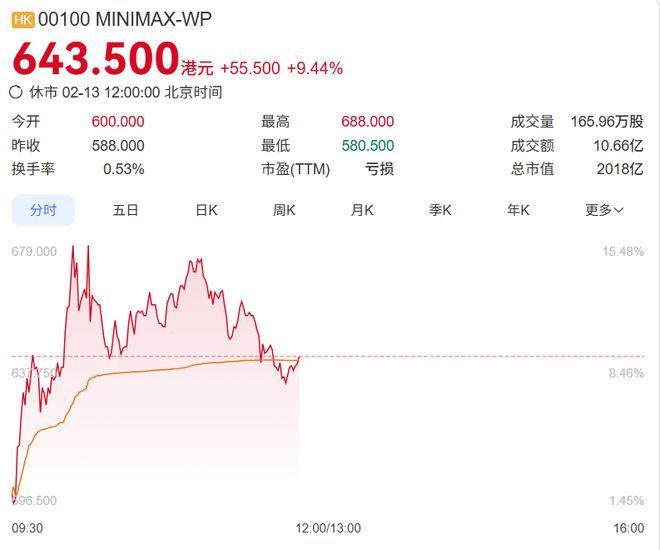
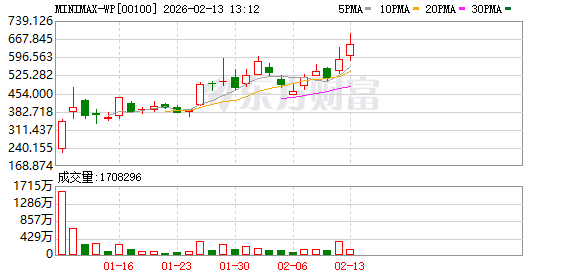
Core Insights - MiniMax has launched its new text model MiniMax M2.5, which is globally open-sourced and supports localized deployment. The model has gained significant traction, with over 10,000 AI Agents built on MiniMax Agent within a day of its launch, leading to a stock price increase of 9.44% to 643.500 HKD per share, doubling its market value since its IPO [1][5]. Performance Metrics - In programming capabilities, M2.5 achieved scores of 80.2% on SWE-Bench Verified and 51.3% on Multi-SWE-Bench, marking a significant improvement over its predecessor. It surpassed Claude Opus 4.6 in multi-language complex environments, reaching industry-leading performance [3]. - The model demonstrated "native Spec capabilities," allowing it to deconstruct architecture and functional planning proactively, mimicking the work patterns of real architects [3]. - In terms of tool invocation and search capabilities, M2.5 improved performance by 20% compared to the previous model, achieving top-tier results in complex tasks like BrowseComp and Wide Search [3]. Cost Efficiency and Speed - The M2.5-lightning version supports over 100 transactions per second (TPS), approximately double that of mainstream models. The input cost is about $0.3 per million tokens, while the output cost is around $2.4 per million tokens. This translates to a theoretical cost of $1 for continuous operation at 100 tokens per second for one hour, or $0.3 at 50 tokens per second, allowing $10,000 to support four agents working continuously for a year [5]. - Over the past three months, MiniMax has iterated from M2 to M2.5, with SWE-Bench Verified scores rising from 69.4 to 80.2, indicating a steep improvement curve in the industry attributed to large-scale Agent Reinforcement Learning (RL Scaling) [5]. Industry Context - The launch of MiniMax M2.5 coincides with a wave of new releases from domestic large model companies, aiming to capture the "AI Spring Festival" market. Notable competitors include ByteDance's Seedance 2.0, Alibaba's Qwen-Image-2.0, and updates from DeepSeek and Mianbi Intelligent [6].
MiniMax官宣M2.5参战“春节档”,总市值超2000亿
2 1 Shi Ji Jing Ji Bao Dao· 2026-02-13 05:11
Core Insights - MiniMax launched its new text model MiniMax M2.5 on February 12, 2026, with significant performance improvements leading to a stock price increase of 14.62% on the first day and a market capitalization exceeding 200 billion HKD [2] - The M2.5 model achieved notable scores in programming capabilities, with an 80.2% score on the SWE-Bench Verified and 51.3% on Multi-SWE-Bench, surpassing the previous generation and outperforming competitors [2] - The model's "native Spec capability" allows it to deconstruct architecture and functional planning proactively, mimicking the work patterns of real architects [2] - M2.5 demonstrated a 20% improvement in task performance efficiency compared to its predecessor, particularly in complex task handling [2] Performance and Cost Efficiency - The M2.5-lightning version supports over 100 transactions per second (TPS), doubling the output speed of mainstream models, with input costs around $0.3 per million tokens and output costs approximately $2.4 per million tokens [5] - The operational cost for continuous use is estimated at about $1 per hour when outputting 100 tokens per second, indicating a potential for significant economic scalability in agent deployment [6] Ecosystem Development - Within a day of its launch, over 10,000 experts were created on the MiniMax Agent platform, indicating rapid user adoption and growth [6] - MiniMax aims to build a sustainable and scalable Agent ecosystem, referred to as the Agent Universe, to enhance the penetration of agents across various sectors, including programming, office work, and entertainment [6] Competitive Landscape - On the same day as MiniMax's launch, Zhiyun announced its GLM-5 model, which excels in programming and intelligent workflows, highlighting the competitive nature of the AI model market [6] - The release cycle of major AI models is intensifying, with significant updates from companies like Baidu and Alibaba, indicating a strategic push to capture user attention and developer ecosystems ahead of the Chinese New Year [7]
宝通证券港股每日观察
宝通证券· 2026-02-13 04:25
港股點評 2026年2月13日9:30 a.m 投資者再度拋售科技股,美股周四走勢急轉直下。道指將早段最多 325 點漲幅 全數蒸發後,全日收跌 669 點或 1.3%,報 49,451 點。納指更重挫 469 點或 2%, 收報 22,597 點;標普 500 指數低收 108 點或 1.6%,報 6,832 點。 繼較早時發表 2025 年 12 月份對外商品貿易的貨值統計數字後,政府統計處今 日發表該月份對外商品貿易貨量及價格統計數字。2025 年 12 月與 2024 年 12 月 比較,香港的商品整體出口貨量及進口貨量分別上升 21.6%及 26.5%。2025 年 12 月與 2024 年 12 月比較,商品整體出口價格及進口價格分別上升 3.7%及 3.4%。 OpenAI 向眾議院中國問題特別委員會發出備忘錄,警告 DeepSeek 正在使用不 公平兼且複雜的方法,從 OpenAI 的 AI 模型中提取結果,以訓練 DeepSeek 下一 代 R1 聊天機械人產品。OpenAI 在備忘錄中表示,雖然公司試圖打擊違反服務 條款的用戶,但相關提取的活動仍然存在,兼且變得更加複雜。OpenAI 拒絕 ...
X @Tesla Owners Silicon Valley
Tesla Owners Silicon Valley· 2026-02-13 03:49
BREAKING: Grok surpasses DeepSeek to become the third biggest AI chatbot. https://t.co/U2SjLCIsZP ...
宝通证券港股每日观察-20260213
宝通证券· 2026-02-13 03:16
Market Performance - The Hang Seng Index (HSI) fell by 233 points or 0.9%, closing at 27,032 points after a drop to 26,932 points during the day[1] - The National Index decreased by 93 points or 1%, ending at 9,175 points[1] - The Hang Seng Tech Index dropped by 91 points or 1.7%, closing at 5,408 points[1] - Total market turnover for the day was 238.705 billion HKD[1] Currency and Economic Indicators - The RMB/USD central parity rate was adjusted down by 19 points to 6.9457[2] - The People's Bank of China conducted a 166.5 billion RMB seven-day reverse repo operation at a rate of 1.4%[2] - The Shanghai Composite Index rose by 2 points or 0.05%, closing at 4,134 points with a turnover of 898 billion RMB[2] - The Shenzhen Component Index increased by 122 points or 0.9%, closing at 14,283 points with a turnover of 1.24 trillion RMB[2] Trade Statistics - In December 2025, Hong Kong's overall export volume increased by 21.6% and import volume by 26.5% compared to December 2024[3] - Export prices rose by 3.7% and import prices by 3.4% year-on-year[3] Corporate Earnings - Wynn Macau reported a 15.7% year-on-year decline in operating revenue to 566.5 million USD[5] - Hua Hong Semiconductor reported a 19.9% increase in sales revenue to 2.402 billion USD, with a net profit of 54.881 million HKD, down 5.6% year-on-year[7]