
Anthropic

Search documents
AI淘金热变成AI恐慌潮!华尔街新共识:躲开一切可能被颠覆的公司
华尔街见闻· 2026-02-11 09:15
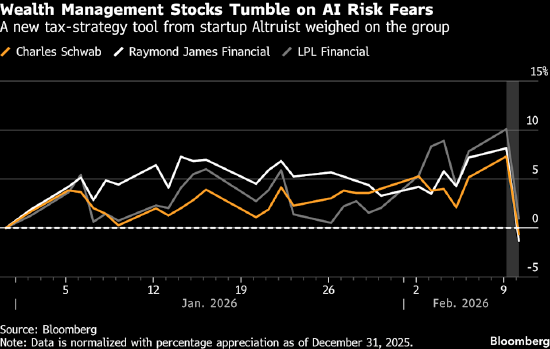
Core Viewpoint - The investment logic on Wall Street is undergoing a significant transformation, with investors rapidly selling stocks of companies that may be disrupted by AI, rather than focusing on identifying AI winners [3][4]. Group 1: Market Reactions - A recent sell-off was triggered by the launch of Altruist Corp.'s tax strategy tool, Hazel, which caused major wealth management companies like Charles Schwab and Raymond James Financial to see stock declines of over 7%, marking the largest drop since the market crash in April [4]. - The panic began when Anthropic introduced a new tool, leading to a deep correction across software, financial services, asset management, and legal services sectors [5][7]. - The insurance brokerage industry was also affected, with stocks plummeting after Insurify launched a ChatGPT-based application for comparing auto insurance rates [7]. Group 2: Industry Impact - Altruist's Hazel tool highlights the market's deep anxiety regarding AI's potential to disrupt traditional financial services, as it can perform tasks that typically require an entire team for just $100 a month [6][7]. - The fear of AI disruption has spread from the software industry to broader sectors, indicating a significant shift in market sentiment [5][7]. Group 3: Diverging Opinions - Despite the prevailing panic, some market participants question the speed and extent of AI disruption, suggesting that technological upheaval often takes longer than anticipated [10][11]. - Concerns about AI's impact on various industries may be premature, as the market is still in the early stages of understanding AI's long-term implications [12]. Group 4: Market Sensitivity - The current sell-off reflects a general anxiety over high valuations in the market, which have been driven by a surge in AI spending and unexpected economic resilience [13]. - In a highly sensitive market environment, even minor negative signals can lead to significant stock declines, as investors prefer to err on the side of caution regarding potential AI disruptions [13].



华尔街新交易策略:抛售处于AI冲击范围内的股票
Xin Lang Cai Jing· 2026-02-11 09:08
Core Viewpoint - Concerns about artificial intelligence (AI) are escalating on Wall Street, leading to significant stock sell-offs across various companies, from small software firms to large wealth management firms [1][3][9]. Group 1: Market Reactions - A recent sell-off was triggered by the launch of a tax planning tool by the startup Altruist, causing stocks of companies like Charles Schwab, Raymond James Financial, and LPL Financial Holdings to drop by 7% or more [1][4]. - The sell-off extended to Europe, impacting wealth management companies such as AJ Bell, Brewin Dolphin, and St. James's Place [1][3]. - This decline is noted as one of the most severe since the market downturn in April due to trade tensions, reflecting a "sell first, ask questions later" mentality among investors [1][7]. Group 2: Industry Impact - The software industry has been particularly affected, with companies like Dassault Systemes experiencing a 20% drop in stock price following disappointing earnings reports [3][9]. - The introduction of AI tools by companies like Anthropic has led to widespread declines in stocks across software, financial services, asset management, and legal services sectors [3][9]. - The insurance sector also faced significant stock declines after Insurify launched a new application utilizing ChatGPT for comparing auto insurance rates [4][10]. Group 3: Investor Sentiment - Investors are shifting from selecting potential winners in the AI space to avoiding any companies perceived to be at risk of being replaced by AI technologies [3][9]. - The CEO of Graniteshares expressed uncertainty about future developments, indicating a shift in sentiment from optimism about AI to fear of its disruptive potential [3][9]. - Concerns about the sustainability of stock valuations have intensified, with market participants reacting sharply to any negative signals [11].
Funding for startup AI companies dominates VC investment arena
Yahoo Finance· 2026-02-11 09:05
Core Insights - Venture capital funding for artificial intelligence (AI) and machine learning startups surged by 72% in 2025, marking a significant milestone where VC dollars for these ventures exceeded all other sectors combined for the first time [1][3]. VC Funding Overview - Global funding for AI startups reached $270.2 billion, representing 52.7% of the total $512.6 billion in venture capital investments [2]. - Despite the increase in funding, the overall number of VC deals declined for the third consecutive year, with 9,844 registered deals in the fourth quarter of 2025, the lowest since early 2020 [3]. Deal Dynamics - The trend indicates fewer deals but larger investments, similar to M&A activity, highlighted by SoftBank's $40 billion investment in OpenAI, the largest single investment in a private company [4]. - Other significant investments included Meta's $14.3 billion in Scale AI and Anthropic's $13 billion funding round at a valuation of $183 billion [5]. Regional Distribution - Of the $270 billion invested in AI by VC firms, 79.3% was allocated to North America, 13.6% to Europe, 5.7% to Asia, and only 0.5% to Latin America [6]. Industry Trends - Many heavily funded startups, such as Thinking Machine Labs and Safe Superintelligence, were founded by former OpenAI staff, indicating a concentration of AI expertise in elite startups [7]. - The share of AI in global VC deal value increased from 27.5% in 2023 to 40% in 2024, and further to 52.7% in 2025 [7]. Exit Value - The aggregate value of AI and machine learning exits was $242.4 billion, accounting for about 40% of all exit value, a significant increase from $73.6 billion and 22% in 2024 [8].
AI冲击下,软件业走向“僵尸化”?
智通财经网· 2026-02-11 08:45
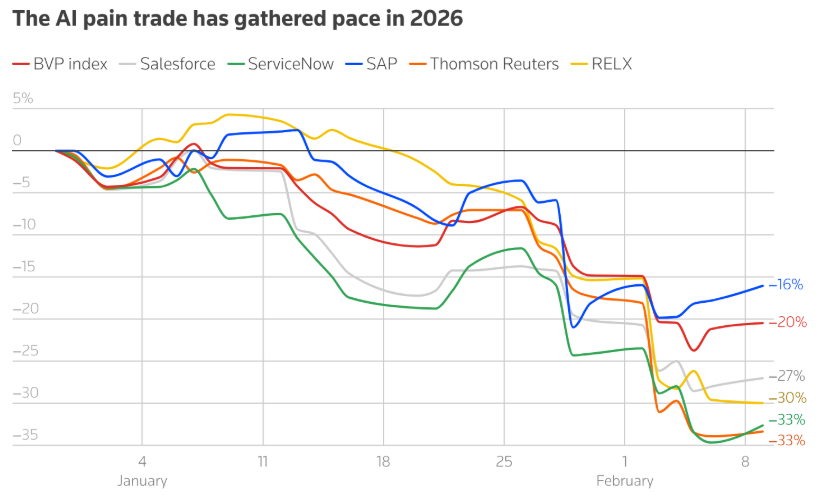
Group 1 - The core viewpoint is that artificial intelligence will impact existing software, data, and professional services companies, but it will not completely destroy them. Investors seem to share this perspective, as indicated by a Breakingviews analysis comparing valuation drops with recent analyst forecasts [1] - The BVP Nasdaq Emerging Cloud Index, a benchmark for software stocks, has declined by 20% year-to-date, raising concerns that AI chatbots like Claude from Anthropic could serve as flexible alternatives to existing company products [1] - Companies such as RELX and Thomson Reuters have seen their stock prices drop by approximately one-third since the end of 2025 due to this panic [1] Group 2 - ServiceNow's enterprise value is estimated at $105 billion, with free cash flow projected to grow from $5.8 billion this year to $10.3 billion by 2029. The implied value of recent cash flows, discounted at a 10% rate, is $27 billion [4] - After subtracting this amount from the enterprise value, ServiceNow's business value from 2030 onwards is approximately $78 billion, which translates to $114 billion in 2030 dollars using a 10% discount rate [5] - The long-term growth rate required to achieve this figure is only 0.9%, significantly lower than the previous year's growth rate of 5.7% [5] Group 3 - A study of 76 stocks, including BVP index components and some European software companies, shows a median long-term growth rate of 0.9%. About 60% of these companies are expected to grow from 2030, but only one-third will exceed a growth rate of 2% [6] - Companies like Monday.com, RingCentral, and Wix.com are exceptions that reflect expectations of significant declines in free cash flow starting in 2030 [6] Group 4 - Analysts caution that the analysis may be overly simplistic, as sell-side brokers might not have adjusted their forecasts for 2029, and a uniform 10% discount rate may not be appropriate across different industries [8] - The analysis suggests that AI is more likely to "zombify" existing companies rather than quickly eliminate them, raising questions about how CEOs should respond to this reality [8] - Stocks like SAP are trading close to what is termed "liquidation value," indicating a scenario where management accepts decline and cuts all growth-related spending to maximize cash extraction [8] Group 5 - Currently, no major data or software companies are pursuing a liquidation strategy, as many, like ServiceNow, continue to show strong growth. However, the market signals that many companies may soon stagnate or even face rapid decline [9] - If investors are pricing these companies as if they are zombie firms, it raises concerns about whether these companies will operate in a manner similar to actual zombie enterprises [9]

甲骨文们的指引一个比一个炸裂,但历史泼了一盆冷水
Hua Er Jie Jian Wen· 2026-02-11 08:42
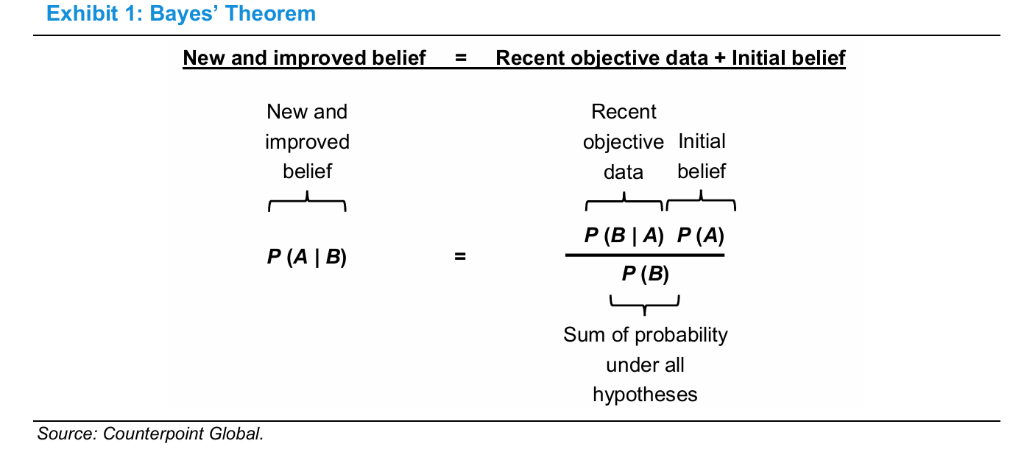
ChatGPT在2022年底把生成式AI推到大众视野后,投资端的变化更快:企业在AI硬件、数据中心上的投入力度,已经接近美国历史上几次最大的 投资浪潮。市场随之抛出一堆漂亮的收入曲线,但问题也变得尖锐——这些预测到底有多大概率能实现,值不值得为此付出资本和时间成本? 据追风交易台消息,摩根士丹利投资管理旗下Counterpoint Global的Michael J. Mauboussin在10日的报告中直截了当地给出方法论:评估这类前瞻 判断,应该"starting with an initial belief and updating that belief as new results appear",也就是"贝叶斯公式":"新结论 = 初始判断(先验概率) × 新 证据带来的调整系数(似然比)"。 | New and improved belief | Recent objective data + Initial belief | ll | | | --- | --- | --- | --- | | Recent | New and | improved | objective Initial | | ...

AI淘金热变成AI恐慌潮!华尔街新共识:躲开一切可能被颠覆的公司
硬AI· 2026-02-11 08:40
Core Viewpoint - Investors are shifting from seeking AI winners to rapidly selling stocks of companies that may be disrupted by AI, leading to a panic selling mentality across various sectors, including software, financial services, wealth management, insurance brokerage, and legal services [2][3]. Group 1: Market Reaction to AI Disruption - The latest wave of selling was triggered by the launch of a tax strategy tool, Hazel, by Altruist Corp., which caused significant stock price drops of over 7% for wealth management firms like Charles Schwab, Raymond James Financial Inc., and LPL Financial Holdings Inc., marking the largest decline since the market crash in April [3][5]. - The panic began when Anthropic introduced a new tool that led to a deep correction in software, financial services, asset management, and legal services sectors, indicating a turning point in market sentiment [6][8]. - The insurance brokerage sector was also heavily impacted after Insurify launched a new application using ChatGPT to compare auto insurance rates, resulting in substantial stock losses for U.S. insurance brokers [6][8]. Group 2: Concerns Over AI's Impact - The introduction of AI tools like Hazel highlights deep-seated anxieties about AI disrupting traditional financial services, as these tools can perform tasks that typically require entire teams, with costs as low as $100 per month [5][6]. - Market participants are increasingly concerned that any intermediary services that could be replaced by AI face existential threats, leading to widespread selling [6][8]. Group 3: Diverging Market Opinions - Despite the prevailing panic, some market analysts express skepticism about the speed and extent of AI disruption, suggesting that technological upheaval often takes longer to materialize than anticipated [8]. - Historical context indicates that industries like banking have faced challenges from emerging technologies, such as cryptocurrencies and electronic services, but these have not significantly undermined their dominance [8]. Group 4: Market Sensitivity and Valuation Concerns - The current sell-off reflects broader anxieties regarding elevated stock valuations, which have been pushed up by a surge in AI spending and unexpected economic resilience in the U.S., making investors highly sensitive to negative signals [10]. - In a tense market environment, even minor product launches from small startups can lead to significant volatility in large public companies, as investors prefer to err on the side of caution regarding potential AI disruptions [10].

春节见?DeepSeek下一代模型:“高性价比”创新架构,助力中国突破“算力芯片和内存”瓶颈
硬AI· 2026-02-11 08:40
Core Viewpoint - Nomura Securities believes that DeepSeek's upcoming next-generation model V4 may further reduce training and inference costs through innovative architectures mHC and Engram technology, accelerating the innovation cycle of China's AI value chain [2][4][5]. Group 1: Innovation in Technology Architecture - The report indicates that computing chips and memory have been bottlenecks for China's large models, and V4 is expected to introduce two key technologies—mHC and Engram—to optimize these constraints from both algorithmic and engineering perspectives [7]. - mHC, or "Manifold Constraint Hyperconnection," aims to address the bottleneck of information flow and training instability in deep Transformer models, enhancing the communication between neural network layers [8]. - Engram is a "conditional memory" module designed to decouple "memory" from "computation," allowing static knowledge to be stored in a sparse memory table, which can be quickly accessed during inference, thus freeing up expensive GPU memory for dynamic calculations [11]. Group 2: Impact on AI Development - The combination of these two technologies is significant for China's AI development, as mHC provides a more stable training process to compensate for potential shortcomings in domestic chips, while Engram smartly manages memory to bypass HBM capacity and bandwidth limitations [13]. - Nomura emphasizes that the most direct commercial impact of V4 will be a further reduction in the training and inference costs of large models, stimulating demand and benefiting Chinese AI hardware companies through an accelerated investment cycle [13][14]. Group 3: Market Dynamics and Competition - Nomura believes that major global cloud service providers are still in a race for general artificial intelligence, and the capital expenditure competition is far from over, suggesting that V4 is unlikely to create the same level of shockwaves in the global AI infrastructure market as last year [15]. - However, global large model and application developers are facing increasing capital expenditure burdens, and if V4 can significantly lower training and inference costs while maintaining high performance, it will serve as a strong boost for these players [15][16]. - The report reviews the market landscape one year after the release of DeepSeek's V3 and R1 models, noting that these models accelerated the development of Chinese LLMs and applications, altering the competitive landscape and increasing attention on open-source models [16]. Group 4: Software Evolution - On the application side, the more powerful and efficient V4 is expected to give rise to more capable AI agents, transitioning from "dialogue tools" to "AI assistants" that can handle complex tasks [20][21]. - This shift will require more frequent interactions with underlying large models, increasing token consumption and thereby raising computing demand [21]. - Consequently, the enhancement of model efficiency is not expected to "kill software," but rather create value for leading software companies that can leverage the capabilities of the new generation of large models to develop disruptive AI-native applications or agents [22].

资讯日报:美国 12 月零售销售增长停滞-20260211
Guoxin Securities Hongkong· 2026-02-11 08:38
Market Overview - The Hang Seng Index closed at 27,183, up 0.58%, maintaining above the 27,000 mark[9] - The S&P 500 index fell by 0.33%, while the Nasdaq dropped by 0.59%[9] - The Dow Jones index increased slightly, reaching a new historical high[9] Retail Sector Performance - U.S. retail sales in December remained flat month-on-month, missing the expected growth of 0.4% and down from a previous increase of 0.6% in November[9] - Costco and Walmart saw declines of over 2% and 1%, respectively, due to the disappointing retail data[9] Technology Sector Insights - Hong Kong tech stocks continued to recover, with Alibaba and JD.com both rising approximately 2%[9] - AI application stocks performed strongly, with the stock of Yueda Group surging over 15%[9] Biopharmaceutical Sector Trends - The biopharmaceutical sector saw widespread gains, with companies like WuXi Biologics and Innovent Biologics also experiencing significant increases[9] - Upcoming earnings disclosures in February and March are expected to show improved performance for several innovative drug companies[9] Economic Indicators - The employment cost index in Q4 reached its lowest growth in four years, indicating potential economic weakness[12] - The Cleveland Fed President suggested that the Federal Reserve may keep interest rates unchanged for an extended period[12]
Seedance 2.0真正的考验,将来自“地表最强法务部”
凤凰网财经· 2026-02-11 08:23
Core Viewpoint - The article discusses the rapid rise of Seedance 2.0 and the ensuing copyright concerns, particularly highlighted by the backlash from copyright holders like Stephen Chow's representatives, indicating a growing anxiety within the content industry regarding the unchecked growth of AI technologies [3][6][10]. Group 1: Seedance 2.0 and Its Features - Seedance 2.0 allows users to easily create videos featuring iconic characters from popular IPs, such as those from Stephen Chow's films, by simply inputting basic materials [4][11]. - The generated videos are noted for their high quality, fluid movements, and expressive features, effectively capturing the essence of the original characters [5][11]. - The platform's appeal lies in its "unrestricted" creative freedom, enabling users to generate content that heavily relies on well-known IPs [11][12]. Group 2: Copyright Issues and Industry Response - The surge in AI-generated content has led to significant copyright concerns, with Stephen Chow's management publicly questioning the legality of the widespread use of his characters [6][10]. - The article emphasizes that Seedance 2.0 lacks adequate copyright protection measures, allowing users to generate videos featuring characters from major franchises like Disney and Dragon Ball without authorization [17][18]. - The content generated by Seedance 2.0 poses a higher risk of copyright infringement compared to static images, as the videos can closely replicate the original characters' actions and expressions [26][28]. Group 3: Legal Precedents and Implications - Disney has been proactive in protecting its IP, having filed lawsuits against various AI companies for unauthorized use of its characters, highlighting a broader concern for the film industry regarding AI's impact on copyright [21][24]. - The legal strategies employed by Disney include seeking economic compensation and establishing industry standards for copyright protection in AI technologies [24][25]. - The article suggests that Seedance 2.0 may face similar legal challenges as other AI platforms, given its ability to generate content that closely resembles copyrighted material [26][30]. Group 4: Potential Paths Forward for ByteDance - The article outlines several potential strategies for ByteDance, including litigation and settlement, proactive licensing agreements, or implementing technical measures to avoid copyright infringement [47][49]. - A historical perspective is provided, noting that ByteDance has previously navigated copyright disputes, but the current landscape may present more complex challenges due to the nature of AI-generated content [40][42]. - The company is advised to consider proactive engagement with copyright holders rather than waiting for legal action, as the stakes in the current environment are significantly higher [60][61].


X @Avi Chawla
Avi Chawla· 2026-02-11 08:10
Google.OpenAI.Anthropic.They're all working on the same problem for agents.How to let agents control the UI layer at runtime, rather than just output text.That's Generative UI, and it's built on three parts:Anthropic's MCP Apps + Google's A2UI + CopilotKit's AG-UIThese are the building blocks that power Generative UI behind agentic apps like Claude.Until now, bringing them into your app has been complex, with no clear resources to follow.But I found 2 resources that cover everything you need to get started. ...
