
中信银行

Search documents
广汽集团(02238):中期票据获注册
智通财经网· 2025-11-14 09:59
Core Viewpoint - GAC Group has received approval for the registration of its technology innovation bonds, allowing it to raise funds through medium-term notes totaling 15 billion yuan [1] Group 1: Registration Details - The registration amount for the medium-term notes is set at 15 billion yuan [1] - The validity of the registration is effective for two years from the date of the notice [1] Group 2: Underwriters - A consortium of banks including China Merchants Bank, Industrial and Commercial Bank of China, and others will act as joint lead underwriters for the bond issuance [1]

银行业数据点评:政策效果仍待显现
Xiangcai Securities· 2025-11-14 09:52
Investment Rating - The industry investment rating is maintained at "Overweight" [3][10] Core Views - Credit recovery is pending the effectiveness of policies, with social financing growth declining by 0.2 percentage points to 8.5% in October, indicating a continued downward trend [6][12] - The demand for loans from residents and medium to long-term corporate loans remains weak, and the impact of policy tools on credit has yet to be fully realized [6][12] - The total amount and structure of credit data in October are weak, but monetary easing support is still expected, enhancing the relative advantage of high-dividend banks [9][32] Summary by Sections Recent Industry Performance - Relative return over the past 12 months shows a 5.4% increase in 1 month, a decrease of 13.7% in 3 months, and a 4.2% increase in 12 months [5] - Absolute return indicates a 7.7% increase in 1 month, a decrease of 1.1% in 3 months, and an 18.5% increase in 12 months [5] Credit Market Analysis - In October, social financing increased by 815 billion yuan, a year-on-year decrease of 597 billion yuan, primarily due to a significant drop in government bond financing [6][12] - The new loans from financial institutions amounted to 220 billion yuan, with a year-on-year decrease of 280 billion yuan, reflecting weak demand in the real estate market [7][15] - Policy financial tools have been implemented but their effect on credit demand remains insufficient, with expectations for continued monetary policy support if credit demand weakens further [16][32] Deposit Trends - In October, M1 grew by 6.2% and M2 by 8.2%, with both growth rates declining compared to previous values [8][24] - New RMB deposits increased by 610 billion yuan, with fiscal deposits showing a significant increase, indicating a slowdown in fiscal spending [27][24] - Non-bank institutions saw a significant increase in deposits, suggesting a shift of funds towards wealth management products [27][32] Investment Recommendations - The report suggests focusing on state-owned banks for stable high-dividend investment opportunities and potential valuation recovery for joint-stock and regional banks as economic conditions improve [9][32] - Recommended banks include Industrial and Commercial Bank of China, Bank of China, CITIC Bank, Jiangsu Bank, Shanghai Rural Commercial Bank, Chongqing Rural Commercial Bank, and Suzhou Bank [9][32]
行业点评报告:社融延续降速,存款“搬家”部分流向理财
KAIYUAN SECURITIES· 2025-11-14 09:43
Investment Rating - The industry investment rating is "Positive" (maintained) [1] Core Viewpoints - The report highlights a continued slowdown in social financing and a shift of deposits towards wealth management products, indicating a need for observation regarding the recovery of resident confidence and corporate operational activity [5][6] - The report notes that the credit growth is slowing down, with new RMB loans added in October amounting to 220 billion yuan, a year-on-year decrease of 280 billion yuan, reflecting seasonal demand factors and constraints on credit expansion [3][4] - Government bonds remain the main contributor to social financing growth, with new government bonds issued in October at 489.3 billion yuan, marking the lowest monthly level for the year [4] Summary by Sections Credit Market Analysis - In October, the new RMB loans were 220 billion yuan, with a year-on-year decrease of 280 billion yuan, and the balance growth rate was 6.5%, down 0.1 percentage points from September [3] - The report indicates that corporate loans increased by 220 billion yuan year-on-year, primarily supported by a 331.2 billion yuan increase in bills, while residential borrowing intentions decreased [3][4] Social Financing Trends - In October, social financing increased by 815 billion yuan, a year-on-year decrease of 597 billion yuan, with a stock growth rate of 8.5%, down 0.2 percentage points from September [4] - The report emphasizes that while social financing growth has been declining since July, the overall downward trend has been limited, with government bonds continuing to play a significant role [4] Deposit and Liquidity Dynamics - The M2 money supply grew by 8.2% year-on-year, while M1 grew by 6.2%, indicating a shift towards demand deposits [5] - There is a notable trend of deposits moving from residents to non-bank financial institutions, with a significant increase of 770 billion yuan in non-bank deposits, suggesting a migration of funds towards wealth management products [5][6] Investment Recommendations - The report suggests that despite the ongoing slowdown in credit growth and social financing, the retail risk for listed banks remains manageable, supported by robust provisioning and stable dividend policies [6] - It recommends increasing allocations to the banking sector, particularly state-owned banks, which are seen as offering value relative to risk-free rates, highlighting specific banks such as CITIC Bank and others as beneficiaries [6]



一周银行速览(11.7—11.14)
Cai Jing Wang· 2025-11-14 09:09
Regulatory Voice - The People's Bank of China reported that by the end of October, the balance of RMB deposits reached 325.55 trillion yuan, a year-on-year increase of 8% [1] - The total balance of domestic and foreign currency deposits was 332.92 trillion yuan, growing by 8.3% year-on-year [1] - In the first ten months, RMB deposits increased by 23.32 trillion yuan, with household deposits rising by 11.39 trillion yuan [1] Industry Focus - The establishment of Xinjiang Rural Commercial Bank has been approved, marking a significant step in China's rural financial reform [2] - Xinjiang becomes the sixth province to have a provincial-level rural commercial bank, with expected assets exceeding 700 billion yuan upon opening [2] Corporate Dynamics - Xinyin Investment, a wholly-owned subsidiary of Industrial Bank, has been approved to commence operations with a registered capital of 10 billion yuan [7][8] - This marks the sixth licensed Asset Investment Company (AIC) approved in the industry, and the first initiated by a joint-stock bank [8] Financial Personnel - Changshu Bank announced a major management reshuffle, with the resignation of its president and vice president due to work changes [9] - The bank plans to appoint Lu Dingchang as the new president and chief compliance officer, alongside two new vice presidents [9] - Additionally, local state-owned shareholders have increased their stake in Changshu Bank, acquiring 561.93 million shares, raising their total holding to 3.98% [9] Industry Trends - Domestic private banking continues to thrive, with several banks reporting double-digit growth in private banking clients [3] - Ping An Bank has surpassed 100,000 private banking clients, joining the "100,000 Club" alongside six other banks [3] - A trend of integrating and shutting down independent credit card and direct banking apps is emerging among banks, reflecting a shift towards digital transformation [4] - Many small and medium-sized banks are actively removing long-term deposit products to optimize their liability structure and reduce costs [6]

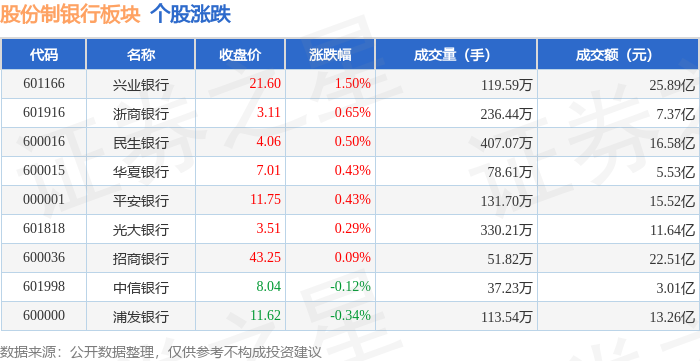
股份制银行板块11月14日涨0.32%,兴业银行领涨,主力资金净流入2.68亿元
Zheng Xing Xing Ye Ri Bao· 2025-11-14 08:58
Group 1 - The banking sector saw a slight increase of 0.32% on November 14, with Industrial Bank leading the gains [1] - The Shanghai Composite Index closed at 3990.49, down 0.97%, while the Shenzhen Component Index closed at 13216.03, down 1.93% [1] - The trading volume and turnover for various banks showed significant activity, with Minsheng Bank having a turnover of 1.658 billion yuan [1] Group 2 - The net inflow of main funds into the banking sector was 268 million yuan, while retail funds experienced a net outflow of 2.7098 million yuan [1] - The individual stock performance varied, with Industrial Bank increasing by 1.50% to a closing price of 21.60 yuan [1] - The overall trading activity indicated a mixed sentiment among investors, with some banks experiencing slight declines in their stock prices [1]


从“跑马圈地”到“精耕细作”:信用卡行业以创新发展破局
Zhong Guo Jin Rong Xin Xi Wang· 2025-11-14 08:18
Core Insights - The credit card industry in China is undergoing a transformation from rapid expansion to a focus on refinement and optimization of user experience, with a significant reduction in the number of credit cards issued over the past three years [1][4]. Industry Overview - The number of credit cards in China has decreased by over 90 million in recent years, with the total number standing at 715 million as of June 2023, marking a decline for 11 consecutive quarters [4]. - Major banks have reported declines in credit card loan balances and transaction volumes, indicating a broader trend of contraction within the industry [4]. Factors Driving Transformation - Regulatory policies have been implemented to guide the credit card business, including restrictions on issuing cards based solely on quantity and limiting the proportion of inactive cards [8]. - The rise of alternative payment methods, such as Huabei and Bai Tiao, has diverted users away from traditional credit cards, particularly among younger consumers [9]. - Changing consumer demands have led to a preference for fewer, more useful credit cards, resulting in cancellations of less utilized cards [9]. - Banks have been reducing cardholder benefits to manage operational costs, which has contributed to the decline in card ownership [10]. Strategic Adjustments - Despite the overall contraction, credit cards continue to play a vital role in facilitating payments and consumer spending [11]. - Banks are shifting their focus from quantity to quality, emphasizing product innovation and deeper integration with consumer spending habits [11]. - Various banks are adapting their strategies to target specific consumer segments, such as the elderly and young people, and are exploring partnerships with e-commerce platforms [12]. - Regulatory adjustments are being made to foster innovation in the credit card sector, including the exploration of online account opening and activation processes [13]. Future Outlook - The credit card industry is expected to maintain a positive growth trajectory, with banks encouraged to adopt differentiated services and leverage digital technologies for product innovation [15].

新华视点丨从“跑马圈地”到“精耕细作”:信用卡行业以创新发展破局
Xin Hua Wang· 2025-11-14 08:17
Core Insights - The credit card industry in China is undergoing a transformation from rapid expansion to a focus on refinement and optimization, with a significant reduction in the number of credit cards issued over the past three years [1][4][10] Market Trends - The total number of credit cards in China has decreased by over 90 million in recent years, with the current total at 715 million as of June 2023, marking a decline for 11 consecutive quarters [4][10] - Major banks have reported declines in credit card loan balances and transaction volumes, with specific examples including a reduction of approximately 20 billion yuan in credit card loan balances at China Merchants Bank and a 4.87% decrease at Citic Bank [4][10] Consumer Behavior - Consumers are increasingly selective about the credit cards they retain, with many choosing to cancel cards that are not frequently used or do not offer sufficient benefits [3][8] - The trend of consumers consolidating their credit cards reflects a demand for more tailored services, as many users now prefer to maintain only a few cards that meet their needs [8][9] Regulatory Environment - Regulatory policies have shifted to promote healthier credit card business practices, discouraging banks from focusing solely on the number of cards issued and requiring a reduction in dormant cards [7][10] - The introduction of regulations has led to a more cautious approach in card issuance, moving the industry from a phase of aggressive expansion to one of careful management and refinement [7][10] Competitive Landscape - The rise of alternative payment methods, such as "Huabei" and "Baitiao," has diverted users away from traditional credit cards, particularly among younger demographics [7][8] - Banks are adjusting their strategies to better align with consumer trends, focusing on product innovation and enhancing customer experiences to remain competitive in a shrinking market [10][12] Strategic Adjustments - Banks are exploring new consumer segments and adjusting their offerings, such as increasing installment credit for home renovations and targeting specific demographics like the elderly and young consumers [12][13] - Recent regulatory changes have allowed for more flexible credit card terms, including adjustments to overdraft interest rates, which may enhance the appeal of credit cards in a competitive market [13]





港股高股息ETF(159302)跌1.41%,成交额1426.30万元
Xin Lang Cai Jing· 2025-11-14 07:10
Core Insights - The Hong Kong High Dividend ETF (159302) closed down 1.41% on November 14, with a trading volume of 14.26 million yuan [1] - The fund was established on August 23, 2024, with an annual management fee of 0.50% and a custody fee of 0.10% [1] - As of November 13, 2024, the fund's latest share count was 83.30 million, with a total size of 118 million yuan, reflecting a 23.44% decrease in shares and a 2.57% decrease in size since December 31, 2024 [1] Fund Performance - The current fund manager, Zhang Yichi, has managed the fund since its inception, achieving a return of 41.98% during his tenure [2] - The fund's performance benchmark is the China Securities Hong Kong Stock Connect High Dividend Investment Index, adjusted for valuation exchange rates [1] Liquidity and Trading Activity - Over the last 20 trading days, the ETF has accumulated a trading volume of 338 million yuan, with an average daily trading amount of 16.92 million yuan [1] - Year-to-date, the ETF has seen a total trading volume of 2.693 billion yuan, averaging 12.82 million yuan per day over 210 trading days [1] Top Holdings - The ETF's top holdings include: - COSCO Shipping Holdings (7.63% holding) - Yancoal Australia (5.59% holding) - Seaspan Corporation (5.05% holding) - Guotai Junan Securities (4.31% holding) - Orient Overseas International (4.00% holding) - Minsheng Bank (3.86% holding) - CITIC Bank (3.61% holding) - China Petroleum & Chemical Corporation (3.55% holding) - China Shenhua Energy (3.47% holding) - China Pacific Insurance (3.44% holding) [2]
港股通央企红利ETF天弘(159281)跌1.12%,成交额3804.08万元
Xin Lang Cai Jing· 2025-11-14 07:10
Core Viewpoint - The Tianhong CSI Hong Kong Stock Connect Central State-Owned Enterprises Dividend ETF (159281) experienced a decline of 1.12% in its closing price on November 14, with a trading volume of 38.04 million yuan [1]. Group 1: Fund Overview - The Tianhong CSI Hong Kong Stock Connect Central State-Owned Enterprises Dividend ETF was established on August 20, 2025, with an annual management fee of 0.50% and a custody fee of 0.10% [1]. - As of November 13, the fund had a total of 213 million shares and a total size of 229 million yuan [1]. - The fund's performance benchmark is the CSI Hong Kong Stock Connect Central State-Owned Enterprises Dividend Index, adjusted for valuation exchange rates [1]. Group 2: Liquidity and Performance - Over the past 20 trading days, the fund has accumulated a total trading amount of 1.069 billion yuan, with an average daily trading amount of 53.45 million yuan [1]. - The current fund manager, He Yuxuan, has managed the fund since its inception, achieving a return of 7.34% during the management period [1]. Group 3: Top Holdings - The top holdings of the fund include: - COSCO Shipping Holdings (0.85% holding, 218,000 shares, market value of 2.9175 million yuan) [2] - Orient Overseas International (0.40% holding, 10,500 shares, market value of 1.3717 million yuan) [2] - China Foreign Transport (0.33% holding, 270,000 shares, market value of 1.1396 million yuan) [2] - China Petroleum (0.32% holding, 162,000 shares, market value of 1.0973 million yuan) [2] - CITIC Bank (0.32% holding, 175,000 shares, market value of 1.1136 million yuan) [2] - CNOOC (0.29% holding, 58,000 shares, market value of 1.0041 million yuan) [2] - China Shenhua Energy (0.29% holding, 30,500 shares, market value of 982,600 yuan) [2] - China Pacific Insurance (0.29% holding, 164,000 shares, market value of 1.0107 million yuan) [2] - China Unicom (0.28% holding, 104,000 shares, market value of 952,800 yuan) [2] - Agricultural Bank of China (0.27% holding, 189,000 shares, market value of 933,900 yuan) [2].


港股央企红利ETF(159333)跌1.16%,成交额1737.35万元
Xin Lang Cai Jing· 2025-11-14 07:10
Core Viewpoint - The Wanjiac Zhongzheng Hong Kong Stock Connect Central State-Owned Enterprises Dividend ETF (159333) has experienced a decline in both share count and total assets in 2024, indicating potential challenges in attracting investor interest [1][2]. Fund Overview - The fund was established on August 21, 2024, with a management fee of 0.50% and a custody fee of 0.10% [1]. - As of November 13, 2024, the fund's total shares stood at 325 million, with a total asset size of 500 million yuan [1]. - The fund's performance benchmark is the Zhongzheng Hong Kong Stock Connect Central State-Owned Enterprises Dividend Index, adjusted for valuation exchange rates [1]. Performance Metrics - Year-to-date, the fund has seen a 24.60% decrease in share count and a 2.58% decrease in total assets compared to December 31, 2024 [1]. - Over the last 20 trading days, the cumulative trading amount reached 484 million yuan, with an average daily trading amount of approximately 24.22 million yuan [1]. - For the year, the cumulative trading amount over 210 trading days was 8.06 billion yuan, with an average daily trading amount of about 38.38 million yuan [1]. Fund Management - The current fund manager is Yang Kun, who has managed the fund since its inception, achieving a return of 54.64% during the management period [2]. - The fund's top holdings include China COSCO Shipping, China Nonferrous Mining, China National Offshore Oil, and others, with varying ownership percentages [2].