中国人民银行

Search documents
刚刚,央行发布重磅报告!
Zheng Quan Ri Bao Wang· 2025-08-15 13:27
Core Viewpoint - The People's Bank of China (PBOC) emphasizes a moderately accommodative monetary policy to support high-quality economic development and ensure a favorable financial environment for sustained economic recovery [1][2]. Monetary Policy Implementation - The PBOC plans to implement a detailed and moderately accommodative monetary policy, ensuring liquidity remains ample and aligning social financing scale and money supply growth with economic growth and price level expectations [2]. - The report highlights the importance of promoting reasonable price recovery as a key consideration in monetary policy, aiming to maintain prices at a reasonable level [2]. Structural Support and Financial Stability - The PBOC aims to utilize both the total and structural functions of monetary policy tools to support sectors such as technology innovation, consumption, small and micro enterprises, and stabilize foreign trade [3]. - The report stresses the need to maintain the stability of the RMB exchange rate and prevent excessive fluctuations, enhancing the resilience of the foreign exchange market [3]. Price Level Trends - The report indicates a moderate recovery in price levels, with the Consumer Price Index (CPI) turning positive in June, and core CPI showing a gradual increase since April [4]. - Factors influencing price levels include ongoing economic improvements and efforts to address low-price competition in certain industries, which are expected to positively impact reasonable price recovery [4]. Credit Structure Optimization - The report discusses the continuous optimization of the credit structure, with a significant portion of new loans directed towards strategic sectors and areas needing support, such as technology and green finance [5]. - The proportion of medium- and long-term loans is increasing, providing stable funding for high-quality economic development, while direct financing's share is also rising [5]. Enhancing Service Consumption - The report highlights the importance of improving high-quality service consumption supply, with a focus on creating effective demand through high-quality supply [6][7]. - Financial policies will target supply-side improvements, ensuring ample liquidity and lowering financing costs to foster consumption growth [6][7].
短期内国债期货维持震荡整理
Bao Cheng Qi Huo· 2025-08-15 11:32
Report Summary 1. Report Industry Investment Rating - No investment rating provided in the report 2. Core View of the Report - Today, all treasury bond futures fluctuated and closed slightly lower. Although the medium - and long - term monetary policy is supportive and the possibility of a policy rate increase is low, the macro - economy shows strong resilience, external risk factors have temporarily eased, and the central bank has introduced a loan interest subsidy policy for the consumption sector, so the possibility of a comprehensive interest rate cut in the short term is low. Recently, the risk appetite in the stock market has been rising, funds have shifted from bonds to stocks, and the demand for buying treasury bonds in the capital market has been suppressed. In general, treasury bond futures will mainly fluctuate and consolidate in the short term [3] 3. Summary According to Relevant Catalogs Industry News - On August 14, the central bank announced that on August 15, 2025, it would conduct a 500 - billion - yuan outright reverse repurchase operation with a 6 - month (182 - day) term through a fixed - quantity, interest - rate tender, and multiple - price winning bid method to maintain sufficient liquidity in the banking system [5] - On August 15, the central bank conducted a 238 - billion - yuan reverse repurchase operation at a fixed interest rate through a quantity tender, with an operating interest rate of 1.40%, the same as before. Since 122 billion yuan of 7 - day reverse repurchases matured today, the net investment on the day was 116 billion yuan [5]
央行:推动物价保持在合理水平
Wind万得· 2025-08-15 10:41
Core Viewpoint - The article emphasizes the importance of maintaining a reasonable recovery of prices as a key consideration in monetary policy, while highlighting the positive performance of major economic indicators and the implementation of proactive macroeconomic policies under the leadership of the central government [2][3][6]. Group 1: Economic Performance - In the first half of the year, China's GDP grew by 5.3% year-on-year, reflecting strong vitality and resilience in the economy [3]. - The social financing scale and broad money supply (M2) increased by 8.9% and 8.3% year-on-year, respectively, by the end of June [5]. Group 2: Monetary Policy Measures - The People's Bank of China (PBOC) has implemented a moderately loose monetary policy, including a 0.5 percentage point reduction in the reserve requirement ratio in May, providing approximately 1 trillion yuan in long-term liquidity [4]. - The PBOC has lowered policy interest rates by 0.1 percentage points and structural monetary policy tool rates by 0.25 percentage points in May, aiming to reduce overall financing costs [4]. Group 3: Financial Stability and Risk Management - The PBOC is focused on maintaining the stability of the RMB exchange rate and preventing systemic financial risks, with measures in place to monitor and assess financial risks [4][6][7]. - The article highlights the need for a balanced approach between supporting the real economy and maintaining the health of the banking system [7]. Group 4: Future Outlook - The PBOC plans to continue implementing appropriate monetary policies while adapting to domestic and international economic conditions, aiming to create a conducive financial environment for economic growth [7]. - The central bank will enhance its macro-prudential and financial stability functions to maintain market stability and prevent systemic risks [7].


中国央行:落实落细适度宽松的货币政策
智通财经网· 2025-08-15 10:27
Core Viewpoint - The People's Bank of China (PBOC) emphasizes the implementation of a moderately accommodative monetary policy to support economic growth and maintain price stability, while addressing the challenges posed by a complex external environment [1][3][6]. Group 1: Monetary Policy Implementation - The PBOC aims to ensure sufficient liquidity in the market, aligning the growth of social financing and money supply with economic growth and price level expectations [1][7]. - The report highlights the importance of promoting a reasonable recovery in prices as a key consideration for monetary policy [1][7]. - The PBOC plans to enhance the interest rate adjustment framework and strengthen the guidance of policy interest rates to lower the cost of bank liabilities and reduce overall financing costs [1][4][7]. Group 2: Economic Indicators - In the first half of the year, China's GDP grew by 5.3% year-on-year, indicating strong economic vitality and resilience [3]. - By the end of June, the social financing scale and broad money supply (M2) increased by 8.9% and 8.3% year-on-year, respectively, with the RMB loan balance reaching 268.6 trillion yuan [5]. Group 3: Financial Stability and Risk Management - The PBOC is focused on maintaining the stability of the RMB exchange rate and preventing systemic financial risks, while enhancing the monitoring and assessment of financial risks [4][6][7]. - The report outlines measures to support key areas such as technological innovation, consumption, and small and micro enterprises through targeted monetary policy tools [4][7].
央行:7月末境外机构持有银行间市场债券3.93万亿元
Zheng Quan Shi Bao Wang· 2025-08-15 09:06
Core Insights - As of the end of July 2025, foreign institutions hold 3.93 trillion yuan in the interbank bond market, accounting for approximately 2.3% of the total custody amount in this market [1] - Among the types of bonds held by foreign institutions, government bonds amount to 2.02 trillion yuan, representing 51.4% of the total, while interbank certificates of deposit and policy financial bonds account for 0.98 trillion yuan (24.9%) and 0.76 trillion yuan (19.3%) respectively [1] - In July, three new foreign institutional entities entered the interbank bond market, bringing the total to 1,171 foreign institutions by the end of July, with 608 entering through direct investment channels and 834 through the "Bond Connect" channel [1]
央行公告:5000亿,今起操作!
Nan Fang Du Shi Bao· 2025-08-15 04:43
Core Points - The People's Bank of China (PBOC) announced a buyout reverse repurchase operation of 500 billion yuan to maintain liquidity in the banking system, set to take place on August 15, 2025, with a term of 6 months [1] - The reverse repurchase operation will utilize a fixed quantity, interest rate bidding, and multiple price level bidding [4] Group 1 - The buyout reverse repurchase operation will include collateral such as government bonds, local government bonds, financial bonds, and corporate credit bonds [4] - The operation targets primary dealers in the open market and is planned to be conducted monthly, with a maximum term of one year [4] - Since its implementation in October 2024, the PBOC has conducted this operation for 11 consecutive months, with the scale varying from several hundred billion to over one trillion yuan [4]

保持银行体系流动性充裕
Jin Rong Shi Bao· 2025-08-15 01:09
Group 1 - The People's Bank of China (PBOC) announced a 500 billion yuan reverse repurchase operation to maintain ample liquidity in the banking system, with a term of 6 months (182 days) starting from August 15, 2025 [1] - On August 8, the PBOC conducted a 700 billion yuan reverse repurchase operation with a term of 3 months (91 days) [1] - The total liquidity injection through reverse repurchase operations in August is expected to be 300 billion yuan, as stated by the chief macro analyst at Dongfang Jincheng [1] Group 2 - Since August 5, the PBOC has been conducting net withdrawals in the open market, but the overall liquidity remained loose in the first half of the month [2] - The PBOC's choice to maintain a net injection through reverse repurchase operations signals a relatively loose monetary policy, which is beneficial for maintaining liquidity amid high government bond issuance [2] - This approach is expected to support the process of broad credit expansion and strengthen counter-cyclical adjustments [2]
5000亿元!央行再出手
Zheng Quan Shi Bao· 2025-08-14 15:33
Core Viewpoint - The People's Bank of China (PBOC) is set to conduct a 500 billion yuan reverse repurchase operation to maintain ample liquidity in the banking system, signaling a commitment to ensure reasonable liquidity levels in the market [1] Group 1: Reverse Repo Operations - On August 15, the PBOC will implement a 500 billion yuan reverse repurchase operation with a six-month term, following the maturity of 900 billion yuan in reverse repos in August [1] - This operation will result in a net injection of 300 billion yuan into the market, as the PBOC had previously conducted a 700 billion yuan three-month reverse repo operation on August 8 [1] - The PBOC has consistently announced reverse repo operations in advance since June, which helps stabilize market expectations and reflects its determination to support liquidity [1] Group 2: Government Bonds and Market Conditions - The current high issuance of government bonds necessitates the PBOC's reverse repo operations to ensure liquidity, which is crucial for counter-cyclical adjustments [1] - Following the Central Political Bureau meeting on July 30, there has been a rapid issuance of local government bonds, indicating a continued focus on maintaining a favorable monetary environment [1] - Analysts expect that the PBOC will likely maintain a collaborative approach to liquidity management, especially with significant government bond payments expected in August and September [1] Group 3: MLF Operations - In August, there is an anticipated 300 billion yuan in Medium-term Lending Facility (MLF) maturing, with expectations for an increase in MLF operations as well [2] - The PBOC has maintained a relatively loose monetary stance, with liquidity expected to remain stable in August [2] - The PBOC's 2025 work meeting emphasized the use of various monetary policy tools to keep liquidity ample, indicating a continuation of the "moderately loose" monetary policy [2]
净投放3000亿元!央行再出手 明日将开展5000亿元买断式逆回购操作
Mei Ri Jing Ji Xin Wen· 2025-08-14 15:26
Core Viewpoint - The People's Bank of China (PBOC) is conducting a buyback reverse repo operation of 500 billion yuan to maintain liquidity in the banking system, indicating a relatively loose monetary policy in August 2023 [1][2][3]. Group 1: Reverse Repo Operations - The PBOC will conduct a buyback reverse repo operation of 500 billion yuan with a term of 6 months on August 15, 2023, following a previous operation of 700 billion yuan on August 8 [1][2]. - In August, there are 4 billion yuan of 3-month and 5 billion yuan of 6-month buyback reverse repos maturing, with a total of 3 billion yuan of Medium-term Lending Facility (MLF) also maturing [2][3]. - The total net injection of funds through the 3-month buyback reverse repo will be 3 billion yuan, while the 6-month variety will be fully offset [2]. Group 2: Market Liquidity and Policy Signals - The PBOC's actions are seen as a response to the upcoming government bond issuance peak and the large scale of maturing certificates of deposit, with a focus on encouraging financial institutions to increase credit supply [3][4]. - Analysts suggest that the PBOC will continue to use MLF and buyback reverse repos to inject medium-term liquidity, indicating a commitment to maintaining ample liquidity in the banking system [4]. - The average weighted interest rate for the interbank market has decreased, reflecting a continued decline in funding costs, which is influenced by various factors including monetary policy operations and market demand for funds [5][6].
货币市场日报:8月14日
Xin Hua Cai Jing· 2025-08-14 13:55
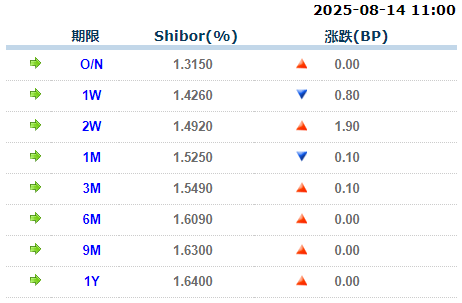
Group 1 - The People's Bank of China conducted a 128.7 billion yuan 7-day reverse repurchase operation at an interest rate of 1.40%, maintaining the previous rate, resulting in a net withdrawal of 32 billion yuan due to 160.7 billion yuan of reverse repos maturing on the same day [1] - The Shanghai Interbank Offered Rate (Shibor) for overnight remained unchanged at 1.3150%, while the 7-day Shibor decreased by 0.80 basis points to 1.4260%, and the 14-day Shibor increased by 1.90 basis points to 1.4920% [2][3] Group 2 - In the interbank pledged repo market, the overnight and 14-day rates saw slight increases, while the 7-day transaction volume decreased. The weighted average rates for DR001 and R001 rose by 0.1 basis points and 0.3 basis points, respectively, while DR007 and R007 rates fell by 1.0 basis points and 0.2 basis points [4] - As of 5:30 PM on August 14, there were 65 interbank certificates of deposit issued, with a total issuance amount of 157.4 billion yuan. The primary market showed active trading sentiment, while the secondary market remained generally stable with yields fluctuating within a range [10] Group 3 - The People's Bank of China announced plans to conduct a 500 billion yuan fixed-quantity, interest-rate tendered, multi-price reverse repurchase operation on August 15, 2025, with a term of 6 months (182 days) to maintain ample liquidity in the banking system [12]