中国中铁

Search documents
震荡市中红利资产配置价值凸显,300红利低波ETF嘉实(515300)备受资金关注
Xin Lang Cai Jing· 2026-01-30 05:10
2026年1月30日早盘,三大股指全线下跌,截至10:58,沪深300红利低波动指数下跌0.39%。成分股方面 涨跌互现,中信银行领涨,杭州银行、工商银行跟涨;中国海油领跌,中国中铁、中国化学跟跌。 消息面上,2026年1月,多家上市公司密集披露半年报、三季报及特别分红方案,红利逐步兑现,进一 步凸显红利资产的配置价值。国信证券表示,随着政策支持为红利资产注入长期估值重塑动能,上市公 司分红力度持续加大。后续随着分红制度的持续完善,红利资产的股息吸引力将进一步提升。 此外,青岛银行发布2025年度业绩快报,实现归属于母公司股东净利润51.88亿元,同比增长21.66%。 此前已有招商银行、兴业银行、宁波银行等8家上市银行率先交出2025年度业绩快报,所有银行均实现 净利润正增长。中国银河证券指出,四季度市场风格整体延续上季度,资金对银行板块青睐程度维持在 相对低位。但同时,国有行、股份行持续受关注。近期被动资金流出对银行资金面形成扰动,但在低利 率与中长期资金加速入市的环境下,银行板块高股息、低估值的红利属性仍对险资等长线资金具备持续 吸引力,加速估值定价重构。 数据显示,截至2025年12月31日,沪深30 ...
港股午评:恒指跌近500点,科指跌1.79%,科网股、黄金股、光伏太阳能股集体走低
Jin Rong Jie· 2026-01-30 04:11
Market Performance - The Hong Kong stock market opened lower on January 30, with the Hang Seng Index dropping by 496.82 points, a decline of 1.78%, closing at 27,471.27 points [1] - The Hang Seng Tech Index fell by 104.83 points, down 1.79%, to 5,736.27 points, while the National Enterprises Index decreased by 2.08% to 9,354.3 points [1] - Major tech stocks experienced declines, with Alibaba down 2.71%, Tencent down 1.53%, and JD Group down 1.4% [1] Company Earnings Forecasts - Guoquan (02517.HK) expects revenue for 2025 to be approximately 7.75 billion to 7.85 billion yuan, a year-on-year increase of about 19.8% to 21.3%, with net profit projected at 443 million to 463 million yuan, up 83.7% to 92.0% [2] - Sunny Optical Technology (02382.HK) anticipates a net profit of 4.5886 billion to 4.7235 billion yuan for 2025, representing a year-on-year increase of approximately 70.0% to 75.0% [3] - Baidu (02315.HK) forecasts revenue of 1.369 billion to 1.389 billion yuan for 2025, with a net profit of 162 million to 182 million yuan, reflecting a significant increase of 384.26% to 443.88% [3] - Spring Medical (01858.HK) expects a net profit of 245 million to 288 million yuan for 2025, an increase of 96.01% to 130.41% [4] - Encounter Small Noodles (02408.HK) projects a net profit between 100 million to 115 million yuan for 2025, an increase of approximately 64.7% to 89.5% [5] - Macro Credit Development (09930.HK) issued a profit warning, expecting a decline in shareholder profit by 70% to 90% for 2025 [6] - Financial Street Securities (01476.HK) issued a profit alert, expecting a shareholder profit increase to approximately 327 million yuan for 2025 [7] Industry Insights - China Railway (00390.HK) recently won several major engineering contracts with a total bid amount of approximately 43.292 billion yuan [8] - New天绿色能源 (00956.HK) reported a cumulative power generation of 15.2104 million MWh for 2025, a year-on-year increase of 7.71% [9] - Huayi Pharmaceutical (01276.HK) received acceptance for a new indication application for its innovative drug, which may become a new treatment option for patients with unresectable liver cancer [9] - Citic Securities suggests focusing on three main lines in the short term: biomanufacturing, embodied intelligence, and 6G technology [11] - Guoyuan International believes that the Hong Kong stock market may continue to outperform the US market due to factors such as fiscal cliffs and geopolitical issues, benefiting from the low long-term valuation levels [12]

沪宁合高铁跨京沪高铁立交特大桥转体施工完成
Zhong Guo Xin Wen Wang· 2026-01-30 03:23
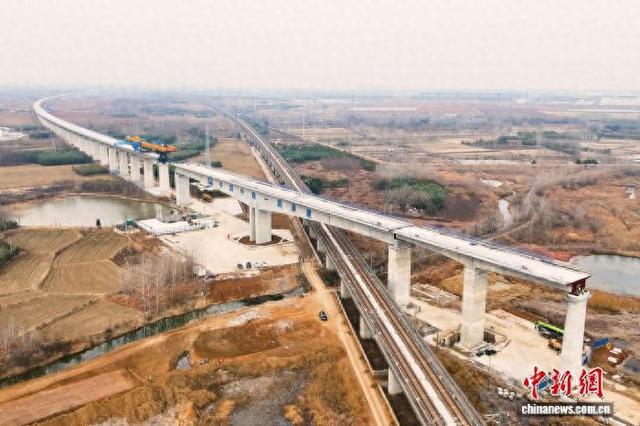
中新网合肥1月30日电 (陈卓然 牛红进)在安徽省滁州市,新建上海至南京至合肥高速铁路(下称沪宁合高 铁)跨京沪高铁立交特大桥的2×32米T构梁29日完成转体,这标志着该特大桥转体施工完成。 1月29日, 沪宁合高铁跨京沪高铁立交特大桥转体施工完成。中国中铁一局集团有限公司 供图 其中,跨越京沪高铁部分采用"2×32米转体T构梁+2×100米T构转体梁"组合设计。2×100米T构梁已于1月 16日转体到位。 此次转体的2×32米转体T构梁全长65.4米,宽12.6米。 该T构梁主墩为圆端型实体墩,承台设转体球铰,转体总重约4800吨,采用悬臂浇筑施工,先平行于既 有高铁预制,转体后与京沪高铁交角呈29度。 为实现安全精准转体,中国中铁一局集团有限公司施工团队采用动态平衡配重法与球铰精准定位牵引系 统,为梁体装上"精密转轴"。 同时,技术人员依托智能监测系统,在施工全程实时采集转体姿态、受力、风速等数据,通过数据终端 动态调控,确保毫米级响应纠偏。 沪宁合高铁是沪渝蓉高铁的东段线路、中国"八纵八横"高速铁路网沿江高铁通道的重要组成部分。该项 目建成后,将在上海大都市圈、南京都市圈和合肥都市圈间建起一条新快速通道 ...



大建筑央企受益于国资央企重组
2026-01-30 03:11
大建筑央企受益于国资央企重组 20260129 摘要 建筑行业面临需求下降和经营压力,2025 年建筑业产值同比下滑 6.95%,新签合同额持续下滑,表明行业整体承压,亟需寻找新的增长 点。 八大建筑央企营收增速放缓,2024 年营收规模同比下降 3.55%,且毛 利率和净利润均低于全行业央企平均水平,2024 年八大建筑央企平均 毛利率不到 11%,净利率仅为 2.75%。 八大建筑央企境外毛利率低于境内,且呈现波动下滑趋势,显示出海外 业务布局中存在同质化竞争,影响了盈利能力,2024 年境外毛利率为 9.84%,境内毛利率为 11.08%。 八大建筑央企资产负债率和有息负债率均达到近年来最高点,截至 2025 年第三季度末,分别达到 77.02%和 26.73%,短期偿债压力增 大。 2024 年起,八大建筑央企员工人数开始减少,同比减少 3.65 万人,反 映出企业正在进行结构调整以应对经营压力。 国资委频繁表态推进国资央企战略性重组和专业化整合,旨在提升资源 利用效率,减少同质化竞争,提高净利润,增强国内外综合竞争力。 八大建筑央企内部整合动作频繁,通过专业化整合提升资源利用效率, 应对行业压力,例 ...
1月30日重要公告一览



Xi Niu Cai Jing· 2026-01-30 03:02
Group 1: Profit Forecasts - Dongcai Technology expects a net profit of approximately 300 million yuan for 2025, representing a year-on-year increase of about 65.73% [1] - Aerospace Electronics anticipates a net profit of 192 million to 247 million yuan for 2025, a decrease of 55% to 65% year-on-year [2] - Oulai New Materials forecasts a loss of 33 million to 48 million yuan for 2025, compared to a profit of 28.17 million yuan in the previous year [3] - Jiu Ding New Materials projects a net profit of 85 million to 98 million yuan for 2025, reflecting a year-on-year increase of 187.68% to 231.68% [5] - Chuan Yi Technology expects a net profit of 78 million to 103 million yuan for 2025, reversing a loss of 73.47 million yuan from the previous year [6] - Ju Yi Technology anticipates a net profit of 70 million to 105 million yuan for 2025, representing a year-on-year increase of 228.36% to 392.54% [7] - ST Xifa forecasts a net profit of 110 million to 160 million yuan for 2025, a year-on-year increase of 319.91% to 510.77% [19] - Light Media expects a net profit of approximately 1.5 billion to 1.9 billion yuan for 2025, reflecting a year-on-year increase of 413.67% to 550.65% [34] - Tianqi Lithium anticipates a profit of 369 million to 553 million yuan for 2025, compared to a loss of 7.905 billion yuan in the previous year [31] Group 2: Loss Forecasts - Star Ring Technology expects a loss of 220 million to 250 million yuan for 2025, with a projected revenue of 420 million to 450 million yuan, a year-on-year increase of 13.06% to 21.13% [9] - Filinger anticipates a loss of 65 million to 85 million yuan for 2025, compared to a loss of 37.31 million yuan in the previous year [10] - Jiahe Meikang forecasts a loss of 240 million to 280 million yuan for 2025, compared to a loss of 256 million yuan in the previous year [11] - Light Textile City expects a loss of 15 million to 22.5 million yuan for 2025 [23] - Ailon Technology anticipates a profit of 14.96 million to 22.44 million yuan for 2025, reversing a loss of 21.70 million yuan from the previous year [24] - ST Yun Chuang forecasts a loss of 139 million to 149 million yuan for 2025, with projected revenue of 53.5 million to 57.5 million yuan, a year-on-year increase of 6.15% to 14.09% [42] - Meike Home expects a loss of 1.2 billion to 1.8 billion yuan for 2025, compared to a loss of 864 million yuan in the previous year [36] Group 3: Shareholder Actions - Huafeng Chemical announced that shareholders plan to reduce their holdings by no more than 0.73% of the company's shares [8] - Naxinwei disclosed that shareholders plan to reduce their holdings by no more than 1.75% of the company's shares [12] - Shikong Technology announced that a shareholder plans to reduce their holdings by no more than 3% of the company's shares [13] - Yandong Micro disclosed that a shareholder plans to reduce their holdings by no more than 1% of the company's shares [37] - Daily Interaction announced that shareholders plan to reduce their holdings by no more than 0.135% of the company's shares [41]
平安证券(香港)港股晨报-20260130
Ping An Securities Hongkong· 2026-01-30 02:46
Market Overview - The Hong Kong stock market experienced mixed performance, with the Hang Seng Index closing at 27,968.09 points, up 0.51%, while the Hang Seng Technology Index fell by 1% to 5,841.1 points [5][6] - The market turnover decreased to HKD 331.99 billion, with net inflows of HKD 4.84 billion recorded in the Hong Kong Stock Connect [5][6] Sector Performance - The real estate sector showed strength, with a 2.8% increase in the Hang Seng Industry Index, led by China Overseas Development, which rose by 6.1%, and Longfor Group, which increased by 5.8% [5][6] - Conversely, the technology sector faced declines, with Horizon Robotics falling by 5.9% and Huahong Semiconductor down by 5.3% [5][6] Investment Recommendations - The report emphasizes the importance of "technological self-reliance" and AI applications as key themes for future growth in the Hong Kong stock market, suggesting that leading companies in these sectors may see long-term development opportunities [3][10] - Specific recommendations include focusing on sectors supported by policies for "expanding domestic demand," such as sports apparel and non-essential service consumption, as well as undervalued central state-owned enterprises with high dividends [3][10] Company Highlights - China Railway (00390.HK) has shown significant stock performance, with a notable increase of 8.6% on Monday and 6.0% on Wednesday, indicating strong market interest [3][10] - The company reported a revenue of HKD 773.814 billion for the first three quarters of 2025, a year-on-year decrease of 5.46%, but its mineral resources segment performed well, with an 8.04% increase in revenue [10]
建筑行业跟踪报告:估值底部叠加春季躁动,推荐“低估值、筹码优”大建央国企
GF SECURITIES· 2026-01-30 02:30
Investment Rating - The industry investment rating is "Buy" [4] Core Viewpoints - The report emphasizes that the construction industry is at a valuation bottom, combined with a seasonal uptick in spring, recommending "undervalued & well-positioned" large state-owned enterprises [4] - The report highlights a positive trend in new orders for major construction state-owned enterprises, with a notable increase in overseas orders outpacing domestic orders [4] - The cash flow situation is improving due to local government debt management and enhanced cash flow control at the enterprise level [4] - The report suggests that market capitalization management is becoming mainstream, with an emphasis on increasing dividend rates and stabilizing dividend amounts [4] - Investment recommendations include major state-owned enterprises such as China State Construction, China Railway Construction, and others based on business performance, valuation, cash flow, and market capitalization management [4] Summary by Sections Industry Overview - The construction sector is experiencing a recovery with improved order volumes and a focus on core engineering business [4] - The report notes that major state-owned enterprises have shown positive growth in new orders, with overseas orders increasing significantly [4] Valuation Analysis - The report indicates that the price-to-book (PB) ratios for leading construction state-owned enterprises have returned to historical lows, suggesting potential for valuation recovery [4] Cash Flow Management - The report states that the net cash flow from operating activities in the construction industry has improved, indicating better cash flow management practices [4] Market Capitalization Management - The report discusses the trend of increasing dividend payouts among major state-owned enterprises, reflecting a commitment to shareholder returns [4] Investment Recommendations - The report recommends investing in companies such as China State Construction, China Railway Construction, and others based on their strong fundamentals and attractive valuations [4]





港股开盘:恒指跌0.65%、科指跌0.88%,科网股、黄金股及AI应用股集体低开
Jin Rong Jie· 2026-01-30 02:27
Market Overview - The Hong Kong stock market opened lower on January 30, with the Hang Seng Index down 0.65% at 27,785.98 points, the Hang Seng Tech Index down 0.88% at 5,789.49 points, the National Enterprises Index down 0.68% at 9,487.76 points, and the Red Chip Index down 0.4% at 4,452.34 points [1] - Major tech stocks experienced declines, with Alibaba down 1.9%, Tencent down 1.13%, JD.com down 0.79%, Xiaomi down 1.15%, Meituan down 0.56%, Kuaishou down 2.35%, and Bilibili down 1.23% [1] - Gold stocks fell broadly, with Chifeng Jilong Gold Mining down over 8% [1] - AI application stocks mostly declined, with Pony.ai down over 4% [1] - Oil stocks were active, with PetroChina up over 1% [1] Company Earnings Forecasts - Guoquan (02517.HK) expects revenue for 2025 to be approximately 7.75 billion to 7.85 billion RMB, a year-on-year increase of about 19.8% to 21.3%, and net profit of 443 million to 463 million RMB, a year-on-year increase of about 83.7% to 92.0% [2] - Sunny Optical Technology (02382.HK) anticipates a net profit of 4.5886 billion to 4.7235 billion RMB for 2025, a year-on-year increase of about 70.0% to 75.0% [3] - Baidu (02315.HK) expects to achieve revenue of 1.369 billion to 1.389 billion RMB in 2025, a year-on-year increase of 39.61% to 41.65%, and net profit of 162 million to 182 million RMB, a year-on-year increase of 384.26% to 443.88% [3] - WuXi AppTec (09969.HK) forecasts total revenue of approximately 2.365 billion RMB for 2025, a year-on-year increase of about 134%, and expects to turn a profit with a net profit of around 633 million RMB [3] - Rainbow New Energy (00438.HK) anticipates revenue of approximately 2.885 billion to 2.915 billion RMB for 2025, a year-on-year decrease of about 11.02% to 11.94%, and a net loss of 542 million to 592 million RMB, a year-on-year increase of about 44.15% to 57.45% [3] - Dazhong Public Utilities (01635.HK) expects net profit of 350 million to 500 million RMB for 2025, a year-on-year increase of 50.12% to 114.46% [3] - Spring Medical (01858.HK) forecasts net profit of 245 million to 288 million RMB for 2025, a year-on-year increase of 96.01% to 130.41% [4] - Meet Xiaomian (02408.HK) expects net profit between 100 million to 115 million RMB for 2025, a year-on-year increase of about 64.7% to 89.5% [5] - Macro Holdings (09930.HK) issued a profit warning, expecting a 70%-90% decline in shareholder profit for 2025 [6] - Financial Street Securities (01476.HK) issued a profit alert, expecting shareholder profit to increase to approximately 327 million RMB for 2025 [7] Project Wins and Developments - China Railway (00390.HK) recently won several major projects with a total bid amount of approximately 43.292 billion RMB [8] - New天绿色能源 (00956.HK) reported a cumulative power generation of 15.2104 million MWh for 2025, a year-on-year increase of 7.71% [9] - Hengrui Medicine (01276.HK) received acceptance for a new indication application for its innovative drug, which may become a new clinical treatment option for patients with unresectable liver cancer [9] - Gilead Sciences (01672.HK) reported positive top-line results from a Phase III open-label study of its oral FASN inhibitor for acne treatment [9] Institutional Insights - CITIC Securities noted that the performance expectations adjustment and funding disturbances that led to the decline in Hong Kong stocks in Q4 2025 have come to an end, predicting a continuation of the spring market trend into February 2026 [11] - Huashan Securities highlighted that the consumer sector, particularly food and beverage, has experienced a rare downturn for five consecutive years, with many leading companies now at historical valuation levels below 5%/10% [12] - Huayuan Securities projected that the copper supply-demand balance may shift from "tight balance" to "shortage" due to insufficient capital expenditure in copper mines [12] - Shenwan Hongyuan confirmed a high growth trend in brokerage performance for 2025, supported by increased trading activity and a recovery in investment banking and public asset management [12]
10股目标价涨幅超20%,宁德时代达75%
2 1 Shi Ji Jing Ji Bao Dao· 2026-01-30 02:20
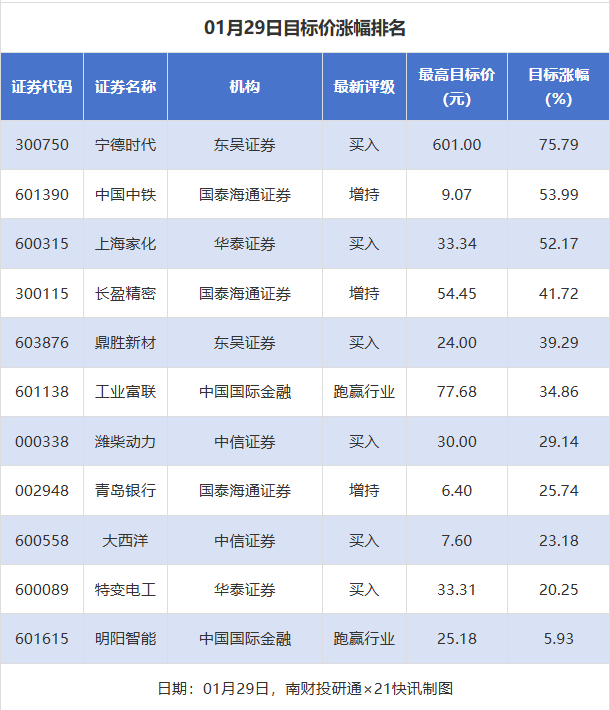
Core Viewpoint - The brokerage firms have set target prices for listed companies, with 10 stocks showing a target price increase of over 20% based on the latest closing prices [1] Group 1: Target Price Increases - A total of 11 target price adjustments were made by brokerages for listed companies [1] - The companies with the highest target price increases include CATL (Ningde Times) at 75.79%, China Railway at 53.99%, and Shanghai Jahwa at 52.17% [1] - These companies belong to the battery, infrastructure, and cosmetics industries respectively [1]


27股获推荐 宁德时代目标价涨幅达75%丨券商评级观察
2 1 Shi Ji Jing Ji Bao Dao· 2026-01-30 01:26
Group 1 - The core viewpoint of the article highlights the target price increases for several listed companies, with notable gains for Ningde Times, China Railway, and Shanghai Jahwa, reflecting strong market confidence in these sectors [1][2]. Group 2 - On January 29, the companies with the highest target price increases were Ningde Times (75.79%), China Railway (53.99%), and Shanghai Jahwa (52.17%), indicating significant bullish sentiment in the battery, infrastructure, and cosmetics industries respectively [1][2]. - A total of 27 listed companies received broker recommendations on January 29, with Qingdao Bank receiving the most recommendations at 5, followed by Mingyang Smart Energy and Ruoyuchen with 2 each [1][3]. - Three companies had their ratings upgraded on January 29, including TBEA, which was upgraded from "Hold" to "Buy" by Huatai Securities, reflecting improved outlooks for these firms [4][6]. - Five companies received initial coverage on January 29, with Qingdao Bank rated "Recommended" by Guolian Minsheng Securities, indicating new interest from analysts in these stocks [6][7].