华泰柏瑞

Search documents
科创创业人工智能ETF华泰柏瑞(159139)盘中翻红,换手率近8%,机构:人工智能景气度或继续保持高位
2 1 Shi Ji Jing Ji Bao Dao· 2025-12-23 06:55
Group 1 - The technology sector is currently active, with the Huatai-PineBridge AI ETF (159139) showing a slight increase of 0.1% and a trading volume exceeding 20 million yuan, indicating active market participation [1] - The ETF tracks the CSI Innovation and Entrepreneurship AI Index, which was launched on December 19 and consists of 50 leading companies focused on AI technology development, hardware support, and commercial applications in vertical fields [1] - According to Jiyin International, the demand for artificial intelligence is expected to remain high, with capital expenditures from major overseas cloud providers projected to grow by over 60% year-on-year in 2024 and 2025, and an additional growth of over 30% in 2026 [1] Group 2 - CITIC Securities highlights that the world is currently undergoing an AI industrial revolution, which has far-reaching implications and should be observed from a long-term perspective, unlike recent trends in cloud computing and renewable energy [2] - The demand for computing power driven by AI is expected to be significant, with B-end applications, such as programming, likely to be the first areas for industrialization and monetization [2] - The successful commercialization and closed-loop of large AI models will require substantial investment in computing power, suggesting a focus on core large model companies [2]

市场早盘震荡拉升,中证A500指数上涨0.54%,4只中证A500相关ETF成交额超64亿元
Sou Hu Cai Jing· 2025-12-23 04:19
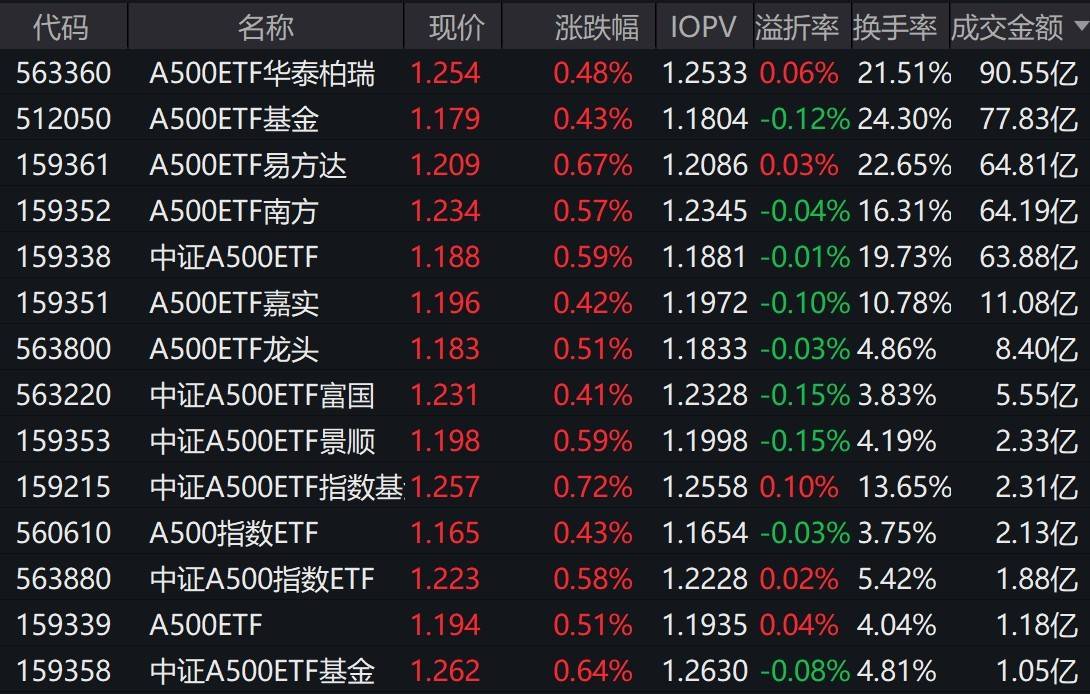
Market Overview - The market experienced a morning rally, with the ChiNext Index rising nearly 1% and the CSI A500 Index increasing by 0.54% [1] - The lithium battery industry chain showed strong performance, while the commercial aerospace concept faced a pullback [1] ETF Performance - Several ETFs tracking the CSI A500 Index saw slight increases, with 14 ETFs having transaction volumes exceeding 100 million yuan, and 4 surpassing 6.4 billion yuan [1] - The transaction amounts for major A500 ETFs were as follows: Huatai-PB A500 ETF at 9.055 billion yuan, A500 ETF Fund at 7.783 billion yuan, E Fund A500 ETF at 6.481 billion yuan, and Southern A500 ETF at 6.419 billion yuan [1][2] Market Liquidity - Analysts predict that the market liquidity environment will remain loose until the first quarter of next year, driven by low interest rates and a scarcity of quality assets [1] - The trend of "deposit migration" among residents is expected to continue, providing a favorable window for investors to position themselves ahead of the upcoming spring market [1]

A500ETF最新规模近2500亿元,华泰柏瑞A500ETF最新规模412亿元
Jin Rong Jie· 2025-12-23 00:03
Core Insights - The A500 ETF has become a dominant player in the market, with a total scale of 245.935 billion yuan and a net inflow of 32.7 billion yuan in the past week, accounting for nearly 70% of the total net inflow into stock ETFs [1] Group 1: Market Performance - The leading product, Huatai-PB A500 ETF, has reached a scale of 41.2 billion yuan, becoming the first ETF tracking this index to exceed 40 billion yuan, achieving a 10 billion yuan increase in just one week [1] - The Southern A500 ETF has seen a net inflow of over 10 billion yuan in a single week, with a total scale of 35.684 billion yuan, ranking second [1] - Other notable ETFs include Huaxia A500 ETF, Guotai A500 ETF, and E Fund A500 ETF, each exceeding 20 billion yuan in scale, while GF, Fuguo, and Jiashi A500 ETFs have scales exceeding 10 billion yuan [1]
ETF 日报 2025.12.22-20251222
Da Lian Shang Pin Jiao Yi Suo· 2025-12-22 09:33
Market Overview - On December 22, 2025, the Shanghai Composite Index rose 0.69% to close at 3917.36 points, the Shenzhen Component Index rose 1.47% to close at 13332.73 points, and the ChiNext Index rose 2.23% to close at 3191.98 points. The trading volume of A-shares in the two markets was 1882.4 billion yuan. The top-performing sectors were communication (4.28%), comprehensive (2.63%), and electronics (2.62%), while the bottom-performing sectors were media (-0.61%), banking (-0.52%), and beauty care (-0.45%) [2][6] Stock ETF - The top-traded stock ETFs on this day were Huatai-PineBridge CSI A500 ETF, which rose 1.22% with a discount rate of 1.28%; ChinaAMC CSI A500 ETF, which rose 1.03% with a discount rate of 1.20%; and Guotai CSI A500 ETF, which rose 1.03% with a discount rate of 1.16%. The top ten stock ETFs by trading volume are also listed in the report, including information such as price, change rate, tracking index, and discount rate [3][7][8] Bond ETF - The top-traded bond ETFs were Haifutong CSI Short-term Financing Bond ETF, which remained unchanged with a discount rate of -0.01%; China Merchants CSI AAA Science and Technology Innovation Corporate Bond ETF, which rose 0.06% with a discount rate of -0.18%; and Penghua Shanghai Stock Exchange AAA Science and Technology Innovation Bond ETF, which rose 0.03% with a discount rate of -0.18%. The top five bond ETFs by trading volume are also detailed [4][9][10] Gold ETF - Gold AU9999 rose 1.77% and Shanghai Gold rose 1.96%. The top-traded gold ETFs were Huaan Gold ETF, which rose 2.13% with a discount rate of 2.01%; Boshi Gold ETF, which rose 2.01% with a discount rate of 1.92%; and E Fund Gold ETF, which rose 2.01% with a discount rate of 1.91%. The top five gold ETFs by trading volume are presented [12][13] Commodity Futures ETF - Dacheng Nonferrous Metals Futures ETF rose 0.83% with a discount rate of 1.38%; Jianxin Yisheng Zhengzhou Commodity Exchange Energy and Chemical Futures ETF rose 1.65% with a discount rate of 1.81%; and ChinaAMC Feed Soybean Meal Futures ETF fell 0.10% with a discount rate of 3.06%. Information on these commodity futures ETFs is provided [15][16] Cross-border ETF - The previous trading day, the Dow Jones Industrial Average rose 0.38%, the Nasdaq Composite rose 1.31%, the S&P 500 rose 0.88%, and the German DAX rose 0.37%. On this day, the Hang Seng Index rose 0.43% and the Hang Seng China Enterprises Index rose 0.43%. The top-traded cross-border ETFs were E Fund CSI Hong Kong Securities Investment Theme ETF, which fell 0.10% with a discount rate of -0.79%; Huatai-PineBridge CSI KRX China-South Korea Semiconductor ETF, which rose 3.57% with a discount rate of 6.06%; and GF CSI Hong Kong Innovative Drug ETF, which fell 1.18% with a discount rate of -1.53%. The top five cross-border ETFs by trading volume are shown [18][19] Money ETF - The top-traded money ETFs on this day were Yin Hua Day Profit ETF, Hua Bao Add Benefit ETF, and Money ETF. The top three money ETFs by trading volume are listed [20][21]
机构资金打响收益保卫战 中证A500ETF演绎“翘尾”行情
Zheng Quan Shi Bao Wang· 2025-12-21 23:26
Core Viewpoint - The market is witnessing a significant inflow of funds into the CSI A500 ETF, indicating a shift in institutional investment strategies towards lower-valued sectors as the year-end approaches [1][5][7]. Group 1: Fund Inflows and Market Activity - As of December 19, the CSI A500 index has surpassed the CSI 300 in net inflows, with a total of over 460 billion yuan since the beginning of December, including a single-day inflow exceeding 100 billion yuan on December 17 [2][4]. - The trading activity of the CSI A500 ETF has become notably active since December 10, with daily transaction volumes consistently exceeding 300 billion yuan, peaking at 525.76 billion yuan on December 19 [3][4]. - The total scale of the CSI A500 ETF has exceeded 240 billion yuan, contributing to a total fund scale of over 300 billion yuan across various fund products [4]. Group 2: Institutional Investment Trends - Institutional investors are increasingly favoring broad-based index products like the CSI A500 ETF, indicating a strategic shift from high-valuation technology sectors to undervalued areas [5][7]. - Insurance funds are expected to contribute over 100 billion yuan in new capital to the market, driven by policy changes that encourage increased equity investments [5][6]. - The low-interest-rate environment is prompting a "migration" of resident funds from savings to equity markets, with a significant increase in the allocation to public funds and other investment vehicles [6][7]. Group 3: Market Outlook for 2026 - Analysts predict a more balanced market in 2026, with opportunities emerging in both technology and value sectors, as the market transitions from a growth-driven to a profitability-driven phase [7][8]. - The focus will likely shift towards cyclical industries and sectors with high return on equity, as well as new energy and innovative technologies, which are expected to be key themes in the upcoming market cycle [8].
影响市场重大事件:我国成功发射通信技术试验卫星二十三号;公募基金大手笔分红,全年逼近2300亿元;A500ETF最新规模近2500亿元,首只产品突破400亿大关
Mei Ri Jing Ji Xin Wen· 2025-12-21 22:26
每经记者|杨建 每经编辑|彭水萍 |2025年12月22日 星期一| NO.1 我国成功发射通信技术试验卫星二十三号 北京时间2025年12月20日20时30分,我国在文昌航天发射场使用长征五号运载火箭,成功将通信技术试 验卫星二十三号发射升空,卫星顺利进入预定轨道,发射任务获得圆满成功。该卫星主要用于开展多频 段、高速率卫星通信技术验证。此次任务是长征系列运载火箭的第618次飞行。 NO.2 商务部会议强调,要做强国内大循环、畅通国内国际双循环 12月20日,商务部召开会议强调,2026年是"十五五"规划开局之年,做好商务工作责任重大。要做强国 内大循环、畅通国内国际双循环、拓展国际循环,为经济实现质的有效提升和量的合理增长贡献商务力 量。鼓励支持服务出口,积极发展数字贸易、绿色贸易。稳步推进制度型开放,有序扩大服务领域自主 开放,深化外商投资促进体制机制改革,优化自由贸易试验区布局范围,塑造吸引外资新优势。引导产 业链供应链合理有序跨境布局,完善海外综合服务体系。推动商签更多区域和双边贸易投资协定。 12月20日,年末ETF排位赛如火如荼,A500ETF霸屏成交榜。最新数据显示,全市场A500ETF规模达 ...
资金扫货宽基ETF!中证A500ETF本周净流入资金326亿元
Ge Long Hui· 2025-12-21 07:00
Core Insights - The article highlights a significant inflow of funds into the China Securities A500 ETF, with a net inflow of 32.6 billion yuan this week, accounting for nearly 70% of the total net inflow into stock ETFs during the same period [1]. Group 1: Fund Inflows and ETF Growth - The total market size of the A500 ETF has reached 243.8 billion yuan, with the Huatai-PineBridge A500 ETF surpassing 41.2 billion yuan, becoming the first A500 ETF to exceed 40 billion yuan in size within just one week [2]. - The Southern A500 ETF has also seen a net inflow of over 10 billion yuan in a single week, bringing its total size to 35.684 billion yuan [3]. - Other A500 ETFs from Huaxia, Guotai, and E Fund have all surpassed 26 billion yuan in size, indicating a strong trend in the A500 ETF market [4]. Group 2: Institutional Investment and Policy Support - The recent surge in A500 ETF inflows is likely driven by institutional investors, particularly insurance funds, following regulatory adjustments that lowered the capital occupation costs for insurance companies investing in stocks [4]. - The regulatory changes involve a reduction in risk factors for long-term holdings in the CSI 300 index and the STAR Market, potentially releasing around 19.8 billion yuan in capital, with a possible total incremental fund size of 72.6 billion yuan if fully allocated to stock investments [4]. Group 3: Market Environment and Investment Trends - The current market environment, characterized by declining interest rates and a shrinking pool of compliant and safe assets, is pushing institutional investors to increase their allocation to equity assets [5][6]. - Data shows that insurance funds have reached record high allocations in both bonds and stocks, with direct stock investment exceeding 3 trillion yuan for the first time [7]. - The advantages of ETFs, such as high liquidity, relatively controlled volatility, low costs, and strong transparency, are making them an important tool for insurance funds in equity allocation [7]. Group 4: A500 ETF as a Key Investment Vehicle - The A500 ETF is gaining recognition as a key vehicle for mainstream long-term funds to share in the benefits of China's economic transformation, supported by substantial capital inflows [8]. - The significant increase in holdings of the A500 ETF not only provides solid support for related assets but also indicates a re-evaluation and re-pricing of its investment value in the market [8].
10万元骤降至10元!QDII基金申购上限调整
Zhong Guo Zheng Quan Bao· 2025-12-20 13:56
Core Viewpoint - The recent adjustments in the subscription limits for QDII funds, particularly the drastic reduction to 10 yuan for the Morgan Nasdaq 100 Index Fund, reflect a broader trend among public funds responding to high demand for overseas investments amid rigid foreign exchange quota constraints [1][2]. Group 1: Market Dynamics - The subscription limit for the Morgan Nasdaq 100 Index Fund was reduced from 100,000 yuan to 100 yuan, and then further to 10 yuan, indicating a near "freezing" of new subscriptions [1]. - Similar actions were observed with other funds, such as the Huatai-PB Nasdaq 100 ETF, which saw its limit drop from 10,000 yuan to 1,000 yuan in October, and then to 100 yuan in November [2]. - The high demand for QDII products has led to significant premiums in the secondary market, with some funds trading at premiums exceeding 20% [2]. Group 2: Supply and Demand Imbalance - As of November 2023, the total approved QDII investment quota reached 170.87 billion USD, with a 2.30% increase in the securities fund category [3]. - The net value of QDII funds reached 939.008 billion yuan by October 31, 2025, marking a 66.72% increase year-on-year [3][4]. - The average premium rate for QDII passive index equity funds exceeded 10% for 14.96% of these funds during the period from December 1 to December 18 [2][3]. Group 3: Risks and Considerations - The high premiums in the secondary market are attributed to a supply-demand mismatch, where the demand for QDII ETFs outstrips the available quotas, leading to potential risks if market sentiment shifts [5]. - Analysts warn that investing in high-premium QDII funds may not be ideal, as a reversal in market conditions could lead to a rapid decline in premiums [5]. - Liquidity risks are also a concern, as some QDII funds have low trading volumes, which could hinder the ability to sell at favorable prices during market downturns [5].

红利品种,为何容易出现低估?|第423期直播回放
银行螺丝钉· 2025-12-19 14:03
Core Viewpoint - The article discusses the performance and risk of dividend indices, highlighting their long-term advantages over the market, including lower volatility and consistent returns [3][5]. Group 1: Long-term Performance - Dividend indices have historically outperformed the market with lower volatility, typically exhibiting 60%-70% of the market's volatility [3]. - From November 14, 2014, to December 17, 2025, the annualized return of the Shanghai-Hong Kong-Shenzhen dividend low-volatility total return index reached 13%, with a maximum drawdown of -33.19%, while the CSI All Share Total Return Index had an annualized return of 6.21% and a maximum drawdown of -55.78% [3]. Group 2: Sources of Returns - The returns from dividend index funds can be broken down into three main sources: undervalued purchases leading to valuation gains, annual profit growth of approximately 6%-7% from underlying companies, and dividend income closely tied to the purchase time's dividend yield [5]. Group 3: Conditions for Underperformance - Dividend indices may underperform the market under certain conditions, such as when bond yields are high. In 2024, U.S. bond yields reached 4%-4.5%, while the dividend yield of U.S. dividend index funds was around 4%, making them less attractive [6]. - Another scenario for underperformance is during growth style bull markets, where indices like the ChiNext Index have shown significantly higher gains compared to the dividend low-volatility index [8]. Group 4: Investment Principles - Investing in dividend index funds should focus on undervalued purchases to reduce holding period volatility, enhance future valuation upside, and increase the attractiveness of dividend yields [10]. - Buying during undervalued phases provides a safety cushion against market fluctuations, making it easier for investors to maintain their positions [12]. Group 5: Attractiveness of Dividend Indices - Dividend indices are often easier to find at undervalued levels due to their strategy of selecting high dividend yield stocks, which typically have lower price-to-earnings and price-to-book ratios [19]. - Regular rebalancing of dividend indices tends to favor the inclusion of undervalued stocks and the exclusion of overvalued ones, effectively implementing a buy low, sell high strategy [20]. Group 6: Comparison with Other Strategy Indices - Similar to dividend indices, other strategy indices such as value, low volatility, and free cash flow indices also exhibit defensive characteristics and are likely to present undervalued investment opportunities [22].

包揽宽基ETF成交前五名 A500指数相关ETF成交持续放大
Xin Hua Cai Jing· 2025-12-19 08:08
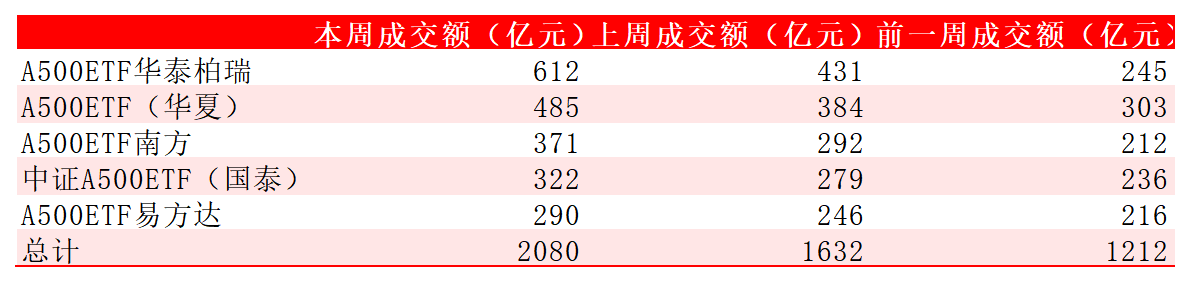
Core Viewpoint - The trading volume of A500 index-related ETFs has significantly increased this week, indicating strong market interest and potential investment opportunities in this sector [1][4]. Group 1: Trading Volume Data - On December 19, the A500ETF from Huatai-PB recorded a trading volume of 13.365 billion yuan, making it the top performer among broad-based ETFs [1]. - The A500ETF from Huaxia also surpassed 10 billion yuan in trading volume, reaching 10.003 billion yuan, marking it as the second ETF to exceed this threshold in a single day [1]. - The top five ETFs by trading volume for the day were all A500 index-related, including A500ETF from Southern, CSI A500ETF, and A500ETF from E Fund, which ranked third to fifth respectively [1]. Group 2: Weekly Trading Volume Comparison - The total trading volume for the five A500 index-related ETFs this week was 208 billion yuan, up from 163.2 billion yuan the previous week, and significantly higher than 121.2 billion yuan two weeks ago, showing an increase of over 40 billion yuan weekly [2][4]. - Specifically, the trading volume for A500ETF from Huatai-PB rose to 61.2 billion yuan this week from 43.1 billion yuan last week, while the A500ETF from Huaxia increased to 48.5 billion yuan from 38.4 billion yuan [2]. Group 3: Market Drivers - Industry experts suggest that insurance funds may be a primary driver behind this surge in trading volume, as regulatory changes have lowered the capital occupation costs for insurance companies, facilitating their entry into the stock market [4]. - The backdrop of declining bond yields and a scarcity of non-standard assets has created an asset shortage, making the CSI A500 index, which covers 500 mid-cap leading companies, attractive for long-term stable returns sought by insurance capital [4]. - Additionally, bank wealth management subsidiaries, brokerage proprietary trading, and foreign institutions are also identified as potential buying forces in this market [4].