台积电

Search documents
通信行业周报(1月12日-1月18日)
Guoxin Securities Co., Ltd· 2026-01-21 10:45
Investment Rating - The communication industry is rated as "Cautiously Optimistic" with a focus on operators with sustained profit growth and enhanced network value, as well as companies benefiting from traffic growth and continuous technological innovation [5][37]. Core Insights - The communication sector showed a 0.77% increase from January 12 to January 16, 2026, outperforming the CSI 300 index by 1.34 percentage points, ranking 7th among 30 sectors [2][12]. - The report highlights the strategic significance of industrial internet platforms in reshaping the manufacturing system and enhancing supply chain resilience and security [3][33]. - The goal for industrial internet platforms by 2028 includes establishing over 450 high-quality platforms, connecting 120 million devices, and achieving a penetration rate exceeding 55% [4][34]. Summary by Sections Communication Industry Market Review - The communication sector's cumulative increase for 2026 is 2.39%, ranking 16th among the primary sectors [2][12]. - The sector includes 119 listed companies, with 54 experiencing price increases and 64 seeing declines during the review period [13]. - The TTM PE ratio for the communication sector is 26.95, positioned at the 37.25 percentile [14]. Industry News - A new satellite constellation plan has been submitted to the ITU, proposing nearly 200,000 satellites, significantly surpassing existing projects [17][18]. - The industrial internet platform development action plan aims to enhance the quality and application of platforms, marking a shift from merely building platforms to strengthening and utilizing them [3][34]. Investment Recommendations - The report suggests maintaining a cautiously optimistic stance, focusing on operators with ongoing profit growth, companies benefiting from traffic and computing network growth, and those with strong core competitiveness through continuous innovation [5][37].


龙虎榜复盘丨强势股持续走弱,半导体多个细分领域携手发力
Xuan Gu Bao· 2026-01-21 10:43
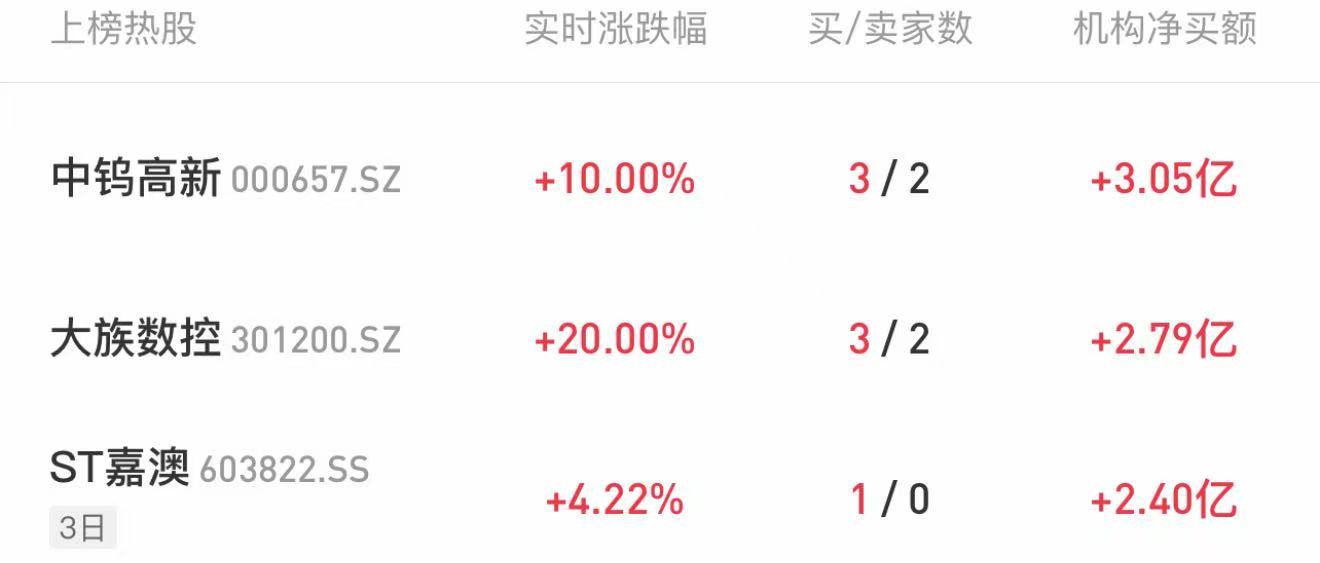
Group 1 - The core viewpoint of the news is that 40 stocks were listed on the institutional leaderboard today, with 23 stocks experiencing net buying and 17 stocks facing net selling [1] - The top three stocks with the highest net buying by institutions are: Zhongtung High-tech (3.05 billion), Dazhu CNC (2.79 billion), and ST Jiaao (240 million) [1] - Dazhu CNC saw a net buying of 2.79 billion from five institutions, and the stock price increased by 20% [2][3] Group 2 - Resonac, a well-known Japanese materials manufacturer, announced a price increase of over 30% for PCB materials such as copper foil substrates and adhesive films due to tight supply and significant price hikes [3] - The company is actively collaborating with industry-leading clients to develop cutting-edge technology solutions for AI PCB, focusing on high precision and complex structures [3] - TSMC's new advanced packaging line at the Jiayi AP7 factory is expected to double its capacity to 60,000 pieces per month by 2026, with plans to double again by 2027 [3]


两大龙头爆发!688041,创历史新高
Zheng Quan Shi Bao· 2026-01-21 09:00
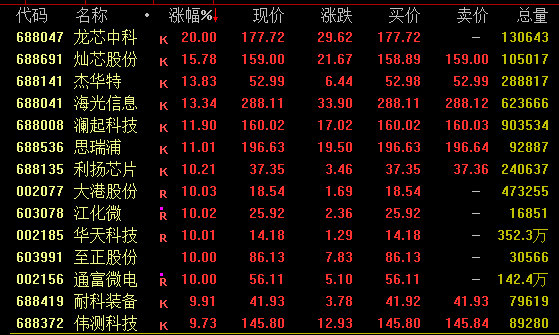
Core Viewpoint - The semiconductor sector is experiencing strong performance, with significant gains in various stocks, particularly in the CPU and AI-related segments [1][3][5]. Semiconductor Sector Performance - The Shanghai Composite Index showed slight fluctuations, closing up 0.08% at 4116.94 points, while the ChiNext Index rose 0.54% and the Sci-Tech 50 Index surged 3.53% [1]. - The semiconductor sector was notably strong, with leading CPU stock Loongson Technology hitting a 20% limit up, and Haiguang Information rising over 13% [3][1]. AI and Server Demand - The demand for server CPUs is expected to grow due to the ongoing evolution of generative AI, with cloud vendors upgrading their data center architectures and replacing older CPUs [5]. - AMD and Intel have recently increased server CPU prices by 10%-15%, indicating a trend that is likely to impact the domestic market [4]. Glass Substrate Industry - The glass substrate industry is transitioning from technology validation to early-stage mass production, with expectations for commercial shipments to begin in 2026 [7]. - The compound annual growth rate for semiconductor glass wafer shipments is projected to exceed 10% from 2025 to 2030 [7]. AI Industry Chain Stocks - Stocks related to the AI industry chain saw significant increases, with Zhishang Technology hitting a 20% limit up and other companies like Robotech and Lian Technology also experiencing notable gains [9][11]. - The integration of AI applications is anticipated to drive further growth in computational power and related sectors [11]. TSMC Financial Performance - TSMC's latest financial report exceeded market expectations in revenue, net profit, gross margin, and capital expenditure guidance, indicating strong future demand in the computational power sector [12].

两大龙头爆发!688041,创历史新高
证券时报· 2026-01-21 08:55
Core Viewpoint - The semiconductor sector is experiencing strong performance, with significant gains in various stocks, particularly in CPU and AI-related companies [2][5][11]. Semiconductor Sector Performance - The A-share market saw nearly 3,100 stocks in the green, with the semiconductor sector leading the charge. Notable stocks include Longxin Zhongke, which hit a 20% limit up, and Haiguang Information, which rose over 13% [2][5]. - The overall market capitalization for the semiconductor sector is bolstered by rising prices for server CPUs, with AMD and Intel increasing prices by 10%-15% [6][7]. Glass Substrate Concept Surge - The glass substrate concept has gained traction, with stocks like Woge Optoelectronics, Jinrui Mining, and Maigemi Tech hitting their daily limit up. The glass substrate industry is transitioning from technology validation to early-stage mass production, with expectations for commercial shipments to begin in 2026 [8][10]. AI Industry Chain Stocks Rally - AI-related stocks, particularly in the CPO concept, have seen significant increases, with Zhishang Technology reaching a 20% limit up and Robotech rising nearly 15% [12][14]. - The demand for AI servers is increasing, driven by the need for upgraded architectures in data centers, which is expected to sustain growth in the server CPU market [7][14].


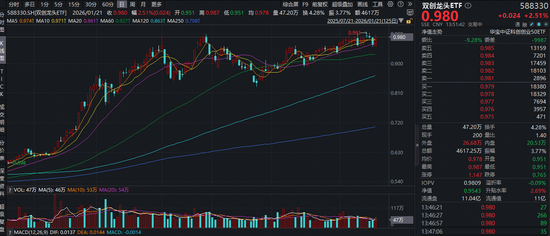
半导体大涨原因或已找到!硬科技宽基——双创龙头ETF(588330)盘中拉升3%,龙芯中科20CM涨停
Xin Lang Cai Jing· 2026-01-21 06:07
Core Viewpoint - The technology sector, particularly in AI and semiconductors, is experiencing significant growth, as evidenced by the performance of the ChiNext and STAR Market, with the Double Innovation Leader ETF (588330) showing a notable increase in value [1][7]. Group 1: Market Performance - The Double Innovation Leader ETF (588330) saw an intraday price increase of over 3.1%, currently up by 2.51% [1][7]. - The top-performing stocks in the semiconductor sector include Longxin Zhongke, which surged by 20%, and other companies like Lanke Technology and Haiguang Information, which rose by over 13% [2][11]. Group 2: AI Sector Developments - TSMC reported financial results that exceeded market expectations and provided a strong revenue guidance for 2026, indicating sustained growth in the AI sector [3][9]. - Micron Technology noted a continued shortage of memory chips due to surging demand for AI infrastructure, highlighting the importance of advanced packaging technology [3][9]. - Nvidia announced that its GB300 AI servers will begin large-scale deliveries in the second quarter of 2026 [3][9]. - OpenAI has invested $10 billion in AI chip manufacturer Cerebras to procure up to 750 megawatts of computing power over three years [3][9]. Group 3: Domestic Policy and Market Trends - The Ministry of Industry and Information Technology in China is promoting high-quality development in the AI industry through the implementation of the "AI + Manufacturing" initiative [3][9]. - China Galaxy Securities predicts a recovery in domestic AIDC bidding starting in Q4 2025, with major internet companies accelerating data center layouts in 2026 [3][10]. - Xinda Securities suggests that as AI demand continues to rise, order volumes and utilization rates in the semiconductor sector are expected to increase [3][10]. Group 4: ETF Characteristics - The Double Innovation Leader ETF (588330) is designed for diversified investment in strategic emerging industries, including new energy, semiconductors, and medical devices [12]. - The ETF has shown a year-to-date increase of 60.86%, outperforming major indices such as the ChiNext 50 and the ChiNext Index [12][13]. - The ETF offers a lower investment threshold, allowing investors to start with less than 100 yuan, making it an accessible option for capturing technology market trends [12].
CPO概念走势活跃,广合科技涨停,罗博特科等大涨
Zheng Quan Shi Bao Wang· 2026-01-21 03:05
Group 1 - The CPO concept saw active trading on the 21st, with Robotech rising over 12% to reach a historical high, Guanghe Technology hitting the daily limit, Lentech increasing by over 9%, and Xinyiseng rising nearly 5% [1] - Qwen App has officially announced full integration with Alibaba's ecosystem, becoming the world's first AI assistant capable of completing complex real-life tasks [1] - CITIC Securities believes that large models have been iterating for over three years, and CSP manufacturers have invested significant capital expenditures, with 2026 expected to be a pivotal year for AI applications [1] Group 2 - TSMC disclosed its latest financial report, with revenue, net profit, gross margin, and capital expenditure guidance exceeding market expectations [1] - The company's capital expenditure guidance was determined after extensive communication with clients, indicating strong future demand in the computing power sector [1] - The firm anticipates that computing power demand will continue to grow robustly through 2027, recommending sectors such as optical modules, liquid cooling, and fiber optic cables [1]
昨夜,美国“股汇债”三杀
Zheng Quan Shi Bao· 2026-01-21 00:25
Market Overview - The US stock market experienced a significant decline on January 20, with all three major indices falling sharply. The Dow Jones Industrial Average dropped by 870.74 points, closing at 48,488.59, marking a 1.76% decrease and the largest single-day drop in three months [2][3] - The S&P 500 index fell by 2.06% to 6,796.86 points, while the Nasdaq index saw a decline of 2.39%, closing at 22,954.32 points [2][3] Currency and Bond Market - The US dollar index decreased by approximately 0.8% during the day, ultimately closing down nearly 0.5% [1] - US Treasury yields rose, with the 10-year yield increasing by 6.76 basis points to 4.2906%, and the 30-year yield rising by 7.92 basis points to 4.9158%, reaching the highest levels since early September of the previous year [1] Sector Performance - Major technology stocks experienced significant declines, with Nvidia and Tesla both dropping over 4%. Other notable declines included Apple and Amazon, which fell by more than 3%, while Meta and Google saw declines of over 2% [3][4] - Financial stocks also faced losses, with Citigroup down over 4%, and both JPMorgan and Morgan Stanley declining by more than 3% [4] - Airline stocks mostly fell, with Delta Air Lines and United Airlines both dropping over 4% [5] - Semiconductor stocks were generally down, with the Philadelphia Semiconductor Index falling by 1.68%. However, Intel saw an increase of over 3% [5] International Market Trends - International gold and silver prices continued to rise, reaching new historical highs due to geopolitical tensions [6][7] - COMEX gold futures surpassed $4,770 per ounce, marking a 2% increase, while silver futures approached $96 per ounce before retreating [7]




美国股债汇三杀,纳指跌超2%,芯片股、中概股普跌,晶科能源跌超12%,黄金白银再创新高
21世纪经济报道· 2026-01-20 23:09
Market Overview - The US stock market experienced a significant decline, with the S&P 500 and Nasdaq dropping over 2%, and the Dow Jones falling by 870 points, a decrease of 1.76% [1] - Major technology stocks also saw substantial losses, with Nvidia and Tesla down over 4%, and Apple and Amazon falling more than 3% [2][3] - The Chicago Board Options Exchange Volatility Index (VIX), known as the "fear index," surged above 20, indicating increased market volatility [1] Sector Performance - Bank stocks fell across the board, with Citigroup down over 4% and JPMorgan Chase and Morgan Stanley dropping more than 3% [4] - Chinese concept stocks mostly declined, with JinkoSolar down 12.5% and Century Internet falling over 10% [4][5] - Semiconductor stocks also faced a downturn, with Broadcom and Skyworks Solutions dropping over 5% [2] Commodity and Currency Movements - Gold and silver prices reached new highs, with spot gold exceeding $4,763 per ounce and silver surpassing $94 per ounce [8][9] - The US dollar index fell by 0.41%, marking its worst two-day performance in about a month [5] - The US Treasury yields rose to their highest levels in over four months, with the 10-year yield reaching 4.292% [6] Cryptocurrency Market - The cryptocurrency market saw a widespread decline, with Bitcoin dropping below $90,000 and Ethereum falling below $3,000 [10] - Approximately 163,000 traders were liquidated in the market downturn [10] Geopolitical Context - US President Trump reiterated his stance on Greenland, indicating a potential for aggressive policies regarding trade and tariffs, which may impact market sentiment [11]

美股科技股,全线下跌
Di Yi Cai Jing Zi Xun· 2026-01-20 15:09
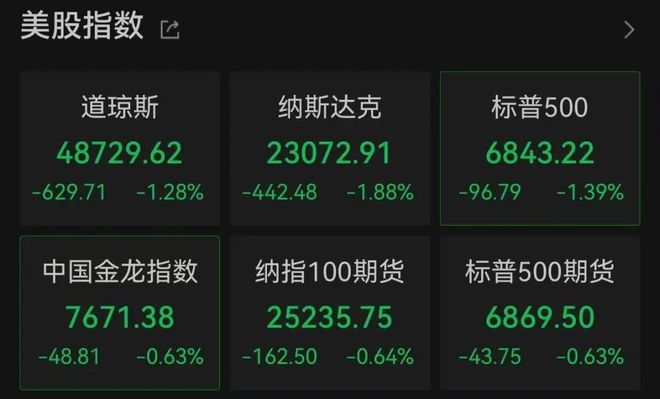
Core Viewpoint - The U.S. stock market experienced significant declines on January 20, with major indices falling sharply, indicating a bearish sentiment among investors. Group 1: Market Performance - The Dow Jones Industrial Average fell by 629.71 points, or 1.28%, closing at 48729.62 [1] - The S&P 500 index decreased by 96.79 points, or 1.39%, ending at 6843.22 [1] - The Nasdaq Composite dropped by 442.48 points, or 1.88%, closing at 23072.91 [1] Group 2: Sector Performance - Major technology stocks saw widespread declines, with Broadcom falling over 3%, and Tesla, NVIDIA, Amazon, META, and Microsoft each dropping more than 2% [2] - Other notable declines included Google, Apple, and TSMC, which also experienced losses [2] Group 3: Chinese Stocks - Chinese stocks mostly fell, with Bilibili dropping over 4%, and both Canadian Solar and Century Internet declining by more than 3% [4] Group 4: Gold Market - Gold stocks surged against the market trend, with Kinross Gold rising over 7%, Harmony Gold increasing by more than 6%, and Barrick Gold gaining nearly 3% [5] - Spot gold prices broke above $4750 per ounce, marking a new historical high with a daily increase of 1.67% [5]
美股科技股,全线下跌
第一财经· 2026-01-20 15:01
Group 1 - NVIDIA stock price is at 181.140, down 2.73% [1] - Tesla stock price is at 425.925, down 2.65% [1] - AppLovin stock price is at 546.640, down 3.89% [1] - Alphabet stock price is at 323.490, down 1.97% [1] - Alibaba stock price is at 164.340, down 0.64% [1] - Pinduoduo stock price is at 104.111, down 2.48% [1] - Apple stock price is at 254.685, down 0.33% [1] Group 2 - TSMC stock price is at 340.960, down 0.42% [2] - Microsoft stock price is at 449.360, down 2.28% [2] - Meta Platforms stock price is at 602.920, down 2.79% [2] - AMD stock price is at 231.115, down 0.31% [2] - Broadcom stock price is at 340.620, down 3.15% [2] - Oracle stock price is at 185.055, down 3.16% [2] - Chinese concept stocks mostly declined, with Bilibili dropping over 4% and Canadian Solar and Century Internet falling over 3% [2] - Gold stocks rose against the trend, with K92 Mining up over 7%, Harmony Gold up over 6%, and Barrick Gold up nearly 3% [2] - Spot gold broke above $4750 per ounce, reaching a new historical high with a daily increase of 1.67% [2]