比亚迪

Search documents
2026年销量目标现分化:传统车企稳健推进 新势力冲刺高增长
Zhong Guo Zheng Quan Bao· 2026-01-15 22:47
Core Insights - The automotive market in 2026 is characterized by significant differentiation among major car manufacturers, with a total sales target exceeding 21.55 million units, approximately 63% of the 2025 domestic sales volume [1] - Traditional automakers are targeting a steady growth rate of 10% to 30%, focusing on new energy vehicles and international expansion, while new entrants and cross-industry brands are setting aggressive targets of 34% to 67.5% to capture market share [1] Summary by Category Traditional Automakers - Major traditional automakers have set sales targets concentrated around 3 million units, with Geely aiming for 3.45 million units in 2026, a 14% increase from 2025, and a new energy vehicle target of 2.22 million units, achieving a penetration rate of 64.3% [2] - Chery Group has set a target of 3.2 million units, also a 14.03% increase, with plans to launch 17 key models focusing on electrification and intelligence [2] - Dongfeng Group is more aggressive, raising its target from 2.5 million to 3.25 million units, a 30% increase, with a focus on 1.7 million new energy vehicles and 600,000 exports [2] - Great Wall Motors has set a more cautious target of 1.8 million units, reflecting a 36% increase from 2025 [2] New Entrants and Cross-Industry Brands - New entrants like Leap Motor are setting high growth targets, with a goal of 1 million units in 2026, representing a 67.5% increase from 2025's 596,600 units [3] - Xiaomi aims for 550,000 units, a 34% increase, with plans to launch multiple new models to enhance its product matrix [3] - NIO has set a target range of 456,000 to 489,000 units, maintaining a stable growth rate of 40% to 50% [3] Joint Venture Brands - Joint venture brands are generally more conservative, with GAC Toyota setting a target of 800,000 units, a mere 3.6% increase from 2025 [4] - SAIC Volkswagen aims for 1 million units, maintaining its 2025 target, while overall, SAIC Volkswagen targets 1.2 million units through the introduction of seven new energy vehicles [4] Factors Supporting Target Achievement - The differentiation in growth targets reflects a shift from incremental expansion to competition within existing market shares, with the difficulty of achieving these targets closely tied to company fundamentals, product strategies, and operational capabilities [5] - New energy vehicle sales growth targets are significantly higher than overall targets, indicating a consensus that new energy vehicles are becoming the main growth driver in the market [5] - The ability to meet sales targets is influenced by three key dimensions: the rollout of new energy products, success in overseas markets, and the overall capability of the organization [6][7]
瑞银:中国AI大模型性价比优势明显
Huan Qiu Shi Bao· 2026-01-15 22:42
对此,瑞银全球投资银行亚太股票资本市场联席主管胡凌寒表示,香港市场资金池与全球互通,"当池 子繁荣发展,就能吸引全球资金"。她表示,去年,比亚迪和小米均在香港完成了大规模融资,比亚迪 募资总额约为56亿美元,小米约为53亿美元,香港市场能迅速支撑如此规模发行,背后正是因为市场繁 荣、企业优秀,能快速调动全世界资金池融入资本市场。"中国领先的AI企业,受资本的关注和支持非 常高", 胡凌寒称,即使这些股票涨幅翻了数倍,也仍能看到外资基金通过瑞银进行买入。 "和美国相比,中国的AI泡沫概率小得多,短期还看不到明确的AI泡沫迹象。" 瑞银中国互联网行业分 析师熊玮14日分析原因称,首先,中国模型厂商没有太多循环融资现象,中国领先的大模型公司,很多 靠母公司自有现金流,产生健康的可持续现金流,来支持AI研发与投入。根据统计,2025年中国头部 互联网大厂总资本开支约为4000亿元人民币,约为美国同行的1/10,但中国模型能力与美国不相上下, 并且在持续追赶。 熊玮预计,2026年中国科技将继续推动模型的快速迭代,逐渐缩小与美国最先进模型能力的差距。"美 国模型追求的是智能水平全球领先,但同时价格也非常贵。实际模型落地 ...

电动汽车市场遇冷 福特汽车与比亚迪洽谈混合动力汽车电池合作
Xin Lang Cai Jing· 2026-01-15 17:05
Core Viewpoint - Ford Motor Company is in discussions with BYD for a potential partnership where Ford would source batteries for its hybrid models from BYD, addressing its need for a battery supplier as it shifts focus from electric vehicles to hybrid models [1][2][5]. Group 1: Partnership Discussions - Ford and BYD are negotiating the terms of a collaboration, with one proposal involving Ford importing batteries from BYD for its factories outside the U.S. [1][4]. - The negotiations are ongoing, and there is a possibility that an agreement may not be reached [2][5]. Group 2: Strategic Shift - Ford is adjusting its strategy in response to declining demand, planning to reduce its electric vehicle business and increase investment in hybrid vehicle production [2][6]. - The company aims for hybrid, plug-in hybrid, and electric vehicles to account for approximately 50% of its global sales by 2030 [6]. Group 3: Battery Supply Needs - As Ford expands its hybrid vehicle lineup, it requires more batteries suitable for these models, which BYD can provide [2][6]. - BYD has produced some batteries for commercial vehicles at its California facility but has not yet manufactured passenger vehicle batteries in the U.S. [6]. Group 4: Manufacturing Developments - Ford is constructing a battery plant in Marshall, Michigan, utilizing technology from CATL to produce cost-effective battery cells, with production expected to start this year [6][7]. - The new plant is intended to supply batteries for an upcoming electric pickup truck priced at $30,000 [7].


Ford, China's BYD in Talks for Hybrid-Vehicle Batteries After EV Market Flames Out
WSJ· 2026-01-15 16:49
Core Insights - A potential deal may see Ford acquiring batteries from a Chinese carmaker for its factories located outside the U.S. [1] Company Summary - Ford is exploring the possibility of purchasing batteries from a Chinese manufacturer to support its production facilities outside the United States [1]

擎旗金融强国路 赋能实体新篇章 | 中信证券投行的2025
Xin Lang Cai Jing· 2026-01-15 16:39
Core Viewpoint - The company aims to play a pivotal role in the realization of China's financial power strategy by enhancing its investment banking capabilities and supporting the real economy through innovative financial services and resource allocation. Group 1: Service to the Real Economy - The company is committed to supporting technological innovation by integrating into the national innovation-driven development strategy, enhancing capital flow to tech sectors, and providing tailored services for high-quality development of tech enterprises [1][2]. - In 2025, the company led equity underwriting in the STAR Market, Growth Enterprise Market, and Beijing Stock Exchange with a total of 55.1 billion yuan, maintaining industry leadership [2]. - The company has actively facilitated mergers and acquisitions in the tech sector, exemplified by its support for significant asset restructuring and financing for companies like AVIC Chengfei [3]. Group 2: Green and Low-Carbon Transition - The company has implemented the "dual carbon" strategy, establishing a green service ecosystem and supporting energy structure transformation with a green bond underwriting scale of 77.6 billion yuan in 2025, leading the industry [4]. - It assisted in the issuance of the first offshore green bond by a central enterprise, raising 6 billion yuan for sustainable financing [4]. - The company has supported significant transactions in the renewable energy sector, including the privatization of environmental companies and the IPO of leading photovoltaic manufacturers [4]. Group 3: Inclusive Finance and Pension Finance - The company has innovated inclusive finance services to support rural revitalization and the pension industry, with a total underwriting scale of 19.3 billion yuan for rural revitalization bonds in 2025 [5]. - It facilitated the issuance of the first pension-themed corporate bond in China, raising funds for various elder care projects [5]. Group 4: Direct Financing Services - The company has strengthened its domestic and offshore equity financing services, achieving an A-share underwriting scale of 272.1 billion yuan in 2025, with a market share of 24.5% [6]. - In the Hong Kong market, it sponsored 33 IPOs, accounting for 28.4% of the market, including significant IPOs for major companies [7]. Group 5: Bond Market Leadership - The company achieved a record bond underwriting scale of 2.2 trillion yuan in the domestic market in 2025, with a market share of 6.9% [8]. - It led offshore bond underwriting with a scale of 5.3 billion USD, supporting major companies in their international financing efforts [8]. Group 6: Capital Market Oversight - The company has maintained high standards in risk management and compliance, achieving an A-class rating in all major business evaluations for four consecutive years [9]. Group 7: Innovation in Financial Services - The company has actively participated in capital market reforms and product innovations, supporting the listing of several tech companies under new regulatory frameworks [10]. - It has been a leader in the REITs market, participating in 29 public REITs with a total issuance scale of 68.9 billion yuan [11]. Group 8: Internationalization Efforts - The company has enhanced its international service capabilities, supporting Chinese enterprises in their global expansion and participating in significant IPOs across various countries [14][15]. - It has facilitated the issuance of offshore RMB bonds, contributing to the internationalization of the RMB [18].

Ford, BYD in Talks for Hybrid-Vehicle Batteries After EV Market Flames Out
WSJ· 2026-01-15 16:29
Group 1 - The potential deal involves Ford purchasing BYD batteries for its factories located outside the U.S. [1]
Will Tesla's Model Y Discounts Be Enough to Spark India Demand?
ZACKS· 2026-01-15 16:15
Core Insights - Tesla's entry into the Indian market with the Model Y SUV has faced significant challenges, leading to targeted discounts to manage excess inventory [1][11] Group 1: Inventory and Sales Performance - After launching in mid-2025, Tesla imported approximately 300 Model Y units to India, with nearly one-third remaining unsold months later [2] - To address the inventory issue, Tesla is offering discounts of up to Rs 2 lakh ($2,200) on select Model Y variants, indicating a tactical approach rather than a broad promotional campaign [2] - Reports indicate that only about 227 Tesla vehicles were registered in India throughout 2025, falling short of earlier expectations of nearly 600 bookings, with many early reservations canceled [4] Group 2: Pricing and Market Position - The Model Y is priced between Rs 60-68 lakhs ex-showroom, significantly impacted by India's 110% import tariff on completely built units (CBUs), making it less competitive against locally assembled vehicles [3][5] - The high pricing, starting near US$70,000 after import duties, has led to muted demand, as many Indian buyers find the imported electric SUV prohibitively expensive [4][5] Group 3: Strategic Approach - Tesla has no immediate plans to manufacture vehicles locally in India and continues to rely on imports, despite the Indian government's incentives for local production [6][7] - The company is pursuing a "retail-first" strategy, expanding showrooms and service hubs in major cities while building its Supercharger network [6] Group 4: Competitive Landscape - Competition is intensifying as legacy automakers and global EV brands introduce more affordable, locally assembled offerings, diminishing the appeal of the Model Y for aspirational buyers [8] - BYD Co. has achieved over 10,000 electric vehicle deliveries in India, establishing a strong presence with a diverse portfolio [9] - Mercedes-Benz has also strengthened its EV presence, selling approximately 19,000 cars in 2025, with a 12% year-over-year growth in battery electric vehicle sales [10]

中欧电动汽车反补贴案,突破性进展
21世纪经济报道· 2026-01-15 12:10
Core Viewpoint - The negotiations regarding the EU's anti-subsidy measures on Chinese electric vehicles have made significant progress, with the EU set to issue guidelines for price commitment applications, allowing Chinese manufacturers to potentially avoid high tariffs by committing to minimum pricing [1][3]. Group 1: Background and Developments - The EU initiated an anti-subsidy investigation into Chinese electric vehicles in October 2023, leading to the imposition of high tariffs starting October 2024, with rates as high as 35.3% for non-cooperating companies [3]. - The recent agreement allows Chinese electric vehicle manufacturers to submit price commitments based on the EU's guidelines, which could replace the anti-subsidy tariffs [3][4]. - The agreement is seen as a "soft landing" for the ongoing trade tensions, with experts noting that it reflects a cooperative outcome between China and the EU [1][4]. Group 2: Market Implications - The new pricing commitments may not significantly alter the selling prices of Chinese electric vehicles in Europe, but they provide a more stable policy environment for long-term operations [4]. - The average selling price of Chinese electric vehicles in Europe is projected to be around €25,000 by 2025, compared to €30,000 for all imported electric vehicles [4]. - Chinese manufacturers have been facing an average price increase of 118% when selling vehicles in Europe compared to domestic prices, but the new agreement could allow for better profit margins [5]. Group 3: Industry Dynamics - The EU's policy aims to prevent aggressive price competition from Chinese manufacturers that could harm local automotive industries, while still allowing for a degree of flexibility in pricing [4][5]. - European automakers, such as Volkswagen and BMW, are expected to benefit from the revised tariff policies, as they have established production facilities in China and can leverage these changes for exports [6][12]. - The collaboration between Chinese and European automakers is anticipated to deepen, with joint ventures and investments in technology and production facilities becoming more common [13].

比亚迪开年推第五品牌领汇,首发4款车型,剑指B端市场
Nan Fang Du Shi Bao· 2026-01-15 11:14
Group 1 - BYD has launched a new independent brand "Linghui" focused on the B-end market, targeting public transportation scenarios such as taxis and ride-hailing services [2][3] - The Linghui brand has introduced four new models, including three pure electric vehicles (Linghui e5, e7, e9) and one plug-in hybrid MPV (Linghui M9), all based on BYD's existing platforms [2] - The establishment of the Linghui brand aims to separate B-end and C-end markets, allowing the main brand to focus on high-end development without diluting its image due to public transport associations [3][4] Group 2 - In 2025, BYD sold 4.6024 million vehicles, maintaining its position as the global leader in new energy vehicle sales, although growth has slowed to 7.73% year-on-year [3] - The majority of sales came from the Dynasty and Ocean series, which accounted for 89.2% of total sales, while high-end brands contributed only 8.7% [3] - The independent operation of the B-end business through Linghui is expected to strengthen the sales foundation of the Dynasty and Ocean series, benefiting the development of high-end brands like Tengshi and Fangchengbao [4]
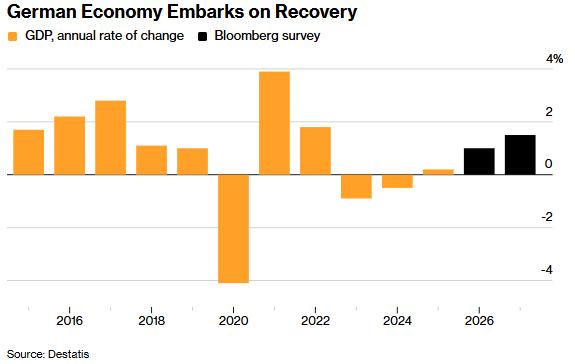
德国经济2025年实现三年来首次增长 财政支出热潮能否扭转颓势?
智通财经网· 2026-01-15 11:12
智通财经APP获悉,在政府支出热潮的推动下,德国经济在2025年实现了自2022年以来的首次年度增 长,艰难摆脱了长期的工业衰退。德国联邦统计局(Destatis)周四公布的数据显示,继此前连续两年萎缩 后,2025年国内生产总值(GDP)增长0.2%,与分析师预期中值一致。第四季度GDP环比也录得相同增 幅。 默茨清楚面临的挑战,并已承诺将重振经济增长作为首要任务。他在给执政联盟议员的信中描述某些行 业处于 "非常危急" 的状态。 近日,大众汽车和宝马均报告其在美国和中国的销量暴跌,美国关税以及比亚迪等亚洲汽车制造商的竞 争造成了冲击。据德国联邦统计局称,尽管欧盟内部贸易是 "稳定的锚" ,但对美国的出口额下降了近 8%,其中机动车辆和零部件受影响尤为严重。对华销售跌幅更大。 统计局指出,去年的经济增长主要由家庭消费和政府支出驱动,而投资出现下滑,贸易则对经济增长形 成拖累。近年来,欧洲最大经济体德国接连遭受能源危机、关键投入品渠道受限以及特朗普对全球贸易 的冲击,其工业中心地带所受打击尤为严重。 "这清楚地表明,中国正日益成为德国工业的竞争对手,而非德国工业产品的购买方," 统计局评论 道。 尽管市场对总 ...