江淮汽车

Search documents
江淮汽车今日大宗交易平价成交21.7万股,成交额1126.88万元
Xin Lang Cai Jing· 2025-09-03 09:39
Group 1 - On September 3, Jianghuai Automobile executed a block trade of 217,000 shares, with a transaction value of 11.2688 million yuan, accounting for 0.35% of the total transaction value for the day [1] - The transaction price was 51.93 yuan, which was in line with the market closing price of 51.93 yuan [1]



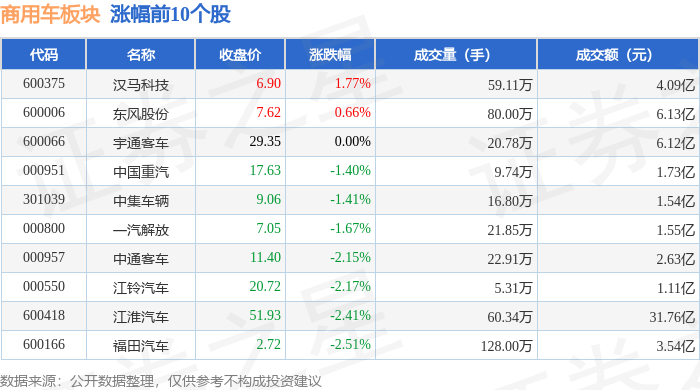
商用车板块9月3日跌0.32%,安凯客车领跌,主力资金净流出2.1亿元
Zheng Xing Xing Ye Ri Bao· 2025-09-03 08:40
Market Overview - The commercial vehicle sector experienced a decline of 0.32% on September 3, with Ankai Bus leading the drop [1] - The Shanghai Composite Index closed at 3813.56, down 1.16%, while the Shenzhen Component Index closed at 12472.0, down 0.65% [1] Individual Stock Performance - Hanma Technology saw an increase of 1.77%, closing at 6.90 with a trading volume of 591,100 shares and a turnover of 409 million yuan [1] - Ankai Bus reported a decrease of 3.37%, closing at 5.73 with a trading volume of 240,400 shares and a turnover of 141 million yuan [2] - Other notable declines included Jianghuai Automobile down 2.41% to 51.93 and Foton Motor down 2.51% to 2.72 [2] Capital Flow Analysis - The commercial vehicle sector experienced a net outflow of 210 million yuan from institutional investors, while retail investors saw a net inflow of 215 million yuan [2] - The main capital inflow and outflow for individual stocks showed that Hanma Technology had a net inflow of 44.72 million yuan from institutional investors [3] - Ankai Bus had a minor net inflow of 1.15 million yuan from institutional investors, while retail investors had a net outflow of 397,840 yuan [3]


第二季度8成汽车整车概念股获机构加仓
Cai Jing Wang· 2025-09-03 07:19
Group 1 - The average stock price of automotive concept stocks has increased by 8.47% this year [1] - Qianli Technology has the highest stock price increase, with a cumulative rise of 53.86% this year [1] - In the second quarter, 80% of automotive concept stocks saw an increase in institutional holdings, with 13 stocks having a more than 1 percentage point increase in institutional ownership [1] Group 2 - Notable stocks with increased institutional holdings include Foton Motor, JAC Motors, China National Heavy Duty Truck Group, Yutong Bus, and SAIC Motor [1]



多家车企相继披露8月销售数据,机构看好这些股
Cai Jing Wang· 2025-09-03 06:38
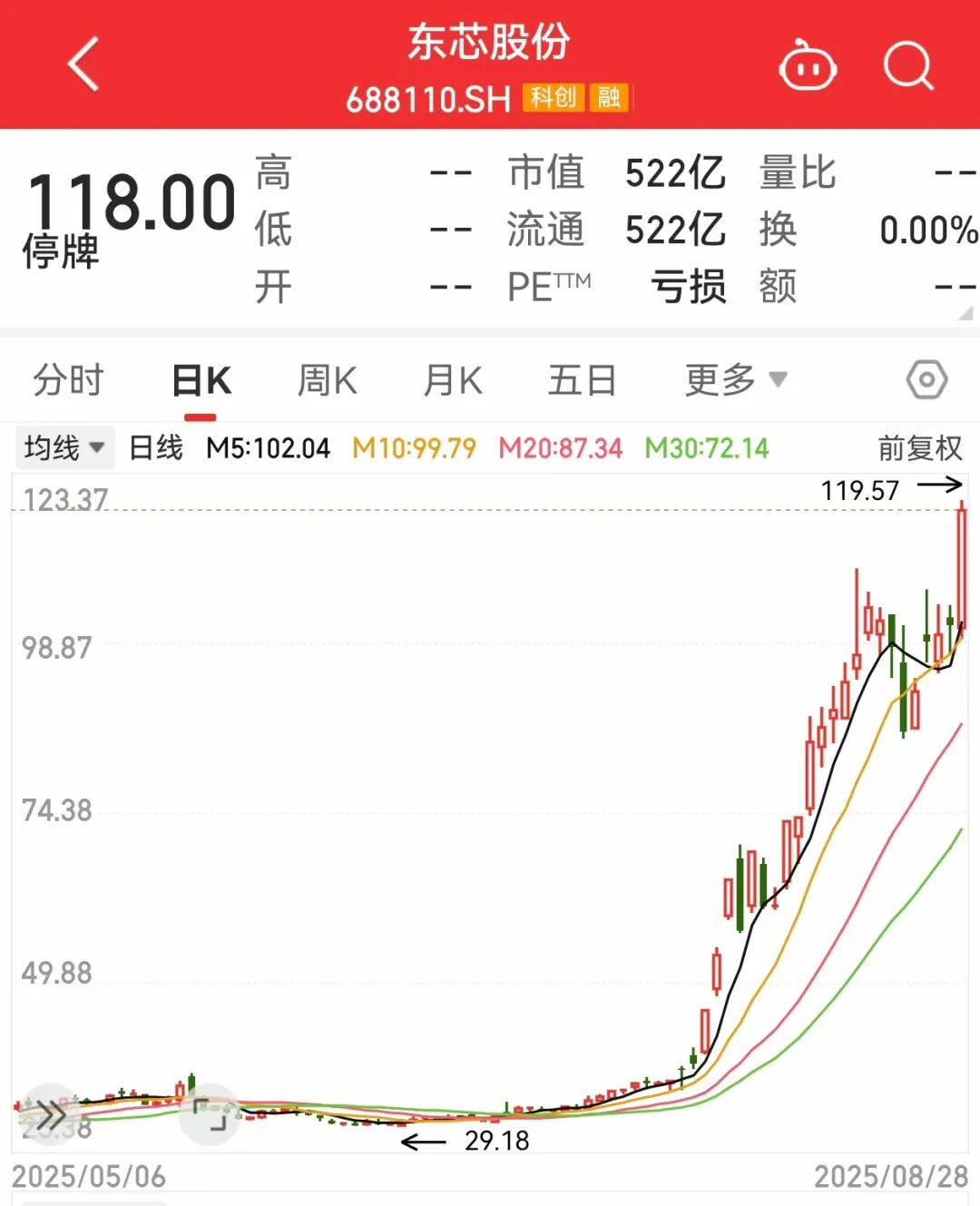
Core Viewpoint - The automotive sector is experiencing significant growth, with several companies reporting record sales and increased institutional investment in their stocks. Group 1: Company Announcements and Stock Performance - Dongxin Co., Ltd. announced a stock suspension due to abnormal trading fluctuations, with a cumulative stock increase of 207.85% since July 29 [1][4] - The company plans to invest approximately 5 billion RMB in Shanghai Lishuan, acquiring about 35.87% of its equity [4] - The average stock price of automotive companies has risen by 8.47% this year, with Qianli Technology showing the highest increase of 53.86% [7] Group 2: Sales Data and Market Trends - Several new energy vehicle companies, including Xiaopeng Motors and Li Auto, reported record monthly delivery numbers in August [5] - Leap Motor achieved a delivery volume of 57,100 units in August, a year-on-year increase of over 88% [5] - Chery Group sold 242,700 vehicles in August, with exports reaching 129,500 units, marking a 32.3% year-on-year increase [6] Group 3: Institutional Investment - In the second quarter, 80% of automotive concept stocks saw increased institutional holdings, with 13 stocks showing a rise of over 1 percentage point [10] - Notable companies with increased institutional holdings include Foton Motor, Jianghuai Automobile, and China National Heavy Duty Truck [10][11] - Foton Motor's stock price increased by 11.16%, while Jianghuai Automobile's stock rose by 41.89% this year [11]


车企账期观察:18家企业半年延长12天、蔚来和理想超200天,长城资金缺口232亿
Sou Hu Cai Jing· 2025-09-03 05:25
Core Insights - The automotive industry in China is experiencing intensified price wars and a collective commitment from 17 companies to reduce supplier payment terms to no more than 60 days to alleviate cash flow pressures on component manufacturers [2][4][8] Group 1: Industry Overview - The first half of 2025 saw a significant increase in accounts payable turnover days among major automotive companies, with an average of 187.97 days, up from 175.75 days at the end of 2024, indicating a trend of extended payment periods [4][6] - Out of 18 major passenger car manufacturers, 12 experienced an increase in payment terms, while only 6 managed to shorten them, highlighting a broader industry trend towards longer payment cycles [4][5] Group 2: Company-Specific Changes - Among the companies, Xpeng Motors had the most significant reduction in accounts payable turnover days, decreasing by 63 days to 170 days, while Seres saw the largest increase, with a rise of 101 days to 266 days [5][6] - BYD's accounts payable turnover days increased by 15 days to 142 days, while NIO's increased by 23 days to 220 days, reflecting a common trend of extended payment terms across the industry [6][12] Group 3: Cash Flow and Financial Health - The cash reserves of many companies are insufficient to cover their accounts payable, with only Jiangling Motors and Haima Automotive having cash reserves that exceed their payables [10][11] - Companies like BYD and Geely are facing significant cash shortfalls, with BYD having a deficit of 805.86 million and Geely 462.61 million, indicating a critical cash flow challenge in meeting supplier payments [11][12] - The shift to a 60-day payment term has led to increased cash flow pressures, as companies like Li Auto reported a negative free cash flow of 38 million, exacerbating their financial strain [9][10]



民生证券:车企自主冲击豪华市场 高端定义增量空间
智通财经网· 2025-09-03 02:34
Core Viewpoint - The automotive industry above 150,000 yuan is characterized by significant potential for domestic brands to increase market share and strong profitability, with brand strength preventing price-only competition [1][2]. Market Characteristics - The mid-to-high-end market (150,000 yuan and above) is expected to be a core area for future profit elasticity for car manufacturers, with current domestic market share below 50% and joint ventures still dominating [1][4]. - The 5-15 million yuan A-class car market is projected to be the main source of market share growth for domestic brands from 2024 to 2025, while the focus will shift to the performance of the mid-to-high-end market [1][2]. Profitability and Market Size - The annual sales volume for the 5-15 million yuan market is estimated at 11-12 million units, generating annual revenue of approximately 1.1-1.2 trillion yuan and net profits of 50-60 billion yuan [2]. - The 15-25 million yuan market is expected to have annual sales of 5.5-6 million units, with similar revenue and profit figures as the 5-15 million yuan market, indicating strong profitability despite lower sales volume [2]. - The luxury market (25 million yuan and above) is projected to have annual sales of around 4 million units, with a potential net profit of approximately 80 billion yuan, surpassing the other two segments [2]. Competitive Landscape - The luxury market is characterized by differentiated brand positioning, with super luxury brands focusing on performance and exclusivity, while traditional high-end brands (BBA) emphasize luxury experience [3]. - The current competitive landscape includes super luxury (e.g., Ferrari, Rolls-Royce), first-line luxury (BBA), and second-line luxury (e.g., Lexus, Infiniti), with domestic brands gradually redefining luxury through technological advancements [3][4]. Investment Recommendations - Recommended companies include Xiaomi Group, Geely Automobile, SAIC Motor, and others, with a focus on new energy and smart vehicle capabilities [5]. - Companies to watch include BAIC Blue Valley and JAC Motors, which may capitalize on the mid-range market opportunities [5].
2025年7月中国货车进出口数量分别为0.03万辆和6.37万辆
Chan Ye Xin Xi Wang· 2025-09-03 01:23
Core Insights - The article discusses the performance of China's truck industry, highlighting significant changes in import and export figures for July 2025 [1]. Import and Export Data - In July 2025, China's truck imports totaled 0.03 thousand units, representing a year-on-year decline of 55% [1]. - The import value for the same period was $0.26 million, down 54.4% year-on-year [1]. - Conversely, truck exports reached 6.37 thousand units, marking a year-on-year increase of 26.4% [1]. - The export value was $11.9 million, reflecting a year-on-year growth of 19.5% [1]. Industry Context - The data is sourced from China Customs and compiled by Zhiyan Consulting, a leading industry research institution in China [1]. - Zhiyan Consulting specializes in providing in-depth industry research reports, business plans, feasibility studies, and customized consulting services [1].

牵手8大国有车企 华为汽车板块扩大朋友圈
Zheng Quan Shi Bao· 2025-09-02 23:36
Core Viewpoint - Huawei's automotive business is rapidly maturing, having established partnerships with all eight major state-owned car manufacturers in China, as well as several luxury brands, indicating a significant shift in the automotive landscape towards smart technology integration [1][3][6]. Group 1: Huawei's Automotive Strategy - Huawei's automotive division evolved from its vehicle communication segment, officially entering the automotive sector in May 2019 with the establishment of the Intelligent Automotive Solutions Business Unit [2]. - The company has developed three main collaboration models with car manufacturers: component supply, Hi (full-stack intelligent automotive solutions), and Hongmeng Zhixing (originally "Smart Choice Car") [2]. - Huawei's automotive structure has solidified over six years, with its automotive business divided into two main parts: the component supply and Hi models under Shenzhen Yingwang Intelligent Technology Co., and the Hongmeng Zhixing model under Huawei's terminal BG [2][5]. Group 2: Recent Developments and Collaborations - The recent partnership between FAW Hongqi and Huawei marks a significant milestone, with plans to develop a new flagship model, the "Hongqi 9 Series," expected to launch in 2026 [3]. - Huawei's automotive technology has gained recognition from all major state-owned car manufacturers, with additional collaborations with BYD and several German luxury brands [3][6]. - The cumulative delivery of Hongmeng Zhixing vehicles has surpassed 900,000 units, indicating a successful transition from exploration to commercial expansion [5][6]. Group 3: Competitive Landscape - The automotive industry is witnessing a shift in competition, with traditional manufacturers, BYD, and new entrants like NIO and Xpeng emerging alongside Huawei [7][8]. - Huawei's technology is expected to accelerate the smart transformation of the Chinese automotive industry, helping domestic brands compete more effectively against international luxury brands [8][9]. - The Hongmeng Zhixing model is becoming a benchmark in the high-end automotive market, potentially positioning Huawei as a leading platform provider in the global automotive smart technology sector [9].
牵手八大国有车企华为汽车板块扩大“朋友圈”
Zheng Quan Shi Bao· 2025-09-02 23:35
Core Insights - Huawei has established partnerships with all eight major state-owned car manufacturers in China, marking a significant milestone in its automotive strategy [1][3] - The collaboration with FAW Hongqi signifies Huawei's growing influence and recognition in the automotive sector, as it aims to leverage its intelligent automotive solutions [3][5] Group 1: Huawei's Automotive Business Development - Huawei's automotive division has evolved from its telecommunications background, officially entering the automotive sector in May 2019 with the establishment of the Intelligent Automotive Solutions Business Unit [2] - The company has developed three main collaboration models with car manufacturers: component supply, Hi (full-stack intelligent automotive solutions), and Hongmeng Zhixing (formerly "Smart Choice") [2] - Huawei's automotive structure is now well-defined, with its component supply and Hi models under Shenzhen Yingwang Intelligent Technology Co., which is co-owned by Huawei and its partners [2] Group 2: Recent Collaborations and Product Launches - The partnership with FAW Hongqi aims to create a new flagship model, the "Hongqi 9 Series," expected to launch in 2026, utilizing Huawei's comprehensive technology stack [3][4] - Huawei's automotive ecosystem has expanded to include collaborations with various brands, including BYD, which has integrated Huawei's intelligent driving technology into its models [3][4] - The cumulative delivery of Hongmeng Zhixing vehicles has surpassed 900,000 units, indicating a strong market presence and acceptance [4][5] Group 3: Competitive Landscape and Market Position - The automotive industry is witnessing a shift in competition, with traditional automakers, BYD, and new entrants like NIO and Xpeng vying for market share alongside Huawei [6] - Huawei's technology is seen as a catalyst for the intelligent transformation of the Chinese automotive industry, helping local brands compete with international luxury brands [7] - The Hongmeng Zhixing model is positioned to challenge established luxury brands in the high-end market, particularly in the segment above 400,000 yuan [7] Group 4: Challenges and Future Outlook - Despite rapid growth, Huawei faces challenges in differentiating its offerings among various brands and models, as there is a risk of brand homogenization within the Hongmeng Zhixing lineup [8] - The company must ensure the safety and regulatory compliance of its intelligent driving technologies, as any failures could impact its reputation [8] - Huawei's future success will depend on its ability to adapt to local regulations and cultural contexts as it seeks to expand internationally [8]
活力源于澎湃的创新——以中央广播电视总台“活力中国调研行”为例
Sou Hu Cai Jing· 2025-09-02 14:32
Core Insights - The "Vibrant China Research Tour" by the Central Radio and Television Station (CRTV) employs a methodology centered on "paradigm restructuring," transforming the research process into a content engine and the research site into a communication field, achieving a paradigm shift from one-way advocacy to value co-creation [1][16] - The initiative has garnered significant attention, with over 120 million total views across platforms by the end of July, indicating strong audience engagement and recognition [2][15] Group 1: Research Methodology and Strategy - The CRTV news team emphasizes precise topic selection, closely aligning theme reporting with social realities, focusing on representative regions and hot phenomena that reflect key issues in China's economic and social development [3][6] - The research tour begins with a focus on Beijing's "Science and Innovation City," showcasing high-tech fields and innovations, effectively breaking conventional perceptions of the capital [5][10] Group 2: Dynamic Reporting and Audience Engagement - The reporting team innovatively transforms the research process into core content, utilizing live broadcasts and real-time scenes to present economic topics in relatable, everyday contexts, enhancing audience immersion [7][10] - The team captures compelling stories and details, such as the transformation of old porcelain factories in Jingdezhen, to illustrate urban renewal and cultural vitality, thereby deepening audience connection [12][13] Group 3: Impact and Future Directions - The "Vibrant China Research Tour" has achieved notable success, with multiple reports trending and high view counts, demonstrating the effectiveness of the CRTV's innovative reporting strategies [15][16] - Future efforts should focus on expanding content formats, such as producing documentary series and interactive reports, to further engage audiences and enhance the impact of the initiative [16]