双环传动

Search documents
趋势研判!2025年中国汽车减速器行业产业链全景、市场运行现状、企业布局及未来发展趋势分析:产业整合加速集聚,智能适配引领转型[图]
Chan Ye Xin Xi Wang· 2025-12-12 01:08
Core Insights - The automotive reducer industry in China has established a complete and closely coordinated industrial chain, with upstream focusing on raw materials and core components, midstream dominated by international giants like BorgWarner, and local companies like Jingzhu Technology and Shuanghuan Transmission gaining significant market share in mainstream and new energy segments [1][6][10] - The market is experiencing steady growth, closely tied to the explosive growth of the automotive industry, particularly in new energy vehicles (NEVs), with local companies making rapid advancements through technological breakthroughs [1][9][10] - Future developments in the industry will focus on deep technological iterations, industry consolidation, and ecological collaboration, with products evolving towards high-speed, low-noise, lightweight, and integrated designs [1][10][14] Industry Overview - Automotive reducers are key components in the automotive transmission system, responsible for reducing speed and increasing torque to provide suitable driving power [2][3] - The industry is characterized by a tight integration of upstream and downstream sectors, with a strong emphasis on localization and integration [6][9] Market Dynamics - The demand for automotive reducers is driven by the rapid growth of the passenger vehicle market, particularly electric and hybrid models, which require lightweight and high-efficiency products [6][7] - In the commercial vehicle sector, the demand for reducers is focused on heavy load and high reliability, with structural upgrades driven by the rise of automatic transmissions and new energy vehicles [7][9] Competitive Landscape - The competitive landscape is marked by a clear stratification, with international giants dominating the high-end market while local companies rapidly rise in the mid-range and NEV segments [10][11] - Key players include Shuanghuan Transmission, Jingzhu Technology, and others, who are establishing themselves as core suppliers for NEV gears [10][12] Future Trends - The industry is expected to evolve along three main directions: technological iteration focusing on precision and integration, industry consolidation with a focus on high-end breakthroughs by local brands, and ecological collaboration emphasizing standardization and cross-industry integration [10][14] - The adoption of advanced materials and manufacturing techniques will drive the development of high-speed, low-noise, and lightweight reducers, with a significant shift towards integrated electric drive systems [12][13]


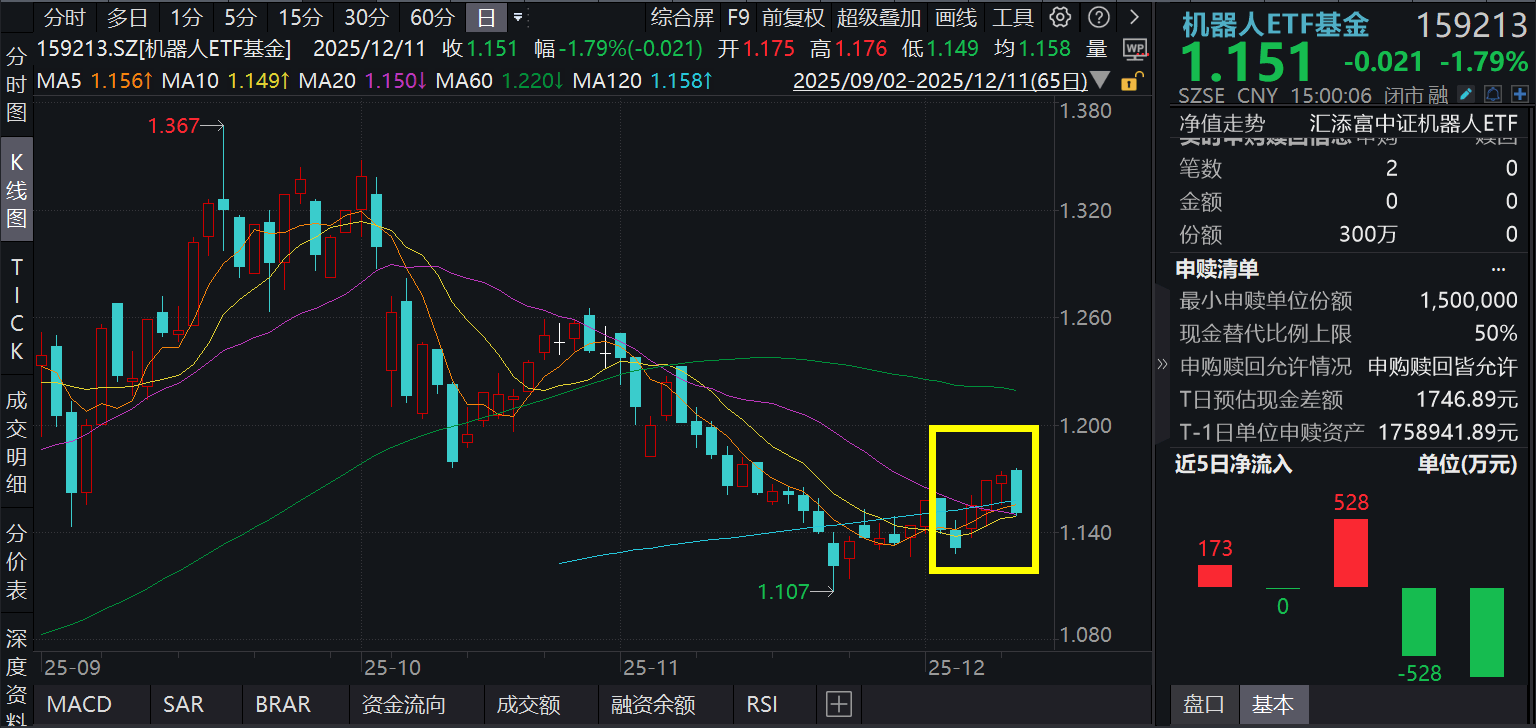
沪指弱势三连阴,机器人板块三连阳后首度回调,机器人ETF基金(159213)收跌1.79%,资金逆势涌入!人形机器人明年迎“量产大考”,怎么看?
Sou Hu Cai Jing· 2025-12-11 09:28
Core Viewpoint - The A-share market experienced a pullback on December 11, with the Shanghai Composite Index showing weakness for three consecutive days. Despite this, the Robot ETF Fund (159213) saw a net subscription of 3 million shares, indicating a capital inflow of over 3.4 million yuan [1]. Group 1: Market Performance - The Robot ETF Fund (159213) closed down by 1.79%, ending its three-day upward trend. The majority of its constituent stocks also experienced declines, with notable drops including Yuntian Lifei down over 3%, and Stone Technology and Zhongkong Technology down over 2% [1][3]. - The top ten constituent stocks of the Robot ETF Fund showed negative performance, with declines ranging from -0.59% to -3.62% across various sectors, including machinery and computer technology [4]. Group 2: Industry Developments - On December 11, the Beijing Humanoid Robot Innovation Center announced the launch of the first fully autonomous humanoid robot tour guide solution in China, which integrates various advanced capabilities for diverse applications [5]. - TrendForce's report indicated that 2026 will be a pivotal year for the commercialization of humanoid robots, with expected shipments exceeding 50,000 units, representing a year-on-year increase of over 700% [5]. Group 3: Investment Recommendations - Huolong Securities suggested that the humanoid robot sector is entering a critical phase of mass production, recommending active investment in this area. The report highlighted the strengthening logic of the robotics industry, with significant developments from both international and domestic players [6]. - Open Source Securities projected that 2026 will see a surge in the humanoid robot market, driven by major companies entering the field and supportive policies, indicating a favorable investment window [7]. Group 4: Supply Chain and Policy Insights - Tesla's supply chain is becoming clearer, with plans for standardization and mass production of its robots by 2026. This includes a timeline for production milestones and supplier confirmations [8]. - Domestic policies are also fostering rapid advancements in the humanoid robot sector, with significant investments from companies like Xiaomi and Yushun, as well as the establishment of new companies focused on humanoid robot technology [9].




一周一刻钟,大事快评(W135):信息发展观点更新-20251210
Shenwan Hongyuan Securities· 2025-12-10 11:11
Investment Rating - The industry investment rating is "Overweight" indicating that the industry is expected to outperform the overall market [2][14]. Core Insights - The core business of the company revolves around Beidou Free Flow technology, which aids the government in accurately collecting road tolls and monetizing related data assets. The company has made significant progress in Hainan, benefiting from supportive policies, and has demonstrated predictable profit prospects [3][4]. - The market growth potential is substantial, particularly with the increasing penetration of electric trucks and the retrofitting of existing vehicles, targeting a national market of approximately 8 million heavy trucks [5]. Summary by Sections Company Overview - The company focuses on processing and monetizing driving data generated by users, holding ownership of this data. It collaborates with insurance companies and mapping service providers to optimize claims processes and enhance map accuracy [4]. Market Analysis - The business model has shown smooth advancement in Hainan due to favorable policy conditions, with a clear path for nationwide expansion, especially in the commercial vehicle sector, particularly electric commercial vehicles [4]. Investment Recommendations - Recommendations include strong domestic manufacturers like BYD, Geely, and Xpeng, as well as companies aligned with the trend of smart technology such as Jianghuai Automobile and Seres. The report also suggests focusing on state-owned enterprise consolidations and component manufacturers with strong growth potential [3].
双环传动(002472):深耕精密齿轮领域 机器人减速器开拓新空间
Xin Lang Cai Jing· 2025-12-09 08:38
Core Insights - The company is expected to achieve a CAGR of 112% in net profit attributable to shareholders from 2020 to 2024, with a weighted ROE of 9% [1] - The company has three main business segments: gears, smart actuators, and reducers, with revenue contributions of 82%, 10%, and 8% respectively in the first half of 2025 [1] Group 1: Gear Business - The gear business is driven by technological upgrades and globalization, with an expected CAGR of 10% from 2024 to 2027 [2] - The scale of the gear industry in China exceeds 300 billion, with a CAGR of 7% from 2017 to 2021; automotive gears account for 62% of the global gear market [2] - The trend towards electric vehicles is changing the relationship between manufacturers and suppliers, creating opportunities for independent gear manufacturers [2] Group 2: Smart Actuator Business - The smart actuator business is expected to grow at a CAGR of 40% from 2024 to 2027, with applications expanding into smart home, smart automotive, and E-bike sectors [3] - The global small modulus gear market is projected to reach $1.26 billion in sales by 2024, with a CAGR of 5% from 2025 to 2031 [3] - The acquisition of SMD by the company has allowed it to enter the smart actuator market, with ongoing expansion into various downstream applications [3] Group 3: Reducer Business - The reducer business is positioned to benefit from the humanoid robot sector, with an expected market increment of approximately 90.8 billion by 2030 and a CAGR of 173% from 2025 to 2030 [4] - The company holds a 61% stake in Huan Dong Technology, a leading domestic RV reducer manufacturer, which is expected to achieve a market share of 25% by 2024 [4] - The technology capabilities of Huan Dong are extending into harmonic reducers, creating new growth opportunities [4] Group 4: Profit Forecast and Valuation - The company is projected to achieve a CAGR of 20% in net profit attributable to shareholders from 2024 to 2027 [5] - Expected net profits for 2025, 2026, and 2027 are 1.24 billion, 1.47 billion, and 1.77 billion respectively, with corresponding PE ratios of 29, 24, and 20 [5] - The company's strong position in precision transmission gears and the growth of its smart actuator and reducer businesses are key drivers for future profitability [5]
双环传动(002472) - 2025年员工持股计划第一次持有人会议决议公告
2025-12-09 08:00
证券代码:002472 证券简称:双环传动 公告编号:2025-079 浙江双环传动机械股份有限公司 2025 年员工持股计划第一次持有人会议决议公告 本公司及董事会全体成员保证信息披露的内容真实、准确、完整,没有虚 假记载、 误导性陈述或重大遗漏。 浙江双环传动机械股份有限公司(以下简称"公司")2025 年员工持股计 划第一次持有人会议于 2025 年 12 月 8 日以通讯表决方式召开。会议由公司董事 会秘书陈海霞女士召集并主持,会议通知已于 2025 年 12 月 1 日向全体持有人发 出。会议应出席持有人 352 名,实际出席持有人 351 名,代表公司员工持股计划 份额为 163,830,753 份,占公司本次员工持股计划总份额的 99.90%。会议的召 集、召开和表决程序符合公司员工持股计划的有关规定。本次会议审议并通过了 如下议案: 一、审议通过了《关于设立公司 2025 年员工持股计划管理委员会的议案》 为保证公司 2025 年员工持股计划的顺利进行,保障持有人的合法权益,根 据公司《2025 年员工持股计划(草案)》《2025 年员工持股计划管理办法》等 相关规定,同意设立公司 2025 ...
全球机器人_2026 人形与四足机器人展望_中国在产量上领先,特斯拉份额存疑;重点看好核心业务增长明确的企业
2025-12-08 15:36
Summary of the Conference Call on Robotics Market Outlook Industry Overview - The global market for humanoid and quadruped robots is still in its early stages, with mass production timelines progressing slower than expected due to supply chain complexities and technological challenges [1][2] - Key players include Tesla (TSLA US, Not rated) and Figure AI in humanoids, and Boston Dynamics in quadrupeds, with no other competitors showing comparable readiness for volume manufacturing [1] Core Insights - **Tesla's Optimus Projections**: Tesla is expected to deliver 60,000–80,000 units of the Optimus robot in 2026, with uncertainties surrounding supply chain and production cadence [2] - **China's Competitive Edge**: The Chinese humanoid and quadruped robot industry is anticipated to outpace Tesla in mass production due to simplified designs that lower manufacturing costs. Leading companies like UBTech and Unitree aim for annual production of 50,000–100,000 units by 2026 [3][4] - **Supply Chain Fragmentation**: The supply chain in China is highly fragmented, with unique mechanical architectures for each robot, limiting component-level standardization and supplier margins [4] Market Dynamics - Initial deployments of Tesla's robots will focus on internal factory tasks, with broader commercial availability expected in 2027 [2] - The 2026 robotics market remains constrained, with uncertain volume ramp-ups and evolving designs, limiting earnings contributions in the near term [5] Investment Recommendations - Companies with strong growth in core non-robotics businesses are preferred, as humanoid exposure is seen as a long-term option rather than a near-term earnings driver [7] - Selective positivity towards companies with technological advantages in critical subsystems is noted, as they are expected to benefit from the anticipated production ramp-up in 2026 [8] - **Buy Ratings**: - Shuanghuan Driveline (002472 CH) is rated Buy due to its confirmation of the Optimus chain and growth in consumer segments [8] - Orbbec (688322 CH) is highlighted as a top pick in robotics, benefiting from its strong position in the vision area and growth in 3D printing [8] Additional Insights - The report emphasizes the importance of geopolitical risks affecting supply chains, particularly for Tesla, which may need to diversify its supplier base outside of China [2] - The anticipated ramp-up in production is expected to focus on commercial-service applications that are quick to monetize, such as warehouse inspections and security patrolling [4]


野村研究判断:2026年,中国人形及四足机器人行业的量产进度将赶超特斯拉
Zhi Tong Cai Jing· 2025-12-08 13:29
如果说2025是人形机器人和四足机器人的元年,那么即将到来的2026年,这个产业的格局会发生哪些重 要变化? 日前,野村证券发布研究报告指出,全球人形及四足机器人市场仍处萌芽阶段,行业头部玩家格局清 晰:人形机器人领域以特斯拉和Figure AI为主,四足机器人领域则以波士顿动力领跑。 但在2026年,中国人形及四足机器人行业的量产进度将赶超特斯拉。野村认为,这主要得益于中国多数 企业的产品设计策略——为实现更快量产及更低成本,主动舍弃了高拟人化性能,如采用轮式底盘、非 灵巧手方案等。 01 特斯拉Optimus:明年预计量产6-8万台 全球人形及四足机器人市场仍处萌芽阶段,受供应链复杂度高、技术壁垒突出等因素影响,量产进度整 体慢于初期预期。 据野村从供应链企业处获取的信息测算,这家头部机器人企业或将于2026年3月后启动产能爬坡,2026 年预计交付6万-8万台Optimus,到2026年下半年周产能有望达到1000-2000台。 若要达成这一目标,核心供应商需具备非中国地区产能。特斯拉方面表示,初期Optimus将优先部署于 自有工厂,承担重复性任务以快速提升生产效率,同时持续迭代技术,计划2027年实 ...
连涨两天!机器人重回市场焦点,相关ETF怎么选?
市值风云· 2025-12-08 10:08
Core Viewpoint - The article emphasizes the stabilization of the robotics sector, highlighting its potential as a long-term investment opportunity driven by government support and technological advancements [4][5][6]. Group 1: Market Trends - The current market lacks a clear direction, with a muted profit effect and fluctuating conditions, necessitating a focus on long-term trends, particularly in technology [4]. - The robotics sector has seen increased attention from investors, indicating a potential upward movement [5]. Group 2: Government Support - The Trump administration is reportedly shifting focus to robotics, considering an executive order and establishing a working group to accelerate industry development [6]. - Domestic policies in China also prioritize robotics as a key area for economic growth, as outlined in the "14th Five-Year Plan" [6]. Group 3: Industry Progress - The robotics industry is transitioning from expectation to validation, with a shift in market focus from mere technological narratives to actual commercialization and performance [8]. - Tesla's Optimus has demonstrated improved capabilities and announced a production timeline, while domestic companies are securing significant contracts [6]. Group 4: ETF Selection - The article discusses two main categories of robotics ETFs: established mainstream ETFs and newly proposed innovation-focused ETFs [11]. - The CSI Robotics Index covers a broad range of companies across the entire industry chain, while the National Robotics Index has increased its focus on humanoid robots [12][17]. - The National Robotics Index has shown a better performance this year, with a 27.8% increase compared to the CSI Robotics Index's 24.8% [22]. Group 5: Investment Strategies - Investors seeking comprehensive industry coverage may consider the CSI Robotics Index products for stability, while those focused on humanoid robots might prefer the National Robotics Index products [31]. - The upcoming innovation-focused ETFs will cater to those interested in smart technology and hard tech attributes [31].
美国储能系统与机器人:东京、新加坡、吉隆坡路演要点-US ESS and robotics_ Marketing takeaways – Tokyo_Singapore_KL
2025-12-08 00:41
Summary of Key Points from the Conference Call Industry Overview - The discussion focused on the energy storage systems (ESS), robotics, and solar anti-involution themes, with key companies mentioned including Sungrow, Canadian Solar, CATL, Tesla, Nidec, Orbbec, Shuanghuan, and Sanhua [1][2]. Core Insights 1. **Energy Storage Systems (ESS) Valuation Concerns** - Investors find the risk/reward for several ESS companies unattractive at current valuations due to policy risks and margin uncertainty [1][2]. - There is a strong demand outlook for 2026 driven by AI data centers and aging electricity grids, but concerns exist regarding the sustainability of the ESS theme post-2028 as alternative solutions may scale up [2]. 2. **Robotics Market Challenges** - There is skepticism regarding the near-term mass production of humanoid robotics, leading to a preference for companies with resilient core businesses rather than those heavily reliant on robotics [3]. - Investors are particularly interested in understanding the mass production timelines and application sequences of leading players in the robotics sector, including Tesla and various Chinese companies [3]. 3. **Solar Polysilicon Sector Dynamics** - Ongoing discussions about solar polysilicon supply consolidation highlight investor interest in anti-involution initiatives, but there is limited visibility on actual progress and price stabilization [5]. - The anti-involution campaign's rationale is being closely examined, with potential implications for other oversupplied sectors like solar cells and EVs [5]. Additional Important Insights - **Client Preferences** - Client interest is concentrated in companies perceived to have competitive advantages, such as Tesla, Sungrow, CATL, and Orbbec, rather than a broad positive sentiment across the sector [1]. - There is a notable shift in conviction towards US beneficiaries and alternative technologies to address energy shortages, with some investors opting to remain on the sidelines until clearer visibility on margins and policies emerges [2]. - **Geopolitical and Margin Risks** - Specific concerns were raised about Sungrow facing near-term headwinds due to gross margin erosion and geopolitical risks, which could impact its performance [2]. - **Market Sentiment** - The overall sentiment indicates a cautious approach among investors, with a preference for companies that can demonstrate visible growth in their core operations while treating robotics as a speculative investment [3]. This summary encapsulates the key points discussed during the conference call, providing insights into the current state and future outlook of the ESS, robotics, and solar sectors.
具身智能时代,谁将成为下一个“中国巴菲特”?
3 6 Ke· 2025-12-05 12:37
Core Insights - The initial successful application of humanoid robots is in the short video industry, showcasing their quirky and often clumsy behaviors, which have become a source of entertainment [1][4] - The humanoid robot industry is transitioning from experimental phases to real-world applications, with significant investment flowing into the sector, indicating a potential for substantial growth [4][10] Industry Development - In the first eight months of 2025, the financing amount in China's robotics sector reached 38.624 billion yuan, highlighting the increasing financial interest in humanoid robots [4] - Global consulting firm Bain predicts that humanoid robots will reshape industrial production and significantly impact commercial services and home life over the next decade [4] Technological Approaches - The U.S. focuses on creating advanced "super brains" for robots, emphasizing a technology-driven approach, while China adopts a more pragmatic strategy, prioritizing hardware development and real-world applications [5][7] - Chinese companies are rapidly developing the physical components of robots, such as advanced sensors and dexterous hands, to enhance their functionality and reduce costs [8][10] Investment Landscape - Venture capital firms like Sequoia Capital and Matrix Partners are strategically investing in various segments of the humanoid robot industry, aiming to capture value across the entire supply chain [11][12] - Major tech companies like Tencent and Alibaba are also investing in robotics, providing not only capital but also valuable application scenarios and resources [14] Government and Institutional Support - National investment entities are aligning their strategies with government initiatives, focusing on securing the supply chain and advancing critical technologies in the humanoid robot sector [15] - The involvement of over 3,331 investment institutions in humanoid robot projects indicates a robust interest in the industry, with significant contributions from state-backed funds [15] Market Challenges - Despite the excitement in the humanoid robot market, there are concerns about product redundancy and the potential for oversaturation, which could hinder innovation and development [17] - The industry faces challenges in achieving sustainable cash flow and viable commercialization paths, as highlighted by the closure of previously promising companies [17][19]