浙商证券

Search documents
香港正在争夺全球黄金定价权
2 1 Shi Ji Jing Ji Bao Dao· 2026-01-30 16:40
Core Viewpoint - The establishment of a central clearing system for gold in Hong Kong is set to enhance its position as an international financial center and improve the efficiency and security of gold transactions, addressing long-standing market bottlenecks [2][4][6]. Group 1: Market Context - Gold prices have reached historical highs, with spot prices hitting $5,598 per ounce on January 29, 2026, and domestic prices in Shanghai rising to 1,243.40 yuan per gram [2]. - The global geopolitical climate, increased central bank gold purchases, and the acceleration of the internationalization of the renminbi are driving factors behind the rising gold prices [2][4]. - In 2025, global central banks purchased a net total of 634 tons of gold, with expectations for total purchases to reach between 750 tons and 900 tons for the year [5][6]. Group 2: Central Clearing System - Hong Kong has lacked a unified central clearing mechanism for gold trading, relying on a bilateral clearing model that has led to high costs and risks [4][5]. - The new central clearing system aims to integrate clearing, storage, and trading, enhancing operational efficiency and reducing transaction costs [8][9]. - The system is designed to facilitate cooperation between Hong Kong and the Shanghai Gold Exchange, allowing for efficient connections between renminbi-denominated gold products [6][10]. Group 3: Infrastructure and Governance - The Hong Kong government has established a wholly-owned company to govern the central clearing system, ensuring collaboration between government, financial regulators, and major banks [6][8]. - The system will enhance the safety and public nature of gold transactions while integrating with existing market institutions [9][10]. - Plans are in place to increase gold storage capacity at Hong Kong International Airport to over 2,000 tons within three years [8]. Group 4: Product Innovation - The central clearing system will support the diversification of gold financial products, including traditional ETFs and digital innovations [13][14]. - The launch of the Hang Seng Gold ETF, which allows for physical gold redemption, marks a significant step in product innovation within the Hong Kong market [14]. - The development of tokenized gold products is being explored, with a focus on establishing a regulatory framework to ensure asset security and integrity [15]. Group 5: Regional Cooperation - The collaboration between Hong Kong and Shenzhen in gold refining and trading is expected to enhance Hong Kong's capabilities and attract more international gold enterprises [16][17]. - The integration of the central clearing system with the Shanghai Gold Exchange's offshore delivery warehouse will facilitate a dual-currency pricing system for gold [17][18]. - The establishment of a "Shanghai-Hong Kong dual hub" is anticipated to strengthen China's influence in the global gold market [10][11].


鲁北化工:关于控股股东股份质押的公告
Zheng Quan Ri Bao Zhi Sheng· 2026-01-30 15:22
Group 1 - The core point of the article is that Luban Chemical announced the pledge of 40 million shares by its controlling shareholder, Luban Group, to Zheshang Securities for operational purposes [1] - The pledge period is from January 29, 2026, to January 28, 2027 [1] - The pledged shares account for 22.10% of Luban Group's holdings and 7.57% of the total share capital of Luban Chemical [1]

山东挑大梁,工业焕新机
Jing Ji Guan Cha Wang· 2026-01-30 14:57
Group 1 - The economic performance of major provinces in China is expected to play a crucial role in national GDP growth, with seven major provinces projected to achieve GDP growth rates between 5.3% and 5.6% in 2025, surpassing the national average of 5% [1][2] - Shandong Province, as a significant economic player, has shown remarkable growth, with its GDP share increasing from 7.19% to 7.36% during the 14th Five-Year Plan, and its GDP crossing the thresholds of 8 trillion, 9 trillion, and 10 trillion yuan [1][2] - The industrial sector in Shandong is a key driver of its economic strength, with the province being the only one in China to have all 41 industrial categories, and a projected industrial value-added growth of 7.6% in 2025, exceeding the national average by 1.7 percentage points [2][3] Group 2 - Shandong's manufacturing sector is undergoing significant transformation, with a focus on integrating advanced technologies into traditional industries, which account for 70% of its GDP [3][4] - The province's digital economy has surpassed 50% of its GDP, reflecting a 9 percentage point increase over the past five years, while high-tech industries now represent 55.3% of industrial output, a 10.6 percentage point increase since 2020 [4][5] - Shandong is actively fostering new production capabilities, with a focus on technological innovation, aiming for the artificial intelligence sector to exceed 200 billion yuan by 2027, maintaining an annual growth rate of over 30% [6][7] Group 3 - The GDP growth targets for Shandong from 2023 to 2025 have consistently been set above 5%, with actual growth rates of 6%, 5.7%, and 5.5%, indicating strong economic resilience [6] - The province plans to implement 12 key industry growth strategies, focusing on technological upgrades and project-based advancements to strengthen its industrial base [6][7] - Shandong aims to enhance its role as a significant economic growth hub in northern China, with initiatives to optimize traditional industries and cultivate emerging sectors [7]
又有5只商业不动产REITs,上报并获受理
Zhong Guo Ji Jin Bao· 2026-01-30 13:47
Market Performance - The public REITs secondary market experienced an overall upward trend this week, with a slight decrease in trading activity compared to the previous week [1] - The CSI REITs total return index increased by 0.47% this week, while the CSI REITs index rose by 0.35%, outperforming the CSI 300 index [1][2] - As of January 30, the CSI REITs total return index closed at 1052.42 points, marking a positive weekly growth for two consecutive weeks [2] Individual REITs Performance - Among the 78 listed public REITs, 41 saw an increase in their prices this week, with the top performers being focused on sectors such as parks, energy, consumption, and transportation [2] - The best-performing REIT this week was Bosera Jinkai Industrial Park REIT, which had a weekly increase of 4.94% [3] - Other notable gainers included ICBC Mengneng Clean Energy REIT and Huaxia Zhonghai Commercial REIT, with weekly increases of 4.64% and 4.52%, respectively [3] New Listings and Applications - Huaxia Zhongke Clean Energy REIT is set to be listed on the Shanghai Stock Exchange on February 2, becoming the 79th public REIT in the market [5] - Five commercial real estate REITs have been reported and accepted for review, with the first three submitted on January 29 [6][7] - The submitted commercial REITs include products from Huaxia Fund, Huitianfu Fund, and CICC Fund, expanding the total number of reported commercial REITs to eight [9]

浙商证券(601878) - 浙商证券股份有限公司第四届董事会第四十一次会议决议公告
2026-01-30 08:30
本公司董事会及全体董事保证本公告内容不存在任何虚假记载、误导性陈述 或者重大遗漏,并对其内容的真实性、准确性和完整性承担个别及连带责任。 浙商证券股份有限公司(以下简称"浙商证券"或"公司")第四届董事会 第四十一次会议于 2026 年 1 月 23 日以书面方式通知全体董事,于 1 月 27 日发 出补充通知,会议于 2026 年 1 月 30 日以通讯表决方式召开。会议应出席董事 9 人,实际出席董事 9 人。会议的召开符合《公司法》和《公司章程》规定。 经审议,作出决议如下: 证券代码:601878 证券简称:浙商证券 公告编号:2026-009 浙商证券股份有限公司 第四届董事会第四十一次会议决议公告 三、审议通过《关于单独设立公司巡查办公室的方案的议案》 表决结果:9 票同意,0 票反对,0 票弃权。 特此公告。 浙商证券股份有限公司董事会 2026 年 1 月 31 日 一、审议通过《关于经理层 2022-2024 任期激励核定的议案》 表决结果:9 票同意,0 票反对,0 票弃权。 本议案提交董事会前已经公司董事会提名与薪酬委员会审议通过。 二、审议通过《关于将"纪检监察室"更名为"纪检室"并明 ...

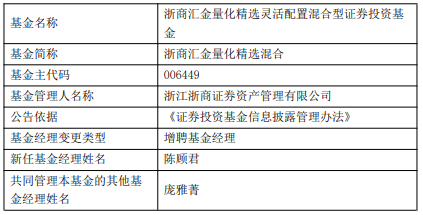
浙商汇金量化精选混合增聘陈顾君
Zhong Guo Jing Ji Wang· 2026-01-30 08:17
中国经济网北京1月30日讯 昨日,浙商证券资产管理有限公司公告,浙商汇金量化精选混合增聘陈 顾君。 浙商汇金量化精选混合A/C成立于2019年03月25日和2025年09月30日,截至2026年01月29日,其今 年来收益率为2.50%、2.47%,成立来收益率为71.29%、2.46%,累计净值为1.7129元、1.7110元。 | 基金名称 | 浙商汇金量化精选灵活配置混合型证券投资基 | | --- | --- | | | 金 | | 基金简称 | 浙商汇金量化精选混合 | | 基金主代码 | 006449 | | 基金管理人名称 | 浙江浙商证券资产管理有限公司 | | 公告依据 | 《证券投资基金信息披露管理办法》 | | 基金经理变更类型 | 增聘基金经理 | | 新任基金经理姓名 | 陈顾君 | | 共同管理本基金的其他基 | 庞雅菁 | | 金经理姓名 | | (责任编辑:康博) 陈顾君历任上海海通证券资产管理有限公司量化研究员,曾任浙江浙商证券资产管理有限公司量化 研究员、基金经理助理,现任基金经理。 ...
银河通用发布工业级重载机器人,SpaceX商讨与xAI合并
Mei Ri Jing Ji Xin Wen· 2026-01-30 01:37
Market Review - The A-share market for artificial intelligence and robotics has shown a simultaneous decline, with related theme ETFs experiencing a downward trend after initial gains. The Sci-Tech Innovation Artificial Intelligence ETF (589010) opened strong but fell to a latest price of 1.607 yuan, down 2.488% from the opening price. Among the 30 constituent stocks, 21 declined, with companies like Lanke Technology and Chipone falling over 5%. Conversely, Sikan Technology surged by 15.08% and Xinghuan Technology rose over 5% [1] - The Robotics ETF (562500) also saw a strong opening but faced volatility, closing at a price of 1.069 yuan, down 1.475% from the opening. Out of 66 constituent stocks, 57 declined, with companies like Dazhu Laser and Jiangsu Beiren dropping over 5%. However, Paislin hit the daily limit, and Keda Xunfei rose by 6.42%, providing some local support [1] - In terms of liquidity, the trading volume for the Sci-Tech Innovation Artificial Intelligence ETF was 77.2 million yuan with a turnover rate of 2.96%, indicating moderate trading activity. The Robotics ETF had a trading volume of 1.719 billion yuan and a turnover rate of 6.74%, reflecting a high level of trading activity [1] Hot News - Galaxy General recently launched the world's first industrial-grade embodied intelligent heavy-duty robot, GalbotS1, which is capable of zero-remote operation and fully autonomous sustainable work, with a maximum load of 50 kg. The core embodied handling model has been recognized as an important achievement in artificial intelligence in Beijing. The cumulative shipment of its GalbotG1 robot is expected to exceed 1,200 units by 2025 [2] - Yushu announced the open-source of its UnifoLM series, specifically the visual-language-action (VLA) large model UnifoLM-VLA-0, designed for general humanoid robot operations. This model continues pre-training on robot operation data, overcoming traditional VLM physical interaction limitations and evolving into an embodied brain with physical common sense [2] - Elon Musk's SpaceX is in discussions with its AI company xAI for a potential merger, aiming to complete it before a significant IPO for SpaceX. Musk serves as CEO for both companies. If the merger occurs, it will integrate rockets, Starlink satellites, the social media platform X, and the Grok AI chatbot into a single entity, with xAI shares being exchanged for SpaceX shares [2] Institutional Views - Zheshang Securities reported that Elon Musk is systematically laying out AI, robotics, and autonomous driving across six key technology areas through Tesla, xAI, and SpaceX. These technologies are complementary and interconnected, forming a grand technological landscape that drives human civilization upgrades. The year 2026 is anticipated to be a "singularity year" for the commercialization of this technological landscape, with several core projects expected to achieve significant milestones and market penetration [3] Popular ETFs - The Robotics ETF (562500) is the only ETF in the market with a scale exceeding 20 billion yuan, offering the best liquidity and comprehensive coverage of the Chinese robotics industry chain, facilitating investors' access to the sector [4] - The Sci-Tech Innovation Artificial Intelligence ETF (589010) is described as the "brain" of robotics, with a 20% price fluctuation limit and small-cap elasticity, aimed at capturing the "singularity moment" in the AI industry [4]

监管火力全开 28天16张罚单砸向7家券商 严打“两融绕标”
2 1 Shi Ji Jing Ji Bao Dao· 2026-01-29 23:42
Core Viewpoint - The China Securities Regulatory Commission (CSRC) is intensifying its regulatory efforts on securities firms, emphasizing the responsibility of these firms as gatekeepers in the capital market, with a notable increase in penalties issued in 2026 [1][11]. Group 1: Regulatory Actions - As of January 28, 2026, a total of 16 penalties have been issued by local securities regulatory authorities against securities firms and their employees, averaging one penalty every two days [1][11]. - The majority of penalties have been directed at small and medium-sized securities firms, with no major firms penalized for company-level issues, indicating stricter compliance and risk management among larger firms [1][11]. - Notable firms receiving penalties include Jianghai Securities and Xinda Securities, with issues related to third-party involvement in investor solicitation and failure to prevent insider trading [1][11]. Group 2: Individual Violations - Among the 16 penalties, five were specifically directed at individuals rather than their firms, indicating that the violations were personal rather than systemic [3][12]. - Common violations included improper operation of client accounts, using one's position for personal gain, promoting non-company products for profit, and borrowing others' accounts for trading [12][13]. Group 3: Specific Firm Issues - Jianghai Securities faced significant issues, including inadequate execution of client follow-up procedures and failure to prevent employees from trading on undisclosed information [6][15]. - Xinda Securities received three warnings, primarily for insufficient control over margin trading and inadequate monitoring of abnormal trading behaviors [6][15][16]. - Other firms like Huajin Securities and Jin Yuan Unified Securities also faced penalties, with issues ranging from operational errors to inadequate supervision of client transactions [17][18]. Group 4: Broader Regulatory Trends - The regulatory environment is characterized by a high-pressure, detailed, and ongoing scrutiny of intermediary institutions, with a focus on both major violations and minor internal control lapses [10][18]. - The trend indicates a shift from mere compliance to substantive responsibility, requiring intermediaries to effectively perform their roles in ensuring market integrity [10][18].

多家房企已不用上报“三道红线”指标
Feng Huang Wang· 2026-01-29 23:32
Core Viewpoint - The regulatory requirement for real estate companies to report the "three red lines" indicators monthly has been lifted for many firms, indicating a shift in oversight and a potential easing of financial pressures in the industry [1][3]. Group 1: Regulatory Changes - Many real estate companies are no longer required to report the "three red lines" indicators monthly, a change communicated verbally by regulatory authorities [1][3]. - Some distressed firms are still required to report financial indicators such as asset-liability ratios and operational recovery progress to local government task forces [1][3]. - The "three red lines" policy, introduced in 2020 to control the debt levels of real estate companies, has seen its reporting requirements relaxed as of 2026 [2][3]. Group 2: Industry Trends - The shift away from monthly reporting of the "three red lines" suggests that the policy is no longer being used as a tool for window guidance, indicating that the initial goals of limiting debt growth have been achieved [3]. - The real estate market has undergone significant adjustments over the past four years, leading companies to prioritize high-quality development over aggressive expansion [3][4]. - Analysts note that many developers have already reduced their debt levels to within the "three red lines," reflecting a broader industry trend towards lower leverage and a focus on asset management [4][5]. Group 3: Future Financing Landscape - The future of financing in the real estate sector is expected to shift towards a "lead bank system," where a single bank or syndicate is designated to manage project financing, ensuring that funds are allocated appropriately [4]. - The focus on optimizing existing debt and supporting "white list" projects is anticipated to continue, with potential extensions of loan terms for quality private firms [5]. - Overall, the financing pressure on real estate companies is expected to ease, influenced by ongoing adjustments within the industry and supportive financial policies [5].
证监会28天开16张罚单,7家券商涉11项违规
Cai Jing Wang· 2026-01-29 16:24
【#证监会28天内向7家券商开出16张罚单#】截至1月28日,2026年以来各地证监局面向证券公司及其从 业人员下发的罚单已多达16张,涉及相关违规案例11个,平均不到两天就有一张罚单发出。 信达证券则连收3张警示函,营业部、营业部负责人以及一名营业部员工同时被点名,"客户存在两融绕 标操作"是其被罚的重要原因之一。值得一提的是,监管对两融绕标的查处力度在加强。 与此同时,华金证券、华林证券、浙商证券、金圆统一证券也各收到一张警示函;国新证券因更名前券 商的历史问题被点名。另有四家券商未被直接点名,但其前员工受到了处罚。(21财经) 需要注意的是,此番被罚的券商以中小券商为主,尚无头部券商因公司层面问题被点名。这既与头部券 商合规风控相对较严有关,也与此轮罚单多针对营业部问题相关。头部券商此前因投行业务被点名的情 况相对较多,而营业部问题则相对较少。 从被罚券商来看,问题相对严重的是江海证券与信达证券。前者公司主体及一家营业部分别被点名,问 题涉及"第三方介入投资者招揽活动""未有效防范从业人员利用未公开信息买卖证券"等。 ...