
平安银行

Search documents
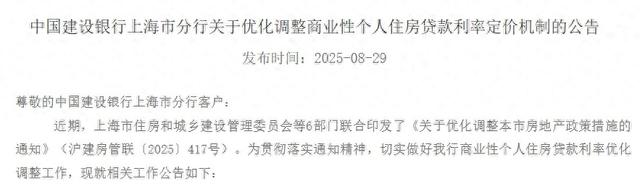
上海房贷新政,多家银行公告
Guan Cha Zhe Wang· 2025-08-30 00:14
Group 1 - The core viewpoint of the news is the recent adjustments in housing loan policies by several banks in Shanghai following the city's new real estate policy announcement on August 25 [1] - Major banks including China Construction Bank, Bank of Communications, Industrial and Commercial Bank of China, Bank of China, China Merchants Bank, Agricultural Bank of China, Ping An Bank, China Everbright Bank, Beijing Bank, and Jiangsu Bank have released announcements regarding the optimization of commercial personal housing loan interest rate pricing mechanisms [1][2] - The new policies indicate that there will no longer be a distinction between first and second home loan interest rates, with rates determined based on the Shanghai market interest rate pricing self-discipline mechanism and other factors [2] Group 2 - Some existing housing loan rates may also be adjusted for eligible borrowers, with specific rules for adjustments based on the average interest rates of newly issued loans [2] - According to the People's Bank of China, the weighted average interest rate for newly issued commercial personal housing loans in the second quarter of 2025 is 3.09% [2] - Starting September 1, borrowers can check their eligibility for interest rate reductions through the banks' mobile banking channels, and applications can be made online without additional fees [3]




银行高管思辨“反内卷”:在规范市场中提高客服硬实力
Zheng Quan Shi Bao· 2025-08-29 19:49
Core Viewpoint - The banking industry has reached a consensus on "anti-involution," transitioning from a slogan to actionable measures, as highlighted in recent semi-annual performance briefings [1]. Group 1: Industry Consensus and Policy - The 2024 Central Economic Work Conference and the 2025 Government Work Report have called for a "comprehensive rectification of 'involutionary' competition" [1]. - The sixth meeting of the Central Financial Committee emphasized the need to "legally and reasonably govern low-price and disorderly competition" [1]. Group 2: Impact on Banking Operations - Ping An Bank's president, Ji Guangheng, stated that competition that does not cover costs is detrimental and poses a potentially disruptive risk to the industry [1]. - Hangzhou Bank's vice president, Zhang Jianfu, noted that irrational price wars negatively affect normal banking development, leading to situations where business growth does not translate into revenue or profit [1]. - The long-term impact of such competition could weaken banks' ability to serve the real economy and accumulate risks that affect macroeconomic development [1]. Group 3: Benefits of "Anti-Involution" - Ping An Bank's vice president, Xiang Youzhi, believes that "anti-involution" will create a fairer and more vibrant market, enhance the effective allocation of financial resources, and maximize the interests of financial entities and society [1]. - The policy is expected to promote long-term, high-quality development in the financial industry and protect the legitimate rights of financial customers [1]. Group 4: Stabilization of Net Interest Margin - Citic Bank's president, Lu Wei, indicated that "anti-involution" policies and neutral monetary policies will help stabilize the banking industry's net interest margin [2]. - Zhang Jianfu echoed this sentiment, suggesting that combating irrational pricing will contribute to stabilizing bank interest margins [2]. Group 5: Addressing Malicious Competition - Industrial Bank's financial planning department general manager, Lin Shu, noted that "anti-involution" helps regulate malicious and disorderly competition in loan pricing, alleviating downward pressure on bank asset returns [2]. - However, Lin also pointed out potential inconsistencies in the implementation of "anti-involution" policies across different regions and banks [2]. Group 6: Focus on Customer Needs - As price competition diminishes, banks will need to compete based on their ability to meet customer needs, emphasizing the importance of enhancing professional service capabilities and optimizing business processes [2]. - Huaxia Bank's president, Qu Gang, stated the importance of adhering to regulatory and self-discipline requirements, shifting focus from price competition to value-based services centered around customer needs [2]. - Zhejiang Merchants Bank's president, Chen Haiqiang, mentioned the shift from price-based competition to differentiated comprehensive services, focusing on the entire customer lifecycle [2].




42家上市银行半年盈利1.1万亿六大国有行将分红超2000亿元
Zheng Quan Shi Bao· 2025-08-29 19:49
Core Viewpoint - The banking sector demonstrated stability and resilience in the first half of 2025, achieving a revenue of over 2.9 trillion yuan and a net profit of 1.1 trillion yuan, while focusing on supporting the real economy and preparing for digital transformation [1] Group 1: Financial Performance - A total of 42 A-share listed banks reported a revenue exceeding 2.9 trillion yuan, with a year-on-year growth of over 1% [1] - The net profit attributable to shareholders reached 1.1 trillion yuan, reflecting a year-on-year increase of 0.8% [1] - The six major state-owned banks collectively achieved a revenue of 1.8 trillion yuan and a net profit of 682.52 billion yuan in the first half of 2025 [3] Group 2: Asset and Liability Management - The total asset scale of the six major banks reached approximately 214 trillion yuan, an increase of about 7% compared to the end of the previous year [3] - The total asset scale of nine listed joint-stock banks was approximately 72 trillion yuan, growing by 2.37% [3] - The Industrial and Commercial Bank of China (ICBC) reported an asset scale of 52 trillion yuan, leading the industry in customer loans and deposits [3] Group 3: Dividend Distribution - The six major state-owned banks announced a total cash dividend exceeding 204.65 billion yuan for the first half of 2025 [2][4] Group 4: Digital Transformation - The application of artificial intelligence (AI) has become a key driver for the banks' transformation, with various banks launching AI initiatives and projects [5] - ICBC has initiated the "AI+" action, while Agricultural Bank of China is advancing its "AI+" applications [5] - By the end of June, ICBC had implemented over 100 AI application scenarios across key business areas [5] Group 5: Credit Growth and Focus on Real Economy - The total loan balance of 42 A-share listed banks reached approximately 180 trillion yuan, with a year-on-year growth of about 6% [6] - State-owned banks are the main contributors to credit issuance, with a loan balance exceeding 120 trillion yuan, growing by 6.59% [6] - Agricultural Bank of China reported a loan and advance total of 26.73 trillion yuan, with significant growth in manufacturing, green loans, and inclusive loans [7]



上市银行探路转型新增长极:扩资产规模 增非息收入
Zhong Guo Jing Ying Bao· 2025-08-29 19:36
Core Viewpoint - The 2025 A-share banking mid-year report reveals significant profit differentiation among banks, with some city commercial banks achieving double-digit profit growth while others face negative growth due to narrowing interest margins and market volatility [1] Group 1: Profit Growth of City Commercial Banks - City commercial banks have emerged as the main contributors to profit growth among listed banks in the first half of 2025, with Hangzhou Bank reporting a net profit of 11.662 billion yuan, a year-on-year increase of 16.66% [2] - Factors contributing to the rapid profit growth of city commercial banks include stable asset scale growth, continuous optimization of asset-liability structure, and a recovery in fee and commission income driven by low base and wealth management growth [2][3] - Other city commercial banks such as Jiangyin Bank, Qilu Bank, and Qingdao Bank reported net profit growth rates of 16.63%, 16.48%, and 16.05% respectively [2] Group 2: Challenges Faced by Some Banks - In contrast, some banks like Guiyang Bank experienced negative profit growth, with a net profit of 2.474 billion yuan, a decrease of 7.20% year-on-year, attributed to declining interest income and weaker bond market performance [4] - The differentiation in profit performance among banks is largely due to variations in customer base, financing capabilities, risk preferences, and asset quality [4] Group 3: Interest Income and Margin Trends - The net interest margin for commercial banks narrowed to 1.42% in the first half of 2025, reflecting ongoing pressure on interest margins [7] - Strategies to manage interest margins include increasing the proportion of low-cost deposits and optimizing asset-liability management to improve net interest income [8][9] Group 4: Non-Interest Income and Business Diversification - Expanding non-interest income is seen as a crucial strategy for banks to mitigate the impact of declining interest margins, with a focus on enhancing middle business services such as custody, agency sales, and settlement [9] - Currently, non-interest income accounts for less than 30% of major listed banks in China, which is significantly lower than that of large international banks [9]



信用卡“缩量”背后:加速出清不良谋转型
Zhong Guo Jing Ying Bao· 2025-08-29 19:16
Core Insights - The credit card business of banks is undergoing a significant contraction, with a shift from expansion to value reconstruction, indicating a transformation in the industry [1][5][7] Group 1: Industry Trends - The overall credit card loan scale is declining across multiple banks, despite some growth in personal loan business [1][2] - Many banks are closing credit card centers, signaling a move towards a more refined and high-value development phase [1][4] - The total number of credit cards and combined credit and loan cards has decreased, with a notable drop of 6 million cards in Q2 compared to the previous quarter [4][9] Group 2: Bank Performance - CITIC Bank reported a credit card issuance of 126 million cards, with a loan balance of 458.45 billion yuan, but a 12.54% decline in transaction volume and a 14.61% drop in business revenue [2] - Ping An Bank's credit card receivables decreased by 9.2% to 394.87 billion yuan, with a significant drop in the number of active credit card users [3] - Smaller banks like Jiangsu Bank and Chongqing Bank also reported declines in credit card loan scales, with reductions of 7.51% and 10.23% respectively [3][4] Group 3: Strategic Shifts - Banks are focusing on improving asset quality and risk management, with CITIC Bank emphasizing a shift from scale to quality in its credit card business [5][6] - The trend of integrating credit card and consumer loan products is emerging, with banks like Chongqing Bank adapting their strategies to maintain competitiveness [6][9] - Experts suggest that the future of credit card business will focus on high-end customer needs and basic customer demands, moving away from merely acquiring new customers [7][8]



从“效率工具”到“价值引擎” 大模型“再造”银行
Zhong Guo Jing Ying Bao· 2025-08-29 19:14
Core Insights - The banking industry is transitioning from pilot AI applications to comprehensive integration, driven by the launch of domestic large models like DeepSeek-R1 and V3.1, with over 330 applications already implemented by Ping An Bank by June 2025 [1][2] - Banks view AI as a key strategy for enhancing operational efficiency, optimizing customer experience, and exploring new growth avenues, shifting from cost-cutting tools to revenue-generating engines [1][2] Industry Application Acceleration - Ping An Bank has developed a large model capability system, enhancing application capabilities through various advanced techniques, with over 330 applications in place by June 2025 [1] - The bank has deepened the use of intelligent algorithms in risk control, establishing a risk expert knowledge base and improving efficiency across risk management processes [2] - Shanghai Bank emphasizes the need to integrate its services with large models to enhance digital transformation efforts [6] Business Model Reconstruction - The banking sector is experiencing a significant evolution in large model applications, moving from efficiency tools to value creation engines, although challenges remain in controllability, interpretability, and cost-benefit ratios [6][7] - The maturity of large model applications in banking shows a tiered structure, with some applications nearing maturity while others are still in exploratory phases [7] - Jiangsu Bank has successfully implemented a large model for business material entry and review, significantly improving operational efficiency [8]
42家上市银行中报交卷:归母净利超万亿,六成营收净利双增
Bei Jing Shang Bao· 2025-08-29 16:10
邮储银行以1794.46亿元的营收和492.28亿元的归母净利润位列上市银行业绩榜第五。 招商银行凭借1699.69亿元的营收成绩,超越交通银行的1333.68亿元,跻身A股上市银行前六,成为唯 一进入营收第一梯队的股份制银行。尽管招商银行营收同比微降1.72%,但其归母净利润仍较去年同期 实现1.87亿元的增长,同比增幅0.25%。交通银行则以1333.68亿元营收、460.16亿元归母净利润位列第 七。另外,兴业银行、中信银行上半年营业收入也均超过千亿元,归母净利润分别为431.41亿元和 364.78亿元。 据北京商报记者统计,42家A股上市银行中,有26家在上半年实现了营收和净利润的双双正增长,占比 超过六成,但也有部分机构呈现双降。数据显示,平安银行、华夏银行、浙商银行、贵阳银行、厦门银 行、光大银行6家机构上半年出现营业收入与归母净利润"双降"。其中,受市场利率下行、贷款业务结 构调整等因素影响,平安银行营收693.85亿元,同比下降10%,归母净利润248.7亿元,同比下降3.9%; 贵阳银行营收表现相对承压,营收65.01亿元,同比下降12.22%,归母净利润24.74亿元,同比下降 7.2% ...
上海,房贷重磅!
Shang Hai Zheng Quan Bao· 2025-08-29 16:00
Core Viewpoint - The implementation details of the new housing policy in Shanghai, announced on August 25, have been released by various banks, focusing on the adjustment of commercial personal housing loan interest rates. Group 1: Policy Implementation - Major banks in Shanghai, including ICBC, Bank of China, Agricultural Bank of China, and others, have issued announcements regarding the optimization of the pricing mechanism for commercial personal housing loans [1][2]. - The new policy eliminates the distinction between first and second home loan interest rates, with rates determined based on the Shanghai market interest rate pricing self-discipline mechanism and individual bank conditions [2]. Group 2: Interest Rate Adjustments - Eligible existing housing loan interest rates can also be adjusted, allowing for a normalization of rates for certain second home loans [2]. - The adjustment rule states that if the existing loan interest rate plus a margin exceeds the average margin of newly issued loans by more than 30 basis points, borrowers can apply for an adjustment [2]. - The weighted average interest rate for newly issued commercial personal housing loans in the second quarter of 2025 is reported to be 3.09% [2]. Group 3: Borrower Actions - Starting from September 1, borrowers can check their eligibility for interest rate reductions through the mobile banking channels of the relevant banks [3].
货币市场日报:8月29日
Xin Hua Cai Jing· 2025-08-29 15:34
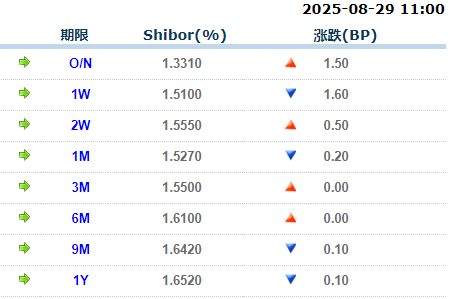
Monetary Policy and Market Operations - The People's Bank of China conducted a 7-day reverse repurchase operation of 782.9 billion yuan at an interest rate of 1.40%, maintaining the previous rate; with 361.2 billion yuan of reverse repos maturing, the net injection was 421.7 billion yuan [1] - This week, the central bank performed a total of 2.2731 trillion yuan in reverse repos and 600 billion yuan in one-year Medium-term Lending Facility (MLF) operations, resulting in a total net injection of 496.1 billion yuan after accounting for maturing operations [1] Interbank Market Rates - The Shanghai Interbank Offered Rate (Shibor) for short-term products remained stable, with the 7-day Shibor slightly declining; specifically, the overnight Shibor rose by 1.50 basis points to 1.3310%, while the 7-day Shibor fell by 1.60 basis points to 1.5100% [2][3] - The weighted average rates for various repo products showed mixed movements, with DR001 and R001 increasing by 1.6 basis points and 5.4 basis points respectively, while DR007 and R007 decreased by 2.4 basis points and 4.7 basis points [4] Funding Conditions - The funding environment on August 29 was characterized by a balanced and slightly loose stance; overnight rates for non-bank institutions were around 1.65%, while 7-day rates were approximately 1.55% [9] - Following the central bank's operations, the funding market became more relaxed, with overnight rates stabilizing around 1.45% and 7-day rates between 1.48% and 1.50% [9] Banking Sector Performance - Industrial and Commercial Bank of China reported a revenue of 409.08 billion yuan for the first half of 2025, a year-on-year increase of 1.8%, with a net profit of 168.80 billion yuan and a non-performing loan ratio of 1.33% [12] - Postal Savings Bank achieved a revenue of 179.45 billion yuan, up 1.5%, with a net profit of 49.23 billion yuan, reflecting a growth of 0.85% [12] - Bank of China reported a revenue of 329.4 billion yuan, a 3.61% increase, with a net profit of 126.1 billion yuan, showing stable performance [12] - Agricultural Bank of China posted a revenue of 369.8 billion yuan, up 0.7%, and a net profit of 139.9 billion yuan, reflecting a 2.5% increase [12] - China Merchants Bank's revenue decreased by 1.73% to 169.92 billion yuan, while its net profit increased by 0.25% to 74.93 billion yuan [13] - Everbright Bank reported a revenue of 65.92 billion yuan and a net profit of 24.74 billion yuan, marking a 0.5% increase [14]

上海多家银行房贷细则落地,新增二套房利率最低3.09%
2 1 Shi Ji Jing Ji Bao Dao· 2025-08-29 13:27
Core Viewpoint - Shanghai's housing market has introduced new mortgage interest rate pricing mechanisms, eliminating the distinction between first and second home loans, aiming to optimize the real estate policy and stimulate market activity [2][3]. Group 1: New Mortgage Policies - Multiple banks in Shanghai have released announcements regarding the optimization of commercial personal housing loan interest rate pricing mechanisms, aligning with the recent government notification [2]. - The new policy states that the specific interest rate for each customer's commercial personal housing loan will be determined based on the Shanghai market interest rate pricing self-discipline mechanism, along with the bank's operational status and customer risk profile [2][4]. Group 2: Existing Loan Adjustments - For existing loans, banks will continue to follow the previous year's guidelines, allowing adjustments for certain second home loans that exceed the average interest rate of newly issued loans by more than 30 basis points [3]. - The weighted average interest rate for newly issued commercial personal housing loans in China was reported at 3.09% for Q2 2025, a decrease of 2 basis points from Q1, indicating potential for lower rates for second home loans in Shanghai [3][4]. Group 3: Regulatory Framework - The central bank's adjustments include four main points, notably the removal of the distinction between first and second home loan interest rates and the emphasis on banks to adhere to market conditions and government regulations [3][4]. - Banks are required to ensure compliance with the new policies, providing adequate communication and support to borrowers regarding their rights and the implications of the new interest rate structures [4].
