万华化学

Search documents
化学制品板块9月26日跌0.27%,华软科技领跌,主力资金净流出7.35亿元
Zheng Xing Xing Ye Ri Bao· 2025-09-26 08:41
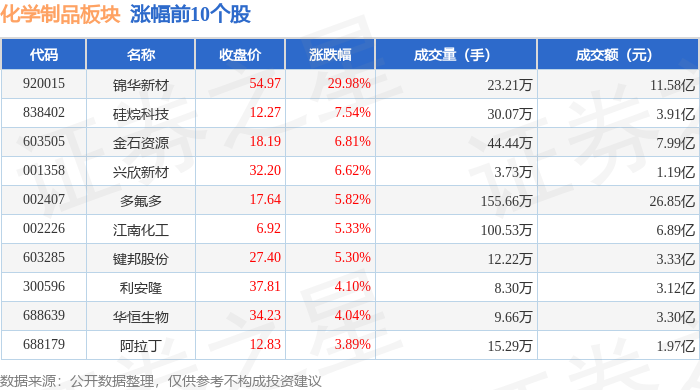
Market Overview - The chemical products sector experienced a decline of 0.27% on September 26, with Huasoft Technology leading the drop [1] - The Shanghai Composite Index closed at 3828.11, down 0.65%, while the Shenzhen Component Index closed at 13209.0, down 1.76% [1] Top Performers - Jin Hua New Material (Code: 920015) saw a significant increase of 29.98%, closing at 54.97 with a trading volume of 232,100 shares and a transaction value of 1.158 billion [1] - Kexin Technology (Code: 838402) rose by 7.54%, closing at 12.27 with a trading volume of 300,700 shares and a transaction value of 391 million [1] - Jingshi Resources (Code: 603505) increased by 6.81%, closing at 18.19 with a trading volume of 444,400 shares and a transaction value of 799 million [1] Underperformers - Huasoft Technology (Code: 002453) fell by 10.04%, closing at 8.78 with a trading volume of 718,600 shares and a transaction value of 655 million [2] - Kaimet Gas (Code: 002549) decreased by 9.98%, closing at 24.80 with a trading volume of 1,270,400 shares and a transaction value of 3.191 billion [2] - Boyuan Co., Ltd. (Code: 301617) dropped by 5.57%, closing at 75.40 with a trading volume of 32,900 shares and a transaction value of 252 million [2] Capital Flow - The chemical products sector saw a net outflow of 735 million from institutional investors, while retail investors had a net inflow of 914 million [2] - The top net inflows from retail investors were observed in multiple stocks, indicating a shift in investor sentiment [3] Individual Stock Capital Flow - Duoliangduo (Code: 002407) had a net inflow of 261 million from institutional investors, representing 9.73% of its total [3] - Keyan Co., Ltd. (Code: 603285) experienced a net inflow of 55.39 million from institutional investors, accounting for 16.65% [3] - Wanhu Chemical (Code: 600309) saw a net inflow of 44.88 million from institutional investors, which is 3.33% of its total [3]




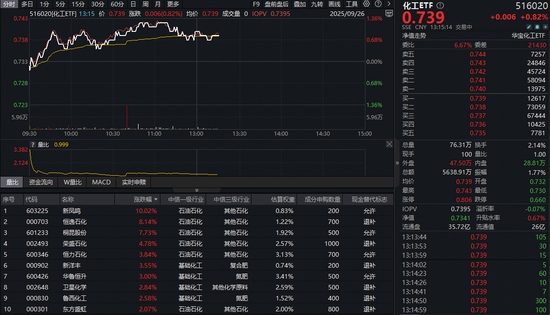
石化股爆发!化工板块逆市猛攻,化工ETF(516020)盘中涨超1%冲击三连阳!
Xin Lang Ji Jin· 2025-09-26 06:05
Group 1 - The chemical sector experienced a significant increase on September 26, with the Chemical ETF (516020) showing a maximum intraday gain of 1.36% and closing up 0.82%, indicating a potential upward trend [1][3] - Key stocks in the petrochemical sector saw substantial gains, with Xin Fengming hitting the daily limit, Hengyi Petrochemical rising over 8%, Tongkun Co. increasing over 7%, and Rongsheng Petrochemical up over 4% [1][3] - The fundamentals of the chemical industry are improving, with low valuation leading to investment opportunities in both established leaders and high-growth emerging sectors [1][4] Group 2 - The demand side is expected to expand due to the steady implementation of fiscal and monetary policies, as well as "new" policies, which will optimize the supply-demand dynamics in the chemical industry [3][4] - As of September 25, the price-to-book ratio of the Chemical ETF (516020) was 2.21, placing it at a low point within the last decade, highlighting its long-term investment value [3][4] - The chemical industry is anticipated to see a recovery in profitability, with core assets entering a long-term value zone, suggesting a potential for both valuation and profit recovery [4][5] Group 3 - The chemical ETF (516020) tracks the CSI Sub-Industry Chemical Index, covering various sub-sectors, with nearly 50% of its holdings in large-cap leading stocks, providing a strong investment opportunity [4][5] - The industry is expected to benefit from a slowdown in global capacity expansion, which could enhance cash flow and dividend yields for Chinese chemical companies [4][5]


反内卷深度报告:反内卷,化工从“吞金兽”到“摇钱树”
2025-09-26 02:29
Summary of Key Points from the Conference Call Industry Overview - The report focuses on the **Chinese chemical industry** and its transition from a "cash-consuming beast" to a "cash-generating tree" due to reduced capital expansion and strong operating cash flow [1][13]. Core Insights and Arguments - **Capital Expansion Trends**: The capital expenditure in the basic chemical industry is decreasing, with the proportion of construction projects to fixed assets declining. This trend is expected to continue, leading to positive free cash flow over the next five years [1][4][5]. - **Cash Flow and Dividends**: The petrochemical sector has turned positive in operating cash flow, with a potential dividend yield exceeding 10% by 2027 for some companies if 70% of cash flow is allocated to dividends [1][9]. - **Cost Advantages**: Chinese chemical companies benefit from lower energy and labor costs compared to European counterparts, which face high production costs and low capacity utilization [1][10]. - **Impact of Anti-Overexpansion Policies**: The anti-overexpansion policies are expected to limit capital expansion but will enhance free cash flow and dividend-paying capacity, improving the investment value of leading companies [1][13][14]. Important but Overlooked Content - **Sector-Specific Insights**: - The chromium salt industry is expected to see strong demand growth due to increased orders from gas turbines and military applications, while supply is constrained by environmental regulations [2][42]. - The coal chemical sector is experiencing a recovery in profitability due to rising global energy prices and improved demand, despite being at historical low price levels [15][18]. - The refrigerant market is projected to grow due to rising demand and supply constraints, particularly for R32 and automotive refrigerants [44]. - **Future Trends**: The report anticipates a significant upward trend for leading companies in the chemical sector, driven by improved profitability and valuation as the industry undergoes capacity clearing [14][41]. Conclusion - The Chinese chemical industry is poised for a recovery phase, with strong cash flow generation and potential for high dividend yields, particularly for leading firms. The anti-overexpansion policies, while restrictive, may ultimately enhance the industry's long-term health and investment attractiveness [1][13][14].
中核山东核能公司增资至55.71亿元
Zheng Quan Shi Bao Wang· 2025-09-26 01:16
Core Insights - Recently, China Nuclear Shandong Nuclear Energy Co., Ltd. has undergone a business change, increasing its registered capital from approximately 5.435 billion to 5.571 billion yuan [1] Company Overview - The company was established in 2021 and is represented by legal representative Hong Yuanping [1] - Its business scope includes power generation technology services, seawater desalination treatment, nuclear power equipment complete sets and engineering technology research and development, as well as engineering and technology research and experimental development [1] Shareholding Structure - The company is jointly held by China National Nuclear Corporation (601985), Wanhua Chemical (600309), and Yantai Energy Investment Development Group Co., Ltd. [1]

冠通每日交易策略-20250925
Guan Tong Qi Huo· 2025-09-25 10:22
Report Summary 1. Industry Investment Rating No investment rating information was provided in the report. 2. Core Views - **Copper**: The copper market is expected to be volatile and bullish in the short term due to supply disruptions at the Grasberg mine, weak TC/RC fees, reduced scrap copper supply, and strong demand before the holiday [10]. - **Crude Oil**: The supply - demand balance of crude oil is weakening. It is recommended to short on rallies due to OPEC+ production adjustments, the end of the peak travel season, and concerns about demand [11][12]. - **Asphalt**: The asphalt futures price is expected to decline in a volatile manner due to increased supply, limited demand, and potential pressure on crude oil prices [13]. - **PP**: PP is expected to trade in a range. The market is affected by new capacity, increased downstream demand during the peak season, but with less - than - expected demand and no anti - involution policies [15]. - **Plastic**: Plastic is expected to move sideways. The market is influenced by new capacity, improving downstream demand in the peak season, but with less - than - expected demand and no anti - involution policies [16][17]. - **PVC**: PVC is expected to face downward pressure in the near term due to increased supply, weak export expectations, high inventory, and slow real - estate recovery [18]. - **Urea**: The weak reality of the urea market remains unchanged. The price may experience a technical rebound, but the supply is still abundant, with pressure around 1730 yuan/ton [19][20]. 3. Summary by Directory 3.1 Futures Market Overview - As of September 25, most domestic futures main contracts rose. Container shipping to Europe increased nearly 4%, and some metals and agricultural products also had significant gains. Some contracts like gold, cotton, and rubber declined slightly. Among stock index futures, most rose except for IM, and among bond futures, most declined except for TL [6]. 3.2 Fund Flows - As of 15:16 on September 25, the main contracts of domestic futures saw funds flowing into沪铜2511 (5.346 billion yuan),沪深300 2512 (1.257 billion yuan), and菜油2601 (880 million yuan), and flowing out of中证1000 2512 (3.222 billion yuan),沪金2512 (2.353 billion yuan), and中证500 2512 (1.2 billion yuan) [8]. 3.3 Specific Commodity Analysis - **Copper**: The Grasberg mine accident disrupted supply. TC/RC fees were weak, and smelter profits were under pressure. August production decreased slightly month - on - month but increased year - on - year. September production is expected to drop significantly. Demand for pre - holiday restocking is strong [10]. - **Crude Oil**: OPEC+ will adjust production in October, increasing pressure in the fourth quarter. The peak travel season is over, and refinery operating rates are falling. However, inventory drawdowns and geopolitical factors are affecting prices [11][12]. - **Asphalt**: The asphalt production rate decreased slightly but remained low. September production is expected to increase. Downstream demand is restricted by funds and weather. Cost support has strengthened, but futures prices are expected to decline [13]. - **PP**: The downstream operating rate increased slightly but remained low. New capacity has been put into operation, and there are more maintenance devices. Demand during the peak season is less than expected [15]. - **Plastic**: The operating rate increased to a neutral level. The downstream demand in the peak season is improving but not as expected. New capacity has been added [16]. - **PVC**: The supply decreased slightly, and downstream demand increased during the peak season. Export expectations are weak, and inventory is high. New capacity has been launched [18]. - **Urea**: The daily production has recovered, and the demand is weak. The inventory is high, and the market is in a weak situation [20].
第四代高压实LFP供不应求,二三线企业窗口期何在?
高工锂电· 2025-09-25 10:20
Core Viewpoint - The demand for high-pressure lithium iron phosphate (LFP) is increasing due to the performance improvements in energy storage and power batteries, while the supply is constrained by the complexity of production processes and the limited number of companies capable of mass production [1][2][4]. Group 1: Market Demand and Supply Dynamics - High-pressure LFP is in high demand due to the scaling of large-capacity, high-energy, and fast-charging batteries [1]. - The production of high-pressure LFP requires strict raw material purity and particle size distribution, with only a few companies mastering mass production technology [1][2]. - The pricing mechanism for LFP has shifted to a model based on "raw material market price + processing fee," with high-pressure LFP commanding an additional processing fee of 2000-5000 yuan per ton compared to standard products [1]. Group 2: Competitive Landscape - The production capacity for fourth-generation high-pressure LFP (≥2.6g/cm³) is concentrated among leading companies such as Fulin Precision, Hunan Youneng, Longpan Technology, and Defang Nano, which limits the survival space for smaller firms [2]. - Despite the capacity of leading firms, actual production and future capacity ramp-up will take time, leading to a significant demand gap in the short term [2][4]. - The market for fourth-generation LFP is expected to see concentrated supply once leading companies complete their capacity expansions, potentially altering the competitive landscape [2]. Group 3: Industry Trends and Innovations - The performance of energy storage batteries is improving, with average capacity utilization rates for leading battery companies reaching 70%-80%, and some even exceeding 80% [5][6]. - The domestic energy storage market saw a cumulative installed capacity of 23.03 GW/56.12 GWh in the first half of 2025, a year-on-year increase of 68% [6]. - The mainstream density for LFP materials is currently between 2.5-2.55 g/cm³, with ongoing technological iterations pushing for larger capacities and longer cycle lives [6]. Group 4: Strategic Moves by Companies - Leading LFP companies are accelerating their fourth-generation product layouts, with Fulin Precision's subsidiary signing a prepayment agreement with CATL to enhance high-pressure LFP supply [10][11]. - Hunan Youneng has introduced its fourth-generation LFP products, achieving batch supply after important customer certifications [11]. - Smaller firms are also making moves, with companies like Pengbo New Materials and Wanhua Chemical planning to invest in high-pressure LFP production projects [13].


基础化工行业资金流出榜:金发科技等14股净流出资金超5000万元
Zheng Quan Shi Bao Wang· 2025-09-25 10:05
Market Overview - The Shanghai Composite Index fell by 0.01% on September 25, with 7 out of the 28 sectors rising, led by Media and Communication sectors, which increased by 2.23% and 1.99% respectively [1] - The Textile and Apparel sector and the Comprehensive sector experienced the largest declines, down by 1.45% and 1.30% respectively [1] Basic Chemical Industry - The Basic Chemical industry declined by 0.43%, with a net outflow of 2.441 billion yuan in capital [1] - Out of 402 stocks in this sector, 82 stocks rose, with 4 hitting the daily limit, while 315 stocks fell [1] - A total of 138 stocks in the Basic Chemical industry saw net capital inflows, with 7 stocks receiving over 30 million yuan in net inflows [1] - The top three stocks with the highest net inflows were: - Kaimete Gas (净流入资金1.54亿元) - Wanhua Chemical (净流入资金1.29亿元) - Xinjin Road (净流入资金6287.20万元) [1] Capital Outflow in Basic Chemical Industry - The following stocks experienced significant capital outflows: - Jinfat Technology (净流出资金3.49亿元) - Beihua Co. (净流出资金1.37亿元) - Hongda Co. (净流出资金1.35亿元) [2] - The overall trend indicates a challenging environment for the Basic Chemical sector, with notable outflows from key players [2]


化学制品板块9月25日跌0.11%,瑞丰新材领跌,主力资金净流出6.88亿元
Zheng Xing Xing Ye Ri Bao· 2025-09-25 08:38
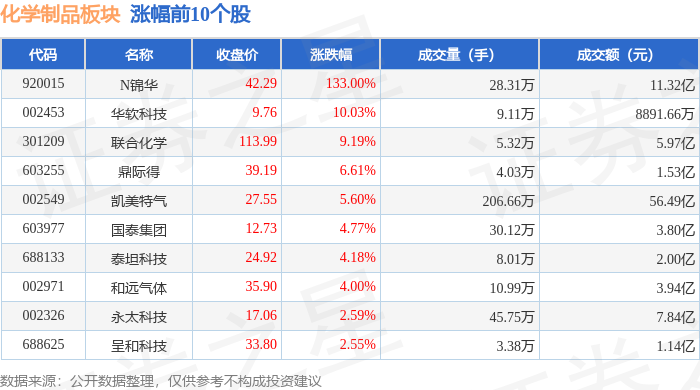
| 代码 | 名称 | 收盘价 | 涨跌幅 | 成交量(手) | 成交额(元) | | | --- | --- | --- | --- | --- | --- | --- | | 920015 | N锦华 | 42.29 | 133.00% | 28.31万 | | 11.32亿 | | 002453 | 华软科技 | 9.76 | 10.03% | 9.11万 | | 8891.66万 | | 301209 | 联合化学 | 66'EII | 9.19% | 5.32万 | | 5.97亿 | | 603255 | 鼎际得 | 39.19 | 6.61% | 4.03万 | | 1.53亿 | | 002549 | 凯美特气 | 27.55 | 5.60% | 206.66万 | | 56.49 Z | | 603977 | 園泰集团 | 12.73 | 4.77% | 30.12万 | | 3.80亿 | | 688133 | 泰坦科技 | 24.92 | 4.18% | 8.01万 | | 2.00亿 | | 002971 | 和远气体 | 35.90 | 4.00% | 10.99万 | | 3.94 ...

万华化学涨2.20%,成交额9.21亿元,主力资金净流入8091.31万元
Xin Lang Cai Jing· 2025-09-25 03:09
Core Viewpoint - Wanhua Chemical's stock price has shown fluctuations, with a recent increase of 2.20% to 65.08 CNY per share, while the company has experienced a year-to-date decline of 7.84% [1] Financial Performance - For the first half of 2025, Wanhua Chemical reported revenue of 90.901 billion CNY, a year-on-year decrease of 6.35%, and a net profit attributable to shareholders of 6.123 billion CNY, down 25.10% year-on-year [2] - Cumulative cash dividends since the A-share listing amount to 50.240 billion CNY, with 14.050 billion CNY distributed over the last three years [3] Shareholder Information - As of June 30, 2025, the number of shareholders increased to 269,200, up 22.10% from the previous period, while the average circulating shares per person decreased by 18.10% to 11,665 shares [2] - The top ten circulating shareholders include Hong Kong Central Clearing Limited, which holds 136 million shares, a decrease of 9.0754 million shares from the previous period [3]
全球首条中欧北极集装箱快航航线开通 单程只需18天
2 1 Shi Ji Jing Ji Bao Dao· 2025-09-24 13:54
Core Viewpoint - The opening of the world's first Arctic container fast shipping route between China and Europe significantly enhances shipping efficiency, reducing transit time to approximately 18 days, which is 22 days shorter than traditional routes [1][3]. Group 1: Shipping Route Details - The new route, operated by Sea Legend Shipping, connects Ningbo-Zhoushan Port to Europe via the Arctic Northeast Passage and the Bering Strait, offering a competitive edge in international trade logistics [1][3]. - The first voyage was fully booked, indicating strong market demand and positive reception from the industry [1]. - The route is expected to facilitate the transportation of sensitive goods, such as lithium batteries and photovoltaic products, due to favorable sea conditions [3]. Group 2: Future Plans and Developments - Sea Legend Shipping plans to develop an "Eastern European Fast Shipping" product during the winter non-navigable window, aiming for a seamless logistics solution that combines sea and rail transport [4]. - The company intends to invest in more ice-strengthened vessels by 2026 to establish a fixed summer navigation schedule, enhancing year-round operational capabilities [4]. Group 3: Impact of Geopolitical Factors - The temporary closure of the Polish Malaszewicze hub highlighted the need for diversified logistics routes, prompting companies to prepare for geopolitical uncertainties [2]. - The Arctic route is positioned as a safer alternative, minimizing risks associated with piracy, congestion, and conflict, thus ensuring a more secure supply chain for European markets [2].