软银集团

Search documents
英特尔打破连续亏损!华人CEO扭转局势
首席商业评论· 2025-10-28 04:37
Core Viewpoint - Intel has reported a significant turnaround in its financial performance, achieving a net profit of $4.1 billion in Q3, marking its first quarterly profit since 2024 after a prolonged period of losses. This improvement is attributed to cost-cutting measures, including layoffs, and a rise in PC processor sales [5][6][8]. Financial Performance - Intel's Q3 revenue reached $13.7 billion, a 3% year-over-year increase, with a Non-GAAP gross margin of 40% and operating cash flow of $2.5 billion [5][8]. - The company's product revenue was $12.7 billion, with client computing revenue at $8.5 billion (up 5% year-over-year) and data center and AI revenue at $4.1 billion (down 1% year-over-year) [5][8]. - Intel's wafer foundry revenue was $4.2 billion, a decrease of 2% year-over-year, while other business revenues increased by 3% to $1 billion [5][8]. Cost-Cutting and Workforce Reduction - Intel has reduced its workforce by 13%, from 101,400 to 88,400 employees, as part of aggressive cost-cutting measures, resulting in a 29% year-over-year decrease in total employees [6][8]. Strategic Initiatives - Under the leadership of CEO Pat Gelsinger, who took over in March, Intel is focusing on restructuring product lines, cutting costs, and attracting more clients for its foundry business [8][9]. - The company is emphasizing its AI accelerator strategy, planning to release optimized GPUs annually and positioning itself as a preferred platform for AI inference workloads [9][10]. Funding and Financial Flexibility - Intel has secured significant funding, including $5.7 billion from the U.S. government and $2 billion from SoftBank, enhancing its operational flexibility [13][17]. - The company repaid $4.3 billion in debt and aims to prioritize deleveraging by paying off debts maturing in 2026 [14]. Market Outlook - Intel's stock has increased by approximately 90% this year, recovering from a 60% decline last year, largely due to new investments and partnerships with major firms like NVIDIA and SoftBank [20]. - The company forecasts Q4 sales between $12.8 billion and $13.8 billion, with expectations of strong growth in data center and AI business, while client computing revenue may see a slight decline [20].



欧洲AI基建再扩!英伟达(NVDA.US)联手德国电信(DTEGY.US) 拟豪掷10亿欧元在德建设数据中心
Zhi Tong Cai Jing· 2025-10-28 03:25
Core Viewpoint - Nvidia and Deutsche Telekom are preparing to announce a plan to build a €1 billion data center in Germany, aimed at enhancing AI infrastructure in Europe [1][2] Group 1: Project Details - The project will involve a joint investment of approximately $1.2 billion (€1 billion) from Nvidia and Deutsche Telekom, with SAP as a key customer [1] - The data center is expected to utilize 10,000 advanced GPUs, which is significantly smaller in scale compared to other global data center projects [2] - The announcement is anticipated to be made next month in Berlin, involving executives from Nvidia, Deutsche Telekom, SAP, and the German Minister for Digital Affairs [1][2] Group 2: Industry Context - European policymakers and tech executives have been discussing the need for Europe to develop its own AI ecosystem to compete with the US and China [1] - The EU has previously announced a €200 billion plan to support AI development, aiming to triple the region's AI computing power within 5 to 7 years [3] - Concerns have been raised regarding the slow progress of local AI infrastructure and the need for quicker actions to support businesses while ensuring data remains within Europe [2]

高通入局AI芯片,竞逐英伟达!AI国产替代需求迫切,科创人工智能ETF(589520)盘中溢价,买盘资金强势
Xin Lang Ji Jin· 2025-10-28 02:24
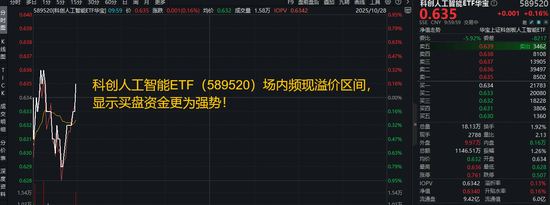
Group 1: AI Industry Developments - The domestic AI industry chain is experiencing strong performance, with the AI ETF (589520) showing a 0.32% intraday high and currently up 0.16%, indicating strong buying interest [1] - Key stocks in the ETF include Kingsoft Office, which rose over 6%, and other companies like Hehe Information, Star Ring Technology, and Foxit Software, which saw gains exceeding 4% [1] - The stock price of Cambricon has surpassed 1510 yuan, making it the new "king of A-shares" after exceeding the price of Kweichow Moutai [1] Group 2: Competitive Landscape - Qualcomm has launched AI chips, intensifying competition with Nvidia in the data center market, highlighting the increasing demand for AI chip resources among tech giants [3] - Chinese tech companies are more urgently seeking to reduce reliance on external computing power, with the domestic AI chip market expected to grow and optimize further [3] - The capital expenditure from major overseas companies, including Nvidia's $100 billion investment in OpenAI, indicates a complex capital cycle forming a closed loop in the computing power industry [3] Group 3: Policy and Strategic Focus - Recent high-level meetings have emphasized the importance of technological self-reliance, with plans to recreate a high-tech industry in China over the next decade [4] - The National Development and Reform Commission has highlighted the need for efficient supply of computing power, algorithms, and data as part of the AI+ initiative [4] - The focus on high-quality development and technological independence is seen as crucial in the context of the ongoing US-China competition [4] Group 4: Investment Highlights - The AI ETF (589520) and its connected funds are positioned to benefit from policy support and the rapid development of AI technologies, with a focus on companies leading in specific segments [5] - The ETF offers a low-threshold investment opportunity with a 20% price fluctuation limit, enhancing efficiency during market surges [5] - Since its low point on April 8, the AI ETF has increased by 66.71%, outperforming other indices like the Sci-Tech Innovation Board Index and the Sci-Tech 50 Index [6]
开盘下挫!
Zhong Guo Ji Jin Bao· 2025-10-28 01:29
Market Overview - Japanese and South Korean stock markets opened lower, with the Nikkei 225 index showing a decline of 0.31% at the start [1][2] - The Nikkei 225 index opened at 50,357.15 points and reached a high of 50,450.38 points, closing at 50,426.91 points, down 85.41 points or 0.17% [3] - The South Korean Composite Stock Price Index (KOSPI) opened lower, dropping over 1% before recovering slightly, closing at 4,009.48 points, down 33.35 points or 0.82% [6][7] Economic Indicators - Japan's government bond market is on alert regarding potential pressure from U.S. President Trump for increased defense spending, which could impact long-term bond yields [5] - The Japanese economy is facing challenges with weak domestic demand and trade performance, leading to concerns about the Bank of Japan's independence and potential fiscal expansion [5] - South Korea's economy showed stronger-than-expected growth in Q3, with a quarter-on-quarter GDP increase of 1.2% and a year-on-year growth of 1.7% [8] Corporate Developments - Notable stocks in Japan include SoftBank Group, Tokyo Gas, and Tokyo Electron, which saw early gains [3] - A joint document on securing rare earth mineral supplies is expected to be signed between Japan and the U.S. during Trump's visit [5] - The South Korean government is focusing on stimulating the economy through cash distributions and fiscal support, despite challenges in construction investment [8]

开盘下挫!
中国基金报· 2025-10-28 01:23
Group 1 - The Nikkei 225 index opened at 50,357.15 points, with a decline of 0.31% [3] - Notable stock performances include DENA with a rise of 9.19%, Furukawa Electric at 4.06%, and SoftBank Group increasing by 2.96% [4] - President Trump arrived in Tokyo for a three-day official visit, with discussions expected to focus on defense spending and a joint document on rare earth mineral supply [5] Group 2 - The South Korean Composite Stock Price Index opened lower, initially dropping over 1% before recovering [8] - South Korea's economy accelerated in Q3, with a quarter-on-quarter GDP growth of 1.2%, surpassing market expectations of 1% [10] - The Bank of Korea maintains a positive outlook for future growth, projecting 2.0% growth for 2024 [11]

奥特曼考虑给ChatGPT加广告了,用8亿用户,救万亿债务
3 6 Ke· 2025-10-27 23:55
Core Insights - OpenAI has achieved 800 million weekly active users and is projected to generate approximately $13 billion in annual recurring revenue (ARR), with 30% coming from enterprise clients [1][4]. - OpenAI's subscription model is insufficient to cover the astronomical costs of training and operating advanced AI models, prompting the exploration of new revenue streams such as advertising [1][16]. - Anthropic, in contrast, focuses on enterprise clients, with 80% of its revenue derived from this segment, and has a projected ARR of $7 billion to $9 billion [4][26]. OpenAI's Business Model - OpenAI's revenue is primarily driven by consumer subscriptions, with only about 3% of individual users willing to pay for generative AI services, highlighting a significant monetization challenge [7][9]. - The company is undergoing a restructuring to become a Public Benefit Corporation (PBC) to facilitate a future IPO, with a total funding target of $300 billion from SoftBank [13][15][16]. - OpenAI's operational costs are projected to reach $16 billion this year and $40 billion next year, necessitating substantial capital to sustain its growth ambitions [16][30]. Anthropic's Business Strategy - Anthropic has adopted a more conservative approach, focusing on enterprise solutions and leveraging partnerships with Google and Amazon for cloud infrastructure and resources [25][31]. - The company has developed a strong presence in sectors like programming and legal documentation, with its Claude model capturing a 42% market share in code generation [5][10]. - Anthropic's revenue model is based on usage-based API and customized solutions, which may lead to more stable cash flow compared to OpenAI's aggressive growth strategy [31][32]. Market Positioning - OpenAI is characterized by its consumer-facing, high-profile approach, while Anthropic emphasizes a low-key, value-driven strategy targeting enterprise clients [3][10]. - The contrasting business models reflect differing market perceptions, with OpenAI seeking to capitalize on its vast user base and Anthropic focusing on delivering reliable solutions to businesses [34][36]. - Both companies are vying for dominance in the AI market, but their paths diverge significantly, with OpenAI betting on mass-market appeal and Anthropic prioritizing steady, incremental growth [26][30].
US and China agree on trade deal framework, Bessent says he has narrowed down Fed Chair choices to 5
Youtube· 2025-10-27 13:48
[Music] Hello and welcome to Morning Brief Market Sunrise. I'm Ramsan Karamali live from Yahoo Finance Studios in London. It's Monday 27th October. It's a big tech earnings week coming up on the show. So the US and China agree on a framework for a trade deal. Then there were five. Trump says he could name his next Fed chair before year end. and I'll tell you about a stock that's up nearly 900% in just six months. So, grab your coffee and let's own the morning. [Music] Well, the first thing you need to know ...






人形机器人前沿:大型科技公司 “投身机器人领域”…… 软银 ABB、苹果、Meta、擎天柱 v3Humanoid Horizons Big Tech 'Doing the Robot'... SoftbankABB, Apple, Meta, Optimus v3
2025-10-27 12:06
Summary of Key Points from the Conference Call Industry Overview - The focus is on the humanoid robotics and physical AI sector, with major players including SoftBank, ABB, Apple, Meta, Google, and Tesla [1][2][3][5][6]. Core Developments 1. **SoftBank's Acquisition of ABB Robotics**: - SoftBank agreed to purchase ABB's Robotics division for $5.4 billion, shifting from a previous plan to spin off the business due to competition from Chinese firms [5][39]. - Masayoshi Son, SoftBank's founder, emphasized that "SoftBank's next frontier is Physical AI," aiming to integrate AI and robotics to drive innovation [5][39]. 2. **Meta's Humanoid Robot Initiative**: - Meta is developing a humanoid robot called 'Meta-Bot' and aims to become a software/AI provider for various hardware developers [5][39]. - The company has formed a robotics team to create datasets and world models for enhanced robot capabilities [5][39]. 3. **Google's Robotics Advancements**: - Google DeepMind released the Gemini Robotics series, enhancing robots' ability to perform complex tasks through embodied reasoning [5][46]. - Google and Meta are both building world models that allow agents to interact in simulations, with potential applications in robotics [5][6]. 4. **Tesla's Optimus Robot**: - Tesla plans to unveil the fully redesigned Optimus v3 in Q1 2026, with ambitious production goals of 1 million units for v3 and up to 100 million for future versions [7][53]. - CEO Elon Musk highlighted the challenges in developing humanoid robots, particularly in creating dextrous hands [7][53]. 5. **China's Dominance in Industrial Robotics**: - China accounted for 54% of global industrial robot installations in 2024, marking a significant increase from 26% a decade ago [7][8]. Financial Insights - The Humanoid 100 index has increased by 27% since its inception on February 6, 2025, outperforming the S&P 500 and other indices [11]. - Tesla's stock rating is currently "Overweight" with a price target of $410, while its market cap stands at approximately $1.58 trillion [3][7]. Notable Partnerships and Funding 1. **Figure AI's Series C Funding**: - Figure AI raised $1 billion in a Series C round, valuing the company at $39 billion, aimed at scaling humanoid robots for home and commercial use [29]. 2. **Strategic Partnerships**: - Figure AI partnered with Brookfield to build a real-world database for its Helix VLA model [35]. - Telexistence and Seven-Eleven Japan are collaborating to deploy humanoid robots in stores by 2029 [35]. 3. **Apple's Robotics Development**: - Apple is reportedly collaborating with BYD to manufacture AI-enabled robots, with products expected to launch in 2026 and 2027 [7][39]. Emerging Trends and Future Outlook - The development of humanoid robots is seen as a significant opportunity, with many companies investing heavily in AI and robotics [5][6][39]. - The integration of AI with robotics is expected to drive advancements in various sectors, including manufacturing, logistics, and consumer applications [5][39]. Conclusion - The humanoid robotics and physical AI industry is rapidly evolving, with significant investments and developments from major tech companies. The competitive landscape is intensifying, particularly with China's growing influence in industrial robotics. The future of humanoid robots appears promising, with potential applications across various sectors.


SoftBank approves final $22.5bn investment in OpenAI
Yahoo Finance· 2025-10-27 11:52
Investment in OpenAI - SoftBank has authorized an additional $22.5 billion investment in OpenAI, raising its total commitment to $30 billion as part of a larger $41 billion financing round announced in April [1][2] - The investment is contingent upon OpenAI completing a corporate restructuring to enable a public listing, with a potential reduction of SoftBank's investment to $20 billion if the restructuring does not occur [2][3] Stargate AI Infrastructure Project - OpenAI, Oracle, and SoftBank announced plans to expand the Stargate AI infrastructure project by developing five new data center sites across the US, increasing total capacity to nearly 7 gigawatts (GW) [4] - The expansion is supported by investments exceeding $400 billion over the next three years, as part of a strategy to meet a 10GW, $500 billion commitment by the end of this year [4] Acquisition of ABB Robotics Division - SoftBank has reached an agreement to acquire the robotics division of Swiss technology firm ABB for an enterprise value of $5.4 billion [5] - The robotics unit generated $2.3 billion in revenue in 2024, accounting for nearly 7% of ABB's total revenue, with an operational EBITA margin of 12.1% [5]

汇川技术:公司将重点发展“AI+视觉”技术
Zheng Quan Ri Bao Zhi Sheng· 2025-10-27 11:40
Core Viewpoint - The acquisition of ABB's robotics business by SoftBank reflects the increasing competitiveness of Chinese companies in the six-axis robot sector, indicating that international giants are facing pressure from the rise of Chinese robotics firms [1] Group 1: Industry Insights - The high-end market, particularly in the automotive sector, is currently dominated by foreign companies, but it represents the largest potential replacement market in the future [1] - Chinese companies are gradually penetrating high-end application fields as they mature in robot body performance and technical solutions [1] Group 2: Company Strategy - The company plans to focus on the development of "AI + Vision" technology and aims to deeply integrate it into industrial robots to enhance intelligence levels [1] - The company is positioning itself to seize significant development opportunities in the robotics sector [1]