天弘基金

Search documents
申报数量同比增长超两倍!这一基金产品彻底火了
券商中国· 2025-04-06 23:13
Core Viewpoint - The public fund industry has seen a surge in the layout of enhanced index funds since the beginning of 2025, indicating a strong market recognition of the "passive investment + active enhancement" strategy and reflecting the dual drivers of quantitative technology development and industry competition evolution [1][2]. Group 1: Growth in Enhanced Index Funds - As of April 4, 2025, there have been 52 enhanced index funds reported, a 206% increase from 17 in the same period last year, marking a historical high for this timeframe [2][3]. - The number of enhanced index funds established this year is 32, with a total issuance scale of 170.88 billion yuan, significantly surpassing the 18 billion yuan from the same period in 2024 [2][3]. Group 2: Market Dynamics and Demand - The surge in applications and issuances is driven by changes in market conditions and adjustments in competitive strategies within the industry, with increased demand for transparent tools that offer potential excess returns amid heightened A-share market volatility [3]. - The participation of smaller public funds has increased, with the number of fund managers involved rising from 13 to 37, indicating a significant shift in market dynamics [3]. Group 3: Policy and Product Innovation - Recent approvals of several products, including the Sci-Tech Innovation Index Enhanced Fund and the CSI A500 Index Enhanced Strategy ETF, have injected new vitality into the market [4]. - The launch of the Sci-Tech Innovation Index, which covers all listed companies on the Sci-Tech Innovation Board, provides investors with a new tool to capitalize on "hard technology" development opportunities [4]. Group 4: Advancements in Quantitative Technology - The explosion of enhanced index funds is closely linked to innovations in quantitative investment technology, with AI and big data integration becoming standard in the industry [5]. - Fund managers are increasingly utilizing machine learning algorithms and multi-factor models to enhance their investment strategies, aiming for higher excess return stability [5][6]. Group 5: Future Outlook - Industry experts predict that enhanced index funds will continue to expand as passive investment remains popular, with a low current market share indicating significant growth potential [7]. - The average excess return of enhanced index funds in 2024 was 2.13%, with 71% outperforming their benchmarks, suggesting a competitive edge over traditional ETFs [8].

重要榜单,公布!
Zhong Guo Ji Jin Bao· 2025-04-05 12:32
Core Insights - The report highlights the performance rankings of fixed income funds managed by various companies over different time frames, showcasing the competitive landscape in the fixed income sector [1]. Group 1: 10-Year Performance - E Fund and Tianhong Fund lead the 10-year performance rankings with returns of 83.97% and 81.73% respectively, both exceeding 80% [2]. - Other notable performers include Zhongjia Fund and Everbright Prudential Fund with returns of 77.03% and 76.53% [2]. - The average return for 17 large fixed income fund companies over the past 10 years is 60.71%, indicating a significant advantage for larger firms [2]. Group 2: 5-Year Performance - Huashang Fund tops the 5-year performance list with a net value growth rate of 46.18%, followed by Hongtu Innovation Fund at 32.02% and Dongxing Fund at 30.62% [3]. - The average return for 18 large fund companies in the last 5 years is 20.29%, showing a slight edge over medium and small-sized firms [3]. Group 3: 3-Year Performance - Guojin Fund leads the 3-year performance with a return of 15.47%, followed by Huatai Baohsing Fund at 14.19% and Dongxing Fund at 13.4% [4]. - The average return for 18 large fund companies in the last 3 years is 9.44%, with notable performances from firms like Industrial Bank and China Merchants [5]. Group 4: 2024 Performance Outlook - In 2024, Huatai Baohsing Fund achieved the highest return in the fixed income sector at 9.28%, followed by Guohai Franklin at 7.85% [6]. - A total of 174 out of 177 fund managers reported positive returns in 2024, indicating a generally favorable market environment for fixed income funds [6]. Group 5: Company Size and Performance - Large fund companies such as E Fund, Invesco Great Wall, and Huaxia are noted for their strong performance in the fixed income space [7].
个人养老金大消息
Zhong Guo Ji Jin Bao· 2025-04-02 15:17
Core Viewpoint - The inclusion of index funds in the personal pension product catalog is set to expand, following the initial inclusion of 85 index funds, which is expected to enhance investment options for individual pension accounts and promote long-term capital inflow into the stock market [1][2][4]. Summary by Relevant Sections Inclusion Standards - The recent notification outlines the criteria for index funds to be included in the personal pension product catalog, focusing on widely recognized core broad-based indices or dividend low-volatility indices as tracking benchmarks [2][3]. - Specific requirements include: - Ordinary index funds and ETF-linked funds must have a minimum scale of 1 billion yuan (approximately 10 million) over the last four quarters or 2 billion yuan (approximately 20 million) at the end of the previous month [3]. - Index-enhanced funds must have been established for at least three years, with a minimum scale of 1 billion yuan (approximately 10 million) over the last four quarters and positive excess returns over the last three years [3]. - The combined share of the top five investors must not exceed 50% [3]. - The fund management company must not have a classification evaluation result of C in the latest assessment [3]. Market Impact - The expansion of index funds into personal pension accounts is expected to diversify investment options for pension participants, meeting their varied investment needs and fostering the rapid development of index products [1][4]. - The anticipated influx of index funds is likely to create a positive interaction between the long-term stable inflow of capital into the stock market and the increase in residents' property income [1][4]. Fund Performance and Adoption - As of the end of December 2024, the first batch of personal pension index funds reached a total scale of 300 million yuan (approximately 30 million) and had nearly 58,700 account holders within a month of launch [5]. - Notable funds include Huatai-PB's Dividend Low Volatility ETF Linked Y, which has around 7,500 account holders, and other funds with over 5,000 account holders [5]. Advantages of Index Funds - Index funds are naturally suited for pension investments due to their low fixed fee rates, which are halved for the Y share of funds included in the personal pension investment catalog, enhancing the compounding effect over the long term [6]. - They offer stable styles and transparent holdings, which help reduce agency costs and minimize style drift issues [7]. - Index-enhanced funds combine the benefits of passive index products and active equity products, allowing for better tracking of index styles while addressing inherent flaws in broad-based indices [7].
大赚1.28万亿!公募格局生变,这些公司“借道超车”
券商中国· 2025-04-02 15:13
Core Viewpoint - The public fund products in 2024 achieved significant profitability, with a total profit of 1.28 trillion yuan, driven largely by the performance of passive index funds, while management fees have decreased due to ongoing fee reduction reforms [1][2][3]. Fund Performance - In 2024, public funds overall made a profit of 1.28 trillion yuan, with stock funds contributing 444.51 billion yuan, marking a substantial turnaround from previous losses [2][3]. - The majority of stock fund profits came from passive index funds, with active equity funds only contributing 868.09 billion yuan, accounting for less than 7% of total profits [2][9]. - Bond funds also performed well, achieving profits of 410.19 billion yuan, a year-on-year increase of 72.29% [3]. Fund Company Analysis - Out of 161 fund companies, 147 reported profits in 2024, with E Fund and Huaxia Fund leading with profits exceeding 140 billion yuan [4]. - The top ten fund companies collectively earned 703.91 billion yuan in profits, significantly higher than the 60.86 billion yuan in 2023 [4]. - Huatai-PB ranked third in profitability with 72.917 billion yuan, showcasing the success of non-head public funds that focus on stock ETFs [4]. Management Fees - Despite the overall profitability of fund products, management fees for public funds decreased by 6.54% in 2024 compared to 2023 [6][7]. - E Fund's management fee was 8.218 billion yuan, down from 9.274 billion yuan in 2023, while Huaxia Fund saw a slight increase in management fees [6][7]. - The top ten fund managers' total sales service fees reached 12.312 billion yuan, showing an increase from the previous year [7]. Cost Structure - Customer maintenance fees are a significant part of management fees, with many mid-sized and smaller public funds having ratios exceeding 30% [8]. - High customer maintenance costs can weaken the operational capabilities of fund companies, indicating a disparity in bargaining power between large and smaller firms [8]. Active Equity Fund Insights - Active equity funds recorded a total profit of 868.09 billion yuan, with mixed performance across different fund types [9][10]. - The management fees for active equity funds fell by 32.33% in 2024, totaling 41.062 billion yuan [10].

2024年公募基金年报大数据分析



Wind万得· 2025-04-01 22:37
2024年报数据显示,近一年公募基金持有人结构总体趋于平稳,机构投资者偏好大盘风格基金,持 仓沪深300ETF已突破8000亿元。港股依旧是公募基金重要配置方向;纯债基金积极把握债牛行 情,久期中位数提升至2.47。费率改革初显成效,2024年公募基金各项费用合计2360.36亿元, 折算后总费率为0.73%,相比去年同期明显回落。 资产配置篇 01 基金全部持股TOP20 2024年报,公募基金全部持股中前三大重仓股的所属行业分别为工业、日常消费和可选消费。其 中,宁德时代的持股总市值位列第一,达1785.75亿元,被2861只基金共同持有。 | 排名 | 股票名称 | 持股总市值 | 持有基金数量 所属行业 | | --- | --- | --- | --- | | | | (亿元) | | | 1 | 宁德时代 | 1,785.75 | 2.861 TV | | 2 | 贵州茅台 | 1.433.12 | 1,669 日常消费 | | 3 | 美的集团 | 735.83 | 2.278 可选消费 | | 4 | 中芯国际 | 677.67 | 1,277 信息技术 | | 5 | 招商银行 | 656. ...

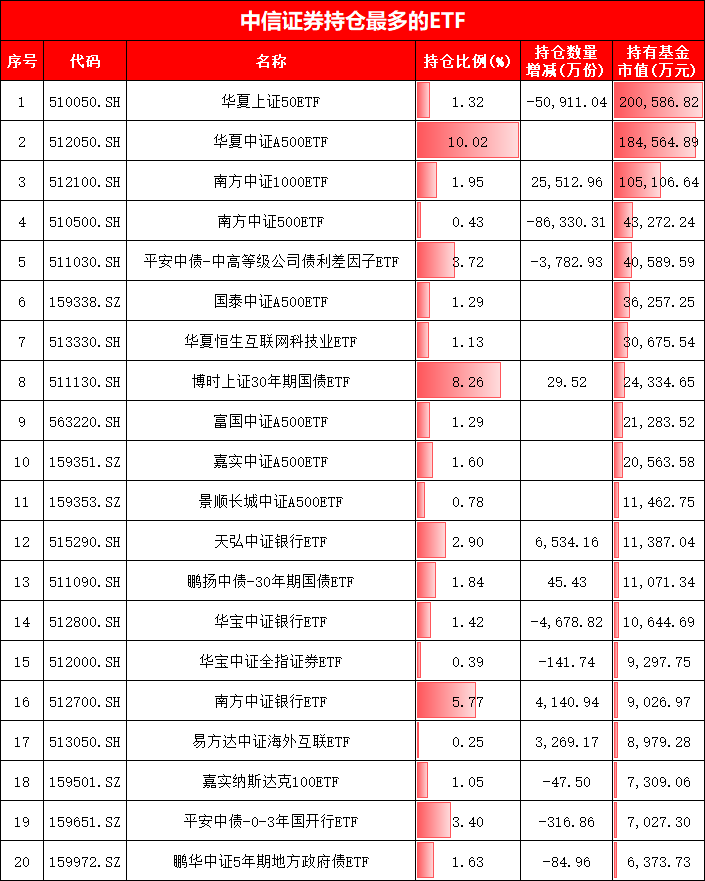
中信证券最新ETF持仓曝光:增持南方中证1000ETF、天弘银行ETF!爆买华夏、国泰等5只A500ETF合计27亿元(图)
Xin Lang Ji Jin· 2025-04-01 13:38
Core Viewpoint - CITIC Securities has made significant adjustments to its ETF holdings, increasing positions in certain ETFs while reducing others, indicating a strategic shift in investment focus towards specific sectors and market segments [1][9]. Group 1: ETF Holdings Overview - CITIC Securities holds the largest position in the Huaxia SSE 50 ETF with a market value of 2 billion yuan, despite a reduction of 50.91 million shares [2][3]. - The second largest holding is the Huaxia CSI A500 ETF, valued at 1.846 billion yuan, reflecting a stable investment strategy as no changes in holdings were reported [2][3]. - The Southern CSI 1000 ETF has seen an increase of 25.51 million shares, indicating a focus on small-cap stocks, which are expected to perform well in the current market environment [2][4]. Group 2: Increases in Holdings - The Southern CSI 1000 ETF was increased by 255 million shares, highlighting CITIC Securities' positive outlook on small-cap stocks and emerging industries [4][5]. - The Tianhong CSI Bank ETF was increased by 6.534 million shares, reflecting confidence in the banking sector amid a favorable macroeconomic environment [5][6]. - The E-Fund SSE 50 ETF saw an increase of 4.492 million shares, emphasizing the importance of large-cap blue-chip stocks in the investment strategy [5][6]. Group 3: Reductions in Holdings - CITIC Securities reduced its holdings in the Southern CSI 500 ETF by 860 million shares, indicating caution towards mid-cap stocks due to potential market uncertainties [7][8]. - The Huaxia SSE 50 ETF also experienced a reduction of 509 million shares, suggesting a strategic shift in focus away from large-cap stocks [7][8]. - The Southern MSCI China A50 ETF was reduced by 261 million shares, further reflecting a cautious approach to blue-chip stocks in the current market context [7][8]. Group 4: New Entrants and Exits - CITIC Securities entered the top ten holders of 46 new non-cash ETFs, indicating a diversification strategy to capture various market opportunities [9][10]. - The firm exited the top ten holders of the Hai Fu Tong SSE Urban Investment Bond ETF, Southern CSI 300 ETF, and the China Merchants CSI Dividend ETF, marking a significant portfolio adjustment [14][15].
棕榈股份(002431) - 棕榈股份:2025年4月1日投资者关系活动记录表
2025-04-01 11:00
Group 1: High-Standard Farmland Construction Goals - The central government aims to build a total of 1.35 billion mu of high-standard farmland by 2030, with an additional 280 million mu to be improved [2] - The investment standard for high-standard farmland construction is approximately 3,000 RMB/mu, with demonstration areas requiring at least 4,000 RMB/mu [2] - The Ministry of Finance has increased the subsidy for high-standard farmland construction from 1,300 RMB/mu to 2,400 RMB/mu in 2024 [2] Group 2: Company Performance and Market Position - In Q1 2025, the company won three major high-standard farmland construction projects, totaling approximately 860 million RMB [4] - The company has cumulatively won 19 high-standard farmland projects, with a total contract value of about 3.3 billion RMB, covering an area of approximately 1.2 million mu [4] - The company ranks among the top three in terms of business scale for high-standard farmland construction projects in Henan Province [7] Group 3: Operational Advantages and Strategies - The company provides a full industry chain service capability, including financing, planning, construction, and operation [5] - The company has strong planning and design capabilities, holding multiple design qualifications and patents in agricultural technology [6] - The company aims to reduce financial costs and debt risks while expanding its business scale through strategic partnerships and internal management improvements [9] Group 4: Government Policies and Financial Recovery - The company has benefited from government debt reduction policies, accelerating project settlements and fund recoveries through negotiations and legal actions [10] - Local government initiatives, such as debt platforms, have positively impacted the company's cash flow recovery [10]

公募产品去年实现利润约1.28万亿元
Zhong Guo Zheng Quan Bao· 2025-03-31 20:40
Group 1 - The core viewpoint of the articles indicates that the public fund industry in 2024 has shown significant profitability, with total profits reaching approximately 1.28 trillion yuan [1] - Equity funds achieved the highest profits in 2024, totaling around 444.5 billion yuan, marking the first positive annual profit since 2022 [1] - Bond funds followed closely with profits of about 410.2 billion yuan, representing a more than 70% increase compared to 2023, and have been profitable for three consecutive years [1] Group 2 - The majority of public fund companies reported positive profits in 2024, with only about ten companies, mainly smaller firms, experiencing losses, the highest being around 900 million yuan [2] - Leading public fund companies such as E Fund and Huaxia Fund reported profits exceeding 140 billion yuan each, dominating the top tier of profitability [2] - The combined profits of the top ten public fund companies accounted for over half of the total market profits, surpassing the profits of approximately 150 other public fund institutions [2]
利好突袭!财政部,斥资5000亿!明日,重磅预告!国资委大动作!影响一周市场的十大消息
券商中国· 2025-03-30 10:06
Group 1: Banking Sector Developments - Four major state-owned banks in China announced plans to raise capital through A-share issuance, with total fundraising amounts reaching up to RMB 105 billion, 165 billion, 120 billion, and 130 billion respectively [2] - The Ministry of Finance will subscribe to all newly issued shares of China Bank and Construction Bank, and over 90% of the new shares of Postal Savings Bank and Transportation Bank, totaling an investment of RMB 500 billion [2] - The banks will hold an investor briefing on March 31, 2025, to discuss the A-share issuance [2] Group 2: Regulatory Changes - The China Securities Regulatory Commission (CSRC) has amended the Securities Issuance and Underwriting Management Measures to include bank wealth management products and insurance asset management products as priority allocation objects for IPOs [3][4] - This change aims to provide equal treatment for bank wealth management and insurance asset management products in new stock subscription standards [3] Group 3: Automotive Industry Initiatives - The State-owned Assets Supervision and Administration Commission (SASAC) plans to strategically restructure central automotive enterprises to enhance industry concentration and resource allocation efficiency [5] - The focus will be on innovation, optimizing layouts, and deepening reforms, particularly in the development of smart connected new energy vehicles [5] Group 4: Consumer Lending Trends - Several banks are set to increase the annual interest rates on credit consumer loans to no less than 3% starting in April, following a competitive pricing environment earlier this year [6] - The consumer loan market has seen rates drop below 3% as banks competed for market share, with some rates as low as 2.4% [6] Group 5: Fundraising and Investment Opportunities - Multiple public funds have launched offerings for index-enhanced funds focused on the Science and Technology Innovation Board, indicating a strong interest in equity fund investments [7][8] - The Science and Technology Innovation Index is seen as a key investment tool for capitalizing on China's technological advancements [8] Group 6: Real Estate Policy Changes - Anhui Province has announced the cancellation of housing restrictions and the opening of inter-city loans to stimulate housing consumption and stabilize the real estate market [10] - The policy includes measures such as promoting housing sales, implementing tax incentives, and expanding the scope of housing provident fund withdrawals [10] Group 7: IPO Activity - The Shanghai Stock Exchange has accepted its first IPO application for a loss-making company this year, indicating a shift towards encouraging high-quality, unprofitable tech firms to go public [11] - The CSRC has approved two IPO registrations, with new stock subscriptions scheduled for the upcoming week [13]

又一批增量资金来了!
证券时报· 2025-03-30 00:27
Core Viewpoint - The launch of multiple Science and Technology Innovation Board (STAR Market) index-enhanced funds indicates a strong interest from fund companies in equity funds, which is expected to bring incremental capital to the A-share market [2][11]. Group 1: Fund Launch and Market Impact - Over 10 STAR Market index-enhanced funds were approved and quickly launched for sale, showcasing efficiency in the process [3][6]. - As of March 29, approximately 70 equity funds are in the issuance phase, indicating a robust pipeline that could provide continuous capital inflow into the A-share market [2][11]. - The first batch of STAR Market index-enhanced funds is set to officially start sales on April 1, with a focus on combining index tracking with active management to potentially exceed index returns [7][11]. Group 2: Fund Characteristics and Strategies - The STAR Market index covers a wide range of companies, including AI chips, biotechnology, and high-end manufacturing, which helps mitigate risks associated with over-concentration in a single industry while targeting high-growth sectors [3][11]. - Fund companies are leveraging advanced strategies, such as using big data and AI algorithms, to create alpha returns while effectively tracking the index [8]. - The STAR Market index is viewed as a core investment tool for investors looking to capitalize on China's technological innovation and growth potential [11]. Group 3: Broader Fund Trends - The popularity of index-enhanced funds is part of a broader trend, with many fund companies also focusing on other types of funds, such as dividend-themed and industry-specific ETFs [12]. - The total fundraising amount for newly established funds in 2023 has reached 249.7 billion yuan, with equity products accounting for approximately 109.9 billion yuan, reflecting significant year-on-year growth [13].