工商银行

Search documents
金价迷雾解读:1月15日最新报价,为何从银行到金店价格千差万别?
Sou Hu Cai Jing· 2026-01-15 20:37
Core Viewpoint - The article discusses the significant price differences in gold from international markets to retail stores, highlighting the various factors that contribute to these discrepancies. Price Chain Analysis - The international gold price on January 15 was approximately $4,622 per ounce, translating to around 1,030 RMB per gram, which serves as the global benchmark influenced by economic and exchange rate factors [1] - The domestic raw gold price, based on the Shanghai Gold Exchange's AU99.99, closed at about 1,033 RMB per gram on the same day, incorporating the impact of the RMB exchange rate [1] - Investment gold bars sold by banks are priced between 1,048 and 1,053 RMB per gram, closely aligned with raw material costs, while retail gold bars from stores like Chow Tai Fook range from 1,259 to 1,390 RMB per gram, reflecting brand premiums [2] - Brand gold jewelry prices, such as those from Chow Tai Fook and Chao Hong Ji, were between 1,395 and 1,436 RMB per gram, with the largest wholesale market in Shenzhen quoting 1,158 to 1,215 RMB per gram for 999 pure gold [2] Brand Premium Breakdown - The additional cost of 200 to 300 RMB per gram for branded jewelry includes three main components: 1. Physical store presence and services, which involve high rental and operational costs [4] 2. Design and craftsmanship value, where intricate designs and advanced manufacturing techniques can exceed the cost of the gold itself [4] 3. Brand reputation and assurance, where established brands provide trust in quality and after-sales service, representing a significant intangible asset [4] Consumer Guidance - For investment purposes, bank gold bars are recommended due to their lower costs and better liquidity, while branded jewelry is justified for personal use or gifts due to its design and service [5] - Consumers are advised to compare prices and inquire about processing fees before purchasing, and to be aware of wholesale market prices to avoid overpaying [5] - A suggested strategy is to use bank gold bars as a stable asset for value preservation while separately purchasing a desired piece of branded jewelry for personal enjoyment [8]


中国工商银行股份有限公司关于董事任职资格获核准的公告
Xin Lang Cai Jing· 2026-01-15 19:28
李金鸿先生的简历请参见本行刊载于上海证券交易所网站(www.sse.com.cn)的《中国工商银行股份有 限公司2025年第一次临时股东大会会议资料》。 ■ 中国工商银行股份有限公司 关于董事任职资格获核准的公告 中国工商银行股份有限公司董事会及全体董事保证本公告内容不存在任何虚假记载、误导性陈述或者重 大遗漏,并对其内容的真实性、准确性和完整性承担法律责任。 中国工商银行股份有限公司(简称本行)收到《国家金融监督管理总局关于李金鸿工商银行独立董事任 职资格的批复》。根据有关规定,国家金融监督管理总局已核准李金鸿先生担任本行独立董事的任职资 格。李金鸿先生担任本行独立董事的任职已生效。本行欢迎李金鸿先生加入本行董事会。 特此公告。 中国工商银行股份有限公司董事会 二〇二六年一月十五日 ...

黄金跌了价,2026年1月14日人民币黄金最新价格,中国黄金最新价格
Sou Hu Cai Jing· 2026-01-15 18:55
Core Viewpoint - The article discusses the persistent price disparity between international gold prices and retail gold jewelry prices in China, highlighting the reasons behind this phenomenon and its impact on consumer behavior. Group 1: Price Disparity - On January 14, 2026, international gold prices fell to $4,587 per ounce, while retail gold prices in stores remained above 1,400 yuan per gram, creating a gap of nearly 400 yuan [1][3] - This price disparity has been ongoing, with similar occurrences noted in late October 2025 when retail gold prices dropped by over 70 yuan per gram but remained significantly higher than the Shanghai Gold Exchange spot prices [3][6] Group 2: Factors Influencing Retail Prices - The price consumers pay for gold jewelry includes not only the base gold price but also manufacturing costs and brand premiums, which can significantly inflate the final price [4][6] - Retailers often hold inventory purchased at higher prices, leading to a "lag effect" where they do not immediately lower prices in response to falling gold prices, thus maintaining higher retail prices [6][11] Group 3: Changing Consumer Behavior - Younger consumers are increasingly viewing gold as an investment rather than just a traditional gift, with many opting for more cost-effective purchasing options [6][8] - The market is splitting into two paths: one focused on high-priced branded jewelry for aesthetic and emotional value, and another seeking investment-grade products closer to the actual gold price [8][11] Group 4: Alternative Purchasing Channels - In Shenzhen's Shui Bei area, gold prices are closely aligned with the actual gold price, offering a significant price advantage over branded stores [8] - Banks are also becoming important players in the gold market, offering competitive prices for investment gold bars and smaller gold products, appealing to consumers seeking reliability and transparency [9][11] Group 5: Investment vs. Consumption - Gold jewelry is primarily a consumer product, while investment gold bars and products like "gold beans" are seen as pure financial investments [11][13] - The article emphasizes the importance of understanding the purpose of gold purchases, whether for consumption or investment, to make informed decisions in the market [13]


多家银行开年推出资产提升活动
Zheng Quan Ri Bao Zhi Sheng· 2026-01-15 16:41
除国有大行外,上海银行、南京银行、祁县农商银行、安庆农商银行等中小银行也纷纷跟进。 本报记者 彭妍 开年以来,多家银行推出资产提升活动,以丰厚权益吸引客户参与。与以往侧重吸纳存款不同,此次银 行将重心转向资产管理规模(AUM)增长,加速布局财富管理业务,引导客户开展多元化财富配置。 苏商银行特约研究员薛洪言对《证券日报》记者表示,在净息差持续收窄的背景下,银行稳定负债端、 扩大零售客户资产规模的需求迫切。在开年的重要节点,推出资产提升活动可快速沉淀资金、缓解负债 压力,还能挖掘客户财富管理需求、提升客户黏性。当前银行业务模式正发生根本性转变,零售AUM 已成衡量零售业务竞争力与盈利潜力的关键指标。 1月12日,中国农业银行广东省分行通过微信公众号发布"资产提升有礼"活动,根据客户月日均金融资 产提升档位发放奖励。活动覆盖存款、理财、基金、保险、国债等多类金融资产,最低提升门槛10万 元,达标可获52000小豆;提升600万元以上最高可领240万小豆。小豆可兑换生活电器、家居百货等实 物,或打车券、购物卡等权益。 1月5日,工商银行推出"升金有礼"活动,同步上线资产提升奖励与资产达标礼双档福利。用户可依据资 产 ...

擎旗金融强国路 赋能实体新篇章 | 中信证券投行的2025
Xin Lang Cai Jing· 2026-01-15 16:39
Core Viewpoint - The company aims to play a pivotal role in the realization of China's financial power strategy by enhancing its investment banking capabilities and supporting the real economy through innovative financial services and resource allocation. Group 1: Service to the Real Economy - The company is committed to supporting technological innovation by integrating into the national innovation-driven development strategy, enhancing capital flow to tech sectors, and providing tailored services for high-quality development of tech enterprises [1][2]. - In 2025, the company led equity underwriting in the STAR Market, Growth Enterprise Market, and Beijing Stock Exchange with a total of 55.1 billion yuan, maintaining industry leadership [2]. - The company has actively facilitated mergers and acquisitions in the tech sector, exemplified by its support for significant asset restructuring and financing for companies like AVIC Chengfei [3]. Group 2: Green and Low-Carbon Transition - The company has implemented the "dual carbon" strategy, establishing a green service ecosystem and supporting energy structure transformation with a green bond underwriting scale of 77.6 billion yuan in 2025, leading the industry [4]. - It assisted in the issuance of the first offshore green bond by a central enterprise, raising 6 billion yuan for sustainable financing [4]. - The company has supported significant transactions in the renewable energy sector, including the privatization of environmental companies and the IPO of leading photovoltaic manufacturers [4]. Group 3: Inclusive Finance and Pension Finance - The company has innovated inclusive finance services to support rural revitalization and the pension industry, with a total underwriting scale of 19.3 billion yuan for rural revitalization bonds in 2025 [5]. - It facilitated the issuance of the first pension-themed corporate bond in China, raising funds for various elder care projects [5]. Group 4: Direct Financing Services - The company has strengthened its domestic and offshore equity financing services, achieving an A-share underwriting scale of 272.1 billion yuan in 2025, with a market share of 24.5% [6]. - In the Hong Kong market, it sponsored 33 IPOs, accounting for 28.4% of the market, including significant IPOs for major companies [7]. Group 5: Bond Market Leadership - The company achieved a record bond underwriting scale of 2.2 trillion yuan in the domestic market in 2025, with a market share of 6.9% [8]. - It led offshore bond underwriting with a scale of 5.3 billion USD, supporting major companies in their international financing efforts [8]. Group 6: Capital Market Oversight - The company has maintained high standards in risk management and compliance, achieving an A-class rating in all major business evaluations for four consecutive years [9]. Group 7: Innovation in Financial Services - The company has actively participated in capital market reforms and product innovations, supporting the listing of several tech companies under new regulatory frameworks [10]. - It has been a leader in the REITs market, participating in 29 public REITs with a total issuance scale of 68.9 billion yuan [11]. Group 8: Internationalization Efforts - The company has enhanced its international service capabilities, supporting Chinese enterprises in their global expansion and participating in significant IPOs across various countries [14][15]. - It has facilitated the issuance of offshore RMB bonds, contributing to the internationalization of the RMB [18].

并购贷款新规施行半月 商业银行“首单”业务纷纷落地
Zheng Quan Ri Bao Zhi Sheng· 2026-01-15 16:36
Core Viewpoint - The new regulations for commercial bank merger loans will take effect on December 31, 2025, leading to the first batch of merger loan businesses being implemented by state-owned banks and some joint-stock banks in early 2026, expanding the scope of applicable merger loans [1] Group 1: Implementation of New Regulations - Major state-owned banks such as Industrial and Commercial Bank of China, Agricultural Bank of China, and China Construction Bank have actively responded to the new regulations, launching merger loan businesses including controlling and equity participation loans [2] - The Industrial and Commercial Bank of China issued a controlling merger loan of 299 million yuan to support a company's acquisition of core assets in an industrial park, marking the first controlling merger loan in the banking industry [2] - Agricultural Bank of China and China Construction Bank also successfully launched their first merger loans under the new regulations shortly after the implementation [2] Group 2: Participation from Other Banks - Other banks, including Shanghai Pudong Development Bank and Beijing Bank, have also engaged in expanding their merger financing services, with notable transactions supporting equity participation in technology enterprises [3] - The new regulations set asset scale thresholds for banks to engage in merger loan businesses, primarily involving state-owned banks, listed joint-stock banks, and city commercial banks [3] Group 3: Upgraded Merger Loan Services - The new regulations optimize merger loan services by broadening the applicable scope, improving loan conditions, and emphasizing the assessment of the acquirer's repayment ability [4] - The new rules allow for a higher proportion of merger loans relative to the total acquisition price and extend the maximum loan term, facilitating financing for technology enterprises and strategic emerging industries [4] - Despite the current low proportion of merger loans in total loans, the growth rate is significant, with Shanghai Pudong Development Bank reporting a 14.53% increase in merger loan balance from the end of 2024 [4] Group 4: Future Market Dynamics - The merger market is expected to see increased activity and expansion potential, with competition shifting from mere capital supply to comprehensive service capabilities [5] - Banks with strong professional and risk control capabilities are likely to stand out in the competitive landscape [5] - Some banks are proactively enhancing their merger-related financial services, with Beijing Bank aiming to establish a new high ground in merger finance [6]

“花式”揽储:有银行送鸡蛋吸引他行储户 多家中小银行上调存款利率……
Zhong Guo Ji Jin Bao· 2026-01-15 16:23
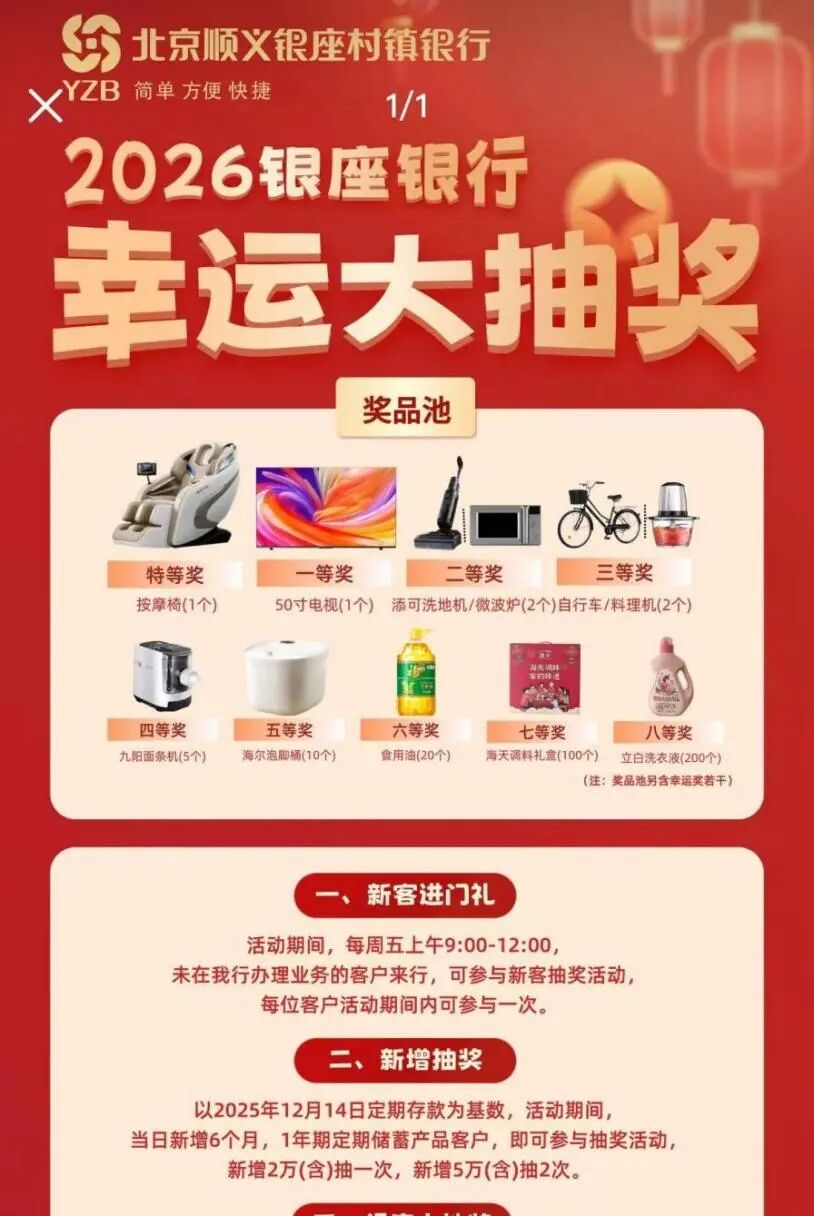
【导读】多家中小银行密集上调存款利率,各家银行为揽储开启"花式"营销 近日,不少银行员工在社交平台"晒"起了存款赠礼活动。同时,多家中小银行悄然上浮了定期存款利率,以"让利"方式吸引储 户。 不过,对比往年,今年中小银行的存款利率上浮幅度较为克制。在业内人士看来,年初"开门红"考核压力下,部分银行会短期 吸储,但非长期趋势,也不改存款利率长期下行趋势。 中小银行"花式"揽储 近日,多家中小银行密集上调了定期存款利率。例如,山西左云农商行发布公告称,从1月13日起调整存款利率,其中,将三 年期、五年期定期存款利率分别从1.45%、1.50%上浮至1.65%、1.65%。 宝应农商银行也表示,该行于1月13日起执行新的存款利率,三年期50万元及以上定期存款利率由1.7%上浮到1.8%,利率上浮 10个基点。 此外,盛京银行于近日上调了部分存款产品利率,吉林银行则将三年期定期存款年化利率从1.75%阶段性上调至2%。 记者注意到,为完成揽储任务,多家中小银行还"花式"推出各种存款送礼活动。 例如,北京顺义银座村镇银行发布公告称,如果是新客来该行办理存款业务,活动期间每周上午可以参与抽奖活动,且如果客 户新增存款,每 ...
“花式”揽储:有银行送鸡蛋吸引他行储户,多家中小银行上调存款利率……
中国基金报· 2026-01-15 16:18
Core Viewpoint - Multiple small and medium-sized banks in China have recently raised their deposit rates and launched various promotional activities to attract depositors, although the increase in rates is more restrained compared to previous years, indicating a short-term strategy rather than a long-term trend [2][11]. Group 1: Deposit Rate Adjustments - Several small and medium-sized banks have increased their fixed deposit rates, such as Shanxi Zuoyun Rural Commercial Bank raising its three-year and five-year rates from 1.45% and 1.50% to 1.65% [4] - Baoying Rural Commercial Bank has also adjusted its three-year fixed deposit rate from 1.7% to 1.8%, an increase of 10 basis points [4] - Jilin Bank has raised its three-year fixed deposit annualized rate from 1.75% to 2% [4] Group 2: Promotional Activities - To meet their deposit targets, many small and medium-sized banks have launched creative promotional activities, such as Beijing Shunyi Yinzou Village Bank offering a lottery for new customers with various household items as prizes [5] - Jiangsu Bank has introduced a unique promotion where customers can receive fresh eggs based on their deposits, allowing for multiple claims [7] - Some bank employees have resorted to personal incentives, such as offering gift cards or small gifts to attract depositors [9] Group 3: Market Trends and Strategies - The increase in deposit rates this year is generally more conservative, with most adjustments ranging from 10 to 20 basis points, reflecting a cautious approach compared to previous years [11] - Analysts suggest that the recent rate increases are part of a short-term marketing strategy aimed at precise customer acquisition, rather than a shift in the overall downward trend of deposit rates [11][12] - Larger banks appear less affected by the need for aggressive deposit strategies, focusing instead on adjusting minimum deposit thresholds while maintaining rates [12]

继续聚焦风险化解:金融监管总局 2026 年监管工作会议学习体会
Guoxin Securities· 2026-01-15 15:17
Investment Rating - The investment rating for the industry is "Outperform the Market" (maintained) [1][5]. Core Insights - The Financial Regulatory Bureau held a meeting to summarize the work of 2025 and arrange key tasks for 2026, with a continued focus on risk resolution, particularly for small and medium-sized financial institutions [2][3]. - The meeting emphasized five main areas: risk resolution for small financial institutions, prevention of risks in real estate and financing platforms, enhancement of high-quality development capabilities, improvement of financial regulation, and better financial services for economic and social quality [3][4]. - Compared to 2025, the requirements for 2026 remain largely unchanged, with a strong emphasis on preventing "explosive" risks in small financial institutions and a focus on normalizing the operation of real estate financing coordination mechanisms [3][6]. Summary by Sections Risk Resolution - The primary focus remains on resolving risks in small and medium-sized financial institutions, with a goal to firmly maintain the bottom line of preventing "explosive" risks [3][6]. - In 2025, nearly 400 banks were approved for dissolution or merger, and this trend is expected to continue into 2026 [3]. High-Quality Development - The requirement to enhance the industry's high-quality development capabilities remains unchanged, with new directives to cautiously advance the reduction and quality improvement of small financial institutions and to address disorderly competition [4][6]. Financial Regulation - There is a strong emphasis on strengthening and improving financial regulation, focusing on substantive risks and practical issues, and enhancing regulatory capabilities [4][6]. Financial Services - The meeting called for continuous improvement in financial services to enhance economic and social quality, including support for major strategies and sectors [4][6]. Investment Recommendations - The industry is expected to benefit from a narrowing of net interest margin declines, leading to an improvement in fundamentals for 2026, maintaining the "Outperform the Market" rating. Recommended stocks include Ningbo Bank and Changshu Bank, with attention to Changsha Bank and Chongqing Rural Commercial Bank. Stable high-dividend stocks such as China Merchants Bank, Industrial and Commercial Bank of China, and Jiangsu Bank are also considered valuable for allocation [7].
银行财富管理架构变阵 抢滩300万亿居民资产
2 1 Shi Ji Jing Ji Bao Dao· 2026-01-15 15:07
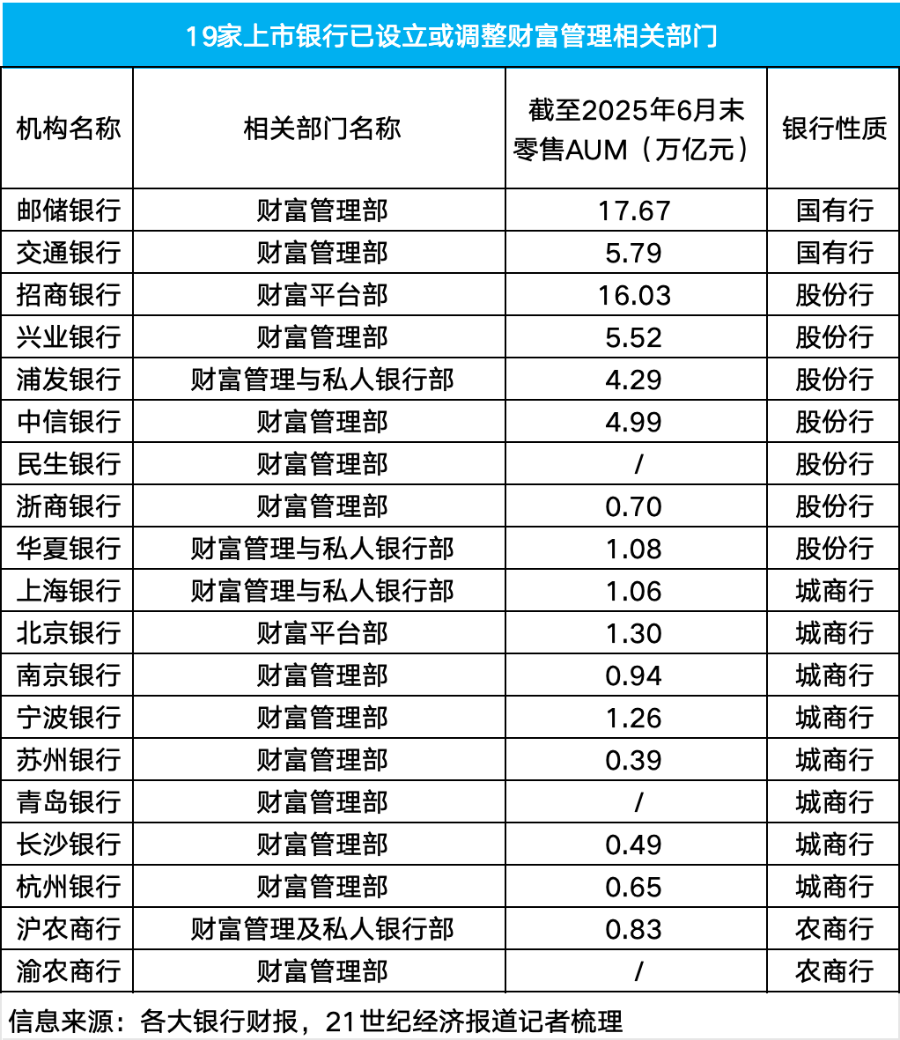
Core Insights - The wealth management market is heating up, with banks accelerating the integration of their wealth management departments to capture this promising market [1][2] - By June 2025, China's investable assets are expected to exceed 300 trillion yuan, indicating significant growth potential in wealth management as many assets remain "asleep" [1] - Major banks are restructuring their organizational frameworks to enhance their wealth management strategies and business layouts [1] Group 1: Bank Actions and Adjustments - In 2025, several major banks, including Bank of Communications and Postal Savings Bank, announced the establishment of wealth management departments at the head office level [3] - As of June 2025, 19 listed banks have established or adjusted their wealth management-related departments, including 2 state-owned banks, 7 joint-stock banks, 8 city commercial banks, and 2 rural commercial banks [3][4] - The establishment of these departments is seen as a key move for state-owned banks to deepen their wealth management strategies and promote digital transformation [3] Group 2: Strategic Focus and Market Dynamics - Different banks are focusing on various aspects of wealth management, with some emphasizing the establishment of wealth management departments as a core strategy [5] - The restructuring of wealth management departments signals a strategic shift in response to narrowing interest margins and evolving customer demands for diversified asset allocation [6][7] - The actions of major state-owned banks serve as a bellwether for the industry, indicating a shift from incremental competition to in-depth management of existing clients [8] Group 3: Wealth Management Market Landscape - As of June 2025, the retail asset management scale (AUM) among 42 listed banks shows a clear tiered structure, with state-owned banks leading the market [11] - The first tier includes major state-owned banks like ICBC, ABC, and CCB, with AUMs of 24 trillion yuan, 23.68 trillion yuan, and 22 trillion yuan respectively [11] - The second tier consists mainly of joint-stock banks, while the third tier includes city commercial banks and rural commercial banks, which are crucial for local wealth management ecosystems [11] Group 4: Future Competition and Technological Integration - Future competition in wealth management will focus on service quality, technological capabilities, and comprehensive financial ecosystems [13] - The establishment of wealth management departments aims to shift banks from product-driven to customer-driven models, enhancing service consistency and customer loyalty [13] - Financial technology is expected to play a critical role in enhancing service depth and breadth, with AI being utilized for investment advisory and customer experience management [14][15]