华为

Search documents
Counterpoint:2025年中国智能手机市场华为排名第一,苹果第二
Xin Lang Cai Jing· 2026-01-19 10:15
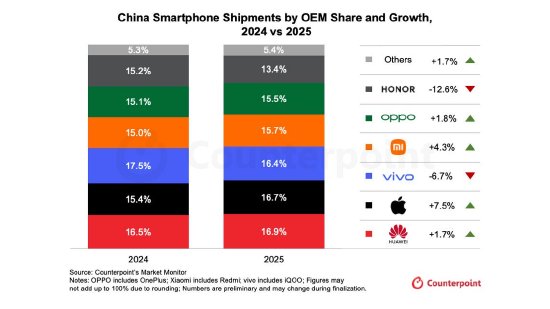
Core Insights - The report from Counterpoint indicates a 1.6% year-on-year decline in smartphone shipments in China for Q4 2025, with an overall annual decline of 0.6% [1][3] Company Performance - Huawei's shipments increased by 1.7% year-on-year, securing the top position in the Chinese market with a 16.9% market share, bolstered by strong performance of mid-to-high-end models following price discounts [1][3] - Apple saw a 7.5% year-on-year increase in shipments, achieving a 16.7% market share, attributed to the successful market performance of the iPhone 17 series and accelerated supply growth [1][3] - Vivo experienced a 6.7% decline in shipments, holding a 16.4% market share, ranking third in the market [1][3] - Xiaomi's shipments grew by 4.3%, capturing a 15.7% market share, placing it fourth [1][3] - OPPO's shipments rose by 1.8%, with a market share of 15.5%, ranking fifth [1][3] - Honor faced a significant decline of 12.6% in shipments, resulting in a 13.4% market share and a sixth-place ranking [1][3]


媒体+融合展销体验!“广货行天下”手机专场1月20日在东莞开启
Nan Fang Nong Cun Bao· 2026-01-19 10:02
Core Viewpoint - The "Guangdong Goods Going Global" mobile special promotion event will officially launch in Dongguan on January 20, showcasing the strength and charm of Guangdong's smart mobile terminal industry while promoting local brands and products [2][3][4]. Group 1: Event Overview - The event is organized by the Guangdong Provincial Department of Industry and Information Technology and the Dongguan Municipal People's Government, marking an annual promotional feast [2][3]. - It aims to present a wide variety of high-quality mobile products from local brands such as Huawei, OPPO, vivo, and Honor, emphasizing the theme of "selecting the best products and government-enterprise collaboration" [6][14]. - The event will feature both online and offline activities, integrating major e-commerce platforms and media for a comprehensive consumer experience [17][18]. Group 2: Industry Significance - Guangdong is recognized as a crucial hub for the smartphone industry, with a production volume of 683 million units in 2024, accounting for 40.9% of the national total [29][30]. - Dongguan specifically contributes 28.6% of Guangdong's smartphone production, hosting major manufacturers and achieving over 90% industry matching rate [32][33]. - The event will highlight the complete industry chain from chips to finished products, showcasing the technological innovations and cultural narratives of leading brands [31][36]. Group 3: Consumer Engagement - The promotion will include a "Quality Traceability Live Broadcast," allowing consumers to engage with the production process and understand the quality of Guangdong's mobile products [19][20]. - Offline promotions will take place in various administrative service centers and key communities in Dongguan, facilitating easy access to technology for consumers [21][22]. - The event aims to create a vibrant consumer atmosphere, encouraging participation through a blend of online and offline experiences [9][26].



电子行业周报:台积电25Q4单季度业绩创历史新高-20260119
Shanghai Aijian Securities· 2026-01-19 10:02
Investment Rating - The electronic industry is rated as "Outperform" compared to the market [1] Core Insights - The SW electronic industry index increased by 3.77%, ranking 2nd out of 31 sectors, while the CSI 300 index decreased by 0.57% [2][5] - TSMC reported a record high quarterly revenue of $33.73 billion for Q4 2025, benefiting from strong demand for AI chips, with a year-on-year growth of 25.5% [22][29] - The approval of NVIDIA's H200 chip export to China is expected to alleviate the high-end computing power supply gap in key sectors such as research and medical imaging [31][33] Summary by Sections Market Performance - The SW electronic industry index rose by 3.77%, with the top five sectors being computer (+3.82%), electronic (+3.77%), non-ferrous metals (+3.03%), media (+2.04%), and machinery (+1.91%) [2][5] - The top three sub-sectors in the electronic industry were integrated circuit packaging and testing (+14.47%), semiconductor equipment (+9.31%), and integrated circuit manufacturing (+8.68%) [9] Company Performance - TSMC's Q4 2025 financial results showed a net profit of approximately NT$505.74 billion, with a gross margin of 62.3% and a net profit margin of 48.3% [22][23] - The revenue structure indicates that high-performance computing (HPC) and smartphones are the main revenue contributors, accounting for 55% and 32% of total revenue, respectively [27] Industry Developments - The U.S. government approved NVIDIA's export of the H200 chip to China, which is expected to enhance AI model training capabilities in various sectors [31][33] - MediaTek launched the Dimensity 9500s and 8500 mobile chips, enhancing performance and efficiency in the flagship market segment [36][37]


百川智能打赢OpenAI,AI圈“惨王”王小川杀回来了
Xin Lang Cai Jing· 2026-01-19 09:56
Core Viewpoint - Wang Xiaochuan's reputation has changed after a period of silence, as he refocuses Baichuan Intelligent on AI healthcare, which he considers his primary passion, while the company prepares for an IPO in 2027 [3][8]. Financial Status - Baichuan Intelligent currently has a cash reserve of 3 billion yuan and has raised a total of 5 billion yuan in funding, with a valuation of 20 billion yuan [3][10][29]. Product Development - The newly released medical model Baichuan-M3 achieved a score of 65.1 in the HealthBench evaluation, ranking first globally, and surpassed GPT-5.2 in the medical field [4][11]. - Baichuan-M3 also boasts the lowest hallucination rate globally at 3.5% [5]. Market Positioning - Baichuan Intelligent is shifting its focus back to AI healthcare after facing challenges in the B2B market due to competition from DeepSeek, leading to significant layoffs and the departure of key team members [12][14]. - The company aims to differentiate itself by emphasizing deep reasoning based on symbolic logic rather than just perception, positioning itself uniquely in the healthcare AI market [28][29]. Competitive Landscape - The AI healthcare market is highly competitive, with major players like Google, Microsoft, and domestic companies like Huawei and Ant Group heavily investing in this space [16][18][21]. - The market is projected to exceed 315.7 billion yuan by 2033, but faces challenges such as data privacy and ethical standards [26]. Challenges and Strategy - Baichuan Intelligent's strategy includes moving away from traditional B2B sales to focus on direct-to-consumer services, aiming to build value recognition from users [29]. - The company faces significant hurdles, including ensuring the reliability of AI health consultations and competing against major platforms like WeChat and Alipay [29].

京东若爆雷,或将成为历史上最大的雷,其规模甚至可能超过恒大
商业洞察· 2026-01-19 09:46
Core Viewpoint - JD.com has achieved a record revenue of 1.15 trillion yuan, surpassing Alibaba by nearly 180 billion yuan and Huawei by approximately 300 billion yuan, establishing itself as China's largest private enterprise and the only private company with over a trillion yuan in revenue [1][3][5]. Group 1: Revenue and Workforce - JD.com reported a total revenue of 1.1588 trillion yuan, significantly exceeding Alibaba's 984.7 billion yuan and Huawei's 860 billion yuan, marking it as the largest private enterprise in China [3][5]. - The company employs 670,000 staff members, contributing to its substantial revenue generation [1]. Group 2: Employee Welfare and Business Strategy - JD.com has invested heavily in employee welfare, with over 116.1 billion yuan spent on labor costs last year, and offers a housing loan program for employees, providing up to 1 million yuan [1][9]. - The company has implemented a strategy of full social insurance coverage for all delivery personnel, enhancing employee satisfaction and loyalty [7][9]. Group 3: JD Health and Growth Potential - JD Health has shown remarkable growth, with total revenue projected to increase by 8.6% to 58.2 billion yuan in 2024, becoming a significant profit driver for the group [10]. - The introduction of innovative health products, such as "Xiaoniu Acid," has led to substantial revenue growth, with JD Health's net profit reaching 2.44 billion yuan, accounting for nearly a quarter of the group's total profit [17]. Group 4: Market Position and Competitive Advantage - JD.com has established a robust logistics network with 3,600 smart warehouses and a storage area equivalent to 4,500 football fields, enabling rapid order fulfillment [7]. - The company has successfully penetrated the high-net-worth consumer market, with 77% of households earning over 500,000 yuan annually making purchases on JD.com [12]. Group 5: Contribution to National Economy - Private enterprises in China, including JD.com, have collectively generated 41 trillion yuan in revenue, significantly contributing to the national economy and employment [21]. - The government is supporting private enterprises through tax reductions and encouraging technological advancements, allowing companies like JD.com to thrive [23].


谁是“中国汽车第一城”?
经济观察报· 2026-01-19 09:37
Core Viewpoint - The article discusses the evolving landscape of China's automotive industry, highlighting the competition among cities and the strategic differentiation of local governments in industrial transformation [2][4]. Group 1: Chengdu-Chongqing Region - Chongqing is set to become "China's Automotive Capital" with an annual production of 2.788 million vehicles in 2025, marking a 9.7% increase, and 1.296 million of these being new energy vehicles (NEVs), which is a 36% growth [4][5]. - The success of Chongqing's automotive industry is attributed to local government support and strategic partnerships, particularly the collaboration between local company Seres and tech giant Huawei [5][6]. - Chengdu's automotive production reached 821,000 vehicles in 2025, a 26.6% increase, with NEV production soaring by 198.3% to 205,000 units [7]. Group 2: Yangtze River Delta - The Yangtze River Delta remains a stronghold for the automotive industry, contributing 28% of national production, with NEVs accounting for 34.6% of the total [11]. - Shanghai's automotive production has declined, with 1.6011 million vehicles produced in 2025, representing about 5% of national output [11]. - Hefei has emerged as a key player in NEVs, producing 1.246 million units in 2025, the highest in the country, driven by government initiatives and partnerships with major manufacturers [12][14]. Group 3: Pearl River Delta - Shenzhen has overtaken Guangzhou as "China's Automotive Capital" in 2024, with BYD producing 4.5374 million NEVs, making it the global leader in this segment [16][17]. - The shift in production statistics from "enterprise location" to "production location" has impacted Guangdong's ranking in automotive output [16]. - Guangzhou's automotive industry faces challenges in transitioning from traditional fuel vehicles to NEVs, with a significant focus on integrating advanced technologies and smart transportation systems [18][19].


全球每卖出3台就有1台广东造,“手机天团”1月20日齐聚东莞
2 1 Shi Ji Jing Ji Bao Dao· 2026-01-19 09:35
作为"广货行天下"系列活动中备受关注的手机主题专场,本次活动以"优中选品、政企联动"为核心,线上联动主流电商平台与 媒体直播,线下走进社区与政务中心,华为、OPPO、vivo、荣耀等本土品牌共同参与,旨在打造一场全民可逛、可买、可信赖 的广货消费盛宴,为新一年"广货出圈"注入扎实动能。 南方财经记者程浩 东莞报道 1月20日,由广东省工业和信息化厅、东莞市人民政府共同举办的"广货行天下"春季行动广东工业品促销活动(手机专场)将在 东莞正式启动。本次"广货行天下"春季行动手机专场活动将全面呈现广货手机"品牌多、种类广、质量优"的鲜明特色。华为、 OPPO、vivo、荣耀、中兴、TCL等本土龙头企业将携最新旗舰产品与创新科技齐聚亮相,天珑、龙旗等手机产业链核心供应商 也将同步展示关键技术解决方案。通过线上线下联动,进一步扩大广东全年促消费、拓展"广货"影响力。 广东是我国最重要的智能手机产业集聚区,也是全球主要的智能手机生产制造基地和创新高地,智能手机产业规模、产量和出 口量均位居全国首位,世界每卖出三台手机就有一台是广东企业制造。目前,广东手机领域主要有华为终端、OPPO、vivo、荣 耀、传音、中兴、TCL等 ...

苹果Q4在中国手机销量猛增28%夺回榜首,但内存短缺危机恐吞噬利润
Zhi Tong Cai Jing· 2026-01-19 09:18
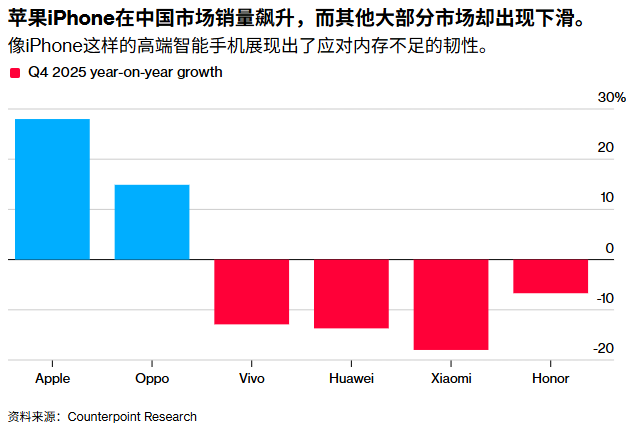
Core Viewpoint - Apple has regained its leading position in the Chinese smartphone market with a 28% increase in iPhone shipments during the holiday season, despite a worsening shortage of key memory chips [1][4]. Group 1: Apple’s Market Performance - In Q4, Apple's iPhone shipments accounted for one-fifth of global shipments, while domestic competitors like Huawei experienced double-digit percentage declines [1]. - For the full year, Apple ranked second in China, closely trailing Huawei, with both holding approximately 17% market share [4]. - Apple's iPhone 17 series has attracted many consumers, contributing to its strong performance [1]. Group 2: Challenges and Risks - The newly launched iPhone Air has underperformed due to its late release in China and compromises made between thinness and functionality [4]. - The rising prices of memory chips pose a significant financial challenge for Apple, as it needs to increase RAM capacity in future models to support advanced features [4][6]. - The semiconductor shortage, driven by manufacturers prioritizing high-end memory for AI chips, has led to increased prices and supply uncertainties for device manufacturers [5][6]. Group 3: Industry Dynamics - Companies like HP and others in the consumer hardware sector are facing pressure due to high memory component costs, which have become an investment risk [5]. - The memory chip shortage is described as a "crisis" by IDC, with expectations of further price increases of 40% to 50% in Q1 2026, followed by an additional 20% in Q2 2026 [6]. - Apple, with its strong market position and financial resources, has the highest bargaining power in negotiations with chip suppliers, allowing it to secure supply despite rising costs [7]. Group 4: Future Outlook - Apple's ability to maintain its leading position in 2026 will largely depend on how it manages the cost impacts from the memory chip shortage [7].
让有路的地方就有高质量充电|华为发布2026充电网络产业十大趋势
Zhong Guo Neng Yuan Wang· 2026-01-19 09:17
Core Viewpoint - Huawei emphasizes the ongoing evolution of the charging network industry, highlighting its potential for high-quality development and the transformative impact of electric logistics on energy and transportation [1]. Group 1: Industry Trends - Trend 1: High-Quality Development - The shift from passenger to commercial vehicles necessitates high-quality charging solutions, leading to the large-scale upgrade of outdated charging equipment to meet diverse energy needs [3]. - Trend 2: Comprehensive Supercharging - The market share of supercharging vehicles is expected to rise significantly, driven by the widespread adoption of third-generation semiconductor materials and high-capacity power batteries [5][6]. - Trend 3: Logistics Megawattization - The transition from diesel to electric in heavy-duty trucks is anticipated to create a commercial ecosystem, with declining battery costs and advancements in megawatt charging technology driving this trend [8]. - Trend 4: Station Megawattization - High-capacity stations (hundred-megawatt level) will become standard in all-electric logistics, benefiting from regional clustering effects due to technological barriers and scale advantages [9]. Group 2: Safety and Technology - Trend 5: Safety and Trustworthiness - The increased charging power for commercial vehicles necessitates a focus on safety, integrating robust electrical safety measures and cybersecurity protocols [11]. - Trend 6: Liquid Cooling for Supercharging - The adoption of liquid cooling technology is essential for efficient heat dissipation in challenging charging environments, transitioning from traditional air cooling to integrated vehicle and charging station cooling solutions [12]. - Trend 7: Direct Current Storage and Charging - Direct current storage and charging can effectively enhance power capacity, facilitating the rapid and cost-effective establishment of supercharging stations [14]. Group 3: Infrastructure and Innovation - Trend 8: Modular Station Construction - Modular solutions for station construction will streamline engineering and equipment setup, offering flexibility and cost-effectiveness for diverse charging scenarios [17]. - Trend 9: Microgrid Integration - The integration of photovoltaic systems and energy storage with advanced cooling technologies will create comprehensive solutions for power capacity enhancement and green energy utilization [18]. - Trend 10: AI Empowerment - The intelligent development of charging networks will enhance the overall charging experience for users, improving logistics efficiency through collaborative digital solutions [19]. Conclusion - By 2026, Huawei aims to collaborate with partners to build a seamless, high-quality supercharging network, seizing opportunities in the electric vehicle transition [21].
OpenAI及谷歌等巨头齐攻AI医疗,健康 160(2656.HK) 与京东健康(6618.HK)等国内龙头如何打造中国方案
Zhong Jin Zai Xian· 2026-01-19 09:16
Core Insights - The global tech giants are intensifying their efforts in the AI healthcare sector, with Chinese companies adopting pragmatic approaches that are becoming essential [1] - The AI healthcare market in China is experiencing rapid growth, driven by an aging population and a structural imbalance in quality medical resources [7] Group 1: Major Players and Their Strategies - OpenAI's ChatGPT Health focuses on consumer engagement, allowing users to upload medical records for personalized health advice, processing over 230 million health interactions weekly [2] - Google has launched the MedGemma 1.5 model, which operates offline and supports 3D scanning and medical text analysis, with a speech-to-text error rate of only 5.2% [2] - Anthropic targets the enterprise market with Claude for Healthcare, emphasizing privacy and compliance, and has partnered with institutions like Boston Children's Hospital [2] Group 2: Chinese Companies' Developments - Health 160 has connected over 44,800 healthcare institutions and developed an AI health management system that covers the entire patient journey, achieving a content click-through rate increase of 90% [3][4] - JD Health aims to evolve AI from a tool to a core engine for personalized health management, launching the "Zhi Yi" AI for evidence-based medicine [5][6] - JD Health's AI initiatives include a comprehensive health service matrix and specialized systems for cancer treatment, showcasing the potential of AI in personalized medicine [6] Group 3: Market Trends and Challenges - The AI medical device market in China is projected to grow from 292 million yuan in 2020 to 24.2 billion yuan by 2025, highlighting the sector's rapid expansion [7] - The competitive focus in AI healthcare is shifting from utility to stable, compliant, and sustainable implementation, with ecological layouts being crucial for achieving these goals [7] - Challenges include data privacy, ethical standards, and the need for improved data quality and interoperability among healthcare systems [8] Group 4: Future Directions - The future of AI healthcare in China will see a complementary relationship between major players' comprehensive strategies and targeted niche developments [9] - As technology matures, AI models are expected to further empower the healthcare industry, shifting the focus from treatment to proactive health management [9]