微创医疗

Search documents
瑞银深度调研报告:2026年中国两大产业主线:自主可控与海外扩张
Zhi Tong Cai Jing· 2026-02-13 13:31
Group 1: Core Insights - UBS's in-depth research in China identifies two main industry themes for 2026: self-sufficiency and overseas expansion [1] - The research covered various sectors including technology, industrial, healthcare, consumer, and utilities, visiting over 100 companies and industry experts [1] - The report highlights a shift in investor interest, with capital goods, media entertainment, and real estate development seeing increased research focus, while semiconductor and automotive parts sectors experienced a decline [1] Group 2: Technology Sector Insights - The technology sector is a key focus, with advancements in self-sufficiency moving from isolated breakthroughs to industry-wide collaboration [2] - AI capital expenditure is expected to grow steadily in 2026, driven by strong demand for AI applications and local semiconductor production [3] - Despite uncertainties regarding H200 GPU imports, domestic supply chains are adapting through technology substitution and demand upgrades [3] Group 3: Semiconductor Developments - The localization of China's semiconductor industry is accelerating, with significant progress in advanced etching/ deposition equipment, advanced packaging, and high-end analog chips [4] - Capital expenditure for wafer fabrication equipment (WFE) is projected to grow by 10-15% annually, driven by capacity expansion in advanced logic and memory wafer fabs [4] - Domestic manufacturers anticipate a substantial increase in storage capital expenditure in 2026, aligning with a global upcycle in the storage industry [4] Group 4: Overseas Expansion Trends - Multiple industries, including industrial, biopharmaceuticals, and consumer goods, are focusing on overseas expansion as a key growth strategy [6] - In the industrial sector, overseas orders for AIDC and renewable energy storage equipment are increasing significantly [7] - The healthcare sector is also prioritizing global expansion, with biopharmaceutical companies actively pursuing international collaborations and local sales team development [9] Group 5: Key Recommendations - UBS recommends several core stocks in the technology and semiconductor sectors, including Northern Huachuang (advanced etching/ deposition), Changdian Technology (advanced packaging), and Horizon Robotics (edge AI) [5][12] - In the healthcare sector, companies like WuXi AppTec (CRO/CDMO) and 3SBio (biopharmaceuticals) are highlighted as key beneficiaries of global expansion [12] - The consumer sector sees recommendations for Jason Furniture (overseas expansion) and Leap Motor (new energy vehicles), while Gree Electric Appliances is advised to sell due to margin pressures [12] Group 6: Overall Industry Outlook - The report concludes that China's industrial development in 2026 will be characterized by a dual focus on self-sufficiency in technology and overseas expansion in various sectors [13] - The integration of these two themes is expected to enhance China's economic globalization, with technology supporting overseas expansion and vice versa [13] - Investment opportunities are identified in sectors with low crowding and improving fundamentals, as well as in high-growth areas like AI and semiconductors [13]


摩根大通增持微创医疗(00853)约89.17万股 每股作价约11.09港元
智通财经网· 2026-02-13 12:47
智通财经APP获悉,香港联交所最新数据显示,2月9日,摩根大通增持微创医疗(00853)89.1713万股, 每股作价11.089港元,总金额约为988.82万港元。增持后最新持股数目约为1.92亿股,持股比例为 10.02%。 ...
摩根大通增持微创医疗约89.17万股 每股作价约11.09港元
Zhi Tong Cai Jing· 2026-02-13 12:46
香港联交所最新数据显示,2月9日,摩根大通增持微创医疗(00853)89.1713万股,每股作价11.089港 元,总金额约为988.82万港元。增持后最新持股数目约为1.92亿股,持股比例为10.02%。 ...
微创医疗(00853.HK):2月12日南向资金增持60.1万股
Sou Hu Cai Jing· 2026-02-12 19:15
Core Viewpoint - Southbound funds increased their holdings in MicroPort Medical (00853.HK) by 601,000 shares on February 12, indicating a positive sentiment towards the company despite some days of net reductions in holdings [1] Group 1: Southbound Fund Activity - Over the past five trading days, there were two days of net reductions in holdings, totaling 2,280,500 shares [1] - In the last 20 trading days, southbound funds increased their holdings on 15 days, with a total net increase of 23,386,700 shares [1] - Currently, southbound funds hold 924 million shares of MicroPort Medical, accounting for 48.19% of the company's total issued ordinary shares [1] Group 2: Company Overview - MicroPort Medical is primarily engaged in the sales, production, research, and development of medical devices [1] - The company operates through eight divisions, including cardiovascular intervention, orthopedic medical devices, cardiac rhythm management, vascular intervention, neurointervention, structural heart disease, surgical robotics, and surgical medical devices [1]


微创医疗(00853.HK):2月11日南向资金减持172.94万股
Sou Hu Cai Jing· 2026-02-11 19:15
Core Viewpoint - Southbound funds have reduced their holdings in MicroPort Scientific Corporation (00853.HK) by 1.72 million shares on February 11, with a total net reduction of 2.70 million shares over the past five trading days [1] Group 1: Shareholding Changes - In the last 20 trading days, southbound funds have increased their holdings on 14 days, resulting in a total net increase of 22.13 million shares [1] - Currently, southbound funds hold 924 million shares of MicroPort, accounting for 48.16% of the company's total issued ordinary shares [1] Group 2: Company Overview - MicroPort Scientific Corporation is primarily engaged in the sales, production, research, and development of medical devices [1] - The company operates through eight divisions, including cardiovascular intervention, orthopedic medical devices, cardiac rhythm management, vascular intervention, neurointervention, structural heart disease, surgical robotics, and surgical medical devices [1]
微创机器人-B:中国手术机器人领军者,“让天下没有难做的手术”-20260211
Huaan Securities· 2026-02-11 07:25
Investment Rating - The investment rating for the company is "Buy" [1][10]. Core Insights - The surgical robot industry has a broad prospect with high clinical value, driven by both industry and policy [4][5]. - The domestic industry is at a pivotal moment, with increasing approval of domestic surgical robots and a growing number of local brands [4][5][6]. - The company is a leading player in the domestic surgical robot market, with a rich product portfolio and positive clinical feedback [7][8]. Summary by Sections Company Overview - The company, Shanghai MicroPort Medical Robotics, focuses on the design, development, and commercialization of surgical robots, aiming to assist surgeons in complex surgeries [17]. - Established in 2014, the company has developed a platform for innovation and industrialization in surgical robots, with multiple products approved for clinical use [18][20]. Market Potential - The global surgical robot market is expected to grow significantly, with a projected market size of $21.2 billion by 2024, reflecting a compound annual growth rate (CAGR) of 22.4% from $7.7 billion in 2019 [42]. - The laparoscopic surgical robot segment is the largest, accounting for over 50% of the total market [42]. Product Portfolio - The company has a diverse range of products, including the TUMAI laparoscopic surgical robot series and the Honghu orthopedic surgical robot series, with a total of seven commercialized products [8][20]. - The TUMAI series has been recognized in over 40 countries and regions, achieving significant sales and installations [8]. Financial Projections - Revenue is expected to reach RMB 569 million, RMB 896 million, and RMB 1.308 billion in 2025, 2026, and 2027, respectively, with year-on-year growth rates of 121%, 57%, and 46% [9][12]. - The company is projected to narrow its losses significantly, with a forecasted net profit of RMB 530 million by 2027 [9][12]. Competitive Landscape - The domestic market is seeing an increase in competition, with 11 local brands now approved for surgical robots, indicating a shift towards domestic alternatives to established international brands [5][53]. - The company maintains a competitive edge through its advanced technology and product offerings, which are well-received in both domestic and international markets [6][8].
微创医疗(00853.HK):2月9日南向资金增持6万股
Sou Hu Cai Jing· 2026-02-09 19:35
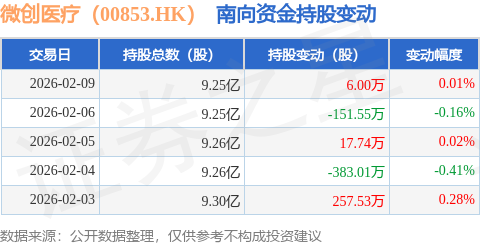
Group 1 - The core point of the article is that southbound funds have increased their holdings in MicroPort Medical (00853.HK) by 60,000 shares on February 9, 2026, while experiencing a net reduction of 2.5329 million shares over the last five trading days [1] - Over the past 20 trading days, southbound funds have increased their holdings in MicroPort Medical on 13 occasions, with a total net increase of 16.2003 million shares [1] - As of now, southbound funds hold 925 million shares of MicroPort Medical, accounting for 48.23% of the company's total issued ordinary shares [1] Group 2 - The total number of shares held by southbound funds on February 9, 2026, is 925 million, with a change of 60,000 shares, reflecting a change of 0.01% [2] - On February 6, 2026, there was a reduction of 1.5155 million shares, representing a decrease of 0.16% [2] - The company operates in the medical device sector, focusing on sales, production, research, and development through eight divisions, including cardiovascular intervention, orthopedic medical devices, cardiac rhythm management, and surgical robotics [2]
金山软件(03888.HK)子企转投科创板,港股回A潮即将袭来
Ge Long Hui· 2026-02-09 14:34
A股市场正在发生着翻天覆地的变化,3月2日,设立科创板并试点注册制主要制度规则正式发布,筹备了3个多月的科 创板正式开闸。近来也有不少港股公司用分拆、科创板+H股等方式回归A股。 北京办公软件转道科创板 金山软件(03888.HK)4月23日收盘后,扔下了一枚重磅:有关北京办公软件普通股建议分拆及上市事宜,经过审慎的 考虑,公司认为上海证券交易所科创板为更加适合的股票上市地。事实上,早在2017年5月,金山软件就已经动了将 WPS业务分拆赴A股上市的心思,当时北京办公软件瞄准的是深市创业板。 快到而立之年的WPS是中国国产可替代最具市场化的软件,近年来营收呈现加速增长态势。2018年内,办公软件全年 实现收入11.3亿,同比增速为56%,远高于2017年同比增速(32%)。金山办公收入模式主要有软件授权、服务订阅 和互联网广告三类,此前广告收入占比较大。 2018年11月,WPS安卓版的月活用户就已经突破了1亿,成为国产办公类手机软件中的冠军。"金山文档"月活突破 6900万,微信小程序用户突破8000万。此外,WPS还与阿里钉钉合作,将线上文档能力注入钉钉智能文档。 软件国产化自主可控为WPS企业版发展创造 ...


业绩与股价背离?港股医药基本面转暖,重视低位吸筹窗口期!
Xin Lang Cai Jing· 2026-02-08 12:09
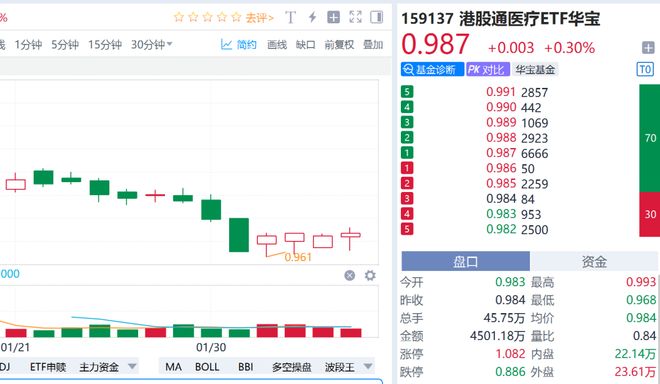
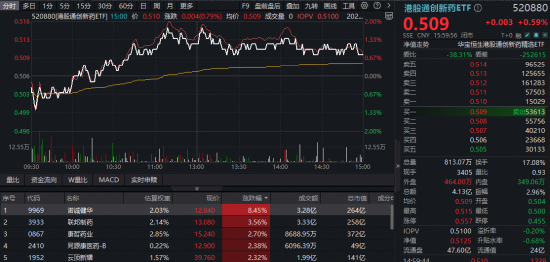
Group 1: Market Overview - The Hong Kong pharmaceutical sector showed significant recovery on February 6, with innovative drugs experiencing a rebound, particularly the Hong Kong Stock Connect Innovative Drug ETF (520880), which rose by nearly 2% after opening lower [1][8] - Notable stocks included Nocera Health, which surged over 12%, projecting revenues of 2.37 billion yuan for 2025, a year-on-year increase of approximately 134%, and an expected net profit of around 630 million yuan, marking its first profit [1][8] Group 2: Company Performance - Companies such as Rongchang Biopharmaceutical and CanSino Biologics also reported profitability, with net profit forecasts exceeding 100% year-on-year growth [1][8] - Ark Health announced a profit forecast of 7 to 10 million yuan for 2025, indicating a turnaround from losses, and raised approximately 144.3 million HKD to accelerate the development of its AI-driven chronic disease management platform [3][10] Group 3: ETF Insights - The Hong Kong Stock Connect Innovative Drug ETF (520880) and the Hong Kong Stock Connect Medical ETF (159137) are highlighted as effective investment vehicles, with the former focusing entirely on innovative drug development companies, where the top ten weighted stocks account for over 73% [6][12] - The Hong Kong Stock Connect Medical ETF (159137) has shown strong performance, with 9 out of 10 disclosed component stocks expected to report profits, and several companies projected to double their net profits year-on-year [3][10]
全球“药王”易主!医药巨头们的最新财报,透露了哪些“财富密码”?
Xin Lang Cai Jing· 2026-02-08 02:12
Group 1: US Pharmaceutical Earnings Season - Eli Lilly reported Q4 revenue of $19.3 billion, a 43% year-over-year increase, with non-GAAP EPS of $7.54, up 42%. The weight loss drug Zepbound has surpassed Novo Nordisk's Wegovy in prescriptions, and the 2026 revenue guidance is set at $80-83 billion, exceeding market expectations with a projected growth of 27% [1][10]. - Novo Nordisk's sales for semaglutide (Ozempic/Wegovy) are expected to reach $34.608 billion in 2025, accounting for 73.9% of total revenue. In China, Ozempic's sales are approximately ¥5.932 billion, while Wegovy's are about ¥874 million. The oral version of Wegovy is set to launch in the US on January 5, 2026, with around 50,000 prescriptions within the first month [2][10]. - Merck's Keytruda achieved annual sales of $31.68 billion, a 7% increase, nearing 50% of total revenue. The new pulmonary hypertension drug Winrevair generated $1.443 billion in sales, more than tripling from 2024 [4][10]. - Johnson & Johnson's Q4 revenue was $24.56 billion, exceeding expectations, with a 10% increase in the innovative pharmaceuticals segment. The 2026 revenue guidance is set at $99.5-100.5 billion, also above expectations [6][10]. - Pfizer's Q4 revenue was $17.6 billion, with a 9% increase excluding COVID products. The 2026 revenue guidance is conservative at $59.5-62.5 billion, reflecting declines in COVID product sales and patent expirations [7][10]. - Sanofi's Q4 earnings exceeded expectations, with record sales of Dupixent reaching €4.246 billion, a 32.2% year-over-year increase [8][10]. Group 2: Industry Trends and Insights - The current earnings season indicates that in the innovative-driven pharmaceutical industry, there are no eternal leaders, only continuous evolution [9][10]. - The competition in the GLP-1 drug market has intensified, with Eli Lilly's tirzepatide overtaking Novo Nordisk's semaglutide, marking a new phase in the industry [10]. - The slowdown in sales growth for Merck's Keytruda, despite record sales, highlights the need for new products and acquisitions to navigate the post-Keytruda era [10]. - The focus of competition is shifting from injectable to oral formulations, as seen with Novo Nordisk's oral Wegovy and Eli Lilly's multi-target drug Retatrutide, to build product moats [10]. - Price competition and pipeline iteration will be key observation points, with the impact of US drug pricing legislation becoming evident and the onset of a "price war" among GLP-1 drugs [10]. Group 3: Hong Kong Pharmaceutical Sector Opportunities - The Hong Kong pharmaceutical sector has seen significant changes, with innovation drugs remaining the strongest growth engine, shifting from "signing" to "realization" of value [11][12]. - The medical device sector is experiencing a "double recovery" opportunity as the impact of centralized procurement policies diminishes, leading to performance and valuation recovery [13][14]. - The Chinese traditional medicine sector is active, driven by favorable policies, but there is a "temperature difference" between policy drivers and fundamental performance, necessitating careful selection of stocks [17][19]. Group 4: ETF Configuration and Strategy - Valuations in the Hong Kong medical sector remain attractive, with the latest PE ratio at 30.77x, still low compared to the past five years [18][19]. - Macro liquidity conditions are favorable, with expectations of RMB appreciation and stable HKD attracting funds to Hong Kong stocks [18][19]. - The upcoming National People's Congress in March will clarify annual growth targets and industry policy priorities, serving as a critical point for risk appetite re-evaluation [18][19].