
江苏金租

Search documents
行业研究|行业周报|投资银行业与经纪业:回调后建议积极配置,持续关注板块绩优个股-20260210
Changjiang Securities· 2026-02-10 08:44
Investment Rating - The report maintains a "Positive" investment rating for the industry [7] Core Insights - The non-bank financial sector has shown weak overall performance this week, with a recommendation to seize allocation opportunities in the brokerage sector as market trading has slightly declined but remains at historical highs. In the insurance sector, the long-term outlook is optimistic due to improved return on equity (ROE) and valuation recovery potential, suggesting a positive allocation strategy for insurance stocks [2][4] - The report continues to recommend stable dividend-paying stocks such as Jiangsu Jinzhong, China Ping An, and China Pacific Insurance, which exhibit strong profitability and market positions. Additionally, it highlights companies like New China Life, China Life, Hong Kong Stock Exchange, CITIC Securities, Dongfang Caifu, Tonghuashun, and Jiufang Zhitu Holdings based on performance elasticity and valuation [4] Summary by Sections Market Performance - The non-bank financial index decreased by 0.6% this week, with an excess return of +0.7% relative to the CSI 300, ranking 20th out of 31 sectors. Year-to-date, the non-bank financial index is down 1.1%, with an excess return of -1.4% compared to the CSI 300, ranking 29th out of 31 [5] - The average daily trading volume in the two markets was 24,066.54 billion yuan, down 21.43% week-on-week, with a daily turnover rate of 2.36%, down 60.83 basis points [5][35] Insurance Sector Insights - In December 2025, the cumulative insurance premium income reached 61,194 billion yuan, reflecting a year-on-year increase of 7.43%. Life insurance premiums increased by 8.91%, while property insurance premiums rose by 3.92% [20][21] - The total assets of insurance companies reached 41.31 trillion yuan, with life insurance companies holding 36.39 trillion yuan, representing 88.09% of the total [25][26] Brokerage and Investment Business - The brokerage business is experiencing a gradual recovery in profitability, with the average daily trading volume exceeding the 2025 average. The report notes that the commission fee rates are stabilizing, which is expected to support the profitability of the brokerage sector [35][41] - In January 2026, the equity financing scale rebounded to 134.86 billion yuan, up 103.4% month-on-month, while bond financing decreased by 15.6% [45] Asset Management and Fund Issuance - The report indicates a recovery in the issuance of collective asset management products, with January 2026 seeing a new issuance of 9.104 billion units, up 40.1% from the previous month. The new fund issuance also increased to 1,094.51 billion units, reflecting a 41.3% month-on-month rise [47][49]



周期板块景气预期开启扩张
GOLDEN SUN SECURITIES· 2026-02-09 09:01
Quantitative Models and Construction Methods 1. Model Name: Industry Mainline Model (Relative Strength Index, RSI) - **Model Construction Idea**: This model identifies leading industries by calculating their relative strength (RS) based on historical price performance. Industries with RS > 90% are considered potential market leaders [13] - **Model Construction Process**: 1. Use 31 first-level industry indices as the configuration targets [13] 2. Calculate the price change percentages over the past 20, 40, and 60 trading days for each industry [13] 3. Rank the industries based on their price changes for each period and normalize the rankings to obtain RS_20, RS_40, and RS_60 [13] 4. Compute the average of the three rankings to derive the final RS index: $ RS = (RS_{20} + RS_{40} + RS_{60}) / 3 $ [13] 5. Industries with RS > 90% before the end of April are identified as potential leaders for the year [13] - **Model Evaluation**: The model effectively identified leading industries in 2024, such as coal, utilities, home appliances, banks, oil and gas, telecommunications, non-ferrous metals, agriculture, and automobiles. These industries aligned with the market's main themes, including high dividends, resources, exports, and AI [13] 2. Model Name: Industry Sentiment-Trend-Crowding Framework - **Model Construction Idea**: This framework provides two right-side industry rotation strategies based on market sentiment, trend, and crowding levels [17] 1. High Sentiment + Strong Trend, avoiding high crowding (aggressive and synchronized with the market) [17] 2. Strong Trend + Low Crowding, avoiding low sentiment (trend-following and user-friendly) [17] - **Model Construction Process**: 1. Use sentiment as the core metric, combined with trend and crowding levels, to identify industries with strong potential [17] 2. Historical backtesting results show the model's annualized return and risk metrics [17] - **Model Evaluation**: The model demonstrates strong performance, with an annualized return of 22.0%, an annualized excess return of 13.4%, an IR of 1.5, and a maximum drawdown of -8.0%. The monthly win rate is 67% [17] 3. Model Name: Left-Side Inventory Reversal Model - **Model Construction Idea**: This model identifies industries in a recovery phase from distress or inventory pressure, aiming to capture turnaround opportunities during restocking cycles [27] - **Model Construction Process**: 1. Focus on industries with current or past distress but showing signs of recovery [27] 2. Evaluate long-term analyst sentiment and inventory pressure to identify industries with restocking potential [27] 3. Historical backtesting results show the model's performance metrics [27] - **Model Evaluation**: The model has shown strong historical performance, with absolute returns of 13.4% in 2023, 26.5% in 2024, and 28.7% in 2025. The excess returns relative to equal-weighted industry benchmarks were 17.0%, 15.4%, and 5.6%, respectively [27] --- Model Backtesting Results 1. Industry Mainline Model (RSI) - **2024**: Industries with RS > 90% included coal, utilities, home appliances, banks, oil and gas, telecommunications, non-ferrous metals, agriculture, and automobiles. These industries aligned with the year's main themes [13] - **2025**: 17 industries showed RS > 90%, including TMT, banks, manufacturing, and some consumer sectors [13] - **2026 (up to February 6)**: 7 industries showed RS > 90%, including media, building materials, oil and gas, non-ferrous metals, basic chemicals, defense, and telecommunications [14] 2. Industry Sentiment-Trend-Crowding Framework - **Annualized Return**: 22.0% [17] - **Annualized Excess Return**: 13.4% [17] - **IR**: 1.5 [17] - **Maximum Drawdown**: -8.0% [17] - **Monthly Win Rate**: 67% [17] - **January 2026 Performance**: Absolute return of 6.5%, excess return of 0.7% [17] 3. Left-Side Inventory Reversal Model - **2023**: Absolute return of 13.4%, excess return of 17.0% [27] - **2024**: Absolute return of 26.5%, excess return of 15.4% [27] - **2025**: Absolute return of 28.7%, excess return of 5.6% [27] - **January 2026**: Absolute return of 10.4%, excess return of 4.8% [27]
非银金融行业周报(2026/2/2-2026/2/6):新年新开户数亮眼,中国平安再次增持中国人寿(H)-20260208
Shenwan Hongyuan Securities· 2026-02-08 15:27
Investment Rating - The report maintains a positive outlook on the non-bank financial sector, indicating an "Overweight" rating for the industry, suggesting it will outperform the overall market [4]. Core Insights - The report highlights a significant increase in new account openings in January 2026, reaching 4.9158 million, a year-on-year increase of 213% and a quarter-on-quarter increase of 89%. This trend is expected to benefit brokerage firms as funds flow from traditional banks to capital markets [4]. - The report emphasizes the need for China's financial sector to transition from being large to strong, focusing on mergers and acquisitions as a core growth engine for brokerage firms. It also notes the expansion of international business opportunities due to the ongoing internationalization of the RMB [4]. - The report discusses specific stock movements, including Huatai Securities' plan to issue HKD 10 billion in zero-coupon convertible bonds, and the restructuring of Zhongtai Securities to enhance operational efficiency [4][13]. - In the insurance sector, the report notes that Ping An Group has increased its stake in China Life (H) multiple times, reflecting confidence in the sector's value re-evaluation. The report anticipates steady growth in new business value (NBV) and an increase in equity allocation for China Life [4][11]. Summary by Sections Market Review - The Shanghai Composite Index decreased by 1.33% during the week, while the non-bank index fell by 0.60%. The brokerage, insurance, and diversified financial sectors reported declines of 0.65%, 0.71%, and an increase of 0.43%, respectively [7]. Non-Bank Financial News and Key Stock Announcements - The report outlines regulatory updates regarding virtual currencies and asset tokenization, indicating a tightening of oversight in these areas [9]. - Specific stock announcements include Huatai Securities' bond issuance and Ping An's increased holdings in China Life, showcasing strategic moves within the sector [11][13]. Key Data Tracking - The report provides data on average daily trading volume, which reached CNY 24,068.65 billion, and highlights the significant increase in new investors, with 995,900 new accounts opened in August 2023 [23][24].


非银金融行业周报:1月新开户高增超预期,银保渠道实现开门红-20260208
KAIYUAN SECURITIES· 2026-02-08 14:01
非银金融 2026 年 02 月 08 日 投资评级:看好(维持) 行业走势图 数据来源:聚源 -24% -12% 0% 12% 24% 36% 2025-02 2025-06 2025-10 非银金融 沪深300 相关研究报告 《1 月基金新发显著增长,头部券商业 绩预告符合预期 — 行 业 周 报 》 -2026.2.1 《偏股基金新发同比明显增长,公募 强化基准约束—行业周报》-2026.1.25 《逆周期调节呵护"慢牛",券商和 保险业务开门红 — 行 业 周 报 》 -2026.1.18 1 月新开户高增超预期,银保渠道实现开门红 ——行业周报 | 高超(分析师) | 卢崑(分析师) | 张恩琦(联系人) | | --- | --- | --- | | gaochao1@kysec.cn | lukun@kysec.cn | zhangenqi@kysec.cn | | 证书编号:S0790520050001 | 证书编号:S0790524040002 | 证书编号:S0790125080012 | | 周观点:1 | 月新开户高增超预期,银保渠道实现开门红 | | 保险在个险和银保两端均实现开 ...
非银金融行业周报:新年新开户数亮眼,中国平安再次增持中国人寿(H)-20260208
Shenwan Hongyuan Securities· 2026-02-08 13:39
Investment Rating - The report maintains a positive outlook on the non-bank financial sector, indicating an "Overweight" rating for the industry [4][48]. Core Insights - The report highlights a significant increase in new account openings, with 4.9158 million new accounts in January 2026, representing a year-over-year increase of 213% and a quarter-over-quarter increase of 89% [4]. - The report emphasizes the ongoing shift of funds from traditional banks to capital markets and non-bank financial institutions, driven by the expiration of 70 trillion yuan in one-year or longer deposits and a decline in net interest margins [4]. - The report discusses the need for China's financial sector to transition from being large to strong, focusing on mergers and acquisitions as a core growth engine for brokerages [4]. - The report notes that the international business landscape for brokerages is expanding due to the deepening process of RMB internationalization and the demand for cross-border wealth management and investment banking services [4]. - The report mentions that Ping An Group has increased its stake in China Life (H) multiple times, reflecting a strong confidence in the insurance sector [4][12]. Summary by Sections Market Review - The Shanghai Composite Index closed at 4,643.60 with a decline of 1.33%, while the non-bank index closed at 2,030.92 with a decline of 0.60% [8]. - The brokerage, insurance, and diversified financial indices reported declines of 0.65%, 0.71%, and an increase of 0.43%, respectively [8]. Non-Bank Industry News and Key Announcements - The report outlines regulatory updates regarding virtual currencies and asset tokenization, indicating a tightening of oversight in these areas [10]. - Ping An Group's recent acquisitions of shares in China Life (H) are detailed, showcasing a strategic investment approach [12]. - Huatai Securities plans to issue 10 billion HKD in zero-coupon convertible bonds to support overseas business development [14]. Investment Analysis Recommendations - The report suggests focusing on brokerages with strong comprehensive capabilities, recommending stocks such as Guotai Junan A+H, GF Securities A+H, and CITIC Securities A+H [4]. - For insurance, the report recommends China Life (H), New China Life, Ping An, China Pacific Insurance, and China Property & Casualty Insurance, highlighting the systemic value reassessment opportunities in the insurance sector [4].




11家银行因虚增存贷款被罚、规模增7.5倍,违规考核问题突出
2 1 Shi Ji Jing Ji Bao Dao· 2026-02-06 10:36
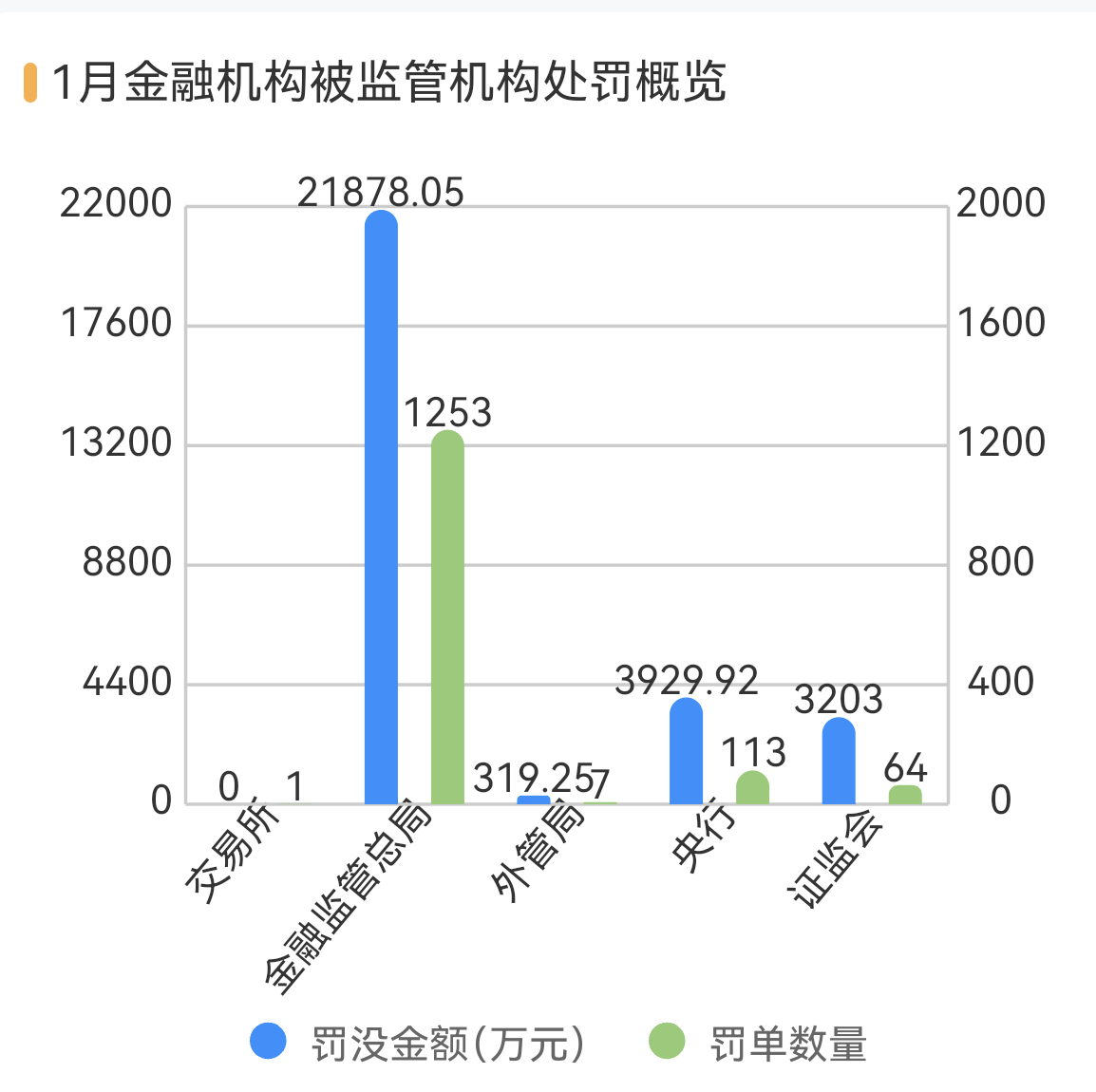
Core Insights - In January, the number of fines imposed on financial institutions increased significantly year-on-year, while the total amount of fines decreased [1][3] Group 1: Overview of Penalties - A total of 1,438 fines were issued to financial institutions in January, representing a year-on-year increase of 54.13%, with a total penalty amount of 29.3 million yuan, down 20.16% from the previous year [1] - The Financial Regulatory Bureau issued 1,253 fines, an increase of 83.19% year-on-year, with a total penalty amount of 21.9 million yuan, up 15.87% [3] - The People's Bank of China issued 113 fines, a decrease of 38.59% year-on-year, while the China Securities Regulatory Commission issued 64 fines, an increase of 18.52% [3] Group 2: Penalties by Financial Institution Type - Banks received 830 fines, an increase of 41.88% year-on-year, with a total penalty amount of 21.4 million yuan, down 25.95% [6] - The insurance sector faced 532 fines, a year-on-year increase of 84.08%, with a slight decrease in total penalty amounts [6] - Securities firms received 12 fines, and futures companies received 9 fines, while private equity firms faced 44 fines [6] Group 3: Major Penalties - Shanghai Riyi Equity Investment Fund Co., Ltd. was fined 14 million yuan for failing to operate investments as per contractual agreements [9] - The actual controller of Shanghai Riyi, Sun, received a fine of 11.9 million yuan for similar violations, including misleading investors about capital safety [9] - Zhejiang Min Tai Commercial Bank was fined 7.15 million yuan for serious violations of prudent management rules [9] Group 4: Compliance Trends - The number of fines related to inflated loan and deposit figures increased 7.5 times month-on-month, with 34 fines issued in January compared to only 4 in December [11] - Misleading sales and promotional practices resulted in 34 fines, doubling from the previous month, primarily affecting insurance companies and banks [12] Group 5: Penalty Rankings - In January, non-bank institutions, particularly insurance companies, dominated the list of penalties, with Shanghai Riyi Equity Investment Fund being the highest fined non-bank entity [17] - China Ping An Property Insurance and China People's Property Insurance ranked second and third in total penalty amounts [17]



威腾电气:拟为参股公司以10%股权为限提供担保
Xin Lang Cai Jing· 2026-02-06 07:46
威腾电气公告称,其全资子公司智慧能源持有中云稷储能10%股权,中云稷储能拟向江苏金租申请融资 租赁业务。公司及智慧能源拟以持有的中云稷储能全部股权为限,为上述业务提供股权质押担保,最高 债权额64952万元,担保有效期为2026年1月-2037年2月。2月5日公司董事会已审议通过该议案,尚需股 东会批准。截至公告披露日,公司对外担保总额15.32亿元(不含本次),占最近一期经审计净资产的 91.97%,无逾期对外担保。 ...

建设金融强国,关注板块投资价值
Shanxi Securities· 2026-02-06 07:25
Investment Rating - The report maintains an investment rating of "Leading the Market - A" for the non-bank financial industry [1][27]. Core Insights - The report emphasizes the importance of building a strong financial nation and highlights the investment value within the sector [1][6]. - It discusses the recent developments in regulatory policies aimed at enhancing the quality of the capital market and increasing the proportion of medium- and long-term funds entering the market [3][7]. - The report notes that certain brokerage firms are expected to achieve steady growth in performance through both external and internal development strategies, including exploring overseas business opportunities [3][7]. Market Performance - During the period from January 26 to February 1, major indices showed mixed performance, with the Shanghai Composite Index declining by 0.44% and the CSI 300 Index increasing by 0.08% [3][8]. - The average daily trading volume in A-shares reached 3.11 trillion yuan, reflecting an increase of 11.27% compared to the previous period [3][8]. - The non-bank financial index rose by 1.04%, ranking 7th among 31 primary industries [8]. Key Data Tracking 1) Market Performance and Scale: The report highlights the top-performing stocks, including Yiyaton (5.94%), Huaxin Shares (4.53%), and Jiangsu Jinzu (3.92%), while noting the worst performers such as Yuexiu Capital (-8.00%) and Zhejiang Dongfang (-6.37%) [9][13]. 2) Credit Business: As of January 30, the market had 2,892.27 million pledged shares, accounting for 3.51% of the total share capital, with a margin balance of 2.72 trillion yuan, reflecting a decrease of 0.30% [13][15]. 3) Fund Issuance: In December 2025, new fund issuance totaled 52.195 billion shares, with a decrease of 1.62% in the number of funds issued [13][16]. 4) Investment Banking: The report states that the equity underwriting scale in December 2025 was 70.318 billion yuan, with IPO amounts at 31.412 billion yuan and refinancing amounts at 38.906 billion yuan [13][16]. 5) Bond Market: The total price index of bonds decreased by 2.22% compared to the beginning of 2025, with the 10-year government bond yield at 1.81%, up by 20.35 basis points [13][16]. Regulatory Policies and Industry Dynamics - The report discusses recent regulatory actions to standardize public fund sales and enhance supervision of fund marketing practices [20]. - It mentions the expansion of strategic investors in the refinancing of listed companies, aimed at facilitating long-term capital entry into the market [20][22].
【头条】江苏金租:聘任江勇为公司总经理兼任首席合规官(附简历)
Xin Lang Cai Jing· 2026-02-05 12:24
Core Viewpoint - Jiang Financial Leasing Co., Ltd. has appointed Mr. Jiang Yong as the new General Manager, pending regulatory approval for his qualifications [1][2] Group 1: Appointment Details - Mr. Jiang Yong's term as General Manager will align with the current board's term, and he will no longer serve as the Deputy General Manager [1][2] - Upon receiving regulatory approval, Mr. Jiang will also take on the role of Chief Compliance Officer [1][2] Group 2: Background of Mr. Jiang Yong - Mr. Jiang Yong was born in October 1985 and is a member of the Communist Party of China, holding a master's degree [1][2] - His career at Jiang Financial Leasing includes roles such as Client Manager and Senior Client Manager from June 2010 to March 2018, Deputy General Manager of the Emerging Industries Division from March 2018 to February 2021, and General Manager of the Clean Energy Division from February 2021 to February 2024 [1][2] - He has also served as Market Supervisor from November 2022 to June 2023, and since June 2023, he has been a Director, Party Committee Member, Deputy General Manager, and Secretary of the Board [1][2]
江苏金租创历史新高
Ge Long Hui· 2026-02-05 06:41
格隆汇2月5日丨江苏金租(600901.SH)涨3.85%,报6.470元,股价创历史新高,总市值374.73亿元。 ...