
歌尔股份

Search documents
奥普特(688686.SH):中标歌尔股份1.2亿元的2026年度2D视觉方案招标项目
Ge Long Hui A P P· 2026-01-13 08:36
Core Viewpoint - The company, Optoelectronics (688686.SH), has recently received a bid notification from GoerTek Inc. for a project related to a 2D visual solution for the year 2026, with a bid amount of 120 million RMB [1] Group 1 - The project won by the company is specifically for the 2026 annual 2D visual solution [1] - The bid amount for the project is set at 120 million RMB, subject to confirmation upon the signing of the formal contract [1]


奥普特:中标歌尔股份2D视觉方案项目,金额1.2亿元
Xin Lang Cai Jing· 2026-01-13 08:22
Core Viewpoint - The company Optoelectronics has received a bid notification from GoerTek for a 2D vision solution project for the year 2026, with a bid amount of 120 million yuan, pending a formal contract [1] Group 1 - The project is expected to have a positive impact on the company's performance in 2026, depending on the contract signing date and performance period [1] - The project will not affect the company's performance in 2025 [1] - There is uncertainty regarding the signing and execution of the contract [1] Group 2 - GoerTek's legal representative is Jiang Bin, and the company has a registered capital of 3.417 billion yuan [1] - There is no related party relationship between Optoelectronics and GoerTek [1]
奥普特:中标歌尔股份2026年度2D视觉方案招标项目
Jin Rong Jie· 2026-01-13 08:21
Core Viewpoint - The company, Optoelectronics (688686.SH), has received a bid notification from GoerTek Inc. for a 2D visual solution project for the year 2026, with a project bid amount of RMB 120 million [1] Summary by Relevant Categories Project Details - The project bid amount is RMB 120 million [1] - The impact on the company's performance for the fiscal year 2025 will be negligible [1] - The performance impact for the fiscal year 2026 will depend on the contract signing date and the fulfillment period of the project [1]
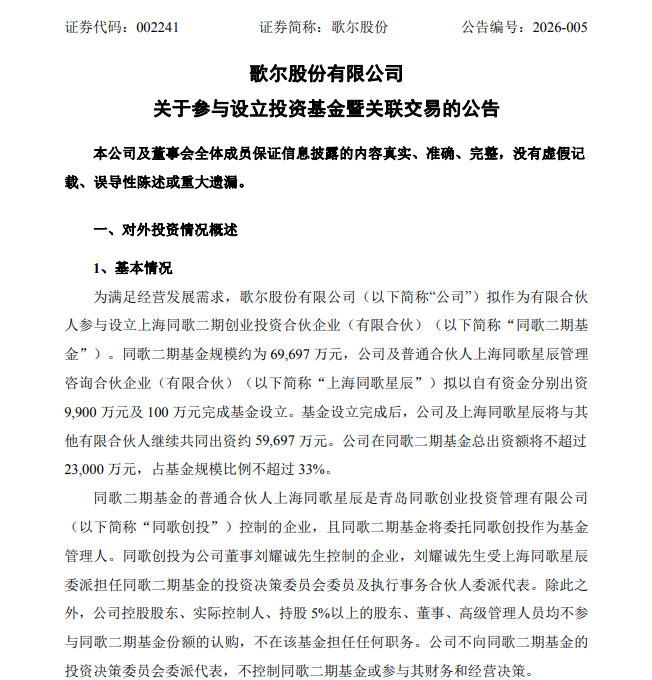
歌尔股份做LP,拟参设6.9亿基金
Sou Hu Cai Jing· 2026-01-13 03:53
Group 1 - The core point of the article is that GoerTek plans to invest in a new venture capital fund, Shanghai Tongge Phase II, with a total scale of approximately 697 million RMB, contributing up to 230 million RMB, which is no more than 33% of the fund's total size [1][6] - The fund will have a duration of 7 years, with the first 4 years designated for investment and the remaining period for exit [4] - The primary investment focus of the fund includes cutting-edge technology sectors such as artificial intelligence, XR and spatial computing, new materials and advanced manufacturing, urban air mobility, and semiconductors [4] Group 2 - GoerTek aims to leverage the management capabilities and resource advantages of professional investment institutions to broaden investment channels and seize market opportunities [6] - The investment will not be included in the company's consolidated financial statements, and it is expected that this investment will not adversely affect the company's operations [6] - GoerTek, established in June 2001 and listed in May 2008, is a globally positioned technology innovation company engaged in the R&D, manufacturing, and sales of precision components and high-end equipment [7]

开源证券:消费电子及元器件 AI终端开启产业链升级新周期
智通财经网· 2026-01-13 02:26
Core Viewpoint - The report from Kaiyuan Securities highlights that by 2026, AI terminals (including Apple, Huawei, AI glasses, and OpenAI hardware) and computing power demand will drive new growth, focusing on opportunities in the upgrade of core components such as optics, batteries, thermal management, and structural processes [1]. Industry Overview - The consumer electronics and components industry is expected to see significant performance improvement in 2025, with the PCB sector leading in growth [2]. - The overall electronic sector is projected to perform strongly, driven by rapid iteration and bulk shipments of AI products, with traditional categories like smartphones and PCs maintaining stable growth while AI glasses and servers exhibit rapid growth [2]. AI Terminals - Investment focus for 2026 includes four main lines: 1. **Apple Supply Chain**: Apple is set to enter a new upgrade cycle starting in 2025, with plans to launch new products including the iPhone 17E and AI glasses, which will enhance AI functionalities [3]. 2. **Huawei HarmonyOS Supply Chain**: Huawei continues to innovate in foldable devices and its HarmonyOS 6 will support various AI capabilities, potentially increasing sales as domestic component sourcing improves [3]. 3. **AI Glasses Supply Chain**: With rising sales of AI glasses led by companies like Meta, this product category is expected to achieve significant sales volumes [3]. 4. **OpenAI Hardware Supply Chain**: OpenAI's entry into hardware aims to create popular native AI devices [3]. Component Upgrades - Key areas for component upgrades include: 1. **Optics**: Enhanced visual perception capabilities in AI terminals require stronger optical hardware, with ongoing upgrades in mobile camera performance [4]. 2. **Batteries and Fast Charging**: New technologies are being applied to meet the higher demands for battery life and charging speed in AI terminals [4]. 3. **Thermal Management**: Increased thermal management challenges are leading to the adoption of advanced cooling solutions in devices [4]. 4. **Structure and Processes**: Upgrades in display technology and manufacturing processes are becoming essential for new consumer electronics [4]. Component Market Outlook - The resonance between AI computing power and AI terminals is expected to sustain an upward cycle for PCBs and passive components: 1. **AI Terminal Side**: The performance upgrades in SoCs and increased integration in smartphones are driving the evolution of PCBs towards higher density and precision [5]. 2. **AI Computing Side**: Continuous iteration of AI chips is increasing the demand for upgraded PCB specifications and quantities, with a shift in power supply architecture in data centers [5]. - Beneficiaries of this trend include companies such as Industrial Fulian, Luxshare Precision, GoerTek, and others [5].

2026市场热点周报1月5日-1月11日
Sou Hu Cai Jing· 2026-01-12 14:10
Global Capital Markets - The global market is characterized by a simultaneous rise in risk appetite and demand for safe-haven assets, with A-shares experiencing a strong start to the year, as the Shanghai Composite Index returns to the 4000-point mark, driven by technology themes [2][3] - The US stock market sees the Dow Jones and S&P 500 indices reaching historical highs, supported by expectations of interest rate cuts and a rally in technology stocks [5][6] A-Share Market - The A-share market shows a strong performance with the ChiNext 50 Index surging nearly 10%, indicating a significant increase in risk appetite among investors [2][3] - The brain-computer interface concept emerges as a major highlight, with related stocks experiencing substantial gains, driven by technological breakthroughs and domestic industry acceleration [3][4] US Stock Market - The US stock market indices collectively rise, with the Dow Jones and S&P 500 achieving record closing highs, driven by expectations of a stable labor market and potential interest rate cuts [5][6] - Technology stocks, particularly semiconductor companies, are at the forefront of this rally, with significant gains observed in major players like Intel and Micron Technology [7] Commodity Markets - The international precious metals market sees significant price increases, with gold and silver prices rising sharply, driven by geopolitical tensions and expectations of liquidity easing [8][9] - Global official gold reserves surpass the value of overseas US Treasury bonds for the first time in 30 years, indicating a shift in the global reserve asset landscape [9][10] Semiconductor Industry - The semiconductor sector experiences a boom, particularly in storage chips, driven by surging demand from AI servers, with significant price increases reported [16][17] - Advanced process technology sees progress, with Qualcomm and Samsung discussing 2nm chip foundry cooperation, marking a new phase in the semiconductor industry's competitive landscape [18] AI Technology and Applications - The CES 2026 showcases significant advancements in AI technology, with major companies like NVIDIA and AMD unveiling new products that enhance AI capabilities [19][20] - Chinese manufacturers actively participate in the AI wearable sector, demonstrating technological strength and innovation, contributing to the global proliferation of AI devices [21][22] Commercial Space Industry - The commercial space sector witnesses intensified competition for frequency resources, with SpaceX receiving approval for additional Starlink satellites and China submitting large-scale satellite applications [23][24] - The rapid development of the space economy is anticipated, with projections indicating that the market could exceed $1 trillion in the coming years [25] Consumer Electronics - Rising storage chip prices are beginning to impact consumer electronics, leading to increased costs for smartphones, PCs, and electric vehicles, prompting companies to adjust their product strategies [26][27] - The smartphone market exhibits signs of "covert price increases," with manufacturers reducing configurations or shrinking discounts to offset rising costs [27][28] Global Market Interconnectivity - The global market shows enhanced interconnectivity, with the performance of the technology sector influencing asset allocation strategies across different markets [29] - The expectation of US Federal Reserve interest rate cuts is becoming a core variable in global asset pricing, affecting capital flows and investment strategies [29][30]


【太平洋科技-每日观点&资讯】(2026-01-13)
远峰电子· 2026-01-12 12:17
Market Overview - Major indices showed positive performance with North Exchange 50 up by 5.35%, Sci-Tech Innovation 50 up by 2.43%, and ChiNext Index up by 1.82% [1] - TMT sector led the gains with SW Marketing Agency increasing by 14.01%, SW Portal Websites by 10.85%, and SW General Publishing by 10.61% [1] - Conversely, TMT sectors that declined included SW Printed Circuit Boards down by 1.82% and SW Discrete Devices down by 0.33% [1] Domestic News - GoerTek plans to establish a fund of 690 million yuan focusing on cutting-edge technology investments including AI, XR, advanced manufacturing, and semiconductors [2] - Huitian Technology announced a breakthrough in high-speed materials and hybrid processing technology, enhancing capabilities in high-end PCB core technology [2] - Shanghai government released a three-year action plan (2026-2028) to support advanced manufacturing, targeting integrated circuit companies for breakthroughs across the entire industry chain [2] - Black Sesame Intelligence raised 568 million HKD, with 90% of the funds allocated for mergers and investments in AI chips and the semiconductor industry [2] Overseas News - MIT team discovered a method to add an extra active device layer in traditional CMOS chips, allowing for a stacked structure that accommodates both logic and storage transistors [3] - The U.S. Department of Commerce quietly announced the withdrawal of a proposal to impose import restrictions on Chinese-made drones, originally set for review in October 2025 [3] - The global smartphone shipment is projected to grow by 2% in 2025, driven by strong demand in emerging markets, although a slowdown is expected in 2026 due to chip shortages [3] - Omdia reported a 10.1% increase in total shipments of desktops, laptops, and workstations in Q4 2025, reaching 75 million units, with an annual growth of 9.2% [3] AI Insights - Gemini partnered with Walmart to enhance customer interaction through AI, providing purchase suggestions based on user intent [4] - AntAngelMed has officially open-sourced a model with 100 billion parameters, applied in various healthcare projects [4] - Tencent released and open-sourced a 3D action model, lowering the barrier for 3D character animation creation [4] - Elon Musk predicted the arrival of general artificial intelligence (AGI) by 2026, with implications for the medical field [4] Industry Tracking - The commercial aerospace sector achieved a successful suborbital flight test with the Zhongke Aerospace Li Hong No.1 vehicle, reaching an altitude of approximately 120 kilometers [5] - In the integrated circuit sector, there is a growing willingness among manufacturers to raise prices due to increased demand and supply constraints [5] - A new generation of ultra-low power brain-machine interface chips was released, significantly improving energy efficiency for long-term implantable systems [5] - The humanoid robot market is expected to see rapid growth, with Omdia projecting shipments to reach 13,000 units by 2025 [5]

端侧AI近况如何-有哪些投资机会
2026-01-12 01:41
Summary of Key Points from the Conference Call Industry Overview: Edge AI Market - **Increased Attention on Edge AI**: Since Apple introduced the Apple Intelligence project in 2024, the market's focus on edge AI has been rising, with advancements in large models and computing power laying the groundwork for AI applications by 2026 [1][2]. - **Maturity of AI Hardware**: Edge AI hardware forms, such as AI glasses and toys, have matured, with wearable devices increasingly capturing consumer interest. At CES 2026, AI interaction features became standard in consumer electronics and home products [1][2]. - **Policy Support**: National subsidy policies now include wearable devices like smartwatches, expected to drive growth by approximately 20% year-on-year. The inclusion of Rokid glasses in a procurement project for the disabled indicates demand stimulation through targeted promotions [1][4]. Key Drivers of Investment Opportunities - **Computing Power Upgrades**: The maturity of technology and models, alongside a competitive arms race in computing facilities, is making conditions for AI application deployment more favorable by 2026 [2]. - **Hardware Iteration**: The current maturity of edge AI hardware, particularly in wearables, is seen as a catalyst for growth. Despite skepticism about blockbuster products in 2025, devices like Rokid AI glasses are gaining traction among consumers [2]. - **Resilience of Edge AI**: In the face of rising storage costs, wearable devices are less affected compared to traditional consumer electronics, which are more vulnerable to cyclical fluctuations. The edge AI market remains in a high-growth phase with significant supply chain premium potential [1][4]. Product Launch and Shipment Forecasts - **AI Glasses Shipment Projections**: Meta anticipates shipping between 20 to 25 million units of AI glasses by 2027, while other brands like Thunder and Roku expect shipments of 300,000 to 500,000 units. Total shipments across all brands are projected to approach 3 million units by 2027, representing significant growth compared to 2025 [3][7]. - **Product Release Schedule**: Meta plans to launch three new products in 2026 and a new brand of AI glasses in 2027. Samsung and Huawei are expected to release new products by the end of Q1 or early Q2 2026, while Xiaomi may iterate its first-generation product this year [5][6]. Investment Recommendations - **Top Investment Picks**: GoerTek is highlighted as a leading company in the AI glasses market, expected to benefit significantly from market growth. Other recommended companies include Luxshare Precision, Lianyi Manufacturing, Lens Technology, Yutong Optical, Changying Precision, and Longqi Technology, all of which have promising market prospects [8]. SOC Sector Insights - **Investment Value of SOC Sector**: The SOC sector is viewed as having high potential due to the anticipated shift from cloud to edge computing over the next two to three years. SOC components represent the highest cost proportion in edge devices, with Chinese A-share SOC companies showing strong market share potential [9]. - **Volume-Price Dynamics**: The SOC sector is driven by new product cycles and flagship product releases, which are expected to enhance average selling prices (ASP). For instance, AI-enabled chips are projected to increase in price from $2 to $4 [10][11]. - **Inventory Adjustments**: Following a chip shortage in late 2021, inventory levels have normalized by early 2024, positively impacting earnings per share (EPS) for companies like Rockchip and Hengxuan, which saw stock prices rise by 30-40% during high inventory periods [12]. Future Outlook for SOC Industry - **Growth Projections**: The period from 2026 to 2027 is expected to see rapid growth in flagship products from leading companies, driven by national subsidy policies and the explosion of new AI products. The current low market expectations for the SOC sector suggest significant upside potential once market conditions improve [13].




科技硬件:CES 2026 _ AI定义端侧硬件,云端硬件革新重构-19页
2026-01-12 01:40
Summary of Key Points from the Conference Call Industry Overview - The conference discussed the 2026 Consumer Electronics Show (CES) where numerous innovative hardware products were showcased, particularly focusing on AI and consumer electronics [3][4][11]. Key Insights on Edge Hardware - AI integration in consumer electronics is rapidly evolving, with AI-enabled edge hardware becoming a central theme at CES 2026. This includes advancements in AI glasses, AI robots, and various innovative "AI + edge hardware" products [4][11]. - AI glasses are becoming lighter and more functional, with products like the XGIMI MemoMind Air Display weighing only 28.9 grams, approaching traditional eyewear weight. The integration of large models enhances translation, recognition, and interaction speed [12][13]. - The application scenarios for AI glasses are expanding, with capabilities for real-time translation and medical applications, which could accelerate hardware sales growth [13]. Key Insights on Cloud Hardware - Nvidia introduced six new chips, including the Rubin GPU and Vera CPU, forming a complete system called Rubin NVL72. This system features significant hardware restructuring in computing cores, PCB, liquid cooling, and storage [5][24]. - The Rubin GPU offers 50 PFLOPS of inference computing power and 35 PFLOPS for training, with a total bandwidth of 22TB/s, significantly enhancing performance compared to previous generations [29][30]. - The new architecture includes a three-tier storage pipeline to address the "memory wall" bottleneck, allowing for efficient data management and access, which is crucial for AI applications [37][42]. Investment Recommendations - For edge hardware, it is recommended to focus on the supply chain related to terminal brands, ODM, optics, structural components, and batteries [6]. - For cloud hardware, attention should be directed towards GPU, storage, cooling, and PCB sectors [6]. Risks Identified - Potential risks include a sluggish macroeconomic environment, slow progress in AI edge technology, and lower-than-expected sales of AI products [7]. Additional Noteworthy Developments - The CES showcased a variety of AI companion robots, highlighting advancements in "active perception" and "scene segmentation" capabilities, indicating a shift towards more practical applications in everyday life [16][17]. - The introduction of AI in wearable technology is expanding, with products like emotion-sensing pendants and brain-machine interfaces being presented, indicating a growing trend in health monitoring and emotional analysis [22][23]. Conclusion - The conference highlighted significant advancements in both edge and cloud hardware, particularly in the context of AI integration. The developments at CES 2026 suggest a robust growth trajectory for the consumer electronics sector, driven by innovative applications of AI technology.
研判2025!全球及中国MR头显行业发展历程、发展现状、出货量、竞争格局及未来发展趋势分析:联接数字与现实,MR头显引领下一代计算平台革命[图]
Chan Ye Xin Xi Wang· 2026-01-12 01:13
Core Insights - The MR headset is emerging as the next-generation computing platform that connects the physical and digital worlds, driven by AI empowerment, supply chain optimization, and ecosystem development by major players [1][10] - Global VR (including MR) headset shipments are expected to reach 9.6 million units in 2024, with a market size exceeding $72.4 billion, supported by both B2B productivity scenarios and B2C entertainment scenarios [1][12] - The Chinese MR market is projected to grow to 4.859 billion yuan in 2024, driven by the demand from Generation Z and independent innovation, with an expected surge to 41.381 billion yuan by 2028, reflecting a compound annual growth rate of over 50% [1][12] Industry Overview - MR (Mixed Reality) headsets integrate optical display, spatial positioning, and multi-modal sensing to achieve deep integration and real-time interaction between virtual content and the real environment, distinguishing it from VR and AR [2][3] - The core functions of MR headsets include real-time seamless integration of virtual and physical environments, supporting multi-modal natural interaction methods such as gesture and eye tracking [3][4] Market Dynamics - The global MR headset market is characterized by a concentrated oligopoly, with Meta, Sony, and Apple holding nearly 90% of the market share, where Meta dominates with a 73% share [13] - In China, the MR headset market is led by domestic giants Huawei and PICO, which together account for over 60% of the market, focusing on different segments such as enterprise and consumer markets [13] Development Trends - The Chinese MR headset industry is expected to advance along three main lines: technological iteration focusing on lightweight and precise interaction, ecological collaboration for a full-link synergy, and expansion of application scenarios [15][16] - Future technological advancements will prioritize user experience, with a focus on reducing device weight and enhancing interaction precision, while domestic supply chains will achieve breakthroughs in core components [15][16] - The market will see a parallel development of B2B high-value applications and B2C consumer scenarios, with manufacturers adopting differentiated positioning to drive market expansion [17]
