百济神州

Search documents
千亿巨头,大举加仓!
Zhong Guo Ji Jin Bao· 2026-02-19 12:11
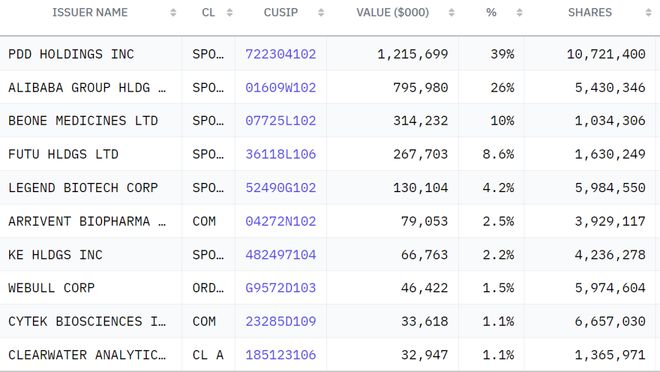
Core Insights - Hillhouse Capital's HHLR Advisors revealed its Q4 2025 holdings, showing a significant portfolio adjustment with a total market value of $3.104 billion, a 24% decrease from the previous quarter [2][3]. Group 1: Portfolio Adjustments - HHLR Advisors increased its positions in Alibaba and Pinduoduo, marking them as core holdings, while also initiating a position in the iShares Bitcoin ETF [2][3][8]. - The top ten holdings include seven Chinese concept stocks, which account for 92% of the portfolio, focusing on internet e-commerce, biomedicine, and fintech sectors [3][6]. Group 2: Major Holdings - Pinduoduo remains the largest holding, with shares increasing from 8.59 million to 10.72 million, raising its market value from $1.136 billion to $1.216 billion, now representing 39% of the portfolio [5][6]. - Alibaba, the second-largest holding, saw its shares rise from 3.289 million to 5.43 million, increasing its market value from $588 million to $796 million, now comprising 26% of the portfolio [5][6]. Group 3: Reductions and Exits - HHLR Advisors significantly reduced its holdings in Futu and Webull, with Futu's shares nearly halved from 3.238 million to 1.63 million, and Webull's shares almost fully liquidated [9][10]. - The firm completely exited positions in Baidu, NetEase, and several other non-core stocks [9][10].


中国创新药产业加速迈向全球价值链核心
Jing Ji Guan Cha Wang· 2026-02-18 03:24
Core Insights - The Chinese innovative pharmaceutical industry is transitioning from "importing and imitating" to "innovating and exporting," enhancing its global influence and authority in the innovative drug sector [1] - In early 2026, the market for outbound licensing transactions in China's innovative drugs continued its strong growth, with the first quarter's transaction amount exceeding $33.28 billion, setting a historical record [1][2] - By 2025, the total value of China's innovative drug license-out transactions reached $140.27 billion, a significant increase from $2.56 billion in 2017, making China the global leader in this sector [2] Transaction Growth - The growth in China's innovative drug licensing transactions is driven by the dual pressures of a "patent cliff" and "innovation demand" in the global pharmaceutical industry [1] - In 2026, the upfront payment scale in just one month approached half of the total for the entire year of 2025, indicating a rapid increase in transaction volume and quality [2] - The structure of transactions is evolving, with a shift from simple rights transfers to deep binding models based on technology platform sharing and global R&D collaboration [2][3] Strategic Partnerships - Notable collaborations include partnerships between Innovent Biologics and Eli Lilly, as well as between 3SBio and Pfizer, showcasing the trend of comprehensive capability partnerships rather than mere product supply [3] - Leading pharmaceutical companies are adopting a dual strategy of "independent R&D + global licensing," creating a sustainable innovation cycle [3] Financial Performance - Over 70% of innovative pharmaceutical companies reported positive revenue growth in 2025, with cash flow from outbound licensing contributing to a virtuous cycle with capital market financing [4] - The evolving payment system in China, which combines basic medical insurance with commercial insurance, supports a stable cash flow from the domestic market while enhancing long-term corporate value through global collaborations [4] Global Impact - The trend of outbound licensing is reshaping cooperation rules and competitive dynamics in the global pharmaceutical industry, with Chinese companies increasingly playing a proactive and critical role [4][6] - The collaboration between companies like Innovent and Takeda exemplifies a mutually beneficial partnership that leverages global channels and local clinical capabilities [4] Market Sentiment - Despite market fluctuations, analysts generally view high-quality innovative pharmaceutical companies as attractive long-term investments, reflecting a dual recognition of explosive innovative potential and structural growth resilience in the Chinese pharmaceutical industry [5] Industry Dynamics - The surge in outbound licensing is prompting local companies to balance "bringing in" and "going out," with the latter gaining prominence and indicating international market recognition of China's innovative drug quality [6] - There is a need for rational and cautious approaches in the face of rising transaction prices and potential market uncertainties, emphasizing the importance of thorough scientific and commercial due diligence [6]

创新药出海开年跑出“加速度”:产业迈入2.0时代
Jing Ji Guan Cha Wang· 2026-02-18 02:45
Core Insights - The Chinese innovative pharmaceutical industry has entered the 2.0 era, shifting from "import imitation" to "innovation output," with new forms like license-out and new co indicating a transformation in internationalization [1] - In the first quarter of 2026, the total transaction amount for Chinese innovative drug licensing (BD) exceeded $33.28 billion, surpassing the highest quarterly level of 2025, marking a shift from a "follower" to a core driver in the global innovation value chain [1][2] - The explosive growth in BD transactions is attributed to multiple factors, including the global pharmaceutical industry's "patent cliff" and "innovation demand," alongside China's recognized R&D efficiency and clinical capabilities [1] Transaction Growth - In 2025, the total value of China's innovative drug license-out transactions reached $140.27 billion, a significant increase from $2.56 billion in 2017, accounting for 49% of global innovative drug licensing transactions, surpassing the U.S. for the first time [2] - In January 2026, the upfront payment scale approached half of the total for 2025, with total transaction amounts reaching 22% of 2025's total [2] - The quality of transactions is also improving, with frequent occurrences of upfront payments exceeding $100 million and 37 transactions exceeding $1 billion, second only to the U.S. [2] Transaction Structure - The upgrade in transaction structure is a core feature of China's innovative drug internationalization, with traditional "selling seedlings" models being replaced by "technology platform output" and "global R&D collaboration" [2][3] - Notable collaborations include Innovent Biologics and Eli Lilly, where the partnership is based on a new molecule, demonstrating deep trust in China's R&D capabilities [2] Strategic Transformation - Leading pharmaceutical companies are adopting a dual strategy of "independent R&D + global licensing," creating a sustainable innovation ecosystem [3] - Examples include BeiGene's revenue surpassing 36 billion yuan in 2025, showcasing strong commercialization capabilities, and other companies achieving breakeven for the first time [3] Financial Performance - Over 70% of innovative pharmaceutical companies achieved revenue growth in 2025, with cash flow from BD transactions and IPO funding providing substantial resources for the industry [4] - The combination of domestic market cash flow and global licensing is creating a dual-driven model that reduces financial risks and accelerates the conversion of innovative results [4] Industry Ecosystem - The internationalization of innovative drugs is reshaping the global pharmaceutical landscape, with predictions of the emergence of global Chinese pharmaceutical giants [4] - Collaborations like that between Innovent Biologics and Takeda illustrate the strategic partnerships that enhance project advancement efficiency [4] Investment Trends - The innovative drug sector has seen a correction over the past two quarters, but long-term prospects for quality targets remain favorable, suggesting increased allocation [5] - The "dumbbell strategy" proposed by CICC highlights the dual characteristics of "innovation output" and "steady growth" in the Chinese innovative drug industry [5][6] Market Dynamics - An increasing number of Chinese innovative pharmaceutical companies are transitioning from "license-in" to proactive "license-out," achieving record high transaction amounts and gaining recognition in international markets [6] - Horizontal cooperation and integration among domestic pharmaceutical companies are accelerating to optimize resource allocation and address market competition and regulatory challenges [6]
高瓴四季度持仓曝光:加仓拼多多、阿里,组合集中度再升
Hua Er Jie Jian Wen· 2026-02-18 00:32
13F报告显示,高瓴旗下专注二级市场投资的基金管理平台HHLR Advisors四季度继续重仓中概股,核心仓位仍集中在拼多多、阿里巴巴等互联网与生物医 药公司。 根据最新披露文件,截至2025年12月31日,HHLR美股持仓总市值约31.04亿美元,较三季度末的40.91亿美元明显下降,持仓数量仍为33只,显示出在整体 仓位上有所收缩,同时继续向少数核心标的集中。 从结构来看,拼多多依然稳居第一大重仓股,阿里巴巴维持第二大重仓地位,百济神州(BeOne Medicines)和富途控股等仍位居前列,组合集中度进一步 提升。核心重仓继续集中,拼多多与阿里巴巴权重上升 四季度最核心的变化仍然发生在电商龙头上。 数据显示,HHLR继续增持拼多多,持股由三季度的859万股增至1072万股,持仓市值由11.36亿美元升至12.16亿美元,占投资组合比例由28%升至39%,第 一大重仓股地位进一步巩固。 与此同时,阿里巴巴也获得明显加仓。持股由328.9万股增至543万股,持仓市值由5.88亿美元升至7.96亿美元,占组合比例升至26%,继续位居第二大重仓 股。 此外,三季度仍位列前十大持仓的网易,以及三季度新建仓的百度、 ...

智通ADR统计 | 2月18日
智通财经网· 2026-02-17 23:17
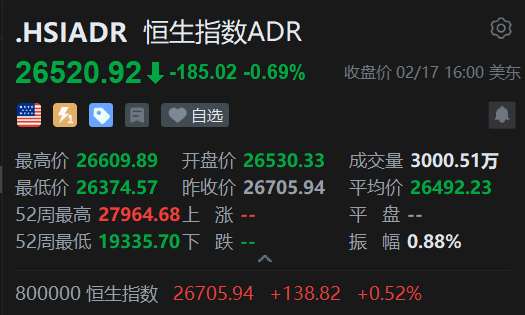
大型蓝筹股涨跌不一,汇丰控股收报135.316港元,较香港收市涨0.83%;腾讯控股收报530.511港元,较香港收市跌0.47%。 | 序号 | 名称 | 港股代码 | 最新价 | 涨跌额 | 涨跌幅 | ADR代码 | ADR换算价(I | | --- | --- | --- | --- | --- | --- | --- | --- | | 1 | 腾讯控股 | O 00700 | 533.000 | +1.000 | 0.19% | TCEHY | 530 | | 2 | 阿里巴-W | 09988 | 154.700 | -0.700 | -0.45% | BABA | 151 | | 3 | 汇丰控股 | 00005 | 134.200 | -1.500 | -1.11% | HSBC | 135 | | 4 | 建设银行 | 00939 | 8.010 | +0.050 | 0.63% | CICHY | 7 | | 5 | 小米集团-W | 01810 | 36.660 | -0.180 | -0.49% | XIACY | 36 | | 6 | 友邦保险 | 01299 | 82.350 | ...
Prediction: These 3 Stocks Will Crush the Market in 2026
Yahoo Finance· 2026-02-16 18:05
I'll readily admit that I don't know how the stock market will perform in 2026. It could continue to climb. On the other hand, the momentum from last year could evaporate. However, I think the individual stocks that outperform the S&P 500 (SNPINDEX: ^GSPC) this year will be those with key catalysts. With that in mind, I predict that three stocks will crush the market in 2026. Will AI create the world's first trillionaire? Our team just released a report on the one little-known company, called an "Indispen ...

中国创新药出海交易额暴涨10倍破千亿美元!信达生物88.5亿美元合作震撼全球
Jin Rong Jie· 2026-02-16 13:56
Core Insights - The IBI EXPO 2026 Biopharmaceutical Innovation Conference will provide a high-level platform for communication and collaboration in the innovative drug industry [1] - Recent favorable news in the innovative drug sector includes a significant increase in licensing agreements, with Chinese companies signing $137.7 billion in deals in 2025, nearly a tenfold increase from 2021 [1][2] - The trend of Chinese biopharmaceutical companies entering international licensing agreements is accelerating, with major collaborations such as the $8.85 billion deal between Innovent Biologics and Eli Lilly [1][5] Market Focus - The IBI EXPO 2026 conference serves as a catalyst for the innovative drug sector, highlighting the substantial growth in licensing agreements and the transition from research investment to commercial realization [2] - The number of licensing agreements reached 186 in 2025, with a total transaction value of $137.7 billion, marking a record high for the past decade [3][5] - Companies like Innovent Biologics and Rongchang Biopharma are transitioning from loss to profit, indicating a clear improvement in the overall profitability of the industry [2][3] Broker Insights - Open Source Securities notes that the period from 2017 to 2026 is a "golden decade" for Chinese pharmaceutical companies, with licensing agreements skyrocketing from $2.562 billion in 2017 to $137.7 billion in 2025 [3] - The overall revenue growth in innovative drugs is evident, with over 70% of companies reporting positive revenue growth in 2025, showcasing strong commercial capabilities [3] - The innovative drug sector has seen a price correction over the past two quarters, but long-term prospects remain positive, suggesting an increase in sector allocation [3] Related Industries - The innovative drug sector is transitioning from a research investment phase to a commercialization phase, with significant implications for the CXO (Contract Research Organization) industry, which is expected to benefit from increased orders [5] - The new business model of external licensing is expected to enhance the early-stage research pipeline, benefiting companies involved in drug discovery and clinical trials [4][5] - The trend of Chinese innovative drugs "going global" is becoming systematic, with major collaborations indicating a shift towards international development [5] Industry Chain Companies - Heng Rui Medicine is a representative company in the domestic chemical innovative drug sector, with a diverse pipeline and ongoing internationalization efforts [7] - Sanofi Biopharma has received approval for its self-developed monoclonal antibody, further enriching its commercial product pipeline [7] - Companies like Rongchang Biopharma and Ailis are demonstrating strong revenue growth and successful international collaborations, indicating a positive trend in the innovative drug sector [7][8]


大华继显:AI创新及国策推动内地互联网医疗领域 看好阿里健康(00241)及平安好医生
Xin Lang Cai Jing· 2026-02-16 01:30
Group 1 - The mainland internet healthcare sector is entering a new phase driven by tech giants accelerating AI innovation and government policy support, such as the online initial diagnosis pilot program launched in Beijing [1] - Despite challenges in profitability, leading companies are leveraging AI ecosystems and innovative strategies for long-term sustainable growth [1] Group 2 - The company maintains a "Buy" rating for Alibaba Health (00241) with a target price of HKD 7.8, expecting a compound annual growth rate (CAGR) of 13% in revenue and 24% in adjusted net profit from FY2026 to FY2028, driven by growth in innovative drugs and healthcare products, deepening synergy with Alibaba Group (09988), and increasing AI application [1] - The company also favors Ping An Good Doctor (01833) with a "Buy" rating and a target price of HKD 20, anticipating a CAGR of 16% in revenue and 56% in adjusted net profit from FY2025 to FY2027, supported by deepening synergy with Ping An Insurance (02318) and ongoing AI empowerment [1] Group 3 - The company maintains an "Overweight" rating for the mainland healthcare sector, preferring leading innovative pharmaceutical companies and contract research, development, and manufacturing organizations (CRDMOs) [2] - The company is optimistic about internet healthcare firms that effectively utilize real-world data to optimize AI algorithms and enhance service quality [2] - Preferred stocks include BeiGene (06160), Innovent Biologics (01801), Hansoh Pharmaceutical (03692), China Biologic Products (01177), Hutchison China MediTech (00013), WuXi Biologics (02269), WuXi AppTec (02359), and Alibaba Health [2]

大华继显:AI创新及国策推动内地互联网医疗领域 看好阿里健康(00241)及平安好医生(01833)
Zhi Tong Cai Jing· 2026-02-16 01:25
Group 1 - The mainland internet healthcare sector is entering a new phase driven by tech giants accelerating AI innovation and government policy support, such as the online initial diagnosis pilot program launched in Beijing [1] - Despite challenges in profitability, leading companies are leveraging AI ecosystems and innovative strategies for long-term sustainable growth [1] - Alibaba Health (00241) is favored with a "Buy" rating and a target price of HKD 7.8, with expected revenue and adjusted net profit CAGR of 13% and 24% from FY2026 to FY2028, driven by innovative drugs, healthcare product growth, and deepening synergies with Alibaba [1] Group 2 - Ping An Good Doctor (01833) is also favored with a "Buy" rating and a target price of HKD 20, with expected revenue and adjusted net profit CAGR of 16% and 56% from FY2025 to FY2027, supported by synergies with Ping An (02318) and ongoing AI empowerment [1] - The firm maintains an "Overweight" rating on the mainland healthcare sector, preferring leading innovative pharmaceutical companies and contract research, development, and manufacturing organizations (CRDMOs) [2] - Companies that effectively utilize real-world data to optimize AI algorithms and enhance service quality in internet healthcare are also favored, with preferred stocks including BeiGene (06160), Innovent Biologics (01801), Hansoh Pharmaceutical (03692), China Biologic Products (01177), Hutchison China MediTech (00013), WuXi Biologics (02269), WuXi AppTec (02359), and Alibaba Health [2]
青蒿素之后,又一款从源头创新的救命药在中国诞生
经济观察报· 2026-02-15 09:33
在成立第11个年头,他们交出了第一份答卷——一款"从头到 尾"中国原创的新药。和路径清晰的仿制药、跟随式创新药物 不同,这种从发现病毒感染机制、作用靶点到药物研发的完全 创新,在中国制药史上是罕有的。 作者:张铃 封图:华辉安健官网 2026年1月23日,深夜11点,李文辉和隋建华走进一家西北餐厅,两碗炒面,是这对科学家夫妻 的晚餐,也是他们的庆功宴。 李文辉是病毒学家,隋建华是抗体工程专家,他们同为北京生命科学研究所(下称"北生所")研 究员、华辉安健联合创始人。吃这顿特别晚餐那天,是他们最重要作品诞生的日子。经过十余年共 同研究,全球病毒性肝炎领域第一款单抗药物立贝韦塔单抗注射液(下称"立贝韦塔")获批上 市。 下午5点半,国家药监局披露立贝韦塔获批的消息,这之后,夫妻俩做的第一件事就是挨个回复国 内外传来的祝贺,直到深夜。李文辉是兰州人,他原本想带隋建华吃碗牛肉拉面,但赶到餐厅时, 最后一锅汤已经被收起来了。第二天,他们没有像往常周末那样早早出门工作,而是继续在家给一 路上支持过立贝韦塔的同道们发感谢信,那是他们罕见的"偷懒"时刻。 "感谢了那么多人,其实,我最想感谢的是这个时代。"隋建华说。 隋建华回 ...