
中国人寿

Search documents
来自华尔街的测算:“存款迁移”只有1万亿,而非10万亿,但对保险和A股仍然“意义重大”
Hua Er Jie Jian Wen· 2026-02-11 03:08
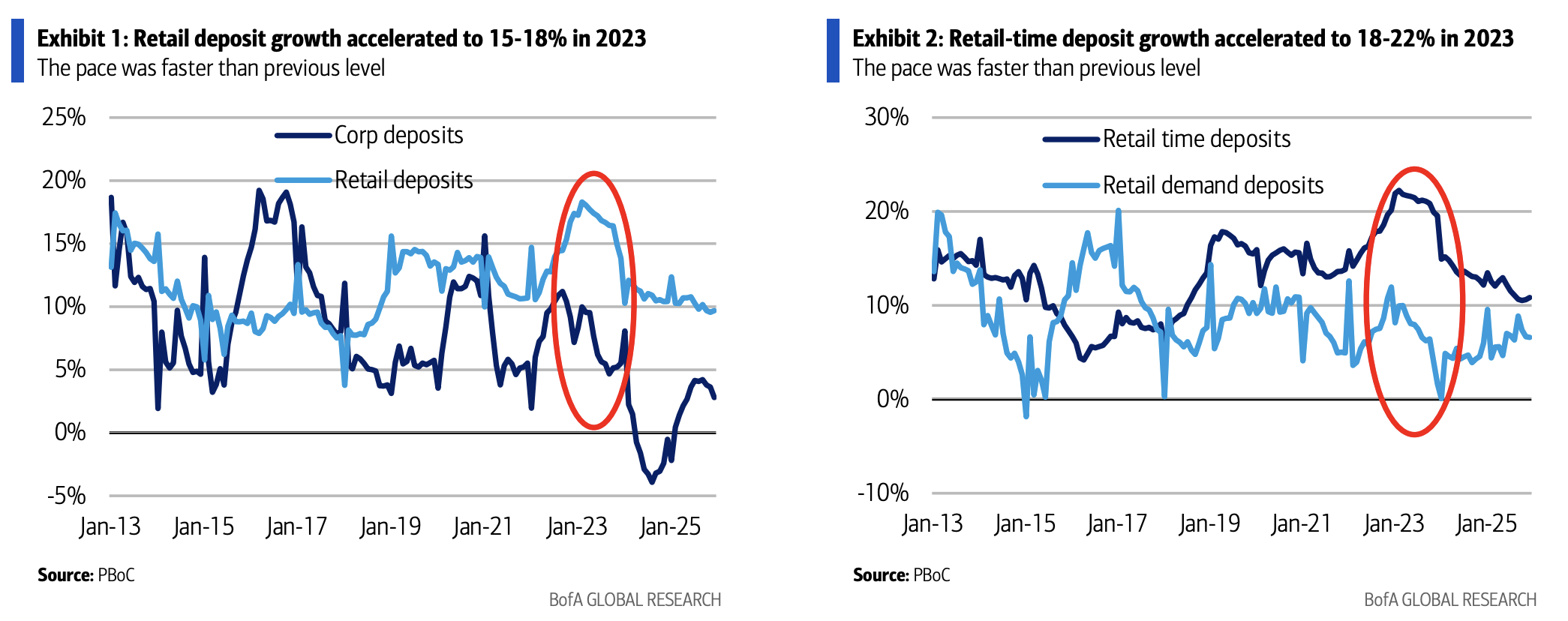
存款"搬家"从2025年中开始成了市场绕不开的话题:大额定存到期,会不会突然从银行体系流向股市、保险、甚至地产和消费?关于到期规模的传言从10万 亿一路飙到70万亿,背后期待的其实是"更快的资金再配置",足以改写不同资产的供需和定价。 据追风交易台,美国银行全球研究部分析师Michael Li在最新报告里把这个预期往回拉了一截,估计存款搬家规模约1万亿元,而不是10万亿元或更高。存款 外流确实在发生,但节奏和体量更像"渐进式",短期很难看到想象中的洪水。 美银表示,居民定存增速从过去常态的14%-16%抬升到18%-22%,累积出约4-5万亿元的"超额"定存,并将在未来逐步到期。问题在于,到期不等于迁徙。 70%-80%仍会留在银行体系(再定存、转活期、偿还按揭等),用于消费的比例不超过10%,真正流向"非存款资产"的规模大约1万亿元。 报告给了两个最直接的落点:一是保险,如果其中5000亿元流向保险,足以让寿险销售端出现"看得见的"弹性;二是A股,哪怕相对>100万亿元市值、日均 2.5-3.0万亿元成交看起来不大,但它是额外增量,还可能通过两融等杠杆放大对成交和情绪的影响。要检验这条链条是否真的在走,报告 ...

未知机构:国盛非银王维逸全力巩固资本市场稳中向好全面看好非银板块资金-20260211
未知机构· 2026-02-11 02:25
Summary of Conference Call Notes Industry Overview - The focus is on the non-bank financial sector, particularly the insurance and brokerage industries, with a positive outlook on the capital market's stability and growth potential [1][2]. Key Points and Arguments 1. **Policy Support**: The chairman, Wu Qing, emphasized the commitment to consolidating the positive momentum in the capital market [3]. 2. **Market Stability**: The trading pressure is easing, enhancing the market's inherent stability and preventing significant fluctuations. The previous disruptions faced by brokerage and insurance sectors are being resolved, leading to a more stable market environment [3]. 3. **Market Performance**: - In 2026, the A-share market's daily trading volume reached nearly 30 trillion yuan, a 73% increase compared to 2025. - In January 2026, there were 4.92 million new A-share accounts opened, reflecting a month-on-month increase of 89% and a year-on-year increase of 213% [3]. 4. **Non-Bank Sector Outlook**: The non-bank financial sector is expected to perform well, with insurance showing improved profitability and a new cycle of growth established [3]. 5. **Asset Side**: Stable long-term interest rates and a favorable capital market environment are expected to enhance performance flexibility in the investment sector [4]. 6. **Liability Side**: The "opening red" (a term for the first sales of the year) sets a positive tone for new business throughout the year, with the insurance sector benefiting from the trend of bank deposits moving to insurance products, which are seen as a safe financial alternative [4]. 7. **Brokerage Sector**: - In a slow bull market, there is a significant mismatch between fundamentals and valuations, presenting high cost-performance ratios for investments. - Listed brokerages that have released earnings forecasts show a year-on-year net profit growth of approximately 60%. Leading brokerages are experiencing steady growth, while some smaller firms are showing notable performance elasticity [6]. - The overall price-to-book (PB) ratio for the brokerage industry is only 1.36 times, indicating a significant lag in valuation compared to fundamentals, suggesting a high cost-performance ratio at current levels [6]. Recommendations - Suggested companies to focus on include China Ping An, China Life, New China Life, and Guotai Junan [7]. Risk Factors 1. Significant fluctuations in the equity market could impact net profits. 2. Policy implementation may not meet expectations. 3. The growth rate of new business value (NBV) in the life insurance sector may fall short of expectations. 4. Risks associated with interest rate declines beyond expectations could lead to margin loss [8].
险资购金试点一周年:配置克制 显“耐心资本”本色
Bei Jing Shang Bao· 2026-02-11 01:55
Core Insights - The insurance funds have cautiously entered the gold market, contrary to expectations of aggressive investment, reflecting a prudent approach amid market volatility [1][3][5] - The pilot program for insurance funds to invest in gold has been operational for a year, with ten insurance companies approved, but only six have completed membership with the Shanghai Gold Exchange [1][2][3] Group 1: Pilot Program Overview - The pilot program was officially launched on February 7, 2025, allowing ten insurance companies, including major players like China Life and PICC, to invest in gold [2][4] - By March 2025, several insurance companies completed their first transactions, indicating initial engagement with the gold market [2][3] Group 2: Investment Strategy and Caution - Despite the theoretical investment limit of nearly 200 billion yuan, actual investments remain low, with many companies still in a trial phase [3][5] - The cautious approach is attributed to the volatile nature of gold prices and the lack of experience among insurance companies in gold investment [5][7] Group 3: Challenges and Professional Barriers - Insurance companies face challenges due to the complex nature of gold as an asset, which requires sophisticated analysis and risk management capabilities [5][6] - Regulatory requirements mandate that insurance companies maintain strict internal controls and reporting mechanisms, adding to the operational complexity [6] Group 4: Long-term Perspectives - Long-term, gold is being recognized for its strategic value in diversifying portfolios and mitigating risks, especially in uncertain market conditions [7][8] - The shift towards gold investment is seen as a response to the limitations of traditional fixed-income assets, prompting insurance companies to explore new avenues for asset growth [7][9]



强投资 推数智 优服务
Jin Rong Shi Bao· 2026-02-11 01:32
Core Viewpoint - The life insurance industry is at a critical stage of value transformation and service model upgrade in 2026, facing both challenges and opportunities due to new accounting standards, complex market environments, and deepening population aging [1] Group 1: Asset-Liability Management and Investment Capability - Strengthening asset-liability management and enhancing investment capabilities are crucial for life insurance companies to establish a solid foundation for stable operations in 2026 [2] - Companies are focusing on a collaborative development model of "insurance + investment + service" to enhance their competitive edge and build a robust investment foundation [2] - Emphasis on innovation in insurance product service models to alleviate interest spread risk and enhance the supply of pension annuities and long-term care insurance [3] Group 2: Digital Transformation - The life insurance industry is advancing from initial exploration to large-scale application of digital transformation, integrating AI, big data, and cloud computing to enhance operational efficiency and create differentiated competition [5] - Companies are prioritizing digital transformation as a key strategy for high-quality development, with specific goals set for 2026 [5][6] Group 3: Customer-Centric Approach - The industry is shifting from scale-driven to value-driven growth, with a focus on upgrading channels and improving service quality to meet diverse consumer demands [7] - Companies are implementing new marketing models centered around customer needs and enhancing their sales teams to adapt to business transformations [7] - Emphasis on improving service quality through the integration of medical, health, and care services, aiming to enrich service offerings and enhance customer experience [8]

保就业 保健康 保底线
Jin Rong Shi Bao· 2026-02-11 01:21
Core Viewpoint - The article highlights the urgent need for insurance solutions tailored to the unique challenges faced by rural populations in Guangxi, particularly in the context of labor migration and economic stability [1][2]. Group 1: Insurance Solutions - A comprehensive insurance scheme has been developed, focusing on "employment protection, health coverage, and basic safety net" to support rural workers [2]. - The scheme includes personal accident insurance for employment, providing compensation for death or disability due to accidents for rural laborers [2]. - A supplementary medical insurance called "Chonghui Bao" is promoted to protect low-income families from falling back into poverty due to health issues [2]. Group 2: Product Development - China Life Insurance has diversified its insurance offerings to meet the varied needs of the agricultural population, launching 23 products under the "Rural Revitalization" series, which includes life, critical illness, medical, and accident insurance [2]. - The "Rural Safety Treasure" series specifically addresses risks associated with operating agricultural machinery, providing targeted coverage [2]. Group 3: Impact and Reach - In 2025, China Life Insurance covered 227 million rural individuals, with a total insurance amount exceeding 27 trillion yuan, and compensated over 1.58 billion yuan to 4.54 million individuals [3]. - The company aims to act as an economic stabilizer and social safety net, contributing to the stability and prosperity of rural areas and improving farmers' livelihoods [3].
回调后建议积极配置,持续关注板块绩优个股
Changjiang Securities· 2026-02-11 01:05
Investment Rating - The report maintains a "Positive" investment rating for the non-bank financial sector [11] Core Insights - The non-bank sector has shown weak overall performance this week, with a recommendation to seize allocation opportunities in the brokerage sector despite a market trading decline. The insurance sector is expected to see improved long-term return on equity (ROE) and valuation recovery, suggesting a positive allocation strategy [2][4] - The report continues to recommend companies with stable profit growth and dividend rates, including Jiangsu Jinzhong, China Ping An, and China Pacific Insurance, highlighting their strong market positions [4] - Additional recommendations include New China Life, China Life, Hong Kong Stock Exchange, CITIC Securities, Dongfang Caifu, Tonghuashun, and Jiufang Zhitu Holdings based on performance elasticity and valuation [4] Industry Performance - The non-bank financial index decreased by 0.6% this week, with a year-to-date decline of 1.1%, ranking 29th out of 31 sectors. The market's trading activity has decreased, with an average daily turnover of 24,066.54 billion yuan, down 21.43% week-on-week [5][15] - The insurance sector saw a year-on-year premium income increase of 7.43% in December 2025, with property insurance and life insurance revenues growing by 3.92% and 8.91%, respectively [18][19] - The report notes a recovery in the stock financing scale in January 2026, with equity financing reaching 134.86 billion yuan, up 103.4% month-on-month, while bond financing decreased by 15.6% [46] Key Industry News - The Hong Kong Monetary Authority released the "Management Measures for Bank Insurance Institution Licenses" to enhance regulatory compliance [59] - The People's Bank of China and other departments issued a notice to further prevent and manage risks related to virtual currencies [60] Company Announcements - CITIC Securities announced a cash dividend distribution of 0.29 yuan per share, totaling 4.298 billion yuan [63] - Red Tower Securities reported a share buyback of 16.03 million shares, accounting for 0.34% of total shares, with a total expenditure of 140 million yuan [62] - Huatai Securities plans to issue H-share convertible bonds totaling 10 billion HKD, with an initial conversion price of 19.7 HKD per share [68]

四大证券报精华摘要:2月11日
Xin Hua Cai Jing· 2026-02-11 00:55
Group 1: Insurance and Investment - Insurance capital is increasingly participating in private equity funds, with companies like Tianjin Lanqin Equity Investment Partnership being established and major insurers like Taikang Life involved as partners [1] - Since 2026, leading insurers such as China Life and Xinhua Insurance have launched new projects in private equity, driven by a policy environment encouraging long-term investments [1] - The need for asset-liability matching in a low-interest-rate environment is pushing insurers to seek private equity investments to enhance long-term returns [1] Group 2: Market Trends and Investor Sentiment - Over 60% of private equity firms plan to heavily invest in A-shares as the Spring Festival approaches, with an average estimated position of 75.68% during the holiday [2] - Public funds are increasingly accumulating positions in the consumer sector, with notable fund managers investing significantly in leading pet companies, indicating a rebound in consumer stocks [3] Group 3: Bond Market Developments - The yield on 10-year government bonds has fallen below 1.8%, indicating a return of the bond market's safe-haven attributes amid improved liquidity and insurance capital allocation [4] - The bond market is experiencing a structural recovery, with differing opinions on the potential for further interest rate declines [4] Group 4: Private Equity Growth - The number of private equity firms managing over 10 billion yuan has reached a record high of 122, with 10 new firms entering this category since December 2025 [5] Group 5: Monetary Policy and Financing - The People's Bank of China emphasizes the continued implementation of a moderately loose monetary policy, utilizing various tools to maintain liquidity and favorable financing conditions [6] Group 6: Corporate Financing and Regulations - New refinancing regulations have been introduced to support quality listed companies and enhance the flexibility of financing for technology innovation enterprises [7] - Many listed companies are actively exploring refinancing opportunities to strengthen their core competitiveness [7] Group 7: Local Government Debt Management - Local governments are making significant progress in clearing hidden debts, with at least 34 cities reporting advancements in their debt clearance tasks since 2026 [8] Group 8: IPO Market Improvements - The quality of IPO applications in the A-share market has improved significantly, with stricter regulations leading to better compliance and transparency among applicants [9] Group 9: Robotics Industry Developments - The humanoid robotics sector is accelerating its capital market activities, with several companies initiating IPO processes as the industry transitions from technology validation to commercialization [10] Group 10: Housing Market Policies - Various cities, including Chongqing, are implementing policies to stimulate housing consumption, such as providing subsidies and enhancing loan support for homebuyers [11] Group 11: Telecommunications Infrastructure - The Ministry of Industry and Information Technology has set a timeline for enhancing low-altitude communication networks, with major telecom companies actively preparing for this development [12][13]
长钱拓展长投路径 险资积极参与私募股权基金
Zhong Guo Zheng Quan Bao· 2026-02-10 20:29
Core Insights - The establishment of private equity funds by insurance companies is increasing, driven by policy encouragement and the need for asset-liability matching in a low-interest-rate environment [1][4][5] Group 1: Recent Developments - Tianjin Lanqin Equity Investment Partnership was recently established with a total investment of 8.601 billion, involving several insurance companies including Taikang Life and China Life [2] - The Huizhi Yangtze River Delta Private Fund Partnership, also established recently, has China Life as its largest partner with an investment of 4 billion [2] - The Taibao War New M&A Private Fund, with a target size of 30 billion, is focusing on key areas of state-owned enterprise reform and modern industrial system construction in Shanghai [3] Group 2: Policy and Market Trends - Policies supporting insurance capital participation in private equity investments have been introduced, promoting long-term capital investment in strategic sectors like integrated circuits and biomedicine [4] - The trend of insurance capital increasing its allocation to private equity funds reflects a shift in asset allocation needs, particularly in response to a declining interest rate environment [4][5] Group 3: Investment Strategy and Focus - Private equity funds are characterized by long investment cycles and high return potential, making them attractive for insurance companies seeking to enhance their yield [6] - Insurance companies are expected to broaden their investment fields within private equity, focusing on hard technology and industries related to public welfare, while enhancing their research capabilities [7] - Companies are emphasizing the importance of investing in high-quality technology enterprises and aligning with national strategies to provide stable funding for innovation and production [7]

购金试点周年 险资克制入场
Bei Jing Shang Bao· 2026-02-10 16:54
Core Viewpoint - The cautious approach of insurance funds in the gold market reflects a combination of risk awareness and a lack of professional capability, despite the theoretical potential for significant investment [1][5][7]. Group 1: Policy and Market Entry - The pilot program for insurance funds to invest in gold was officially launched on February 7, 2025, with ten insurance companies approved to participate [1][4]. - By March 2025, several major insurance companies, including China Life and PICC Property and Casualty, completed their first gold transactions, marking a significant step in the integration of gold into their investment strategies [2][3]. Group 2: Investment Strategy and Caution - Despite the opening of the investment channel, insurance companies have been cautious, with many reporting low gold investment ratios, indicating a trial phase rather than aggressive investment [3][5]. - The theoretical investment cap for the ten pilot companies is nearly 200 billion, but actual allocations remain low, reflecting a careful approach amid market volatility [5][8]. Group 3: Challenges and Professional Barriers - The complexity of gold as an asset, including its price volatility and the need for sophisticated analysis, poses significant challenges for insurance companies lacking experience in precious metals investment [5][6]. - Regulatory requirements mandate that insurance companies maintain strict internal controls and risk management practices, adding to the operational challenges [6]. Group 4: Long-term Perspectives - From a long-term perspective, gold is being recognized for its strategic value in diversifying risk and enhancing portfolio resilience, especially in uncertain global market conditions [7][8]. - The shift towards including gold in investment portfolios is seen as a response to the limitations of traditional fixed-income assets, which have been under pressure due to low interest rates [7][8].
险资购金试点一周年:配置克制 显“耐心资本”本色
Bei Jing Shang Bao· 2026-02-10 16:05
政策闸门开启一年后,曾被认为将汹涌入市的近2000亿元保险资金,在黄金市场的巨浪前展现出了怎样 的配置策略?2月10日,北京商报记者了解到,保险资金投资黄金业务试点已开展一周年,获批开展试 点的10家保险公司中,6家完成了上海黄金交易所的入会手续,真正迈入了直接投资的大门。更为关键 的是,即便已经入场的机构,其落下的棋子也极为审慎,与市场一度期待的"长期重量级买家"形象相去 甚远。 一边是理论上的广阔投资空间,另一边是实际运作中的克制。在刚刚经历了历史性高位与剧烈震荡的黄 金市场面前,保险资金这番选择背后,究竟是基于对后市风险的警惕,还是暴露出其作为"市场新兵"在 专业能力与内部机制上的短板? 试点周年:克制入场 2025年2月7日,国家金融监督管理总局发布《关于开展保险资金投资黄金业务试点的通知》(以下简称 《通知》),正式批准包括人保财险在内的10家保险公司开展黄金投资业务试点。 尽管黄金投资闸门已经打开一年,北京商报记者了解到,保险资金并未在一路疯涨中"追高",对黄金的 投资较为审慎,更多处于试水阶段。 回顾来看,政策落地后,首批试点机构迅速响应,纷纷完成入会流程并落地首笔交易。2025年3月,中 国人 ...