
大唐新能源

Search documents
如何解读国资委要求反内卷、稳电价?
2025-09-28 14:57
Summary of Conference Call on Power Industry Policies Industry Overview - The conference call discusses the power industry in China, focusing on the implications of the State-owned Assets Supervision and Administration Commission (SASAC) policies aimed at stabilizing coal and electricity prices to prevent vicious competition and ensure healthy industry development [1][2]. Key Points and Arguments 1. **Stabilization Policies**: SASAC's policies are designed to stabilize coal and electricity prices, alleviating concerns about the profitability of thermal power companies [1][3]. 2. **Shift in Business Model**: The thermal power business model is transitioning from relying on coal-electricity price differences to providing regulation and capacity services, with capacity pricing being a key factor [1][4]. 3. **Focus on Market Value**: SASAC's assessment criteria have shifted from profit margin growth to market value management and dividends, encouraging thermal power companies to diversify income sources and stabilize electricity prices for profit growth and shareholder returns [1][2][8]. 4. **Capacity Pricing Policy**: The capacity pricing policy is crucial for the next five years of power reform, correcting the over-reliance on generation volume and enhancing the competitiveness and predictability of thermal power [1][11]. 5. **Impact on Different Power Sources**: The stabilization policies benefit all types of power sources, with thermal power being the most directly affected as it anchors electricity prices in China [1][12][13]. Important but Overlooked Content 1. **Future Capacity Pricing Changes**: By 2026, the national rural grid capacity price will increase from 100 yuan to at least 165 yuan per kilowatt per year, enhancing the profitability and competitiveness of thermal power [1][7]. 2. **Market Performance**: The performance of thermal power in the capital market has been lackluster due to its cyclical pricing model, but recent policy changes and shareholder return measures are transforming it into a dividend-generating asset [1][10]. 3. **Investment Opportunities**: Investors are encouraged to focus on thermal power companies benefiting from policy support, such as China Resources Power and Datang International Power Generation, as well as hydropower and nuclear power companies like China Three Gorges Corporation [2][14][15]. Conclusion - The SASAC's introduction of the anti-involution framework into the energy sector marks a significant shift, providing opportunities for various power generation companies and enhancing the overall competitiveness of the industry [2][14].
险资扫货!举牌“大户”长城人寿瞄准新天绿能
Guo Ji Jin Rong Bao· 2025-09-26 15:57
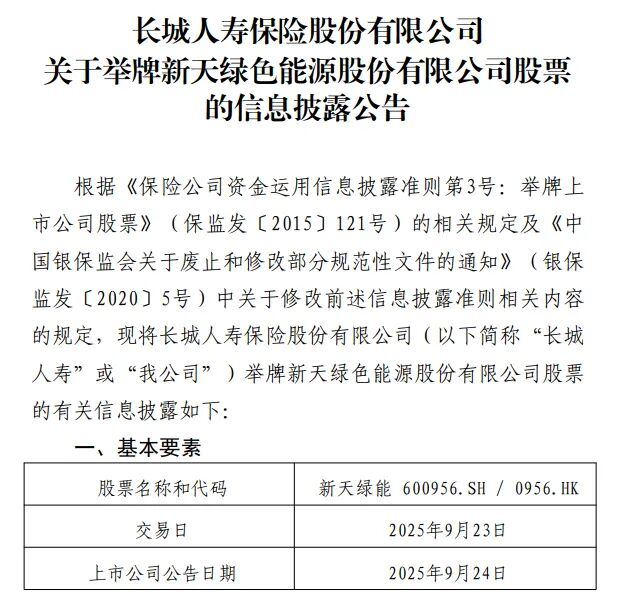
Core Insights - Insurance companies are actively increasing their stakes in listed companies, with 23 companies being targeted this year, matching the total number of stake increases from the previous three years combined [3][7] - The recent acquisition by Great Wall Life Insurance of 1 million shares in New Tian Green Energy has pushed its holding above 5%, triggering regulatory disclosure requirements [4][5] Group 1: Insurance Companies' Activities - Great Wall Life Insurance has increased its stake in New Tian Green Energy from 4.9790% to 5.0027%, with a total holding of 210.4 million shares valued at approximately 804 million HKD [5][6] - In addition to New Tian Green Energy, Great Wall Life has also made significant investments in China Water Affairs, Datang Renewable, and Qin Port Shares this year [6][7] - The total number of stake increases by insurance companies has reached 31 this year, indicating a strong trend in the market [3][7] Group 2: Market Dynamics and Motivations - The surge in stake acquisitions by insurance companies is driven by low interest rates and a need to enhance returns through equity investments [7][8] - New accounting standards have made it beneficial for insurance companies to adjust their accounting measures post-stake acquisition, contributing to profit stability [7][8] - Policy support for increasing insurance funds' investment in A-shares has further encouraged this trend, with a focus on long-term investments [7][8] Group 3: Investment Preferences - Bank stocks are particularly favored by insurance companies, with significant increases in holdings in various banks [8] - Insurance companies are looking for reliable, growth-oriented, and sustainable dividend-paying companies as part of their investment strategy [8] - The current environment of declining interest rates and new accounting standards has heightened the demand for high-dividend stocks among insurance firms [8]


智通港股解盘 | 节前效应叠加关税冲击市场 碳化硅中试线成功突破封锁
Zhi Tong Cai Jing· 2025-09-26 12:43
Market Overview - The market sentiment is cautious ahead of the holiday, leading to a decline in the Hong Kong stock market, which closed down 1.35% [1] - New tariffs announced by the U.S. on various imported products, including a 25% tariff on heavy trucks and a 100% tariff on patented and branded drugs, are expected to impact the market negatively [1] Company Performance - Pharmaceutical companies like Kelaiying and Yaojie Ankang saw their stocks drop over 7% due to the tariff news, although the impact on the pharmaceutical sector is limited as U.S. domestic companies bear the sales burden [2] - Boleton, focusing on electric heavy trucks, surged over 20% as it is not affected by the new tariffs [2] Automotive Industry - XPeng Motors announced its entry into five European markets, planning to launch new models and implementing a stock incentive plan, resulting in a stock increase of over 5% [4] - Chery Automobile is expanding its overseas market presence and has established a local development and global collaboration system, with a projected strong sales performance in various regions [4] Energy Sector - The National Energy Administration emphasizes expanding the use of green hydrogen and integrating it into various industries, which is expected to create new growth points in the renewable energy sector [5] - Wood Mackenzie forecasts that global wind power installations will exceed 170 GW annually over the next five years, with a peak of 200 GW by 2034, benefiting companies like Goldwind Technology [5] Gaming and Entertainment - The gaming sector is experiencing growth, with NetDragon leveraging AI technology to reduce costs and improve efficiency, leading to a stock increase of over 16% [6] Semiconductor Industry - The successful launch of a 12-inch silicon carbide substrate processing line marks a significant advancement for China's third-generation semiconductor industry, positioning companies like Jingrui SuperSiC as leaders in the field [7] Battery Industry - Tianneng Power's revenue for the first half of 2025 decreased by 51.53% due to rising raw material costs, but the company is refocusing on its lead-acid battery business, which holds a significant market share [8] - The lithium battery segment showed a revenue increase of 174.6%, driven by demand in the domestic and U.S. markets, indicating potential for recovery in profitability [9]
港股收盘 | 恒指收跌1.35% 特朗普关税施压医药股 小米集团-W发布会后跌8%
Zhi Tong Cai Jing· 2025-09-26 08:48
Market Overview - The Hong Kong stock market experienced significant declines, with the Hang Seng Index falling by 1.35% to close at 26,128.2 points, and a total trading volume of HKD 3,236.74 million [1] - The Hang Seng Tech Index dropped by 2.89%, while the Hang Seng China Enterprises Index decreased by 1.49% [1] - Weekly performance showed cumulative declines of 1.57% for the Hang Seng Index, 1.79% for the China Enterprises Index, and 1.58% for the Tech Index [1] Blue-Chip Stocks Performance - Xiaomi Group-W (01810) led the blue-chip decline, falling 8.07% to HKD 54.65, impacting the Hang Seng Index by 137.07 points [2] - Other notable blue-chip movements included Hang Seng Bank (00011) rising 3.23% and Mengniu Dairy (02319) increasing by 2.87% [2] - Semiconductor stocks showed mixed results, with SMIC (00981) down 5.01% and Hua Hong Semiconductor (01347) up 3.02% [2][11] Sector Performance - Large tech stocks generally declined, with Xiaomi's new product launch contributing to its drop [3] - Pharmaceutical stocks faced pressure due to new tariffs announced by President Trump, with many stocks in this sector declining significantly [4][3] - Wind energy stocks performed well, with companies like Goldwind Technology (002202) rising over 4% [4][5] Wind and Nuclear Energy Insights - Morgan Stanley reported a positive outlook for the Chinese wind energy sector, predicting a turnaround in pricing and profitability by early 2025 [5] - The report anticipates an average annual new installed capacity exceeding 110 GW during the "14th Five-Year Plan" period [5] - Nuclear energy stocks also saw gains, with China National Nuclear Power (02302) increasing by 8.91% [6] Notable Stock Movements - Xinjiang Xinxin Mining (03833) surged 32.43% after announcing plans to issue A-shares [7] - Jiali International (01050) rose 33.33% after being included in NVIDIA's supplier list [8] - Xiaopeng Motors-W (09868) gained 5.03% as it announced market entry into several European countries [10]

港股收盘(09.26) | 恒指收跌1.35% 特朗普关税施压医药股 小米集团-W(01810)发布会后跌8%
智通财经网· 2025-09-26 08:48
Market Overview - The Hong Kong stock market experienced significant declines, with the Hang Seng Index dropping 1.35% to close at 26,128.2 points, and the Hang Seng Technology Index falling 2.89% to 6,195.11 points. The total trading volume for the day was 323.67 billion HKD [1] - Weekly performance showed the Hang Seng Index down 1.57%, the Hang Seng China Enterprises Index down 1.79%, and the Hang Seng Technology Index down 1.58% [1] Blue-Chip Stocks Performance - Xiaomi Group-W (01810) led the decline among blue-chip stocks, falling 8.07% to 54.65 HKD, contributing a loss of 137.07 points to the Hang Seng Index. The company launched its new Xiaomi 17 series smartphones, with prices starting at 4,499 HKD [2] - Other notable blue-chip movements included Hang Seng Bank (00011) rising 3.23% to 118.2 HKD, and Mengniu Dairy (02319) increasing by 2.87% to 14.71 HKD. Conversely, Semiconductor Manufacturing International Corporation (00981) fell 5.01% to 72.95 HKD [2] Sector Performance - Large technology stocks generally declined, with Xiaomi dropping over 8%, Alibaba down over 3%, and Tencent nearly 1% [3] - Pharmaceutical stocks faced pressure due to new tariffs announced by President Trump, which will impose a 100% tariff on branded and patented drugs starting October 1. However, the impact on Hong Kong's innovative drug sector is expected to be limited [4][3] - Wind power stocks saw gains, with China High-Speed Transmission (00658) up 5.45% and Goldwind Technology (02208) up 4.13% [4] Wind Power Industry Insights - Morgan Stanley reported that after a three-year downturn, the Chinese wind power value chain has successfully reversed negative competition through industry self-discipline. The firm expects domestic wind power installation demand to remain resilient, with annual new installations projected to exceed 110 GW during the 14th Five-Year Plan period [5] Nuclear Power Sector - Nuclear power stocks rose, with China National Nuclear Power (02302) increasing by 8.91% and China General Nuclear Power (01164) up 5.23% [5] - The market is experiencing a surge in demand for nuclear energy and AI, while major producers are cutting output, leading to a supply bottleneck. Uranium prices have risen approximately 5% this year due to these dynamics [5] Notable Stock Movements - Xinjiang Xin Mining (03833) surged 32.43% to 2.45 HKD after announcing plans to issue A-shares and list on a Chinese stock exchange [6] - Jiali International (01050) rose 33.33% to 2.48 HKD after being included in NVIDIA's qualified supplier list [7] - Boleton (01333) increased by 20.2% to 46.18 HKD following a strategic cooperation agreement in the autonomous mining transport sector [8] - XPeng Motors-W (09868) gained 5.03% to 90.8 HKD as it announced its entry into five European markets [9] - Hua Hong Semiconductor (01347) reached a new high, closing up 3.02% at 68.25 HKD, with expectations of improved pricing negotiations in 2025 [10]
同比激增2424%!装机数据引爆港A风电股,超级风口已至?
Ge Long Hui· 2025-09-26 06:49
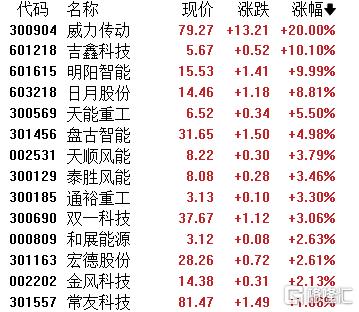
Core Viewpoint - The wind power sector in both Hong Kong and A-shares has shown significant strength, with various stocks experiencing notable gains, driven by positive fundamentals and supportive policies [1][4][5]. Group 1: Market Performance - The wind power equipment sector has seen a remarkable rally, with stocks like Weili Transmission and Jixin Technology hitting the daily limit up [1][2]. - The wind power equipment sector has increased nearly 60% year-to-date since hitting a low on April 9 [2]. - Key stocks in the sector include Weili Transmission (+20%), Jixin Technology (+10.1%), and Mingyang Smart Energy (+9.99%) [2]. Group 2: Industry Fundamentals - The wind power industry has experienced strong fundamentals, with the National Energy Administration reporting a 22.1% year-on-year increase in wind power installed capacity, reaching 58 million kilowatts [4][6]. - From January to August, the newly installed wind power capacity surged by 5,784 megawatts, reflecting a 2424% year-on-year growth [4][6]. - The total installed power generation capacity in China reached 369.379 million kilowatts, with a year-on-year growth of 18% [6]. Group 3: Policy Support - Recent policies have been favorable for the wind power sector, including the promotion of offshore wind power construction and the acceleration of large-scale onshore wind and solar bases [7]. - The Chinese government aims for non-fossil energy consumption to exceed 30% by 2035, with a target of wind and solar power capacity reaching six times that of 2020 [4][7]. Group 4: Market Outlook - International institutions have expressed optimism about the wind power industry, with Morgan Stanley upgrading its rating and predicting a rebound in pricing and profitability by early 2025 [8]. - Wood Mackenzie forecasts that global annual wind power installations will exceed 170 GW over the next five years, with China maintaining a leading position in the market [8]. - Chinese wind power companies are expanding their overseas presence, with significant project orders reported [8]. Group 5: Investment Recommendations - The wind power equipment sector is expected to maintain a competitive advantage in exports, particularly in the context of ongoing trade conflicts [9]. - Companies with strong overseas expansion capabilities, such as Oriental Cable and Daikin Heavy Industries, are recommended for investment [9].
港股午评|恒生指数早盘跌0.65% 风电股逆市走高
智通财经网· 2025-09-26 04:09
Group 1 - The Hang Seng Index fell by 0.65%, down 171 points, closing at 26,312 points, while the Hang Seng Tech Index dropped by 1.04% [1] - Morgan Stanley upgraded the rating for China's wind power industry, suggesting a potential recovery following anti-involution efforts, leading to a rise in wind power stocks such as Goldwind Technology, which increased by 4.6% [1] - Domestic property stocks surged as cities in China optimized real estate policies to stimulate housing demand, with Longfor Group rising by 2.3%, Vanke Enterprises by 2.42%, and Country Garden by 3.5% [1] Group 2 - Huahong Semiconductor reached a new high with a 4.8% increase, following a recent announcement of a restructuring with Huali Microelectronics, and Goldman Sachs noted that the company is negotiating price increases with clients [1] - NetDragon surged over 13% as several of its games are set to launch overseas in the second half of the year, with core IP optimization expected to drive growth [1] Group 3 - Boleton saw a rise of over 20% after signing a strategic cooperation agreement with a mining construction group to advance intelligent development in mine transportation [2] - Lakai Pharmaceuticals increased by over 9% after completing a placement that raised approximately HKD 577 million, intended for the development of its ActRII product portfolio [2] - XPeng Motors rose by over 6% after announcing its entry into five European countries, with the first batch of new cars rolling off the production line at its Austrian factory [2] Group 4 - Xiaomi Group fell by over 5% following the official release of its 17 series smartphones, starting at a price of HKD 4,499 [3] Group 5 - China Everbright Holdings retreated by over 13% after a cumulative increase of over 37% in the previous two trading days [4] - The MicroPort group saw declines across the board, with MicroPort Medical dropping 6.8% due to a major shareholder's discounted sell-off, totaling over HKD 1.1 billion [4]
港股风电股逆市走高,金风科技领涨!机构:反内卷努力后板块或迎来复苏
Zhi Tong Cai Jing· 2025-09-26 03:06
Group 1 - Wind power stocks in Hong Kong rose against the market trend, with increases of over 7%, 5%, and nearly 5% among various companies [1] - Morgan Stanley upgraded the rating of the Chinese wind power industry, suggesting that the sector may experience a recovery following efforts to combat internal competition [2] - The report indicates that after a challenging period from 2022 to 2024, the Chinese wind power industry successfully reversed the trend of vicious competition through self-regulation [3] Group 2 - Morgan Stanley forecasts that during the "14th Five-Year Plan" period, the average annual new installed capacity will exceed 110 GW, potentially reaching around 120 GW between 2028 and 2030 [3] - The investment opportunities are particularly favorable for key component suppliers and submarine cable companies within the wind power value chain [2]

风电股逆市走高 金风科技涨超7% 大唐新能源涨超6%
Zhi Tong Cai Jing· 2025-09-26 02:40
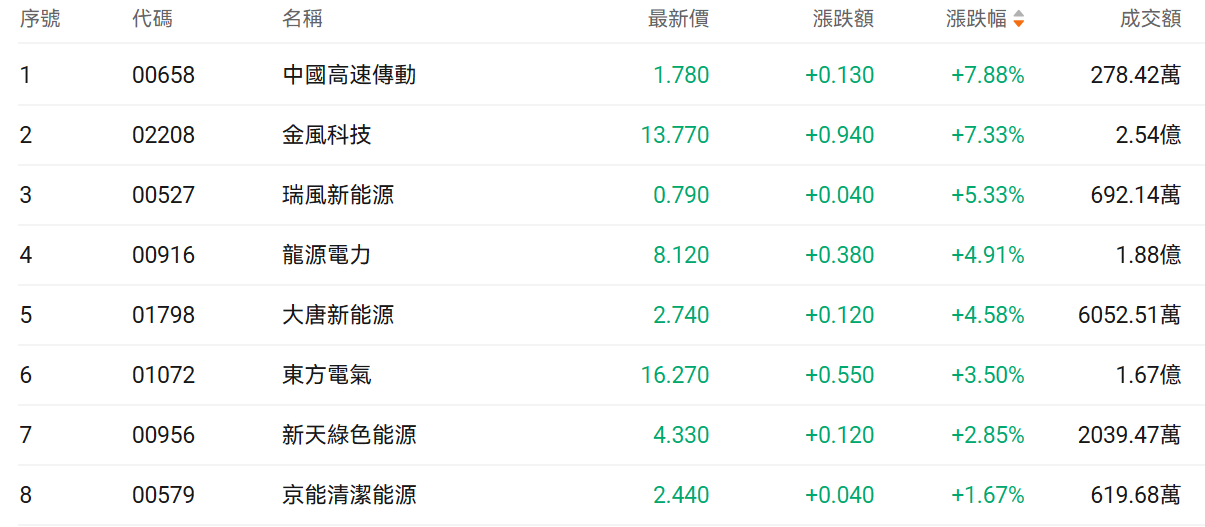
Core Viewpoint - Morgan Stanley upgraded the rating of the Chinese wind power industry, suggesting that the sector may experience a recovery following efforts to combat internal competition [1] Group 1: Market Performance - Wind power stocks rose in early trading, with notable increases: Goldwind Technology (002202) up 7.64% to HKD 13.81, Datang New Energy (01798) up 6.11% to HKD 2.78, and China High-Speed Transmission (00658) up 5.45% to HKD 1.74 [1] - Longyuan Power (001289) also saw a rise of 5.56%, reaching HKD 8.17 [1] Group 2: Industry Outlook - Morgan Stanley indicated that after nearly three years of a downturn, the Chinese wind power value chain has successfully achieved self-regulation, reversing the trend of unhealthy competition [1] - The firm expects domestic wind power installation demand to remain resilient, with a positive outlook for key component suppliers and submarine cable companies [1] - The report forecasts that during the 14th Five-Year Plan period, the average annual new installed capacity will exceed 110 GW, potentially reaching around 120 GW during 2028-2030 [1]

港股异动 | 风电股逆市走高 金风科技(02208)涨超7% 大唐新能源(01798)涨超6%
智通财经网· 2025-09-26 02:38
Core Viewpoint - Morgan Stanley upgraded the rating of China's wind power industry, suggesting that the sector may experience a recovery following efforts to combat internal competition [1] Group 1: Market Performance - Wind power stocks rose in early trading, with Goldwind Technology (02208) up 7.64% at HKD 13.81, Datang New Energy (01798) up 6.11% at HKD 2.78, China High-Speed Transmission (00658) up 5.45% at HKD 1.74, and Longyuan Power (00916) up 5.56% at HKD 8.17 [1] Group 2: Industry Outlook - After nearly three years of a downturn, the Chinese wind power value chain has successfully achieved self-regulation, reversing the trend of unhealthy competition [1] - Morgan Stanley expects domestic wind power installation demand to remain resilient, with key component suppliers and submarine cable companies presenting investment opportunities [1] - The report indicates that during the 14th Five-Year Plan period, the average annual new installed capacity will exceed 110 GW, potentially reaching around 120 GW during 2028-2030 [1]