
正邦科技

Search documents
重庆女博士在广东养鸡养猪,一年净赚8.9亿元
Mei Ri Jing Ji Xin Wen· 2025-11-19 14:12
Core Viewpoint - Tian Nong Group, a poultry and pig farming company, is preparing for an IPO in Hong Kong, highlighting its success in revitalizing the Qingyuan chicken breed while facing significant challenges related to its dual reliance on both chicken and pig farming [1][11]. Company Overview - Founded by Zhang Zhengfen and her husband, the company focuses on the industrialization of Qingyuan chicken, achieving a market share of over 59% in this niche [1][8]. - The company has developed a complete breeding system for Qingyuan chicken, emphasizing high-quality, natural farming practices [5][8]. Financial Performance - Tian Nong Group's revenue structure shows over 60% dependence on pig farming, with pig product revenue increasing from 25.87 billion to 32.03 billion from 2022 to 2024 [11][12]. - The company's net profit has fluctuated significantly, from a peak of 8.9 billion in 2022 to a loss of 6.7 billion in 2023, before rebounding in 2024 [12][13]. - Average selling prices for Qingyuan chicken have decreased by over 20% from 2022 to 2025, impacting gross margins which have shown significant volatility [9][12]. Market Position - The market for Qingyuan chicken is expected to grow from 1.363 billion in 2020 to 1.788 billion by 2024, with projections to exceed 3.1 billion by 2029 [8]. - The company has established a comprehensive supply chain involving over 4,000 poultry farmers, enhancing its market position [8][11]. Governance and Management - The company exhibits a strong family governance structure, with the founding couple controlling approximately 52.28% of voting rights [14][17]. - The management team includes several family members, indicating a close-knit operational approach [14]. Capital Market Journey - Tian Nong Group has faced challenges in its previous attempts to list on the A-share market, which adds pressure to its current IPO efforts in Hong Kong [16][17]. - The company has engaged in various capital operations, including share buybacks and restructuring, to optimize its financial position ahead of the IPO [16][17]. Debt and Financial Health - The company has a high debt ratio, with liabilities reaching approximately 1.334 billion, of which 83.13% is due within one year [17]. - The financial strategy includes addressing short-term debt pressures while aiming to improve cash flow stability [17].


重庆女博士在广东养鸡养猪,去年净赚8.9亿元!儿子、侄子、学生也是公司高管,将赴香港IPO
Mei Ri Jing Ji Xin Wen· 2025-11-19 12:41
Core Viewpoint - Guangdong Tiannong Group Co., Ltd. has officially submitted its IPO application to the Hong Kong Stock Exchange, focusing on the production of Qingyuan chicken, which holds over 59% market share in its segment [1][8]. Group 1: Company Overview - Tiannong Group is primarily engaged in the breeding and production of Qingyuan chicken, a premium chicken variety, and has expanded its operations to include pig farming, with over 60% of its revenue derived from this sector [2][10]. - The company was founded by Dr. Zhang Zhengfen and her husband, who revitalized the Qingyuan chicken breed from a state of genetic decline, achieving an annual output of over 32 million chickens [3][5]. Group 2: Financial Performance - The company's net profit has fluctuated significantly over the past three years, ranging from a peak profit of 890 million yuan to a loss of 670 million yuan, indicating vulnerability to both the pig and chicken market cycles [2][12]. - In 2024, Tiannong Group's revenue is projected to reach 4.8 billion yuan, with pig farming revenue increasing from 2.587 billion yuan in 2022 to 3.203 billion yuan in 2024, while poultry revenue accounts for only about 20% of total revenue [10][11]. Group 3: Market Position and Pricing - Tiannong Group's Qingyuan chicken commands a premium price, with average selling prices dropping from 37.7 yuan per chicken in 2022 to 30.7 yuan in the first half of 2025, reflecting a decline of over 20% [9]. - The average price of Qingyuan chicken remains significantly higher than that of other chicken varieties, with a stable price range of 17.6 to 22.3 yuan per kilogram compared to 7.2 to 15.6 yuan for white feathered chickens [8]. Group 4: Governance and Capital Structure - The company exhibits a strong family governance structure, with the founders controlling approximately 52.28% of voting rights and a significant portion of the executive team being family members [13][16]. - Tiannong Group has faced challenges in its capital journey, having previously attempted to list on the A-share market before shifting focus to the Hong Kong market, indicating a strategic pivot in response to market conditions [15][16]. Group 5: Debt and Financial Strategy - The company is under considerable debt pressure, with a debt-to-asset ratio consistently above 65% and approximately 83.13% of its 1.334 billion yuan in outstanding loans due within one year [16]. - Despite high debt levels, Tiannong Group has engaged in significant share buybacks and capital restructuring, aiming to optimize its equity structure ahead of its IPO [16].

“鸡王之王”IPO:年入48亿元天农集团携11亿元“急债”闯关港股,曾借年息18%高息贷款
Mei Ri Jing Ji Xin Wen· 2025-11-19 10:21
Core Viewpoint - Tian Nong Group has submitted its IPO application to the Hong Kong Stock Exchange, highlighting its dominance in the Qingyuan chicken market, but faces significant challenges due to its reliance on the pig farming business and various operational issues [1][2][6]. Group 1: Company Overview - Tian Nong Group specializes in raising Qingyuan chicken, holding over 59% market share in this niche, and has successfully increased its annual output to over 32 million chickens [1][4]. - The company was founded by Dr. Zhang Zhengfen and her husband, who revitalized the Qingyuan chicken breed through scientific breeding techniques and a premium growth strategy [3]. Group 2: Financial Performance - The company's net profit has fluctuated dramatically over the past three years, ranging from a peak profit of 890 million yuan to a loss of 670 million yuan, indicating vulnerability to both chicken and pig market cycles [2][8]. - Revenue from pig farming constitutes over 60% of total income, with pig product revenue increasing from 2.587 billion yuan in 2022 to 3.203 billion yuan in 2024 [7]. Group 3: Market Position and Pricing - The average selling price of Qingyuan chicken has decreased from 37.7 yuan per chicken in 2022 to 30.7 yuan in the first half of 2025, reflecting a decline of over 20% [5]. - Despite the price drop, Qingyuan chicken maintains a premium price range of 17.6 to 22.3 yuan per kilogram, compared to the lower-priced white feather and yellow feather chickens [3][4]. Group 4: Governance and Capital Structure - The company exhibits a strong family governance structure, with the founding couple controlling approximately 52.28% of voting rights and several family members in key management positions [10]. - Tian Nong Group has faced challenges in its capital journey, having previously attempted to list on the A-share market before shifting focus to the Hong Kong market [11]. Group 5: Debt and Financial Strategy - The company has a high debt ratio, with liabilities reaching approximately 1.334 billion yuan, of which 83.13% is due within one year, indicating significant short-term repayment pressure [12]. - Recent capital maneuvers, including share buybacks and new investments, suggest a strategic effort to optimize its capital structure ahead of the IPO [12].
养殖业板块11月19日涨0.03%,益客食品领涨,主力资金净流出1.59亿元
Zheng Xing Xing Ye Ri Bao· 2025-11-19 08:46
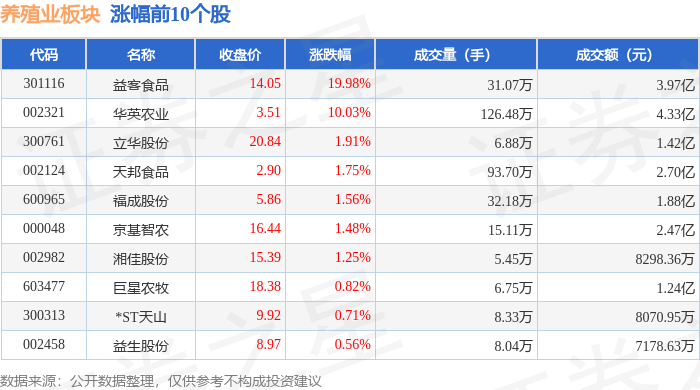
Core Insights - The aquaculture sector experienced a slight increase of 0.03% on November 19, with Yike Food leading the gains [1] - The Shanghai Composite Index closed at 3946.74, up 0.18%, while the Shenzhen Component Index closed at 13080.09, unchanged [1] Stock Performance - Yike Food (301116) saw a significant rise of 19.98%, closing at 14.05 with a trading volume of 310,700 shares and a transaction value of 397 million [1] - Huaying Agriculture (002321) increased by 10.03%, closing at 3.51 with a trading volume of 1,264,800 shares and a transaction value of 433 million [1] - Other notable performers included Lihua Co. (300761) up 1.91%, Tianbang Food (002124) up 1.75%, and Fucheng Co. (600965) up 1.56% [1] Capital Flow - The aquaculture sector experienced a net outflow of 159 million from institutional investors, while retail investors saw a net inflow of 208 million [2] - Yike Food had a net inflow of 79.29 million from institutional investors, but a net outflow of 56.70 million from retail investors [3] - Huaying Agriculture also saw a net inflow of 54.96 million from institutional investors, with a net outflow of 33.55 million from retail investors [3]

东兴晨报P1-20251119
Dongxing Securities· 2025-11-19 07:53
Economic News - The People's Bank of China and 12 departments issued a plan to enhance financial support for consumption in Beijing, focusing on the automotive sector, especially new energy vehicles, with measures including reasonable loan ratios, terms, and interest rates [1] - The Ministry of Industry and Information Technology released guidelines for building high-standard digital parks, aiming to establish around 200 parks by 2027 and promote digital transformation for industrial enterprises [1] - The State Post Bureau reported that the postal industry generated a revenue of 156.42 billion yuan in October, a year-on-year increase of 7.9%, with express delivery revenue reaching 131.67 billion yuan, up 4.7% [1][4] Company Insights - Xiaomi Group reported an adjusted net profit of 11.311 billion yuan for the third quarter, representing a year-on-year increase of 80.9% [4] - O-film Technology plans to issue shares to acquire a 28.2461% stake in O-film Microelectronics [4] - Tianyi Ma intends to purchase a 98.56% stake in Xingyun Kaiwu for a transaction amount of 1.189 billion yuan [4] Industry Analysis: Agriculture and Animal Husbandry - In October, pig prices showed a slight rebound but lacked sustained support, with average prices for piglets, live pigs, and pork at 25.80 yuan/kg, 12.57 yuan/kg, and 23.41 yuan/kg respectively, reflecting month-on-month declines of 14.19%, 8.95%, and 4.47% [7] - The supply side saw a decrease in the breeding sow inventory, with a reported 40.35 million heads, down 0.70% from the previous month, indicating potential for accelerated capacity reduction due to low prices and policy adjustments [8] - The industry anticipates a gradual acceleration in capacity reduction, with leading companies like Muyuan Foods reducing their breeding sow inventory significantly [9] Industry Analysis: Transportation - The airline industry experienced an overall improvement in supply-demand dynamics, with an increase in passenger load factors in October, reflecting a year-on-year increase of approximately 1.8 percentage points [12][13] - Domestic airlines increased capacity by about 3.6% year-on-year in October, driven by the National Day holiday, which boosted travel demand [13] - International route capacity saw a significant year-on-year increase of approximately 14.3%, although there are concerns about potential oversupply as passenger load factors remained stable [14] Investment Recommendations - The report suggests focusing on leading companies in the pig farming sector, such as Muyuan Foods, which have strong cost advantages and high performance visibility [9] - In the airline sector, the report highlights the importance of maintaining supply control and improving load factors to enhance profitability, recommending attention to major airlines benefiting from these trends [17]






东兴证券:猪价上行支撑不足 产能去化有望逐步加速
智通财经网· 2025-11-19 06:37
Core Viewpoint - The report from Dongxing Securities indicates that pig prices experienced a bottom rebound in October, rising above 12 yuan/kg by the end of the month, but the sustainability of this upward trend is weak, leading to a price correction in November, with an average price of 11.80 yuan/kg as of November 10 [1][2]. Supply and Demand Analysis - Supply Side: In October, some enterprises reduced the weight of pigs to accelerate cash flow, resulting in actual slaughter exceeding planned numbers. Following a slight rebound in prices, there is an increased tendency to secure profits due to pessimistic market expectations, leading to significant monthly slaughter pressure [2][4]. - Demand Side: The pace of secondary fattening increased in mid-October, providing slight support for short-term prices. However, after the price rebound, market participants returned to a wait-and-see attitude. Additionally, the rise in northern temperatures at the end of October suppressed meat consumption, and demand for cured meat in the south has not yet started, indicating insufficient demand support [2][4]. Capacity Change Trends - As of the end of September, the number of breeding sows was 40.35 million, a decrease of 0.70% month-on-month. Data from various sources show a mixed trend in October, with a slight decline in breeding sow samples and a minor increase in others, indicating limited willingness to reduce production capacity due to previous backlogs and a slight price rebound [3]. Policy and Market Outlook - With ongoing policy adjustments and low prices, capacity reduction is expected to accelerate. Recent meetings have emphasized production capacity control and other requirements, with leading enterprises responding positively. As of November 14, 2025, the average profit per head for self-bred pigs was -114.81 yuan, indicating continued losses in the industry. The combination of policy implementation and accumulated losses suggests a potential upward price turning point in the second half of 2026 [4][5]. Future Cycle Prediction - The core theme for the near future will be capacity control guided by policy, with expectations for the elimination of outdated capacity increasing. The cost advantages of high-quality production capacity are expected to become more pronounced, leading to better profit elasticity post-regulation. Although the industry index PB has rebounded, it remains below historical median levels, indicating a safety margin for valuations. Recommended stocks include leading breeding companies with high performance realization rates, such as Muyuan Foods (002714.SZ), along with other related companies like Wens Foodstuff Group (300498.SZ), Tiankang Biological (002100.SZ), and Shennong Group (605296.SH) [5]. October Sales Data of Listed Companies - The average sales price in October decreased month-on-month for major companies, with Muyuan Foods, Wens, Zhengbang Technology, and New Hope reporting average prices of 11.55, 11.57, 11.28, and 11.28 yuan/kg, respectively, reflecting declines of 10.33%, 12.22%, 11.53%, and 12.49% [6]. - Slaughter volumes increased significantly, with Muyuan Foods, Wens, New Hope, and Zhengbang Technology achieving sales of 708, 389, 169, and 91 million heads, respectively, marking increases of 26.97%, 17.07%, 20.87%, and 14.81% month-on-month [6]. - The average slaughter weight showed a slight increase, with Muyuan Foods, Wens, and New Hope reporting average weights of 126.41, 112.08, and 100.91 kg, respectively, indicating a general upward trend in average slaughter weights [6].


江西裕民银行将完成高管变更
Zheng Quan Shi Bao· 2025-11-19 00:06
今年4月,该行公告称,此前董事会组织开展行长候选人公开招聘和遴选工作,最终选定宋源为拟任行 长人选,并报江西金融监管局核准。 据了解,宋源长期供职于农行系统,曾任农行台州分行副行长、湘西分行行长、长沙分行行长等职,于 2017年加入湖南首家民营银行——湖南三湘银行,担任该行首席风险官,后升任三湘银行副行长,直至 今年加盟裕民银行。 裕民银行于2019年5月获批筹建,同年9月获准开业,成为江西首家、全国第18家民营银行。去年8月, 成立5年的裕民银行迎来国资大股东,这也是国内民营银行第一大股东易主于国资的首个案例。 具体来说,金融监管总局彼时批复同意南昌金融控股有限公司(下称"南昌金控")受让正邦集团持有的 裕民银行6亿股股份。受让完成后,南昌金控持有裕民银行6亿股股份,占该行总股本的30%。 证券时报记者 马传茂 又一民营银行迎来高管变动。 公开信息显示,黄书川已出任江西裕民银行党委书记。此前,他曾任南昌市产业投资集团副总经理,后 出任裕民银行党委副书记。 在他之前,裕民银行党委书记由余红永担任。后者曾任中邮消费金融总经理,也是裕民银行2019年开业 后首位党委书记、董事长。值得一提的是,据该行消息,余红永仍 ...
开源证券:年前生猪供给压力逐步积累 猪价低位运行去化延续
智通财经网· 2025-11-12 06:27
Core Insights - The report from Kaiyuan Securities indicates a significant decline in the average selling price of live pigs in October 2025, with a decrease of 10.74% month-on-month and 33.56% year-on-year, suggesting ongoing pressure on pig prices in the near future [1] - The slaughter volume in October 2025 was 5.0352 million heads, reflecting a month-on-month increase of 10.40% and a year-on-year increase of 9.55%, indicating a temporary oversupply situation [1] - The report highlights that the proportion of large pigs being sold is lower than in the same period in 2024, while the inventory of large pigs is increasing, suggesting a potential easing of supply in the future [1] Industry Overview - The gross white price difference as of November 6, 2025, was 4.18 yuan/kg, showing a month-on-month increase of 0.08 yuan/kg but a year-on-year decrease of 0.84 yuan/kg, indicating mixed market conditions [2] - The national frozen product inventory rate was reported at 20.03%, up 4.06 percentage points year-on-year, which may exert downward pressure on future pig prices due to high inventory levels [2] - In October 2025, the industry faced significant losses, with self-breeding and self-raising operations losing 167.97 yuan per head, reflecting a worsening financial situation for producers [3] - The breeding stock decreased by 0.77% month-on-month as of November 7, 2025, indicating a trend of reduction in breeding capacity [3] Company Performance - In October 2025, 12 listed pig companies reported a total of 16.9469 million heads sold, a year-on-year increase of 29.29%, with individual companies like Muyuan Foods and Wens Foodstuffs showing significant increases in their sales volumes [4] - The average selling price for major listed pig companies fell month-on-month, with prices for companies like Muyuan Foods and Wens Foodstuffs decreasing by 10.3% and 12.2% respectively [5] - The average weight of pigs sold by major companies also saw a decline, with Dabeinong reporting an average weight of 110.1 kg per head, down 18.8 kg from the previous month [4]




农林牧渔行业点评报告:年前生猪供给压力逐步积累,猪价低位运行去化延续
KAIYUAN SECURITIES· 2025-11-11 15:19
Investment Rating - The industry investment rating is "Positive" (maintained) [1] Core Viewpoints - The industry is experiencing increasing supply pressure of live pigs as the year-end approaches, with low prices continuing to decline. In October 2025, the national average selling price of live pigs was 11.69 yuan/kg, down 10.74% month-on-month and 33.56% year-on-year. The slaughter volume in October was 5.0352 million heads, up 10.40% month-on-month and 9.55% year-on-year. The actual output in October exceeded the planned output by 5.70%, but the planned output for November is expected to decrease by 3.27% compared to October [3][14][24] Summary by Sections Industry Overview - The supply pressure of live pigs is gradually accumulating as the year-end approaches, with low prices continuing to decline. The average selling price in October 2025 was 11.69 yuan/kg, reflecting a significant decrease [3][14] - The slaughter volume in October was 5.0352 million heads, indicating a month-on-month increase of 10.40% and a year-on-year increase of 9.55% [3][14] Market Dynamics - The proportion of large pigs (over 150kg) in the slaughter structure was 4.89%, which is lower than the same period in 2024. The stock of large pigs is expected to increase, leading to a more relaxed supply in the future [4][18] - The winter pork consumption is expected to improve, which may drive the price difference between lean and fatty pork. However, the high inventory rate of frozen products may suppress future prices [4][19][23] Financial Performance - In October, the industry faced deepening losses, with self-breeding losses reaching 167.97 yuan per head. The breeding stock decreased by 0.77% month-on-month [5][24] - The average selling price of major listed pig companies decreased month-on-month, with prices ranging from 10.97 to 11.87 yuan/kg, reflecting declines of 9.9% to 13.9% [6][7][34]
旺季不旺:10月猪企“增量不增价”,高成本猪企亏损加剧
Feng Huang Wang· 2025-11-11 12:45
Core Insights - The pig farming industry is facing significant challenges as many companies are experiencing losses despite increased output during the traditional peak season for pig sales [1][2][3] - The average selling prices of pigs have dropped to their lowest levels of the year, leading to a situation where companies are selling pigs at a loss [3][5] - Companies with lower breeding costs are better positioned to withstand price declines, while those with higher costs are under severe financial pressure [5][6] Industry Performance - In October, major pig farming companies reported substantial increases in the number of pigs sold, with Muyuan Foods selling 7.076 million pigs (up 13.17% year-on-year) and Wens Foodstuffs selling 3.8928 million pigs (up 45.69% year-on-year) [2][3] - Despite the increase in sales volume, the average selling prices for major companies like Muyuan and Wens fell by approximately 32.73% and 34.41% year-on-year, respectively [3][4] Cost Dynamics - The cost of pig farming varies significantly among companies, with leading firms like Muyuan and Wens reporting costs below 12.5 yuan/kg, while others like Huazhong and Jinxinnong have costs exceeding 13.5 yuan/kg [5][6] - The industry is currently experiencing an overall loss, with average breeding costs maintained between 12.5 and 13 yuan/kg, and losses per pig reaching 161.69 yuan for self-breeding and 283.92 yuan for piglets [5][6] Future Outlook - The demand for pork is expected to increase as the southern regions begin their seasonal consumption, which may provide some support for prices in the coming months [4] - However, the overall price trend is expected to remain weak due to the cyclical nature of the pig market [4]