天弘基金

Search documents
投顾周刊:央行行长表示2026年降准降息有空间
Wind万得· 2026-01-24 22:24
Monetary Policy - The central bank will implement a moderately loose monetary policy in 2026, with room for rate cuts and reserve requirement ratio reductions. The focus will be on maintaining ample liquidity and managing expectations for the RMB exchange rate [2][5]. Fund Management - Multiple funds have announced fee reductions to lower investment costs for investors. For instance, 华夏基金 reduced the management fee of its financial technology ETF from 0.50% to 0.15% and the custody fee from 0.1% to 0.05% [2][5]. Banking Sector - The interest rates on large time deposits from local small and medium-sized banks have fallen below 2%. It is predicted that the maturity scale of time deposits over one year will be around 50 trillion yuan in 2026 [3][5]. - The wealth management business of small and medium-sized banks is experiencing changes, with reports indicating that the scale of raised funds is lower than that of maturing funds [3][5]. Real Estate Market - The second-hand housing market in several regions continues to show a "tail-up trend" at the beginning of 2026, with notable recovery in transaction volumes in major cities like Beijing, Shanghai, and Shenzhen [3][5]. Fiscal and Financial Policies - A package of policies promoting domestic demand through fiscal and financial collaboration has been introduced, including a 500 billion yuan special guarantee plan for private investment and interest subsidies for loans to small and micro enterprises [5][6]. Global Market Trends - Concerns over the Greenland crisis and fiscal pressures have triggered a global bond market sell-off, with significant increases in yields for long-term bonds in Japan and the U.S. [6][6]. - NVIDIA's CEO highlighted that AI has initiated the largest infrastructure buildout in human history, requiring substantial investments and resources [6][6].





ETF市场跟踪与配置周报-20260124
Xiangcai Securities· 2026-01-24 15:29
1. Report Industry Investment Rating No relevant content provided. 2. Core Viewpoints - The report analyzes the market and ETF performance in the past week, and recommends industries and ETFs to focus on next week based on the PB - ROE framework and the ETF redemption sentiment indicator model [8][36] 3. Summary by Directory 3.1 Recent Market Overview (January 19 - 23, 2026) - Among the 31 Shenwan primary industries, 24 rose and 7 fell. The top three gainers were building materials (up 9.23%), petroleum and petrochemicals (up 7.71%), and steel (up 7.31%); the top three losers were banks (down 2.70%), communications (down 2.12%), and non - bank finance (down 1.45%) [4][11] - The Shanghai Composite Index closed at 4136.16, up 0.84% for the week; the Shenzhen Component Index closed at 14439.66, up 1.11% for the week; the ChiNext Index closed at 3349.50, down 0.34% for the week; the Beixin 50 Index closed at 1588.66, up 2.60% for the week; the Hang Seng Index closed at 26749.51, down 0.36% for the week. The average daily trading volume of the Shanghai and Shenzhen stock markets was 27727.12 billion yuan, and the total trading volume for the week was 13.86 trillion yuan [11] - Main funds had net outflows on 4 trading days and net inflows on 1 trading day, with a total net outflow of 125.207 billion yuan for the week. The industries with more net inflows of main funds were banks, non - bank finance, and non - ferrous metals; the industries with more net outflows were electronics, communications, and computers [4][11] 3.2 Recent ETF Market Performance (January 19 - 23, 2026) 3.2.1 Stock - type ETFs - 8 new stock - type ETFs were listed, including 2 battery ETFs and 6 other stock - type ETFs. 9 new ETFs were established, including 2 Shanghai - STAR Market chip ETFs and 7 other ETFs, with a total issuance scale of 4.416 billion yuan [5][18] - The median weekly increase or decrease of stock - type ETFs was 0.88%. Gold stock ETFs and photovoltaic leading ETFs performed well, with gold stock ETFs rising the most (13.17%); science and innovation semiconductor ETFs and financial real - estate ETFs performed poorly, with science and innovation semiconductor ETFs falling the most (3.86%) [5][21] - The average weekly share change of stock - type ETFs was a decrease of 51.8174 million shares. Chemical ETFs and power grid equipment ETFs had more share increases, with chemical ETFs increasing the most (6.316 billion shares); CSI 300ETF and SSE 50ETF had more share decreases, with Huatai - Ber瑞 CSI 300ETF decreasing the most (15.345 billion shares) [21] 3.2.2 Bond - type ETFs - The median weekly increase or decrease of 53 bond - type ETFs was 0.11%. Convertible bond ETFs had the highest increase (2.94%), and treasury bond ETFs had the lowest increase (0.01%). As of January 23, 2026, the scale of Haifutong CSI Short - term Financing ETF (511360.SH) was the largest, at 70.223 billion yuan [24] 3.2.3 Cross - border ETFs - The median weekly increase or decrease of cross - border ETFs was - 0.66%. The Brazilian ETF and the S&P Biotechnology ETF had high increases or decreases, with the Brazilian ETF rising the most (7.63%); the Hong Kong Stock Connect Innovative Drug ETF and the Hong Kong Innovative Drug ETF had low increases or decreases, with the Hong Kong Stock Connect Innovative Drug ETF falling the most (3.94%) [26] - Since the beginning of the year, the median increase or decrease of cross - border ETFs has been 3.84%. The China - South Korea Semiconductor ETF and the Hong Kong Medical ETF had high increases, with the China - South Korea Semiconductor ETF rising 23.87%; the Nasdaq ETF and the Nasdaq Technology ETF had high decreases, with the Nasdaq Technology ETF falling 2.79% [26] 3.3 PB - ROE Framework - based ETF Rotation Strategy Tracking - The strategy focuses on the communications, agriculture, forestry, animal husbandry, and fishery, and transportation industries, corresponding to their respective industry ETFs. This week, the strategy's cumulative return was 1.29%, the CSI 300 Index's cumulative return was - 0.62%, and the strategy's cumulative excess return relative to the CSI 300 Index was 1.91% [7][31] - Since 2023, the strategy's cumulative return has been 27.65%, the CSI 300's cumulative return has been 21.46%, and the strategy's cumulative excess return relative to the CSI 300 Index has been 6.19% [7][33] - Since 2022, the strategy's cumulative return has been 9.16%, the CSI 300's cumulative return has been - 4.81%, and the strategy's cumulative excess return relative to the CSI 300 Index has been 13.98% [35] 3.4 Investment Recommendations - Based on industry PB - ROE and supplementary indicators, the PB - ROE framework - based ETF rotation strategy recommends focusing on the communications, agriculture, forestry, animal husbandry, and fishery, and transportation industries next week, corresponding to their respective industry ETFs [8][36] - According to the ETF redemption sentiment indicator model, it is recommended to focus on breeding ETFs, satellite ETFs, pharmaceutical ETFs, securities ETFs, and science and innovation AI ETFs next week [8][36]
行业费率改革持续深化 基金公司密集宣布降费
Sou Hu Cai Jing· 2026-01-24 12:36
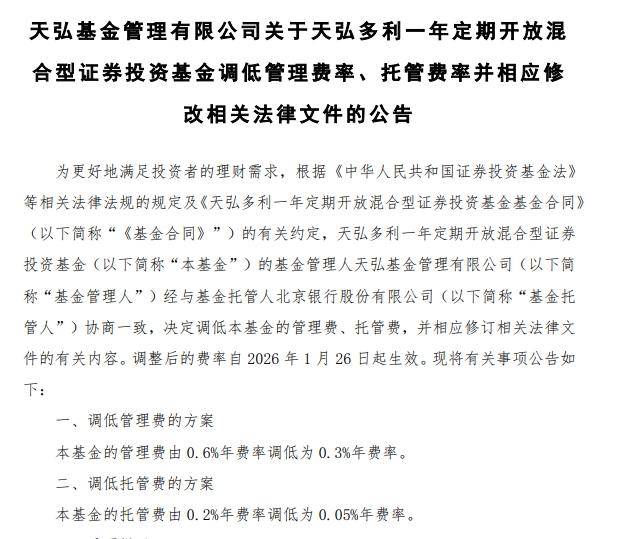
Core Viewpoint - The recent trend in the fund industry shows a significant reduction in management and custody fees by various fund companies, driven by regulatory reforms aimed at lowering overall industry costs and enhancing investor benefits [1][4][7]. Group 1: Fee Reductions by Fund Companies - Tianhong Fund announced a reduction in management fees from 0.6% to 0.3% and custody fees from 0.2% to 0.05%, effective January 26, 2026 [1]. - Prior to this, Tianhong Fund also reduced fees for another fund, lowering management fees from 0.7% to 0.3% and custody fees from 0.15% to 0.05% [3]. - Huaxia Fund reduced management fees for its financial technology ETF from 0.50% to 0.15% and custody fees from 0.10% to 0.05%, effective January 22, 2026 [4]. - Haifutong Fund lowered management fees for its bond fund from 0.5% to 0.4%, effective January 21, 2026 [6]. Group 2: Industry Context and Regulatory Changes - The China Securities Regulatory Commission (CSRC) initiated a fee reform plan for the public fund industry in July 2023, aiming to lower comprehensive fee levels through a structured approach [7]. - As of January 1, 2023, the new regulations on sales fees for publicly offered securities investment funds were implemented, marking a smooth transition in the fee reform [7]. - The CSRC's action plan for promoting high-quality development in public funds, released in May 2025, emphasizes optimizing fund operation models and establishing a floating management fee mechanism linked to fund performance [7]. Group 3: Market Impact and Future Outlook - As of January 24, 2023, nearly 1,200 funds have management fees at or below 0.15%, and over 2,400 funds have custody fees at or below 0.05% [8]. - Research indicates that the fund industry previously relied on a "high scale, high fee, high profit" model, which deviated from the principle of prioritizing investor interests [8]. - Future developments in the public fund industry will increasingly depend on quality improvements, focusing on value creation for investors through product innovation, research, and customer service [8].
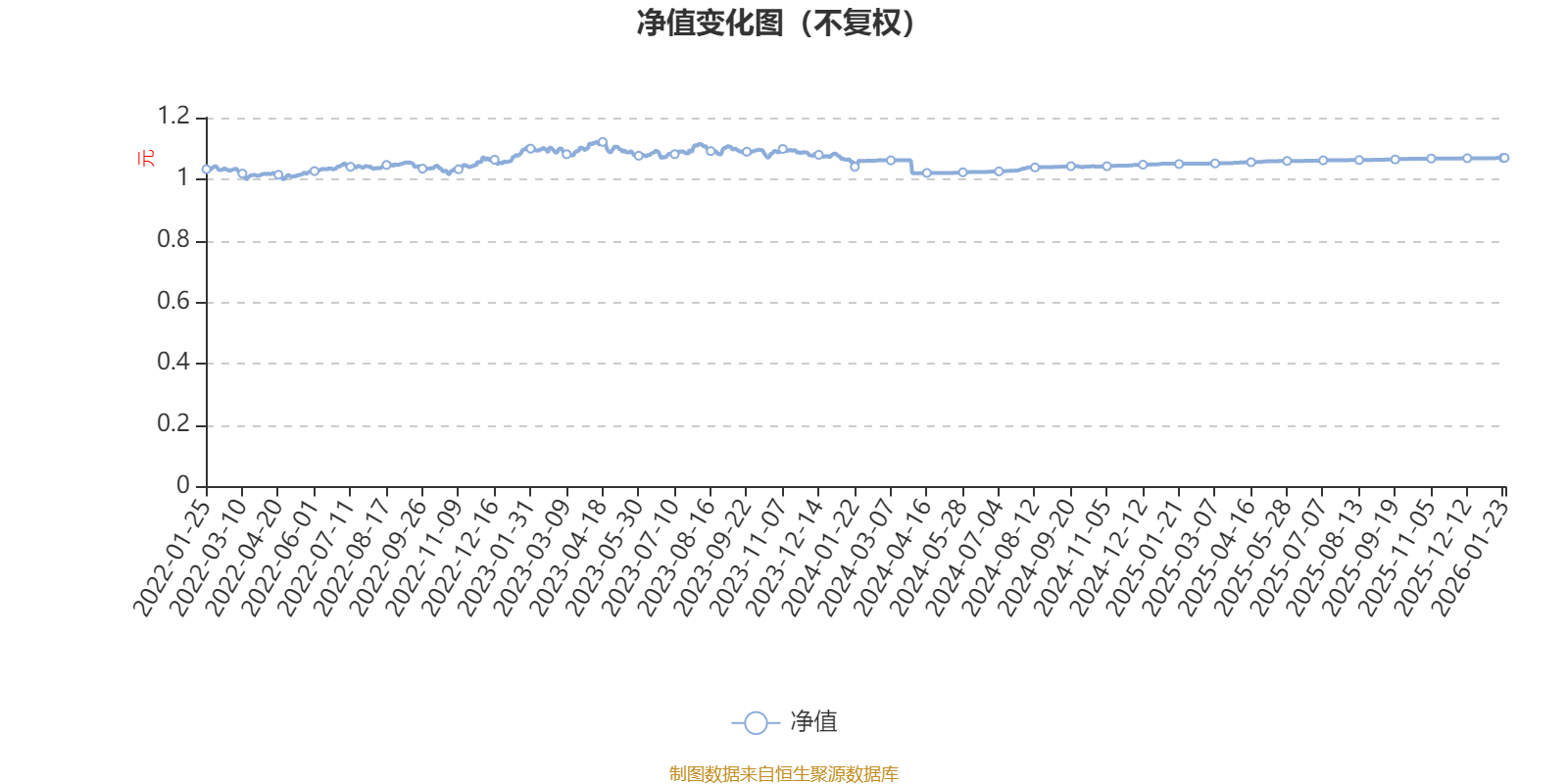
天弘恒新混合A:2025年第四季度利润30.36万元 净值增长率0.27%
Sou Hu Cai Jing· 2026-01-24 11:09
Core Viewpoint - The Tianhong Hengxin Mixed A Fund (011048) reported a profit of 303,600 yuan for Q4 2025, with a weighted average profit per fund share of 0.0029 yuan. The fund's net value growth rate was 0.27%, and the fund size reached 113 million yuan by the end of Q4 2025 [3][12]. Fund Performance Summary - The fund is classified as a mixed bond fund, with a unit net value of 1.069 yuan as of January 23 [3]. - Over the past three months, the fund's cumulative net value growth rate was 0.30%, ranking 613 out of 683 comparable funds [3]. - Over the past six months, the cumulative net value growth rate was 0.79%, ranking 617 out of 683 comparable funds [3]. - Over the past year, the cumulative net value growth rate was 1.91%, ranking 637 out of 683 comparable funds [3]. - Over the past three years, the cumulative net value growth rate was 0.80%, ranking 559 out of 617 comparable funds [3]. Risk and Return Metrics - As of December 31, the fund's Sharpe ratio over the past three years was 0.0406, ranking 499 out of 563 comparable funds [7]. - The maximum drawdown over the past three years was 7.33%, with a ranking of 340 out of 563 comparable funds. The largest single-quarter drawdown occurred in Q1 2022, at 4.98% [9]. Market Conditions and Strategy - The fund management noted that bond market fluctuations in October were significantly influenced by US-China relations, with a rebound in the last week due to the central bank's resumption of bond purchases. In November, easing tensions between the US and China led to new redemption regulations impacting bond trends. The central bank's bond purchase amounts were below market expectations, resulting in weak market sentiment. December saw overall liquidity improvement, with some recovery in credit bonds, although interest rates remained weak. The fund maintained a low duration strategy and continued leveraging and coupon strategies throughout Q4 [3].
公募基金管理规模稳健扩张 10家跻身“万亿元俱乐部”
Zheng Quan Ri Bao· 2026-01-23 16:16
Group 1 - The public fund management industry demonstrated strong resilience, with a total asset management scale reaching a historical high of 37.64 trillion yuan by the end of 2025, an increase of approximately 1.85 trillion yuan from the end of the third quarter of 2025 [1] - Excluding money market funds, the public fund management scale was 22.67 trillion yuan in the fourth quarter of last year, reflecting a quarter-on-quarter growth of 0.62 trillion yuan, with equity funds (including QDII funds) at 10.38 trillion yuan, showing a slight increase of 0.03 trillion yuan [1] Group 2 - By the end of last year, 10 companies entered the "trillion yuan club," with E Fund and Huaxia Fund exceeding 2 trillion yuan in management scale, while several others managed between 1 trillion and 2 trillion yuan [2] - Excluding money market funds, only three companies had management scales exceeding 1 trillion yuan: E Fund, Huaxia Fund, and GF Fund, with only E Fund and Huaxia Fund surpassing 1 trillion yuan in equity fund scale [2] - The top five industries favored by public funds were technology, industrial, financial, transportation, and consumer sectors, with technology, industrial, and financial sectors each holding over 100 billion yuan in market value [2] Group 3 - Several fund companies expressed their market outlook, with a focus on the digital economy and financial technology as key long-term investment themes for 2026 [3] - The overall performance of the equity market was positive, particularly for technology stocks, with expectations that opportunities will outweigh risks in 2026 [3] - The public fund industry showed strong growth in the fourth quarter, contributing to the stability of the capital market and the real economy, while demonstrating professional asset management capabilities [3]
2025 年四季度国内公募基金份额点评
GUOTAI HAITONG SECURITIES· 2026-01-23 14:11
Report Industry Investment Rating No information provided. Core View of the Report In Q4 2025, the share of domestic public - offering funds (excluding money funds) was 1.7 trillion shares, a 3.40% increase from the end of the previous quarter. The growth came from both the share growth of existing funds and the issuance of new funds [4][6]. Summary by Related Catalogs 2025 Q4 Domestic Public - Offering Fund Share Review - The share of domestic public - offering funds (excluding money funds) in Q4 2025 was 1.7 trillion shares, up 3.40% from the previous quarter. New funds issued 311.863 billion shares with an average share of 6.52 billion shares, and the share of existing funds increased by 246.971 billion shares [4][6]. Index Funds Equity - New funds: In Q4 2025, 196 index stock - type products were newly issued, with a total new share of 84.712 billion shares. Products tracking the science - innovation index, artificial intelligence index, and dividend low - volatility index had high issuance popularity. - Existing funds: The total share of stock index - type products in Q4 was 353 billion shares, an increase of 18.8918 billion shares compared to Q3 [4][7]. Fixed - Income - New funds: In Q4 2025, 4 bond index - type products were newly issued, tracking credit bond and policy - financial bond indices, with a total new share of 12.549 billion yuan. - Existing funds: The share of index bond - type funds decreased by 22.851 billion shares in Q4 [4][8]. Active Equity - Hybrid Funds - New funds: Affected by the previous upward trend of the equity market, the issuance popularity of active equity - hybrid funds in Q4 significantly recovered. 313 funds were newly issued, with a total new share of 143.156 billion shares, accounting for 45.90% of the total new fund shares. - Existing funds: The share of active equity - hybrid funds declined. The total share of existing funds was 283 billion shares, a reduction of 13.5586 billion shares compared to Q3. Some investors redeemed funds for profit - taking due to the large net - value fluctuations of technology - themed funds [4][9]. Active Bond Funds - New funds: Affected by the overall decline of the bond market, the issuance popularity of bond funds remained low. 93 active bond funds were established, with a total new share of 82.091 billion shares, accounting for 26.32% of the total new fund shares. - Existing funds: The share of active bond funds slightly expanded in Q4, mainly due to the growth of partial - bond fund shares. The total share of existing active bond funds was 824 billion shares, an increase of 2.6545 billion shares compared to Q3 [4][10]. Other Funds - Inter - bank certificate of deposit funds: The share increased by 4.4649 billion shares in Q4, with 4 new funds issued and a total new share of 1.2463 billion shares. - QDII funds: The share increased by 13.5817 billion shares in Q4, with some Hang Seng Technology - themed products having obvious share expansion [4][12]. Fund Share Change Table | Fund Type | Q4 2025 Share (billion shares) | Q3 2025 Share (billion shares) | Share Change (billion shares) | Share Change Rate | | --- | --- | --- | --- | --- | | Stock | 396.028 | 369.3527 | 26.6754 | 7.22% | | Hybrid | 255.096 | 261.4112 | - 6.3152 | - 2.42% | | Bond | 914.6488 | 904.8124 | 9.8364 | 1.09% | | Commodity | 9.4389 | 7.0547 | 2.3842 | 33.80% | | Domestic Other | 19.7786 | 15.0969 | 4.6817 | 31.01% | | QDII Equity - Hybrid | 76.2795 | 63.4886 | 12.7909 | 20.15% | | QDII Bond | 5.9473 | 5.1731 | 0.7742 | 14.97% | | QDII Other | 0.0555 | 0.0389 | 0.0166 | 42.55% | | FOF | 22.3698 | 17.3224 | 5.0473 | 29.14% | | MOM | 0.1465 | 0.1546 | - 0.0081 | - 5.26% | | Total (excluding money funds) | 1699.789 | 1643.9056 | 55.8833 | 3.40% | [14]
公募基金规模新榜:易方达保持第一,ETF、固收+成胜负手
Nan Fang Du Shi Bao· 2026-01-23 12:11
随着公募基金2025年第四季度报告披露收官,全行业最新管理规模排名出炉。Wind数据显示,2025年 末,易方达基金以2.49万亿元(ETF使用最新场内规模,下同)管理规模蝉联第一,华夏基金以2.21万 亿元紧随其后,成为业内仅有的两家管理规模超2万亿的公募机构。同时,公募基金管理规模Top10门 槛跃升至万亿元,广发基金、南方基金、富国基金等8家机构规模均超万亿,头部效应持续强化。 截至2025年末,公募基金规模同比新增约5万亿元,其中非货币型基金增长3.38万亿元,成为行业增长 主力,ETF与"固收+"产品则分别贡献了2.08万亿元和1.02万亿元增长,是全年机构规模增长的核心胜负 手。 易方达、华夏基金管理规模超2万亿元 Wind数据显示,截至2025年末,公募基金规模达37.5万元,同比增长约5万亿元。 公募基金管理规模前十门槛已经提升至万亿元级别。截至2025年末,易方达基金以2.49万亿元管理规模 蝉联榜首,华夏基金以2.21万亿元紧紧跟随。两家成为业内仅有的管理公募基金规模超2万亿的机构, 且增幅非常接近。易方达基金、华夏基金全年管理规模分别增加4361.11亿元、4268.44亿元,增幅分别 ...
上证50指数ETF今日合计成交额130.88亿元,环比增加37.76%
Zheng Quan Shi Bao Wang· 2026-01-23 10:15
Core Viewpoint - The trading volume of the SSE 50 Index ETFs increased significantly today, with a total trading amount of 13.088 billion yuan, representing a week-on-week increase of 3.587 billion yuan, or 37.76% [1] Trading Volume Summary - The Huaxia SSE 50 ETF (510050) had a trading volume of 12.352 billion yuan, up 3.427 billion yuan from the previous trading day, with a week-on-week increase of 38.39% [1] - The E Fund SSE 50 ETF (510100) recorded a trading volume of 620 million yuan, an increase of 122 million yuan, with a week-on-week increase of 24.41% [1] - The ICBC SSE 50 ETF (510850) had a trading volume of 24.75 million yuan, up 14.26 million yuan, with a week-on-week increase of 136.01% [1] - The Shenwan Hongyuan SSE 50 ETF (510600) and the Wanji SSE 50 ETF (510680) saw the largest increases in trading volume, with increases of 355.35% and 213.23% respectively [1] Market Performance Summary - As of market close, the SSE 50 Index (000016) fell by 0.69%, while the average decline for related ETFs was 0.64% [1] - The ETFs with the largest declines included the Bosera SSE 50 ETF (510710) and the Jianxin SSE 50 ETF (510800), which fell by 1.01% and 0.90% respectively [1]
4只沪深300指数ETF成交额环比增超100%
Zheng Quan Shi Bao Wang· 2026-01-23 09:31
Summary of Key Points Core Viewpoint - The trading volume of the CSI 300 Index ETFs reached 100.59 billion yuan today, marking an increase of 45.57 billion yuan from the previous trading day, representing a growth rate of 82.82% [1] Group 1: Trading Volume and Changes - The E Fund CSI 300 ETF (510310) had a trading volume of 31.58 billion yuan, an increase of 15.28 billion yuan from the previous day, with a growth rate of 93.74% [1] - The Huatai-PB CSI 300 ETF (510300) recorded a trading volume of 31.83 billion yuan, up by 11.46 billion yuan, reflecting a growth rate of 56.24% [1] - The China Asset CSI 300 ETF (510330) saw a trading volume of 20.77 billion yuan, increasing by 11.07 billion yuan, with a growth rate of 114.17% [1] - The Fortis Fubon CSI 300 ETF (515360) and the China Asset CSI 300 ETF (510330) had the highest increases in trading volume, with growth rates of 3081.91% and 114.17% respectively [1] Group 2: Market Performance - As of market close, the CSI 300 Index (000300) fell by 0.45%, while the average decline for related ETFs was 0.36% [2] - The best-performing ETF was the Bosera CSI 300 ETF (515130), which increased by 0.06% [2] - The worst performers included the China Life Asset CSI 300 ETF (510380) and the Huabao CSI 300 Enhanced Strategy ETF (562070), which decreased by 0.72% and 0.68% respectively [2] Group 3: Detailed ETF Performance - The trading performance of various ETFs showed significant fluctuations, with the Fortis Fubon CSI 300 ETF (515360) experiencing a dramatic increase in trading volume by 3081.91% [2][3] - Other notable ETFs included the E Fund CSI 300 ETF (510310) and the Huatai-PB CSI 300 ETF (510300), both showing substantial increases in trading volume and relatively minor declines in price [2][3] - The overall trend indicates a mixed performance among the ETFs, with some experiencing significant trading activity despite the overall market decline [2][3]
太空算力点燃光伏新需求,2026年光伏行业迎政策与供需双重拐点!
Ge Long Hui· 2026-01-23 09:15
Core Viewpoint - The solar photovoltaic (PV) industry is experiencing new demand and technological advancements driven by space computing and energy supply reliance on solar power, with significant developments expected in the coming years [3]. Group 1: Market Dynamics - SpaceX and Tesla plan to achieve an annual solar manufacturing capacity of 100GW within three years, which is expected to boost market sentiment [3]. - China has submitted applications for 203,000 satellite orbits, potentially generating nearly 10GW of demand for space solar power, favoring high-efficiency battery technologies like HJT [3]. - The solar industry is entering a critical phase of governance, with the Ministry of Industry and Information Technology (MIIT) promoting the exit of outdated production capacity and accelerating the implementation of quality standards [3][4]. Group 2: Supply and Demand - The overall supply-demand structure of the solar industry is stable, but there are concerns about inventory accumulation during the off-peak season due to cost pressures and exchange rate fluctuations [4]. - Prices for silicon materials have risen above 65 yuan/kg, but transactions remain sluggish; silicon wafers and battery cells have also seen price increases, with battery cells averaging 0.38 yuan/W [4]. - The MIIT is focusing on capacity regulation and price monitoring, with a strong emphasis on eliminating non-compliant enterprises, which is expected to lead to a gradual improvement in the industry fundamentals by 2026 [4]. Group 3: Technological Advancements - Emerging demands such as space solar power, along with advancements in high-efficiency battery technologies (HJT, BC, perovskite), are expected to open up new growth opportunities for the industry [5]. - The industry is transitioning from scale expansion to a focus on quality, efficiency, and technology-driven growth, indicating a solid long-term development foundation [5].