
铠侠

Search documents
亚太股市 全线重挫!
Zheng Quan Shi Bao· 2025-11-21 02:13
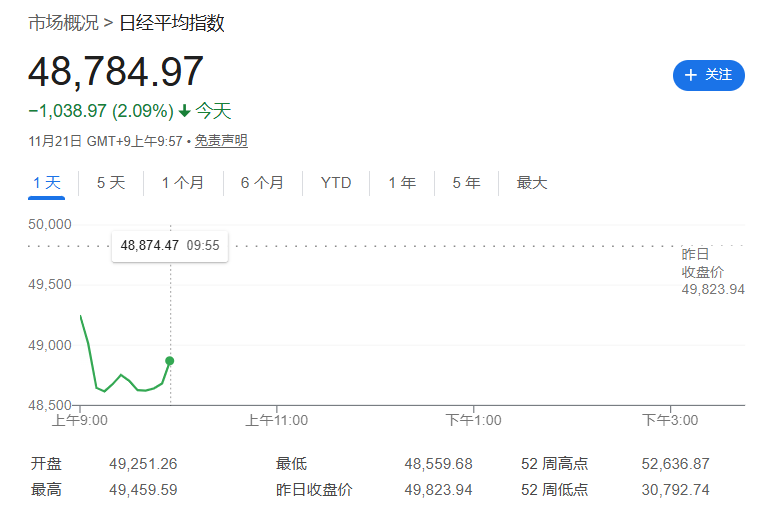
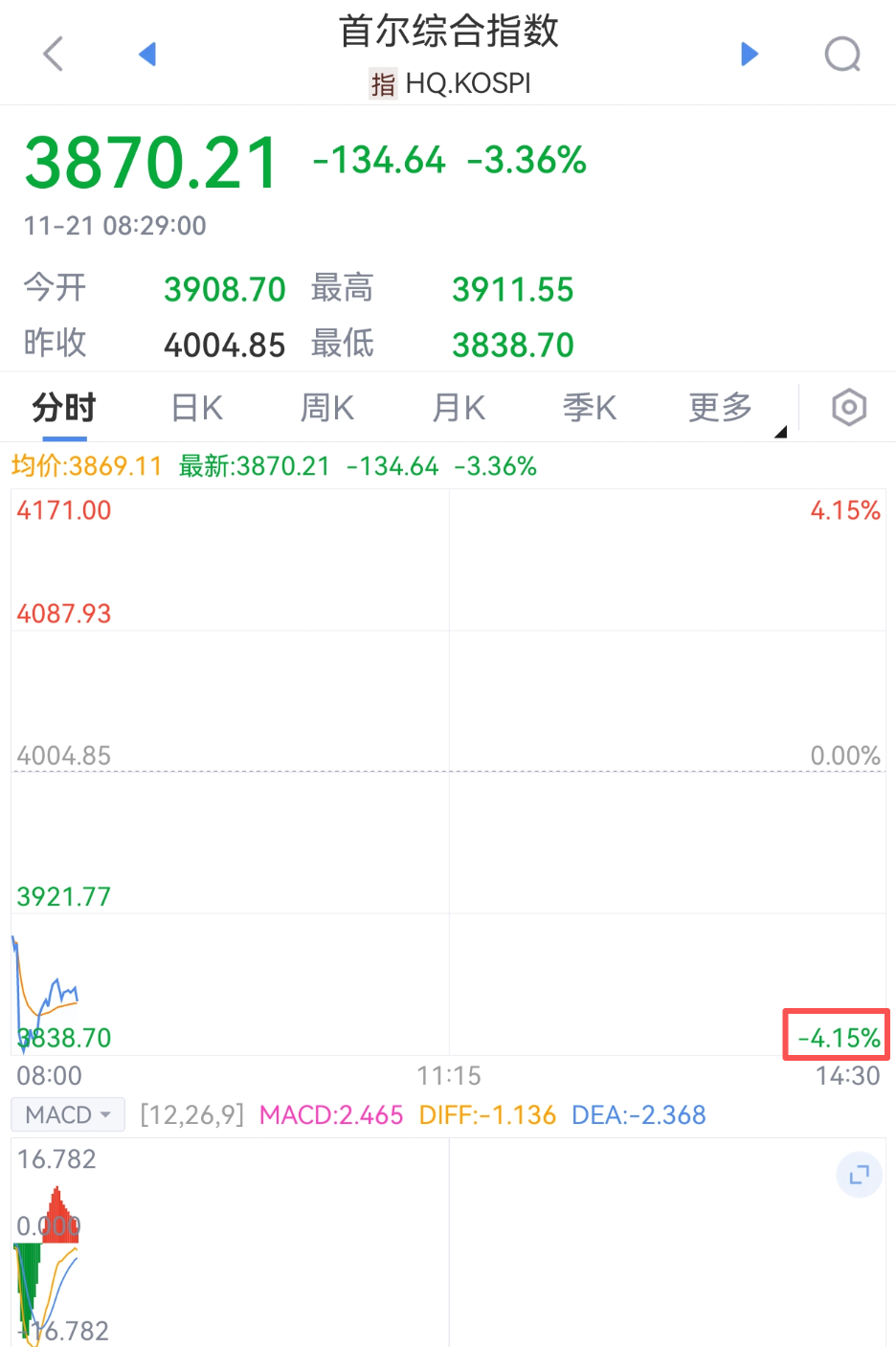
Group 1 - The Asia-Pacific stock markets experienced a significant decline, with the South Korean Composite Index showing the most pronounced drop, falling over 4% during intraday trading [1][2] - Concerns over the high valuations of artificial intelligence and technology-related stocks intensified, leading to a sell-off in tech stocks [1][2] - The South Korean Composite Index opened lower and fell below the key psychological levels of 4000 and 3900 points, with a decline exceeding 100 points at one point [2] Group 2 - In Japan, the Nikkei 225 index also saw a substantial drop, with intraday losses exceeding 2%, falling below the 49000-point mark [4] - Kioxia, a global leader in storage solutions, experienced a rare drop of over 16% in its stock price [4] - SoftBank Group's stock also faced a significant decline, with intraday losses surpassing 10% [4] Group 3 - The A-share market opened lower, with the Shanghai Composite Index dropping 0.87% and falling below the 3900-point threshold [6] - The Shenzhen Component Index opened down 1.76% and was down 1.71% at the time of reporting, while the ChiNext Index opened down 2.07% and remained nearly 2% lower [6][7] - Sectors such as non-ferrous metals, power equipment, telecommunications, and electricity saw the largest declines, while agriculture, food, and beverage sectors were relatively resilient [8]


亚太股市,全线重挫!
Zheng Quan Shi Bao· 2025-11-21 01:59
Group 1 - The Asia-Pacific stock markets experienced a significant decline, with the South Korean Composite Index dropping over 4% during the session [1][2] - Concerns over high valuations of artificial intelligence and technology-related stocks intensified, leading to a sell-off in tech stocks [1][2] - The South Korean stock market saw major declines, with SK Hynix's stock plummeting over 9% and Samsung Electronics falling more than 5% [2] Group 2 - The Japanese stock market also faced a sharp decline, with the Nikkei 225 index dropping over 2% and falling below the 49,000-point mark, with a drop of over 1,000 points [4] - Kioxia's stock experienced a rare decline, dropping over 16%, highlighting volatility in the semiconductor sector [4] - SoftBank Group's stock also saw a significant drop, with intraday losses exceeding 10% [5] Group 3 - The A-share market opened lower, with the Shanghai Composite Index falling 0.87% and breaking below the 3,900-point mark [6] - The Shenzhen Component Index and the ChiNext Index also experienced declines of 1.76% and 2.07%, respectively [6][7] - Sectors such as non-ferrous metals, power equipment, and telecommunications saw the largest declines, while agriculture and food sectors showed relative resilience [8]

亚太股市,全线重挫!
证券时报· 2025-11-21 01:56
Market Overview - The Asia-Pacific stock markets experienced a significant decline, with the South Korean Composite Index showing a particularly sharp drop, falling over 4% during intraday trading [1][3][5]. Technology Sector Concerns - There is growing concern regarding the overvaluation of stocks related to artificial intelligence and technology sectors, leading to a sell-off in tech stocks [2]. South Korean Market Details - The South Korean stock market opened lower, with the Composite Index breaking through key psychological levels of 4000 and 3900 points, dropping more than 100 points at one point, with a decline exceeding 4% before slightly narrowing [5]. - Major stocks in the South Korean market, such as SK Hynix, saw a significant drop, with its price falling over 9%. Samsung Electronics, another leading tech stock, also experienced a substantial decline, with intraday losses exceeding 5% [6]. Japanese Market Performance - The Japanese stock market mirrored the downward trend, with the Nikkei 225 index dropping over 2% and falling below the 49000-point mark, with intraday losses exceeding 1000 points [8]. - Kioxia, a global leader in storage solutions, faced a rare decline, with its stock price dropping over 16% [8]. A-Share Market Movement - The A-share market opened lower, with the Shanghai Composite Index falling by 0.87% and breaking below the 3900-point threshold. The Shenzhen Component Index opened down 1.76%, and the ChiNext Index opened down 2.07% [10][11]. - As of the latest update, sectors such as non-ferrous metals, power equipment, telecommunications, and electricity saw the largest declines, while agriculture, food, and beverage sectors remained relatively resilient [13].

日本股债汇"三杀",德银:相比美股波动,日本市场更令人担忧!
Hua Er Jie Jian Wen· 2025-11-21 01:43
Core Viewpoint - The Japanese financial market is experiencing a "triple whammy" of declines in stocks, bonds, and currency, raising concerns about potential capital flight similar to the 2022 UK bond market crisis [1][11]. Market Performance - The Nikkei 225 index saw a significant drop, falling nearly 3% on Thursday, with notable declines in individual stocks such as SoftBank, which fell 11%, and Kioxia, which saw a 16% drop [1]. - The Japanese yen has reached its lowest level since January, approaching a threshold that may prompt intervention from the Bank of Japan [1]. Bond Market Dynamics - The yield on 30-year Japanese government bonds has surged to levels not seen in decades, exceeding 3.35%, compared to around 3% earlier in the month [4][10]. - This increase in bond yields is occurring while other global fixed income markets are rebounding, highlighting Japan's unique market challenges [8]. Government Fiscal Policy Concerns - The turmoil is largely attributed to concerns over the new government's fiscal policy, which includes plans for the largest fiscal spending since the pandemic [7]. - Analysts warn that the combination of substantial fiscal stimulus and the Bank of Japan's dovish stance is eroding investor confidence in Japan's fiscal health [7][13]. Investor Sentiment and Risks - Deutsche Bank analysts have compared the current situation in Japan to the 2022 UK crisis, indicating a loss of confidence in domestic assets [12]. - If investors lose faith in the government's commitment to maintaining low inflation, the rationale for holding Japanese government bonds may disappear, leading to intensified capital outflows [12][14]. Future Monitoring - Analysts will closely observe for signs of broader capital flight, particularly if the current price trends affect the weak stock market and if Japanese bonds continue to decouple from global fixed income trends [14].
刚刚,开盘暴跌!
Zhong Guo Ji Jin Bao· 2025-11-21 01:40
【导读】日韩股市开盘重挫,AI泡沫隐忧带累科技股走低 亚太市场,不平静! 隔夜美股巨震,拖累日韩股市下挫。11月21日,日韩股市开盘集体跳水。 韩国KOSPI 200期货开盘下跌4%,韩国KOSPI指数跌超4%。 | 首尔综合指数 | | | --- | --- | | 指 HQ.KOSPI | | | 3870.21 -134.64 -3.36% | | | 11-21 08:29:00 | | | 今开 3908.70 最高 3911.55 | | | 昨收 4004.85 最低 | 3838.70 | | સ્ત્રે મથ 日K 周K 季K | 更多 | | 均价:3869.11 最新:3870.21 -134.64 -3.36% | | | 4171.00 | 4.15% | | 4087.93 | | | 4004.85 | 0.00% | | 3921.77 | | | 9838.70 | -4.15% | | 11:15 08:00 | 14:30 | | MACD ▼ [12,26,9] MACD:2.465 DIFF:-1.136 DEA:-2.368 | | | 16782 | | 对人 ...
刚刚,开盘暴跌!
中国基金报· 2025-11-21 01:29
【导读】日韩股市开盘重挫,AI泡沫隐忧带累科技股走低 中国基金报记者 晨曦 亚太市场,不平静! 隔夜美股巨震,拖累日韩股市下挫。11月21日,日韩股市开盘集体跳水。 韩国KOSPI 200期货开盘下跌4%,韩国KOSPI指数跌超4%。 | | KIOXIA | | | | | --- | --- | --- | --- | --- | | | 285A.T | | | | | 量 746万 9428.0 | | 股本 5.41亿 市盈 " | 32.8 万得 | | | -1907.0 -16.82% | 换 1.38% 市值5.10万亿 市净" | | 월 □ 6.22 | | | 分时 モ日 日K | 周K | | 童家 | (0) | | 叠加 | | | 英1 9430.0 | 300 | | 13330.0 | | 17.60% | 拿1 9428.0 | 400 | | | | | 09:28 9436.0 | 100 | | | | | 09:28 9440.0 | 100 | | 11335.0 | | 0.00% | 09:28 9441.0 | 100 | | | | | 09:28 94 ...

AI泡沫担忧加剧!日韩股市早盘大幅下挫,隔夜美股上演“过山车”式行情
Sou Hu Cai Jing· 2025-11-21 01:09
11月21日早盘,日韩股市早盘出现大幅下挫,此前隔夜的美国股市在大型科技股集体下跌下出现暴跌。 截至收盘,道琼斯指数跌0.84%,标普500指数跌1.56%,纳斯达克综合指数跌486.18点,跌幅2.15%。大 型科技股集体下挫,AMD跌超7%,甲骨文跌超6%,英伟达跌超3%,亚马逊跌逾2%,微软跌逾1%,特 斯拉跌超2%,谷歌跌超1%,苹果跌近1%,脸书跌0.19%。 导致美股上演"过山车"行情的背后,是美联储官员的鹰派言论和对AI高估值的担忧引发市场风险偏好回 落,这再度触发了美股大规模技术性抛售。 知名投资人、华尔街"大空头"迈克尔·伯里(Michael Burry)则在社交平台再度发文,抨击AI泡沫。他 表示:"下面列出的每家公司都存在可疑的收入确认问题。如果把所有交易都算进去,那图表简直难以 辨认。未来人们会把这看作是欺诈,而不是飞轮效应。真正的终端需求少得可怜,几乎所有客户都是靠 经销商出资的。" "认为芯片使用寿命更长(用于折旧)是因为3—4年前的芯片已被预订一空,这种想法混淆了物理利用 率和价值创造。仅仅因为某样东西被使用,并不意味着它就能盈利。"迈克尔·伯里写道。他举例称,通 用会计准则(G ...




长城证券:AI巨头上调资本开支 存储减产加剧价格上行
智通财经网· 2025-11-20 09:00
Core Viewpoint - The report from Changcheng Securities indicates that the demand for AI computing power is continuously strong, leading to a significant increase in prices for Flash Wafer and related high-end PCB products, benefiting the entire industry chain [1][2][3]. Group 1: Capital Expenditure Adjustments - Major North American CSPs such as Google, Microsoft, Amazon, and Meta have raised their capital expenditure forecasts for 2025, reflecting an unexpected surge in AI computing power demand [2][3]. - Google has increased its 2025 capital expenditure forecast from $85 billion to $91-93 billion, with a backlog of cloud orders amounting to $155 billion, up 82% year-on-year [3][4]. - Microsoft anticipates a growth rate in capital expenditure for FY26 that will exceed that of FY25, with a remaining performance obligation (RPO) nearing $400 billion, reflecting over 50% growth [4]. - Amazon's AWS backlog has reached $200 billion, with a capital expenditure forecast of $125 billion for 2025, expected to rise further in 2026 [4]. - Meta has also adjusted its 2025 capital expenditure forecast to between $70 billion and $72 billion, anticipating significant growth in computing power demand [4]. Group 2: NAND Flash Price Surge - NAND Flash prices have surged significantly, driven by major manufacturers reducing supply to counteract previous oversupply issues and enhance profitability [5][6]. - Companies like Samsung and Kioxia have lowered their NAND wafer production targets for the year, with Samsung reducing its target from 5.07 million wafers to approximately 4.72 million, a decrease of about 7% [5]. - The demand for NAND is expected to exceed supply significantly, with forecasts indicating that the data center market's bit demand will grow by over 40% year-on-year in 2026 due to increased AI inference capabilities [6].



下一代DRAM,三星大幅扩产
半导体行业观察· 2025-11-20 01:28
Core Viewpoint - Samsung Electronics is significantly expanding its next-generation DRAM production capacity, aiming to enhance its market position in anticipation of increased demand driven by AI technologies [2][3]. Group 1: Expansion Plans - Samsung plans to increase its monthly production capacity of 10nm sixth-generation DRAM (1c DRAM) to 200,000 wafers by the end of next year, starting with 60,000 wafers in Q4 of this year and adding 80,000 wafers in Q2 next year, followed by another 60,000 wafers in Q4 [2]. - The 1c DRAM, which features a line width of less than 11nm and utilizes multi-layer EUV processes, is expected to account for about one-third of Samsung's total DRAM monthly production capacity of 650,000 to 700,000 wafers [2]. Group 2: Market Dynamics - The demand for DRAM has surged due to AI, leading to shortages not only in HBM but also in general DRAM products, with instances of pre-orders for unproduced goods [3]. - Samsung's decision to invest heavily in 1c DRAM production is aimed at securing competitive pricing power in the upcoming DRAM cycle [3]. Group 3: Market Performance - In Q3, Samsung regained its position as the world's largest DRAM seller, with sales reaching $13.942 billion, a 29.6% increase from the previous quarter, resulting in a market share of 34.8% [4]. - SK Hynix followed closely with sales of $13.79 billion and a market share of 34.4%, indicating a competitive landscape between the two companies [5]. - The overall DRAM market saw total sales of $40.037 billion in Q3, marking a 24.7% increase from the previous quarter and a 54% increase year-over-year [6]. Group 4: NAND Flash Market - Samsung also maintained its leading position in the NAND flash market with sales of $5.366 billion, achieving a market share of 29.1% [6]. - The NAND flash market is expected to continue its growth momentum into Q4, driven by ongoing supply shortages across various applications [6].


产业链及主题投资周报:创新药及电池方向强势,机器人超跌-20251119
East Money Securities· 2025-11-19 08:22
Strategy Insights - The report highlights strong performance in the innovative drug sector and solid-state batteries, while robotics has seen a significant decline [1][8] - Key themes to focus on include innovative drugs, solid-state batteries, lithium batteries, energy storage, robotics, and commercial aerospace [2] Theme Investment Review - During the week of November 10-14, 2025, innovative drugs showed notable strength, while solid-state batteries experienced slight gains. Other sectors, particularly AI, faced declines [8] - The computing power index fell below the 60-day moving average, with MFI and RSI indicators continuing to decline [8] - The robotics index dropped, with MACD reaching its lowest point since April 7, and MFI entering the oversold zone below 20 [8] - Innovative drug stocks surpassed the 30-day moving average, with MACD trending upwards and MFI indicators showing an upward movement, though not yet in the overbought zone [8] - Solid-state batteries remain in an upward trend, with MA30 providing support, but MFI showed a significant decline this week, indicating a potential weakening of upward momentum [8] - Other sectors such as commercial aerospace, controllable nuclear fusion, quantum technology, and low-altitude economy are experiencing general fluctuations or weakness, but no clear oversold signals have emerged [8] Industry Chain Tracking AI Sector - The recent decline in storage was triggered by Kioxia's disappointing earnings, attributed to a fixed-price agreement with Apple that prevented it from benefiting from spot price increases. This is seen as an individual company issue rather than an industry turning point [41] - Future stock selection may shift from a broad rally to structural opportunities driven by AI, with a focus on core stocks that can benefit from rising storage prices [41] - Close monitoring of upstream manufacturers' capacity expansion plans and the actual implementation of AI demand is recommended [41] Lithium Battery Sector - Recent strong performance in lithium battery stocks is primarily driven by explosive growth in AIDC's electricity demand [42] - AIDC's power consumption has surged due to increased GPU power and AI cabinet upgrades, leading to significant power investment expansion [42] - AIDC's high reliability requirements for backup power are driving rapid growth and even premium pricing in the backup power market, with price increases expected to continue due to persistent supply-demand gaps [42] Technological and Industrial Developments - Baidu launched its native multimodal model, Wenxin Model 5.0, with 2.4 trillion parameters, aiming to enhance AI applications across various industries [47] - Avenzo's EGFR/HER3 dual antibody ADC drug received fast-track designation from the FDA, marking a significant breakthrough for domestic dual antibody ADCs internationally [47] - The successful launch of 13 low-orbit satellites using the Long March 12 rocket from Hainan's commercial aerospace launch site demonstrates advancements in China's commercial aerospace capabilities [47] - Developments in brain-computer interfaces and humanoid robots are also noted, indicating progress in these cutting-edge technologies [47]