新凤鸣

Search documents
新凤鸣1月6日获融资买入3165.32万元,融资余额1.52亿元
Xin Lang Cai Jing· 2026-01-07 01:31
1月6日,新凤鸣涨6.25%,成交额4.24亿元。两融数据显示,当日新凤鸣获融资买入额3165.32万元,融 资偿还2062.21万元,融资净买入1103.11万元。截至1月6日,新凤鸣融资融券余额合计1.58亿元。 机构持仓方面,截止2025年9月30日,新凤鸣十大流通股东中,香港中央结算有限公司位居第九大流通 股东,持股1673.14万股,为新进股东。 责任编辑:小浪快报 截至12月19日,新凤鸣股东户数1.81万,较上期减少8.20%;人均流通股83564股,较上期增加8.93%。 2025年1月-9月,新凤鸣实现营业收入515.42亿元,同比增长4.77%;归母净利润8.69亿元,同比增长 16.53%。 分红方面,新凤鸣A股上市后累计派现17.33亿元。近三年,累计派现7.20亿元。 融资方面,新凤鸣当日融资买入3165.32万元。当前融资余额1.52亿元,占流通市值的0.49%,融资余额 低于近一年40%分位水平,处于较低位。 融券方面,新凤鸣1月6日融券偿还6.64万股,融券卖出2600.00股,按当日收盘价计算,卖出金额5.35万 元;融券余量28.13万股,融券余额578.55万元,超过近一 ...

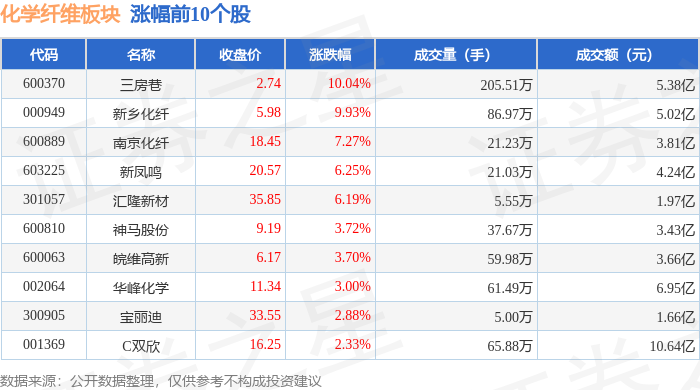
化学纤维板块1月6日涨2.88%,三房巷领涨,主力资金净流出3982.58万元
Zheng Xing Xing Ye Ri Bao· 2026-01-06 08:56
Group 1 - The chemical fiber sector increased by 2.88% on January 6, with Sanfangxiang leading the gains [1] - The Shanghai Composite Index closed at 4083.67, up 1.5%, while the Shenzhen Component Index closed at 14022.55, up 1.4% [1] - Notable stock performances include Sanfangxiang with a closing price of 2.74, up 10.04%, and Xinxing Chemical Fiber at 5.98, up 9.93% [1] Group 2 - The main capital flow in the chemical fiber sector showed a net outflow of 39.83 million yuan from institutional investors, while retail investors experienced a net outflow of 53.86 million yuan [2] - Retail funds saw a net inflow of 93.69 million yuan, indicating active trading by retail investors [2] - The individual stock capital flows reveal that Sanfangxiang had a net inflow of 48.63 million yuan from institutional investors, while it faced a net outflow of 27.08 million yuan from retail investors [3]


新凤鸣(603225) - 可转债转股结果暨股份变动公告
2026-01-05 08:16
| 股票代码:603225 | 股票简称:新凤鸣 | | | 公告编号:2026-001 | | --- | --- | --- | --- | --- | | 转债代码:113623 | 转债简称:凤 | 21 | 转债 | | 新凤鸣集团股份有限公司 可转债转股结果暨股份变动公告 本公司董事会及全体董事保证本公告内容不存在任何虚假记载、误导性陈述或者重大遗 漏,并对其内容的真实性、准确性和完整性承担个别及连带责任。 重要内容提示: 累计转股情况:截至 2025 年 12 月 31 日,累计共有 101,000.00 元"凤 21 转债"已转换成公司股票,累计转股数为 6,203 股,占可转债转股前公司已发行 股份总额的 0.0004%。 未转股可转债情况:截至 2025 年 12 月 31 日,尚未转股的可转债金额为 2,499,899,000.00 元,占可转债发行总量的 99.9960%。 2025 年度第四季度转股情况:本季度可转债转股的金额为 15,000 元,因 转股形成的股份数量为 949 股。 一、可转债发行上市概况 (一)可转债发行情况 经中国证券监督管理委员会《关于核准新凤鸣集团股份有限 ...
新凤鸣(603225) - 2026年第一次临时股东会会议资料
2026-01-05 08:15
新凤鸣集团股份有限公司 2026 年第一次临时股东会 新凤鸣 2026 年第一次临时股东会会议资料 目录 会议资料 2026 年 1 月 | 新凤鸣集团股份有限公司 2026 | 年第一次临时股东会通知 3 | | --- | --- | | 新凤鸣集团股份有限公司 2026 | 年第一次临时股东会会议须知 4 | | 新凤鸣集团股份有限公司 2026 | 年第一次临时股东会会议议程 6 | | 议案一、关于修订《公司章程》的议案 | 7 | 2 新凤鸣 2026 年第一次临时股东会会议资料 新凤鸣集团股份有限公司 2026 年第一次临时股东会通知 各位股东及股东代表: 新凤鸣集团股份有限公司(以下简称"公司")2026 年第一次临时股东会拟 于 2026 年 1 月 14 日下午 14:00 时在公司总部二十四楼会议室召开。 本次股东会审议和表决议题如下: 1、审议《关于修订<公司章程>的议案》 以上议案已经于 2025 年 12 月 29 日召开的公司第六届董事会第四十四次会议 审议通过,并于 2025 年 12 月 30 日在上海证券交易所网站(www.sse.com.cn)及 《上海证券报》《证券时报 ...
对二甲苯:成本支撑,高位震荡市,PTA:成本支撑,高位震荡市,MEG:上方空间有限,中期仍有压力
Guo Tai Jun An Qi Huo· 2026-01-05 05:22
1. Report Industry Investment Ratings - No investment ratings are provided in the report. 2. Core Views of the Report - PX is expected to remain in a high - level volatile market supported by cost, and it is recommended to hold long spreads. PTA is also in a high - level volatile market driven by cost, and long spreads operation should be maintained. MEG has limited upside space and faces medium - term pressure, and short spreads operation is advised [1][6][7][8] 3. Summary by Relevant Catalogs 3.1 Market Data - **Futures Prices**: The closing prices of PX, PTA, MEG, PF, and SC futures on the previous day were 7260, 5110, 3803, 6514, and 432.2 respectively, with daily changes of - 56, - 34, - 44, - 50, and - 3.9, and daily change rates of - 0.77%, - 0.66%, - 1.14%, - 0.76%, and - 0.89% [2] - **Spot Prices**: The previous day's spot prices of PX CFR China, PTA in East China, MEG, naphtha MOPJ, and Dated Brent were 894 dollars/ton, 5097 yuan/ton, 3678, 530.12 dollars/ton, and 60.98 dollars/barrel respectively [2] - **Spot Processing Fees**: The previous day's PX - naphtha spread, PTA processing fee, short - fiber processing fee, bottle - chip processing fee, and MOPJ naphtha - Dubai crude spread were 363.88, 361.63, 120.64, 43.68, and - 4.34 respectively [2] 3.2 Market Dynamics - **PX**: As of January 4, the domestic PX plant operating rate was 90.4%, and the Asian PX operating rate was 80.9% [2] - **PTA**: The PTA load was 78.1%. Dushan Energy's 250 - million - ton plant restarted, Zhongtai's 120 - million - ton plant restarted at a low load, and Weilian Chemical's 250 - million - ton plant increased its load [3] - **MEG**: A 200,000 - ton/year syngas - to - ethylene glycol plant in Henan stopped for catalyst replacement at the end of December 2025, with an expected duration of about 2 weeks. A 615,000 - ton/year MEG plant in Kuwait plans to stop for maintenance on January 9, with an expected maintenance duration of about one month. As of January 4, the overall operating load of ethylene glycol in mainland China was 73.73% (a 1.58% increase from the previous period), and the operating load of oxalic acid catalytic hydrogenation (syngas) to ethylene glycol was 75.86% (a 0.51% decrease from the previous period) [3][4] - **Polyester**: The operating load of large domestic polyester industrial yarn manufacturers remained basically stable, with the overall theoretical operating load of domestic polyester industrial yarn at around 75% (starting from January 2026, the production capacity base of polyester industrial yarn is 3.28 million tons). As of Sunday, the polyester load in mainland China was around 90.8%. The sales of polyester yarn in Jiangsu and Zhejiang were weak, with an average sales rate of less than 40% as of 4 pm. The sales of direct - spun polyester staple fiber were highly differentiated, with an average sales rate of 57% as of 3 pm [4] 3.3 Terminal Market in Jiangsu and Zhejiang - **Operating Rates**: The comprehensive operating rate of texturing in Jiangsu and Zhejiang dropped to 74%, the comprehensive operating rate of looms dropped to 59%, and the comprehensive operating rate of dyeing remained at 69% [5] - **Raw Material Stockpiling**: Terminal factories mainly consumed raw material stocks this week, and raw material purchases were mainly for new orders. The raw material purchase volumes of terminal factories varied widely. Currently, the stockpiles of production factories are concentrated between 1 - 3 weeks, and some with more stockpiles still have 1 - 2 months' worth [5] - **Orders and Prices**: New orders in the weaving sector remained weak, with some foreign trade and spring - summer new orders being slightly followed up. The inventory of grey fabric continued to accumulate. The prices of conventional grey fabric varieties declined locally, and the nominal cash - flow losses of grey fabric widened [5] 3.4 Trend Intensity - The trend intensity of PX and PTA is 1, while that of MEG is 0 [6] 3.5 Views and Suggestions - **PX**: With strong cost support, long spreads should be held. After the US air - strike on Venezuela on January 3, oil prices are expected to rise in the short - term, supporting the valuation of PX. The 1 - million - ton plant of Fujia Dahua restarted, and India's GAIL purchased Middle - East PX supplies for its planned start - up in March - April. The domestic PX operating rate is 88%. For domestic PTA plants, the processing fee of the 05 contract on the futures market has risen to over 300 yuan/ton. The 2.5 - million - ton plant of Xin Fengming Phase 1 and the 1.2 - million - ton plant of Zhongtai Chemical restarted, and the operating rate is expected to recover. The overall operating rate is expected to remain at around 78% [6] - **PTA**: In a cost - driven market, the bullish pattern is difficult to disprove for now, and long spreads operation should be maintained. The situation of PTA domestic plants is the same as that mentioned for PX. The profits of polyester filament factories have been declining, leading to a decrease in operating enthusiasm, but the current decline in polyester operating rate is not significant. Coupled with the large - scale export of PTA to India in December, the PTA segment is still in a state of continuous inventory reduction [6][7] - **MEG**: Although it is affected by the rising valuation of oil and coal prices in the short - term, its medium - term trend remains weak, and short spreads operation is recommended. The domestic ethylene glycol supply remains at a high level of 73.73%. The 200,000 - ton plant of Guangxi Huayi restarted. Overseas, plants in Taiwan, China (720,000 tons), Kuwait (530,000 tons), and Iran (400,000 tons) are under maintenance. The import volume of ethylene glycol is expected to decline marginally in January - February. The operating rate of polyester plants is 90.8%, and the rigid demand for ethylene glycol is decreasing. The polyester load is expected to drop from 89% in January to 84% in February [8]
新凤鸣跌2.00%,成交额7381.63万元,主力资金净流入514.79万元
Xin Lang Cai Jing· 2026-01-05 02:18
Core Viewpoint - The stock price of Xin Feng Ming has experienced a decline of 2.00% this year, with fluctuations in trading performance over various periods, indicating a mixed market sentiment towards the company [1][2]. Group 1: Stock Performance - As of January 5, Xin Feng Ming's stock price is reported at 19.07 CNY per share, with a trading volume of 73.82 million CNY and a turnover rate of 0.25%, resulting in a total market capitalization of 29.073 billion CNY [1]. - Year-to-date, the stock has decreased by 2.00%, with a 5-day decline of 1.14%, a 20-day increase of 11.85%, and a 60-day increase of 18.82% [2]. Group 2: Company Overview - Xin Feng Ming Group Co., Ltd. was established on February 22, 2000, and went public on April 18, 2017. The company is located in Tongxiang City, Zhejiang Province, and specializes in the research, production, and sales of polyester filament, short fibers, and PTA, which is a key raw material [2]. - The revenue composition of Xin Feng Ming includes POY at 42.73%, PTA at 13.29%, FDY at 13.27%, short fibers at 11.16%, DTY at 10.16%, and other segments accounting for 4.72% [2]. Group 3: Financial Performance - For the period from January to September 2025, Xin Feng Ming achieved a revenue of 51.542 billion CNY, reflecting a year-on-year growth of 4.77%. The net profit attributable to shareholders reached 0.869 billion CNY, marking a 16.53% increase [2]. - Since its A-share listing, Xin Feng Ming has distributed a total of 1.733 billion CNY in dividends, with 0.720 billion CNY distributed over the past three years [3]. Group 4: Shareholder Information - As of December 19, 2025, the number of shareholders for Xin Feng Ming is reported at 18,100, a decrease of 8.20% from the previous period, with an average of 83,564 circulating shares per shareholder, which is an increase of 8.93% [2]. - Among the top ten circulating shareholders, Hong Kong Central Clearing Limited is the ninth largest, holding 16.7314 million shares as a new shareholder [3].
国泰君安期货·能源化工短纤、瓶片周度报告-20260104
Guo Tai Jun An Qi Huo· 2026-01-04 12:21
1. Report Industry Investment Rating No relevant content provided. 2. Core Views of the Report - Short - fiber: Short - term sideways market, medium - term weakening. The current situation shows a continuation of upstream - downstream contradictions, with short - term high - level sideways trends. The actual output of short - fiber has increased, and the strategy of going long on PX/TA and short on PF should be continued [3][8]. - Bottle chips: Sideways with a weakening tendency. There is also a continuation of upstream - downstream contradictions, short - term high - level sideways. The actual supply of bottle chips in January is expected to increase first and then decrease, and the supply - demand situation will gradually improve from late January to the end of the month. A light - position long spread strategy can be considered at low prices [2][10]. 3. Summaries by Related Catalogs 3.1 Short - fiber (PF) 3.1.1 This Week's View - Supply: Factory operating rates have increased to 98.5%. Some factories plan to shut down before the Spring Festival, mostly around the end of January [8]. - Demand: Domestic terminal orders are weakening, and the yarn, weaving, and grey fabric sectors are reducing their loads. Terminal restocking increased during the low - price promotions last weekend, but overall sales were weak during the week. Short - fiber has a nominal inventory reduction but a physical inventory build - up, with the inventory index rising to 8.9 days (+1.2 days) [8]. - View: The upstream - downstream contradictions continue, and it will be in a short - term high - level sideways trend. The short - fiber and bottle chips have followed the price increases in a timely manner, and the processing margins on the futures market have not been compressed to near the cost. Although some factories have announced production cuts, there are no unexpected developments. The actual output of short - fiber has increased, and the strategy of going long on PX/TA and short on PF should be continued [8]. 3.1.2 Valuation and Strategy - Valuation: The current spot premium is 950 - 1000 yuan/ton, and the processing margin on the futures market is 1000 yuan/ton, which is relatively high [9]. - Strategy: No unilateral strategy; for inter - period trading, observe long spreads at low prices and enter when the valuation is reasonable; continue to hold the strategy of going long on PX/TA and short on PF [9]. 3.2 Bottle chips (PR) 3.2.1 This Week's View - Supply: The average operating rate this week is expected to reach 82.2%. Factory operating rates have increased again, with new production from a 300,000 - ton new device of Fuhai. Overall operating rates may start to decline in late January [10]. - Demand: Downstream operating rates have increased month - on - month. The average operating rate of beverage factories has rebounded to around 70%, and the operating rates of edible oil and sheet material sectors have also increased. Exports from November to December are expected to be in the range of 550,000 - 600,000 tons. Factories have reduced their inventories to around 13 days [10]. - View: The upstream - downstream contradictions continue, and it will be in a short - term high - level sideways trend. The supply of bottle chips in January is expected to increase first and then decrease, and the supply - demand situation will gradually improve from late January to the end of the month. A light - position long spread strategy can be considered at low prices [10]. 3.2.2 Valuation and Strategy - Valuation: The spot processing margin is 400 - 450 yuan/ton, which is neutral; the 02 - 03 processing margin is also 400 - 450 yuan/ton, neutral [10]. - Strategy: No unilateral strategy; for inter - period trading, take profit on short spreads and consider light - position long spreads for contracts after March; no cross - variety strategy [10]. 3.3 New Capacity and Supply - Demand Outlook - **Bottle chips in 2026**: The planned new capacity is relatively small, with only a 400,000 - ton device of Kesen and the remaining 300,000 tons of Fuhai, with a total capacity increase of 700,000 tons and a capacity growth rate of 3.2%. The profit trend is expected to recover [11]. - **Short - fiber in 2026**: The capacity growth rate is relatively high, with two main devices: a 250,000 - ton device of Hengyi Yida and a 550,000 - ton device of Xin Fengming, with a capacity growth rate of 8.7%. This may also put pressure on non - standard price differentials [14]. 3.4 Market Conditions and Related Indicators - **Bottle chips**: - Price: The price has been rising, with an average weekly quotation of 6035 yuan/ton, and the average FOB price is 795 US dollars/ton [25]. - Basis and monthly spreads: The price has corrected from a high level, the basis has significantly recovered, the near - month monthly spreads are still affected by deliverable goods, and the far - end structure is gradually strengthening [22]. - Production and operating rates: The current effective capacity has reached 2.168 billion tons (CCF caliber), and after the commissioning of the Fuhai device, the capacity will increase to 2.198 billion tons. The operating rate of bottle chips this week is expected to rise to 82.2% [33]. - Raw materials: The PTA operating rate is low, and the processing margin has slightly recovered; the ethylene glycol operating rate has rebounded to a high level, and port inventories are increasing [34][42]. - Costs and profits: The polymerization cost is around 5550 - 5600 yuan/ton, the bottle chip processing margin is passively compressed, and the export profit is about 725 - 750 yuan/ton [44]. - Inventories: The inventory pressure of domestic polyester bottle chip factories is neutral, with inventories at around 13 days (CCF caliber), and the estimated social inventory in November is 3.23 million tons and 3.44 million tons in December [49]. - Device changes: Pay attention to the commissioning rhythm of new devices. In December, the operating rate increased. Some devices are planned for maintenance in January and are expected to restart in March [55]. - Demand: Downstream operating rates have increased month - on - month. The operating rates of beverage, edible oil, and sheet material sectors have all shown an upward trend, but the overall demand for beverages and edible oil is still relatively weak [59][67][68]. - Exports: In November 2025, the total export volume of polyester bottle chips and slices was 658,000 tons, a year - on - year increase of 2.5%. From January to November 2025, the total export volume was 7.088 million tons, a year - on - year increase of 13.9% [82]. - **Short - fiber**: - Valuation: The basis has generally recovered, the monthly structure is in contango, and the near - month contracts are gradually flattening. The processing margin on the futures market is relatively low [95][99]. - Operating rates: Short - fiber factory operating rates are high, currently at 98.5% [105]. - Inventories: Polyester product inventories are generally at a low level, and short - fiber inventories have increased slightly, with the inventory index rising to 8.9 days (+1.2 days) [8][109]. - Exports: In November, polyester exports increased year - on - year but showed a differentiated performance month - on - month. Short - fiber direct exports are expected to remain strong [113][15]. - Profits: The profits of long - fiber and chip sectors are weak, and losses are intensifying [117]. - Downstream: The operating rate of polyester yarn has decreased slightly month - on - month, and inventories are gradually increasing. The weaving operating rate has also decreased slightly [124][126]. 3.5 Textile and Apparel Market - **Retail**: In November 2025, the retail sales of clothing, footwear, needles, and textiles increased year - on - year but decreased month - on - month [135]. - **Exports**: In November 2025, textile and apparel exports decreased month - on - month. From January to October 2025, the cumulative export of textile and apparel was 174.919 billion yuan, a slight year - on - year decrease of 0.7% [143][147].
聚酯数据周报-20260104
Guo Tai Jun An Qi Huo· 2026-01-04 08:46
1. Report Industry Investment Rating - Not provided 2. Core Viewpoints - In the first half of 2026, PX is expected to be the strongest variety in the polyester industry chain [15] - The cost - driven PX market has strong support, and the long - spread position should be held; the PTA market is in a high - level oscillation range with cost - driven strength and the long - spread position should be maintained; the MEG market is suitable for range operation with a weak mid - term trend and a short - spread position [3][4][5] 3. Summary by Directory PX Valuation and Profit - PX price fluctuates and the curve near - end is flat; the 05 - 9 month spread strengthens, while the 1 - 5 spread weakens [17][19] - PXN expands due to weak naphtha demand, and the aromatics blending oil demand is weak [24][27] - The aromatics blending oil economy weakens, the PX - MX spread hits a new high, and the overseas MX isomerization economy improves [38][42][46] - The profitability of STDP units at home and abroad recovers, and the enthusiasm for starting work is restored [48] Supply and Demand, Inventory - The domestic PX operating rate is at a historical high. The 100 - million - ton PX device of Dalian Fujia is restarting, and the Asian overall operating rate is 79.5% (+0.6%) [53][55] - In November, PX imports were 820,000 tons, with an increase in imports from South Korea and Japan and a decline from Brunei [60] - In November, Japan's aromatics production and inventory declined; South Korea's aromatics export and inventory data show certain trends [71][78] - In November, the long - term PX monthly inventory accumulated by 50,000 tons to 4.07 million tons [85] PTA Valuation and Profit - The PTA price rises significantly, the basis rebounds steadily, the basis and month - spread of the 1 - 5 contract change, and the warehouse receipt volume decreases marginally [87][91] - The processing fee rebounds from the bottom, the overall price of the polyester chain moves up, and the downstream follow - up increase is limited [93][94] Supply and Demand, Inventory - The PTA operating rate stabilizes at 71 - 72%. The 2.5 - million - ton device of Xin凤鸣 Phase I and the 1.2 - million - ton device of Zhongtai Chemical are restarting [96] - In November, PTA exports were 360,000 tons, with significant increases in Egypt, Oman, and India [99] - The PTA inventory decreases marginally [114] Position - The long - position holdings of Morgan Qiankun in PTA increase, and foreign - funded seats increase their long - position holdings to 154,000 lots (+40,000 lots) [118][120] MEG Valuation and Profit - The MEG month - spread declines, the basis weakens, and the single - side price trend is weak [132] - The relative valuation continues to decline, and the trend continues until active production cuts [136] - The coal - based device profit is - 217 yuan/ton (+43), and the oil - based device continues to be in a loss pattern [138] Supply and Demand, Inventory - In 2026, many MEG production projects are put into production. The domestic MEG operating rate is 72% (+2%), and the weekly supply is about 400,000 tons [128][144] - In November, MEG imports were 580,000 tons, lower than market expectations. Overseas multiple devices reduce their loads, and imports are expected to decline [146][149] - The MEG port inventory continues to rise [154] Polyester Segment Operating Rate and Inventory - The current polyester operating rate is 89.5%. The production reduction of the three major polyester filament factories is about 2.819 million tons. The polyester load in January is adjusted from 89% to 88%, and is expected to be 84% in February [161] - During the New Year's Day, the sales volume is light, and the inventory is expected to accumulate again. The equity inventory of filament (POY/FDY) is 5 - 10 days [165][171] Export and Profit - From January to November, the total polyester exports were 13.3 million tons, +14.7%. The export growth rates of various polyester products are different [173] - The losses of filament factories expand, while the profitability of staple fiber and bottle chips is acceptable [175] Terminal: Weaving, Textiles and Apparel Operating Rate and Order - The operating rate of Jiangsu and Zhejiang looms is 60% (-2%), and the texturing machine operating rate is 79% [196] - Domestic orders weaken, and raw material inventory increases. The weaving end has weak new orders, and the坯布 inventory accumulates again [199][201] Retail and Export - From January to November, the retail sales of Chinese textile and apparel were 1.3597 trillion yuan, +3.5% [202] - From January to November, the cumulative export of Chinese textile and apparel was 137.8 billion US dollars, with a cumulative year - on - year decrease of 4.4% [208] Overseas Market - The retail data of textile and apparel in the US and Europe show strong growth. The US clothing retail in January - September 2025 was 160.7 billion US dollars, +7.5% [212][214] - The UK clothing retail in January - November was 43.8 billion pounds, +6% [216] - The overseas textile and apparel inventory declines slightly month - on - month [218]
硫酸行业保供稳价,碳酸锂、PTA涨幅居前
Zhong Guo Neng Yuan Wang· 2026-01-04 06:11
Market Performance - The basic chemical index increased by 2.58% from December 13 to December 19, while the CSI 300 index decreased by 0.28%, indicating that the basic chemical sector outperformed the CSI 300 by 2.85 percentage points, ranking fifth among all sectors [1][2] - The top-performing sub-industries included spandex (15.38%), other rubber products (10.78%), viscose (5.14%), civil explosives (4.25%), and potassium fertilizer (3.98%) [1][2] Chemical Price Trends - The top five products with the highest weekly price increases were hydrochloric acid (Jiangsu) at 57.14%, hydrochloric acid (Shandong) at 44.44%, industrial-grade lithium carbonate at 7.63%, battery-grade lithium carbonate at 7.57%, and butadiene at 6.12% [3] - The top five products with the largest weekly price declines included concentrated nitric acid at -9.30%, VCM (vinyl chloride monomer) at -6.25%, international gasoline at -6.11%, caustic soda (32% ion membrane) at -5.45%, and sulfur at -5.06% [3] Industry Dynamics - The sulfuric acid industry is focusing on supply stability and price control to ensure national food security, with measures being implemented to stabilize fertilizer supply and prices ahead of the spring farming season [4] - The current international sulfur supply is tight, leading to increased global sulfur resource prices and significantly raising the production costs for phosphate fertilizer [4] - As of December 19, the market price for sulfuric acid (98% smelting acid, Shandong) was 865 RMB/ton, with an increase of 8.81% in December and a year-to-date increase of 162.12% [4] Company Developments - Mitsui Chemicals announced an expansion of its MDI production capacity in South Korea, adding 100,000 tons/year, which will increase the plant's annual capacity from 610,000 tons to 710,000 tons, with production expected to start in May 2027 [5] - Dow Chemical plans to raise prices for its polymer MDI products in Southeast Asia by $200/ton, while Wanhua Chemical will also increase prices for all MDI and TDI products in Latin America by $200/ton starting December 15 [5] Investment Recommendations - The current investment focus includes the refrigerant sector, chemical fiber sector, and high-quality growth stocks, with specific companies recommended for attention [6] - Suggested companies in the refrigerant sector include Jinshi Resources, Juhua Co., and Sanmei Co. [6] - In the chemical fiber sector, recommended companies include Huafeng Chemical and Xinfengming [6] - Other notable companies include Wanhua Chemical, Hualu Hengsheng, and Luxi Chemical [6]

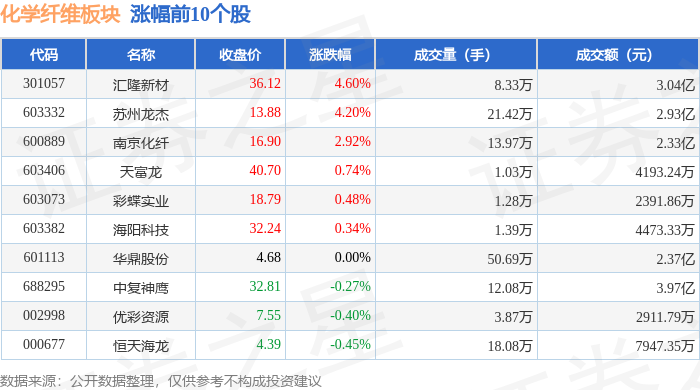
化学纤维板块12月31日跌1.41%,C双欣领跌,主力资金净流出2.44亿元
Zheng Xing Xing Ye Ri Bao· 2025-12-31 08:56
Group 1 - The chemical fiber sector experienced a decline of 1.41% on December 31, with C Shuangxin leading the drop [1] - The Shanghai Composite Index closed at 3968.84, up 0.09%, while the Shenzhen Component Index closed at 13525.02, down 0.58% [1] - Key stocks in the chemical fiber sector showed varied performance, with Huillong New Materials rising by 4.60% and C Shuangxin falling by 16.11% [1][2] Group 2 - The main funds in the chemical fiber sector saw a net outflow of 244 million yuan, while retail investors had a net inflow of 177 million yuan [2] - The trading volume for C Shuangxin was 1.0414 million shares, with a total transaction value of 1.82 billion yuan [2] - The fund flow analysis indicates that Suzhou Longjie had a net inflow of 27.84 million yuan from main funds, while Jilin Chemical Fiber experienced a net outflow of 38.83 million yuan from retail investors [3]