天弘基金

Search documents
激烈!公募基金最新数据出炉!非货万亿俱乐部再添新丁,5家机构规模缩水超百亿元
券商中国· 2026-01-23 01:17
Core Viewpoint - The public fund industry in China is experiencing significant shifts in product scale and investor preferences, with a notable divergence in risk appetite among investors, leading to a mixed environment of opportunities and challenges for the industry [2]. Group 1: Market Trends - Since the fourth quarter of last year, there has been a rapid rotation in market styles, with a clear adjustment in the scale of industry products. Index funds, mixed bond funds, commodity funds, overseas investment funds, and FOFs have all seen growth, while actively managed equity funds and pure bond funds continue to shrink [2]. - As of December 31, 2025, the total net asset value of public funds exceeded 37.64 trillion yuan, marking a historical high, with continued net inflows into the public fund market [3]. - The bond fund sector has rebounded, with a quarterly growth exceeding 300 billion yuan, bringing the total scale close to 11 trillion yuan, also a historical high [4]. Group 2: Fund Performance - Actively managed equity funds faced net redemptions, with investors losing confidence despite improved performance. The overall share of these funds showed a net outflow in the fourth quarter [3]. - In contrast, investors favored index equity funds, particularly the A500 index ETFs, which saw significant inflows, with several funds growing by over 10 billion yuan in the fourth quarter [3]. Group 3: Multi-Asset Growth - 2025 is marked as a year of explosive growth for multi-asset funds, with overseas investment funds, commodity funds, and FOFs experiencing substantial increases in scale. The commodity fund sector saw a quarterly increase of over 45%, with gold and silver products leading the growth [5][6]. - The FOF products regained popularity, with several newly established funds achieving impressive fundraising results in the fourth quarter [6]. Group 4: Competitive Landscape - The public fund industry exhibits a pronounced "Matthew Effect," where leading firms maintain strong competitive positions, while mid-tier firms face intense competition. The top three firms in non-monetary fund scale are E Fund, Huaxia Fund, and GF Fund, with GF Fund recently surpassing the 1 trillion yuan mark for the first time [7][8]. - Smaller firms, some with non-monetary scales below 100 billion yuan, have also shown significant growth, with several achieving over 10 billion yuan in quarterly increases [9].


基金早班车丨公募新发市场持续升温,首发70亿元股基重现
Jin Rong Jie· 2026-01-23 00:45
Group 1 - The public fund issuance market has been heating up since the beginning of the year, with the Guangfa Research Smart Selection Mixed Fund achieving a record initial scale of 7.221 billion yuan, marking the first active equity fund to exceed 7 billion yuan since November 2022 [1] - There is a trend of high-performing old funds closing to new subscriptions to prevent rapid scale expansion, indicating a cautious approach to fund management in the current market [1] - Analysts suggest that the shift of household assets is still in its early stages, and there is potential for long-term incremental capital in equities, with expectations of another wave of blockbuster fund issuances around the Spring Festival [1] Group 2 - On January 22, two new funds were launched, primarily Fund of Funds (FOF), with Tianhong Yuexiang Zhenxuan Mixed Fund (FOF) A targeting a fundraising goal of 8 billion yuan [2] - As of January 9, the stock private equity position index rose to over 81%, ending a three-week decline, with significant increases in positions among large private equity firms [2] - A total of 27 public funds announced early termination of fundraising as of January 22, a year-on-year increase of 28.57%, with passive index funds making up half of this number [2] Group 3 - The Huaxia National Index Free Cash Flow ETF has surpassed 10 billion yuan in scale, becoming the first product of its kind to reach this milestone, reflecting a growing interest in stable cash flow companies amid market uncertainties [3] - The rapid expansion of free cash flow ETFs indicates a shift from niche strategies to mainstream investment tools, as investors seek refuge in companies with stable cash flows [3]

腰部基金公司规模“突围”!“爆款基”密集现身
Zhong Guo Zheng Quan Bao· 2026-01-22 23:19
Group 1 - The total scale of public funds reached 37.26 trillion yuan by the end of Q4 2025, with a quarter-on-quarter increase of over 1.3 trillion yuan [2] - The largest growth came from money market funds, which increased by 571.93 billion yuan, followed by bond funds with an increase of 446.94 billion yuan, and stock funds with an increase of 155.08 billion yuan [2] - The top two fund companies by total management scale are E Fund and Huaxia Fund, each managing over 2 trillion yuan, while eight other companies manage over 1 trillion yuan [2] Group 2 - The largest increase in non-money management scale was seen in Guotai Fund, which grew by 62 billion yuan, followed by Invesco Great Wall Fund with a growth of 53.12 billion yuan [3] - Several large fund companies experienced significant growth, with notable products contributing over 20 billion yuan in scale increase, such as the Huaxia CSI 500 ETF and the Invesco Great Wall Jing Sheng Dual Income Bond [3] - Mid-sized fund companies showed considerable changes, with several becoming "dark horses" in Q4 2025, such as Changcheng Fund and Dongcai Fund, which saw increases of over 20 billion yuan [4] Group 3 - Smaller fund companies like Shanzheng Asset Management and Huayin Fund also reported substantial growth in non-money management scale in Q4 2025 [4] - The rebranding of Beixin Ruifeng Fund to Huayin Fund led to a rapid increase in scale, reaching 26.75 billion yuan with a growth of 6.1 billion yuan [4] - Notable products from smaller firms, such as the Debon Xin Xing Value Fund, contributed significantly to their growth [4]
降费、降费!又有基金出手
Zhong Guo Ji Jin Bao· 2026-01-22 22:55
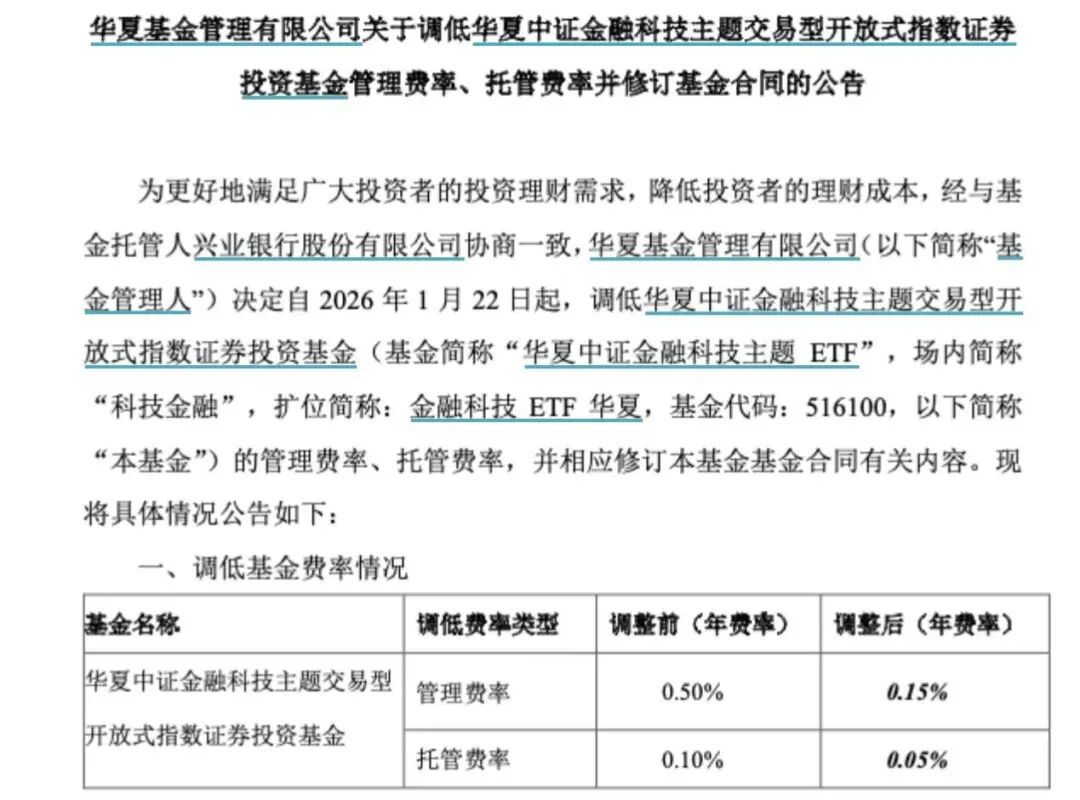
Core Viewpoint - The comprehensive fee reform in the public fund industry has been fully implemented, leading to a continuous trend of fee reductions among various funds to lower investment costs for investors and enhance their return experience [1][7]. Group 1: Fee Reductions Announced - Multiple funds have announced fee reductions, including Huaxia Fund, which lowered the management fee from 0.50% to 0.15% and the custody fee from 0.10% to 0.05%, representing a reduction of 70% and 50% respectively [3][5]. - Tianhong Fund reduced its management fee from 0.70% to 0.30% and custody fee from 0.15% to 0.05%, with reductions of 57.1% and 66.7% respectively [5]. - Other funds, such as GF Fund and Huatai Baoxing, have also announced similar fee reductions, contributing to a broader trend of decreasing fund fees across the market [6]. Group 2: Impact of Fee Reform - As of January 1, 2026, the implementation of the "Publicly Raised Securities Investment Fund Sales Expense Management Regulations" marks the completion of a two-year fee reform process, resulting in a significant increase in the number of low-fee funds [7]. - Currently, nearly 1,200 funds have an annual management fee of 0.15% or lower, while over 2,400 funds have a custody fee of 0.05% or lower, primarily consisting of stock index funds, bond funds, and money market funds [7]. - The fee reform is seen as a systemic and structural transformation of the industry, shifting the focus from scale expansion to service enhancement, which is expected to promote sustainable development in the long term [8].
公募基金规模环比大增 腰部机构黑马频现
Zhong Guo Zheng Quan Bao· 2026-01-22 22:42
Core Insights - The public fund management scale increased by over 1.3 trillion yuan in Q4 2025, driven mainly by money market funds, bond funds, commodity funds, and index funds [1][2] Group 1: Fund Management Scale - As of the end of Q4 2025, the total scale of public funds reached 37.26 trillion yuan, with significant contributions from various fund types: stock funds at 5.997 trillion yuan, mixed funds at 3.769 trillion yuan, bond funds at 10.907 trillion yuan, money market funds at 14.969 trillion yuan, overseas investment funds at 0.971 trillion yuan, commodity funds at 0.04268 trillion yuan, fund of funds (FOF) at 0.02188 trillion yuan, and other funds at 0.0001367 trillion yuan [2] - The largest growth in scale was seen in money market funds, which increased by 571.93 billion yuan, followed by bond funds with an increase of 446.94 billion yuan, and stock funds with an increase of 155.08 billion yuan, primarily from index stock funds [2] Group 2: Competitive Landscape - The top two fund companies, E Fund and Huaxia Fund, each managed over 2 trillion yuan, while eight other companies managed over 1 trillion yuan [3] - Among the top twenty fund companies by non-money management scale, most experienced growth in Q4 2025, with Guotai Fund leading the increase at 62 billion yuan, followed by Invesco Great Wall Fund at 53.11 billion yuan [3][4] Group 3: Emerging Players - The mid-tier fund companies saw significant changes, with several emerging as "dark horses" in Q4 2025, such as Changcheng Fund with over 20 billion yuan growth, and Dongcai Fund, Zhongjia Fund, Guotai Haitong Asset Management, Morgan Fund, and Rongtong Fund each growing by over 15 billion yuan [5] - Notably, Dongcai Fund's growth was driven by its bond fund, while Morgan Fund's growth was attributed to its index funds [5][6] Group 4: Small Fund Companies - Smaller public fund institutions like Shanzheng Asset Management, Huayin Fund, and Debang Fund also saw substantial growth in their non-money management scales [6] - Huayin Fund, after rebranding from Beixin Ruifeng Fund, achieved a scale of 26.753 billion yuan, with a significant contribution from a single product [6]
公募基金规模环比大增腰部机构黑马频现
Zhong Guo Zheng Quan Bao· 2026-01-22 20:56
Core Insights - The public fund management scale increased by over 1.3 trillion yuan in Q4 2025, driven primarily by money market funds, bond funds, commodity funds, and index funds [1][2] Fund Scale Growth - As of the end of Q4 2025, the total scale of public funds reached 37.26 trillion yuan, with significant contributions from various fund types: stock funds at 5.997 trillion yuan, mixed funds at 3.769 trillion yuan, bond funds at 10.907 trillion yuan, money market funds at 14.969 trillion yuan, overseas investment funds at 0.971 trillion yuan, commodity funds at 0.043 trillion yuan, fund of funds (FOF) at 0.022 trillion yuan, and other funds at 0.0000137 trillion yuan [1][2] - The largest growth was seen in money market funds, which increased by 571.93 billion yuan, followed by bond funds with an increase of 446.94 billion yuan, and stock funds with an increase of 155.08 billion yuan, primarily from index stock funds [2] Competitive Landscape - The top two fund companies, E Fund and Huaxia Fund, both managed over 2 trillion yuan, while eight other companies, including GF Fund and Southern Fund, managed over 1 trillion yuan [2] - The top twenty fund companies in non-money management scale saw most companies achieve growth, with Guotai Fund leading with an increase of 62 billion yuan, followed by Invesco Great Wall Fund with an increase of 53.12 billion yuan [3] Emerging Players - The mid-tier fund companies experienced significant changes, with several emerging as "dark horses" in Q4 2025, such as Changcheng Fund, which grew by over 20 billion yuan, and Dongcai Fund, among others, which saw increases exceeding 15 billion yuan [3][4] - Notably, Dongcai Fund's growth was primarily driven by its bond fund, while Morgan Fund's growth stemmed from its index funds [4] Small Fund Institutions - Smaller public fund institutions, including Shanzheng Asset Management and Huayin Fund, also experienced substantial growth in non-money management scale [4] - After rebranding, Beixin Ruifeng Fund, now known as Huayin Fund, saw rapid growth, reaching a non-money management scale of 26.75 billion yuan, with a significant contribution from a single product [4]
2.6万亿元!公募去年整体盈利 宽基ETF表现抢眼
Shang Hai Zheng Quan Bao· 2026-01-22 18:52
Core Insights - In Q4 2025, public funds experienced a loss of 110.1 billion yuan, despite an overall annual profit exceeding 2.6 trillion yuan, indicating a strong performance in equity assets throughout the year [1][2] - Passive investment strategies, particularly large-scale ETFs, dominated the profitability rankings, reflecting significant changes in the capital market over the past year [1][2] - The bond products emerged as the main profit contributors in Q4, with bond funds earning 57.725 billion yuan, while commodity funds also saw substantial gains due to rising precious metal prices [1] Annual Performance Summary - For the entire year of 2025, public funds achieved a total profit of 2.6 trillion yuan, with all fund types reporting gains, particularly mixed and equity funds, which collectively earned nearly 2 trillion yuan [2] - The stock funds alone generated profits exceeding 1.1 trillion yuan, highlighting the strong rise of ETFs in the market [2] Top Performing Funds - In Q4, the top 10 profitable fund products were predominantly gold ETFs and related funds, with six gold ETFs making the list, showcasing the demand for precious metals [2] - The leading fund, Huaan Gold ETF, reported a profit of 8.218 billion yuan, the only product exceeding 8 billion yuan in profit [2] - Other notable funds included Bosera Gold ETF, Huaxia SSE 50 ETF, and E Fund Gold ETF, each earning over 3 billion yuan [2] ETF Performance - The performance of broad-based ETFs remained strong, with Huatai-PB CSI 300 ETF leading with a profit of 78.516 billion yuan, the only fund surpassing 70 billion yuan [3] - Other significant performers included E Fund CSI 300 ETF and Huaxia CSI 300 ETF, both earning over 40 billion yuan [3]
2.6万亿元! 公募去年整体盈利,宽基ETF表现抢眼
Shang Hai Zheng Quan Bao· 2026-01-22 18:37
Group 1 - The core viewpoint of the articles highlights that despite a loss of 110.1 billion yuan in Q4 2025 for public funds, the overall annual profit exceeded 2.6 trillion yuan, indicating a strong performance in equity assets throughout the year [1][2] - In Q4 2025, mixed and stock funds collectively lost over 180 billion yuan, while QDII funds lost 71.047 billion yuan, and public FOFs had a slight loss of 213 million yuan [1] - Fixed income products emerged as the main profit contributors in Q4 2025, with bond products earning 57.725 billion yuan, money market funds earning 44.18 billion yuan, and commodity funds profiting 39.266 billion yuan [1] Group 2 - For the entire year of 2025, all types of public funds achieved profitability, with mixed and stock funds collectively earning nearly 2 trillion yuan, showcasing the characteristics of a strong equity year [2] - The top 10 profitable fund products in Q4 were predominantly gold ETFs and related funds, with six gold ETFs making the list, indicating a significant shift in capital market dynamics [2] - The Huatai-PB CSI 300 ETF was the standout performer, earning 78.516 billion yuan, making it the only product to exceed 70 billion yuan in profit [3]
年内36只基金提前结募 被动指数型基金数量居首
Zheng Quan Ri Bao· 2026-01-22 16:15
Core Insights - The early closure of fundraising for Tianhong CSI Industrial Nonferrous Metals Theme ETF and Jianxin Hongtai Multi-Asset Allocation 3-Month Holding Mixed Fund reflects new characteristics in the fund issuance market, with passive index funds and public FOFs leading the way in early closures [1] - As of January 22, 36 funds from 27 public institutions have announced early closures, a 28.57% increase from 28 funds in the same period last year, with passive index funds being the most prevalent at 18 funds [1] Fund Market Trends - The rise in early closures is driven by multiple factors including market performance, capital demand, and institutional positioning, with passive index funds aligning well with current investor needs [1][2] - The demand for passive index funds has surged, with a significant increase in the number of new funds issued in 2025 compared to previous years, and a notable reduction in average subscription days [1] Investor Behavior - The overall trading sentiment in the A-share market has improved, leading to heightened enthusiasm for equity and thematic funds, with many products reaching or exceeding their target sizes quickly [2] - Public institutions are designing products that better meet market demands, with an increase in the frequency of short-term holding FOFs and thematic ETFs, catering to investors' needs for flexibility and efficient asset allocation [2] Market Dynamics - In a low-interest-rate environment, some funds are actively seeking high-yield assets, with equity funds and multi-asset allocation products becoming primary options [2] - The proactive shortening of fundraising periods by public institutions aims to reduce idle capital costs and enhance overall product efficiency, supported by banks promoting public FOFs and index funds [2] Investment Strategy - There is a clear shift in investor preference towards transparent, logically sound, and efficient investment tools, particularly in passive index funds that track industry trends closely [2] - The early closures of funds primarily concentrated in passive index funds indicate a consensus among investors regarding technology growth and structural allocation opportunities, rather than merely short-term sentiment [2]
降费!降费!又有基金出手
中国基金报· 2026-01-22 16:07
Core Viewpoint - Multiple funds have announced fee reductions to lower investment costs for investors and enhance their return experience, following a comprehensive fee reform that has been in place for over two years [2][3]. Group 1: Fee Reductions Announced - 华夏基金 has announced a reduction in management and custody fees for its Financial Technology ETF, effective January 22, 2026, with management fees decreasing from 0.50% to 0.15% (a 70% reduction) and custody fees from 0.10% to 0.05% (a 50% reduction) [5][7]. - 天弘基金 will lower the management fee from 0.70% to 0.30% (a 57.1% reduction) and the custody fee from 0.15% to 0.05% (a 66.7% reduction) for its Tianhong Ninghong six-month holding period mixed fund, effective January 21, 2026 [8]. - 海富通基金 will reduce the management fee for its Hai Futong Ruixiang one-year regular open bond fund from 0.50% to 0.40% starting January 21, 2026 [8]. Group 2: Market Trends in Fund Fees - As of January 1, 2026, the implementation of the "Publicly Raised Securities Investment Fund Sales Expense Management Regulations" marks the full realization of the fee reform, leading to an increase in low-fee funds [10]. - Nearly 1,200 funds now have annual management fees of 0.15% or lower, primarily consisting of stock index funds, bond funds, and money market funds, while over 2,400 funds have custody fees of 0.05% or lower [10]. - In the actively managed equity fund category, a unified fee cap was established on July 7, 2023, with management fees not exceeding 1.2% and custody fees not exceeding 0.2%, resulting in these rates becoming common [11]. Group 3: Industry Implications - The ongoing fee reductions indicate a systemic and structural transformation in the industry, moving from a focus on scale expansion to service enhancement, which is expected to contribute to sustainable industry development in the long term [11].