荣耀

Search documents
万咖壹联20260202
2026-02-03 02:05
Summary of Conference Call Notes Company and Industry Overview - The company is deeply integrated with six major smartphone manufacturers: Apple, Huawei, Xiaomi, OPPO, vivo, and Honor, exclusively managing all game advertisements on the Honor platform, which provides access to a wealth of real-time dynamic data for precise ad targeting [2][4][5]. Core Insights and Arguments - **AI Advertising Effectiveness**: Through partnerships with Volcano Engine and Alibaba Cloud, the company has significantly enhanced its AI advertising system, achieving client ad ROI typically between 120% and 140%, with some clients exceeding 150% [2][4]. - **Revenue Sharing Model**: The company plans to implement a revenue-sharing model where 10% of the revenue from ROI exceeding 150% will be allocated to the company, which is expected to significantly improve gross margins and will be reflected in the 2025 annual report [2][4][5]. - **AI Mobile Era**: The rise of AI mobile technology is expected to transform the mobile smart terminal landscape, with voice input becoming a primary information entry point, simplifying user interactions and potentially increasing revenue from direct service transactions rather than traditional advertising [6][8]. - **International Expansion**: The company aims to leverage its partnerships with smartphone manufacturers to expand its AI business internationally, focusing on Apple iOS and some Xiaomi overseas operations, with plans to extend to platforms like Google Play, Meta, and TikTok [7][8]. Additional Important Content - **Market Share and Growth Projections**: The company has surpassed a 50% market share in its domestic niche and anticipates rapid growth in overseas revenue, projecting a target of 10 billion yuan by the end of 2025, with international business expected to account for over 30% of total revenue [2][7]. - **Stock Option Plan**: A new stock option plan has been introduced, linked to market capitalization targets of 4 billion, 8 billion, and 12 billion yuan, aimed at attracting new strategic investors from the internet or smartphone sectors [3][11][12]. - **Collaboration with Local Governments**: The company is selectively collaborating with local government industrial funds based on specific regional needs, such as cultural and AI-related digital industry development [13]. - **Future Outlook**: The company expresses confidence in its growth potential, emphasizing its advantageous position in the AI era and the significant opportunities presented by the evolving mobile landscape [14].
荣耀新机首月销量破40万台
Jing Ji Guan Cha Wang· 2026-02-03 01:36
经济观察网据供应链人士透漏,荣耀WIN系列首销当月的销量已经突破40万台,打破了新荣耀历史产品 线上销量记录。此前,荣耀WIN系列在首销日的开售2小时就打破了新荣耀以来发布日的首销记录,首 销日也斩获京东平台全品牌全机型销额冠军,天猫、抖音和快手平台全品牌全机型销量冠军。 ...
爱施德:公司依托海外渠道优势,紧抓品牌出海机遇
Zheng Quan Ri Bao Wang· 2026-02-02 11:41
证券日报网讯2月2日,爱施德(002416)在互动平台回答投资者提问时表示,公司是荣耀品牌的全渠道 零售服务商,与荣耀在国内及澳洲、东南亚、中东、非洲等海外市场保持紧密合作关系,助力其实现全 球化布局。公司依托海外渠道优势,紧抓品牌出海机遇,25年上半年实现海外销售收入同比增长30%。 26年将继续推进国内提质增效、海外稳健拓展,积极应对市场变化,实现长期高质发展。 ...

蓝思科技:全球精密制造龙头,多极增长开启新篇章-20260202
Caixin Securities· 2026-02-02 08:24
Investment Rating - The report maintains an "Accumulate" rating for the company [4] Core Insights - The company is a leading provider of precision manufacturing solutions across the entire supply chain for smart terminals, leveraging its strong technological foundation in various materials to achieve vertical integration from raw material production to final assembly [6][11] - The financial performance shows steady growth in revenue and profit, with a projected increase in revenue from 544.91 billion yuan in 2023 to 1,395.99 billion yuan by 2027, and net profit expected to rise from 30.21 billion yuan to 83.81 billion yuan in the same period [4][6] - The company is expanding its business into emerging markets such as smart automotive, humanoid robots, AI/XR glasses, and smart retail, which are expected to drive future growth [6][7] Summary by Sections Company Overview - The company has a solid business foundation and high-quality customer resources, being a strategic partner to many global brands like Apple, Samsung, and Tesla [12][11] - It has a diversified business structure covering multiple sectors including consumer electronics and smart automotive [21][11] Financial Performance - Revenue is projected to grow from 466.99 billion yuan in 2022 to 698.97 billion yuan in 2024, with a compound annual growth rate (CAGR) of 22.34% [29] - The net profit is expected to increase from 24.48 billion yuan to 36.24 billion yuan in the same period, with a CAGR of 21.67% [29] Consumer Electronics - The company is positioned to benefit from the AI upgrade and innovation in the consumer electronics sector, with a focus on high-value products like foldable screens and 3D glass [6][48] - The revenue from the smartphone and computer segments is expected to grow significantly, driven by increased demand and product upgrades [30][34] Smart Automotive - The company is expanding into the automotive electronics sector, with innovative products like ultra-thin laminated glass and smart cockpit components, which are expected to enhance the value per vehicle [6][33] - The automotive segment's revenue is projected to grow significantly as the penetration of electric vehicles increases [6][33] Emerging Fields - The company is strategically positioning itself in emerging markets such as humanoid robots and AI data centers, with a focus on vertical integration and technological innovation [7][6] - Collaborations with leading companies in these fields are expected to foster growth and enhance market presence [7][6]

全球智能手机产业链回暖!升级换机驱动2025年出货量创新高
Ge Long Hui· 2026-02-02 06:10
其中,2025年,苹果(AAPL.US)创下年度出货量新高,iPhone 出货量同比增长7% 至2.406亿部,使其连 续第三年保持全球最大智能手机厂商的地位。三星在经历连续三年的年度下滑后于 2025 年实现显著反 弹,同比增长 7%,出货略低于苹果。 在前五名之外,尽管市场环境充满挑战,仍有多家厂商保持正向增长。得益于在核心市场激烈竞争中快 速拓展地理版图带来的增长,荣耀和联想(00992)分别同比增长11% 和 6%,创下历史新高。 Omdia最新研究显示,2025年全球智能手机出货量增长 2%,达到12.5亿部,为2021年以来的最高水 平。除大中华区外,各地区出货量均同比增长,中国内地则因2025年国家补贴政策的激励效应不及预期 而略有下降。升级和换机的强劲需求支撑使市场保持增长,尽管商业环境充满不确定性,多家厂商仍然 打破了纪录。 受季节性利好因素和厂商强劲表现推动,2025年第四季度,全球智能手机出货量同比增长4%。 Omdia 研究经理 Le Xuan Chiew认为,市场波动时期,为能够快速应对挑战的厂商、供应商及合作伙伴 提供了竞争窗口。这种条件创造了一个战略机遇,可以抓住升级换机用户、开 ...

手机产业链全线走低 12月手机销量同比下滑20% 内存涨价或抑制手机出货量
Zhi Tong Cai Jing· 2026-02-02 04:06
Core Viewpoint - The smartphone supply chain is experiencing a significant downturn, with major companies seeing declines in stock prices and forecasts indicating a drop in smartphone sales in China by approximately 20% year-on-year by December 2025 [1] Group 1: Company Performance - QiuTai Technology (01478) shares fell by 5.91%, trading at HKD 8.75 [1] - BYD Electronics (00285) shares decreased by 4.13%, trading at HKD 32.02 [1] - GoerTek (01415) shares dropped by 3.76%, trading at HKD 29.14 [1] Group 2: Market Forecasts - China's smartphone sales are projected to reach approximately 21 million units by December 2025, reflecting a year-on-year decline of about 20% [1] - Goldman Sachs has revised its global smartphone shipment forecasts for 2026/27 down by 6% and 5% to 1.2 billion units for both years, indicating a year-on-year change of -6% and +2% respectively [1] Group 3: Market Share - The top five smartphone brands in China by market share are Huawei (20%), OPPO (17%), Honor (14%), Vivo (14%), and Apple (13%) [1]

港股异动 | 手机产业链全线走低 12月手机销量同比下滑20% 内存涨价或抑制手机出货量
智通财经网· 2026-02-02 04:04
Group 1 - The smartphone industry is experiencing a decline, with major companies like Q Technology, BYD Electronics, and GoerTek seeing significant stock price drops of 5.91%, 4.13%, and 3.76% respectively [1] - By December 2025, China's smartphone sales are projected to reach approximately 21 million units, representing a year-on-year decrease of about 20% [1] - The top five smartphone brands in China by market share are Huawei (20%), OPPO (17%), Honor (14%), vivo (14%), and Apple (13%) [1] Group 2 - Goldman Sachs has revised its global smartphone shipment forecasts for 2026/27 down by 6% and 5% to 1.2 billion units for both years, indicating a year-on-year change of -6% and +2% respectively [1] - The decline in smartphone shipments is attributed to rising memory prices impacting the overall market [1]
华为Mate80销量超上代同期,苹果均价突破1000美元
Guan Cha Zhe Wang· 2026-02-02 03:51
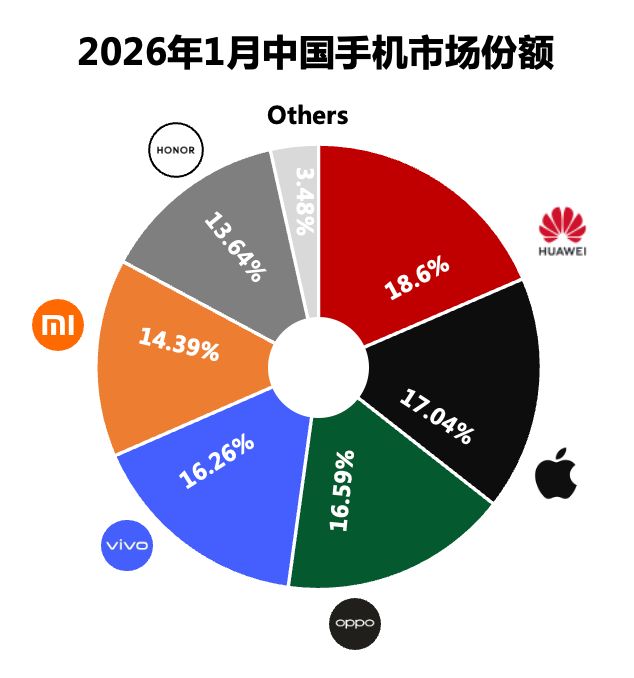
Group 1 - In January, Huawei regained the top position in the Chinese smartphone market with an 18.6% market share, closely followed by Apple at 17.04% [1] - The Huawei Mate80 series, launched later than competitors, has shown strong sales momentum, with approximately 2.54 million units sold by the end of January 2026, surpassing the Mate70 series during the same period [1] - Apple's iPhone 17 series performed well in China, achieving a market share of 21.2% and a year-on-year revenue increase of 38% in the Greater China region, with shipments reaching 16 million units in Q4 2025 [3] Group 2 - Globally, Apple leads the market with a 25% share of shipments and 59% of revenue, while the average selling price of Apple phones reached $1,011, significantly higher than competitors [4] - Despite current successes, Apple faces challenges such as rising component costs and increased competition, with price cuts from various manufacturers intensifying market rivalry [7][8] - The global smartphone market is expected to see rising average prices due to high-end trends and increased demand for AI features, but rising component costs may pressure manufacturers to focus on value growth and product optimization [8]

营收下滑,净利腰斩 “非洲之王”传音失速
Bei Jing Shang Bao· 2026-02-02 00:52
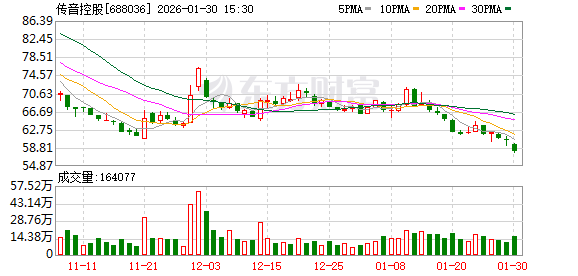
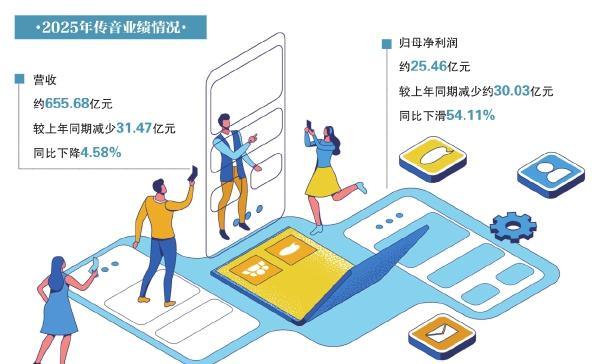
Core Viewpoint - Transsion Holdings, known as the "King of Africa" in the mobile phone industry, reported disappointing annual results for 2025, with significant declines in revenue and net profit due to rising supply chain costs and intensified competition in emerging markets [1][3]. Financial Performance - The company expects to achieve approximately 65.568 billion yuan in revenue for 2025, a decrease of 4.58% year-on-year [1]. - Net profit attributable to shareholders is projected to be around 2.546 billion yuan, down 54.11% compared to the previous year [1]. - The first quarter of 2025 saw a revenue decline of 25.45% and a net profit drop of 69.87% [3]. - By mid-year, revenue had decreased by 15.86%, with net profit down 57.48% [3]. - Despite a 22.6% revenue increase in the third quarter, cumulative revenue for the first three quarters still showed a decline of 3.33% [3]. Market Position and Competition - In the third quarter, Transsion achieved a 13.6% year-on-year increase in shipments, reaching 29.2 million units, making it one of the top five global smartphone manufacturers [5]. - However, the company struggled in other quarters, failing to appear in the top rankings during the first quarter and experiencing a 1.7% decline in the second quarter [5]. - In the African market, Transsion maintained a leading position with a 51% market share, but growth has slowed, with competitors like Xiaomi and Honor rapidly increasing their market presence [6]. Challenges in Emerging Markets - Transsion's attempts to replicate its African success in Southeast Asia and Latin America have faced significant challenges, with declining shipments and market share in these regions [7]. - The company reported a 19% year-on-year drop in shipments in the Latin American market during the third quarter [7]. Industry Challenges - Rising storage costs have become a common issue in the smartphone industry, significantly impacting Transsion's operations in price-sensitive emerging markets [8]. - The increase in DRAM prices has raised production costs across all price segments, with the lowest segment experiencing the most significant increase [8]. - The global smartphone shipment forecast for 2026 has been revised downwards, indicating a 2.1% decline, which disproportionately affects the low-price segment where Transsion operates [8][9].

全年净利腰斩背后 “非洲之王”传音的怨与愁
Bei Jing Shang Bao· 2026-02-01 14:13
Core Viewpoint - Transsion Holdings, known as the "King of Africa" in the mobile phone industry, reported a disappointing annual performance for 2025, with significant declines in revenue and net profit due to rising supply chain costs and intensified competition in emerging markets [2][3]. Group 1: Financial Performance - The company expects to achieve approximately 65.568 billion yuan in revenue for 2025, a decrease of 4.58% year-on-year, equating to a drop of 3.147 billion yuan [2]. - Net profit attributable to shareholders is projected to be around 2.546 billion yuan, reflecting a substantial decline of 54.11%, or a reduction of about 3.003 billion yuan compared to the previous year [2]. - The non-recurring net profit saw an even steeper decline of 58.06% [2]. Group 2: Market Challenges - The decline in performance is attributed to a combination of rising storage chip prices impacting supply chain costs and increased competition in both local and global emerging markets [2][4]. - The first quarter of 2025 saw a revenue drop of 25.45% and a net profit plunge of 69.87%, indicating a significant early warning of ongoing pressure throughout the year [4]. - By the end of the third quarter, despite a seasonal revenue increase of 22.60%, cumulative revenue still showed a decline of 3.33% year-on-year [4][6]. Group 3: Competitive Landscape - In the global smartphone market, Transsion's performance was mixed, with a notable increase in third-quarter shipments of 29.2 million units, marking a 13.6% year-on-year growth, positioning it among the top five manufacturers [6]. - However, the company struggled in other quarters, failing to maintain a consistent presence in the global top rankings, reflecting instability in its competitive position [6][7]. - In the African market, while still leading with a 51% share, Transsion faced challenges from competitors like Xiaomi and Honor, who exhibited significantly higher growth rates [7][8]. Group 4: Cost Pressures - The rising cost of storage components has become a common challenge in the smartphone industry, particularly affecting Transsion's low to mid-range offerings, where price sensitivity is high [9][10]. - The increase in DRAM prices has raised production costs across all price segments, with low-end models experiencing the most significant increases [9]. - The inability to fully pass on these costs to consumers may lead to further profit compression or reduced shipments of lower-end models, exacerbating the company's operational pressures in emerging markets [10].