中国银行

Search documents
中国银行上海市分行为新春消费注入金融活力
Zhong Guo Jin Rong Xin Xi Wang· 2026-02-14 07:08
Core Viewpoint - The Bank of China Shanghai Branch is actively integrating into the construction of Shanghai as an international consumption center by enhancing financial services tailored to the Spring Festival consumption scene, thereby improving the consumption experience for visitors to Shanghai [1][2]. Group 1: New Spring Consumption Initiatives - The bank has launched a series of promotional activities such as "BOC Travel Benefits," "BOC Exciting Experiences," and "BOC Shared Rides" to cater to the concentrated consumption needs of citizens during the Spring Festival [2]. - These initiatives include payment discounts, installment benefits, and interactive activities to boost consumer willingness and ensure financial benefits reach the consumption end [2]. - The bank is also integrating finance, culture, tourism, and technology through various Spring Festival activities, enhancing the convenience and enjoyment of payments with digital financial solutions [2]. Group 2: Cross-Border Consumption Services - The bank is enhancing its cross-border financial services by focusing on both outbound and inbound consumption, aiming to upgrade the quality of cross-border consumption services [3]. - For outbound consumers, the bank has upgraded credit card services, offering benefits such as unlimited access to domestic and international airport lounges and a 1% cash back on cross-border spending without limits [3]. - For inbound foreign visitors, the bank provides comprehensive services at the Pudong Airport, including 24/7 foreign currency exchange and mobile payment options, and collaborates with over 120 shopping malls and 1,800 merchants for tax refund services [3]. Group 3: Consumer Loan and Financial Support - The bank is expanding the application scenarios for consumer loans and enhancing the experience of applying for interest subsidies on consumer loans and credit card installments [4]. - Utilizing the "BOC E-loan" brand, the bank is focusing on various consumption areas such as education, home decoration, and tourism, while combining national financial subsidies and interest rate discounts to enhance consumer satisfaction [4]. - The bank has also launched a self-service feature for credit card installment interest subsidies on its mobile banking platform, making it easier for consumers to access financial benefits and reducing financing costs [4].

怎么花钱最划算?看这份银行卡攻略就够了
Xin Jing Bao· 2026-02-14 06:57
Core Viewpoint - The upcoming 2026 Spring Festival is prompting banks to launch various promotional activities aimed at boosting consumer spending, with a focus on enhancing participation among middle and low-frequency users, particularly in lower-tier cities [3][10]. Group 1: Bank Promotions - China Construction Bank (CCB) is offering a "Payment Achievement Win Gifts" campaign from January 1 to March 31, where users can win up to 1998 yuan in WeChat discounts by meeting monthly spending thresholds [4][6]. - Industrial and Commercial Bank of China (ICBC) has multiple promotions, including discounts on movie tickets and food delivery, with specific offers like 5 yuan off for spending over 30 yuan on the Maoyan platform [6][8]. - Other banks, including Bank of China and Postal Savings Bank, are also rolling out New Year promotions, such as discount vouchers and cash rebates for various spending categories [8][10]. Group 2: Government and Financial Support - The Ministry of Commerce and other agencies have issued a plan to enhance financial support for consumer activities during the Spring Festival, encouraging banks to collaborate with key merchants [3][10]. - The "2026 'Happy Shopping Spring Festival' Special Activity Plan" emphasizes the importance of integrating local promotional activities with financial incentives like cash rebates and digital currency red envelopes [10]. Group 3: Economic Impact - The promotional activities are expected to stimulate short-term consumer spending and enhance market confidence, contributing to economic circulation [10]. - Data from January 2026 shows a 0.2% year-on-year increase in consumer prices, indicating a gradual recovery in consumer demand, particularly in the automotive and home appliance sectors [11].


固收点评 20260214:二级资本债周度数据跟踪(20260209-20260213)-20260214
Soochow Securities· 2026-02-14 06:39
Report Industry Investment Rating - Not provided in the content Core Viewpoints - This week (from February 9th to February 13th, 2026), there were no new secondary capital bonds issued in the inter - bank and exchange markets [1] - The weekly trading volume of secondary capital bonds this week was approximately 204.5 billion yuan, a decrease of 70.6 billion yuan compared to last week. The top three bonds in terms of trading volume were 25 Bank of China Secondary Capital Bond 02BC, 25 Bank of China Secondary Capital Bond 03A(BC), and 25 Agricultural Bank of China Secondary Capital Bond 04A(BC) [2] Summary by Relevant Catalogs Primary Market Issuance - No new secondary capital bonds were issued in the inter - bank and exchange markets from February 9th to February 13th, 2026 [1] Secondary Market Transactions - **Trading Volume**: The total weekly trading volume of secondary capital bonds was about 204.5 billion yuan, down 70.6 billion yuan from last week. The top three bonds in trading volume were 25 Bank of China Secondary Capital Bond 02BC (13.209 billion yuan), 25 Bank of China Secondary Capital Bond 03A(BC) (8.914 billion yuan), and 25 Agricultural Bank of China Secondary Capital Bond 04A(BC) (8.217 billion yuan) [2] - **Regional Trading Volume**: The top three regions in terms of trading volume were Guangdong Province (about 155.3 billion yuan), Shandong Province (about 16.5 billion yuan), and Shanxi Province (about 8.5 billion yuan) [2] - **Yield to Maturity**: As of February 13th, for 5Y secondary capital bonds, the yield to maturity of AAA -, AA +, and AA - rated bonds changed by - 6.56BP, - 6.91BP, and - 6.91BP respectively compared to last week; for 7Y bonds, the changes were - 8.84BP, - 5.66BP, and - 5.66BP; for 10Y bonds, the changes were - 6.53BP, - 4.86BP, and - 4.86BP [2] Top 30 Bonds with Valuation Deviation - **Overall Situation**: This week, the overall valuation deviation of the weekly trading average price of secondary capital bonds was not large. The proportion of discount transactions was greater than that of premium transactions, and the discount amplitude was larger than the premium amplitude [3] - **Discount Bonds**: The top three bonds with the highest discount rates were 17 Binhai Rural Commercial Secondary 01 (- 0.5685%), 23 Huaxing Bank Secondary Capital Bond 01 (- 0.4765%), and 22 Industrial and Commercial Bank of China Secondary Capital Bond 04B (- 0.4336%). The implicit ratings of China Central Depository & Clearing Co., Ltd. were mainly AAA -, AA, and AA +, and the bonds were mostly from Beijing, Shanghai, and Tianjin [3] - **Premium Bonds**: The top three bonds with the highest premium rates were 21 Huishang Bank Secondary 01 (0.5063%), 23 Hankou Bank Secondary Capital Bond 02 (0.4304%), and 23 Tianjin Bank Secondary Capital Bond 01 (0.3847%). The implicit ratings of China Central Depository & Clearing Co., Ltd. were mainly AA +, AAA -, and AA, and the bonds were mostly from Beijing, Zhejiang, and Fujian [3]
系统重要性银行分层洗牌:谁在晋级,谁在降组?
Jing Ji Guan Cha Wang· 2026-02-14 06:32
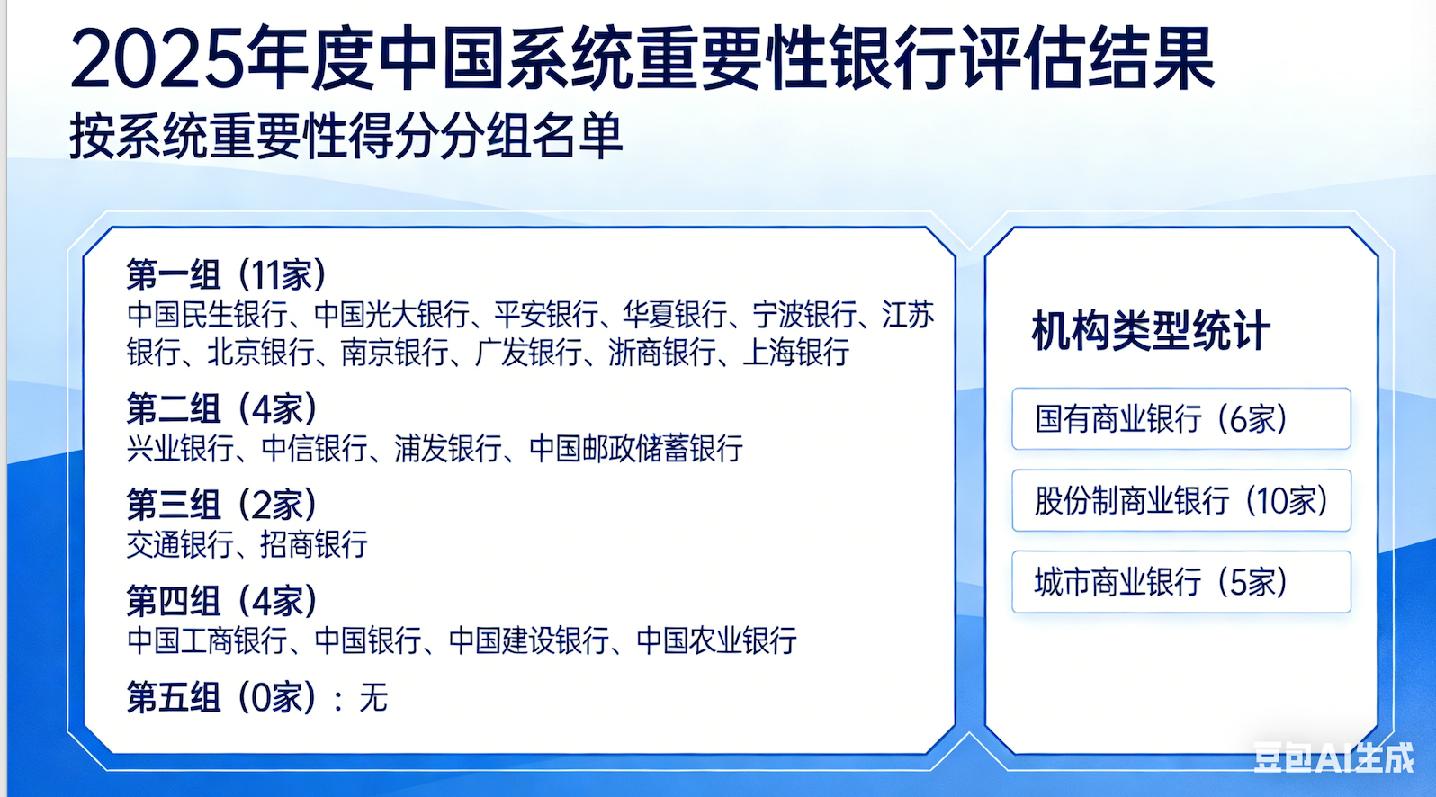
Core Insights - The People's Bank of China and the National Financial Regulatory Administration released the list of systemically important banks (D-SIBs) for 2025, expanding the number of institutions from 20 to 21, with Zheshang Bank being the new addition [1][3] - The list reflects a significant internal reshuffling, with Industrial Bank being downgraded from the third group to the second group, indicating a re-evaluation of systemic risk profiles by regulators [3][8] Group Summaries - **First Group (10 Banks)**: Includes China Everbright Bank, China Minsheng Bank, Ping An Bank, Huaxia Bank, Ningbo Bank, Jiangsu Bank, Guangfa Bank, Shanghai Bank, Nanjing Bank, and Beijing Bank [5] - **Second Group (4 Banks)**: Comprises CITIC Bank, Shanghai Pudong Development Bank, China Postal Savings Bank, and now includes Industrial Bank [5][8] - **Third Group (3 Banks)**: Contains Bank of Communications, China Merchants Bank, and Industrial Bank [5][6] - **Fourth Group (4 Banks)**: Dominated by the four major state-owned banks: Industrial and Commercial Bank of China, Bank of China, China Construction Bank, and Agricultural Bank of China [5][6] - **Fifth Group (0 Banks)**: No banks are currently classified in this group, which has the highest additional capital requirements [10] Zheshang Bank's Inclusion - Zheshang Bank's inclusion in the first group is attributed to its performance across four dimensions: scale, interconnectedness, substitutability, and complexity, achieving a weighted score that meets the threshold [6][11] - As of Q3 2025, Zheshang Bank's asset size reached 3.39 trillion yuan, with a core Tier 1 capital adequacy ratio rising by 0.02 percentage points to 8.40% [6][11] Industrial Bank's Downgrade - Industrial Bank's downgrade to the second group signifies a reduction in regulatory costs, as the additional capital requirement drops from 0.75% to 0.5%, potentially freeing up hundreds of billions in capital [8][10] - The downgrade reflects a shift in the competitive landscape, where Industrial Bank's relative advantages in market operations may have diminished due to the performance of peer banks [8][11] Regulatory Dynamics - The release of the new list comes after a gap of nearly 18 months, indicating a shift in regulatory oversight and a more cautious approach to data evaluation by the authorities [9][10] - The regulatory framework emphasizes both macro-prudential and micro-prudential management, requiring banks to meet various additional capital and leverage ratio requirements based on their group classification [10][11]


系统重要性银行扩围至21家:浙商银行突围,兴业银行跌落第三组
Jing Ji Guan Cha Wang· 2026-02-14 06:32
Core Viewpoint - The People's Bank of China and the National Financial Regulatory Administration have updated the list of Domestic Systemically Important Banks (D-SIBs), increasing the total from 20 to 21, with Zhejiang Commercial Bank being newly included [2][3]. Group Summaries Group 1 - The first group now includes 10 banks, such as China Everbright Bank, Minsheng Bank, and Ping An Bank, reflecting a strong position in the financial system [6]. - Zhejiang Commercial Bank's inclusion in this group indicates its significant role and improved risk profile within the banking sector [4][8]. Group 2 - The second group consists of four banks, including Citic Bank, Shanghai Pudong Development Bank, and Postal Savings Bank, with the addition of Industrial Bank [3][6]. - The adjustment of Industrial Bank to this group signifies a shift in its risk assessment and regulatory requirements [4]. Group 3 - The third group includes three banks: Bank of Communications, China Merchants Bank, and Industrial Bank, which maintain advantages in cross-regional operations and market coverage [3][6]. - The downgrade of Industrial Bank from the third to the second group reflects a relative loss of competitive edge in the financial market [6]. Group 4 - The fourth group remains unchanged with the four major state-owned banks: ICBC, ABC, BOC, and CCB, which continue to be the backbone of the national financial system [3][6]. - These banks are subject to the highest regulatory scrutiny due to their systemic importance [3]. Regulatory Insights - The update of the D-SIB list demonstrates a dynamic adjustment in the assessment of systemic risk, emphasizing the importance of both macro and micro-prudential regulations [3][7]. - The additional capital requirements for each group range from 0.25% to 1.5%, with the first group facing the lowest and the fifth group (currently empty) facing the highest [7][8]. - The regulatory framework aims to ensure that banks not only meet micro-level indicators but also adhere to macro-level capital and leverage requirements [7].
广发银行资产托管中心获批筹建!银行业托管业务哪家强?
Nan Fang Du Shi Bao· 2026-02-14 05:55
近日,国家金融监督管理总局发布批复称,同意广发银行筹建广发银行股份有限公司资产托管中心。财 报显示,该行已设有一级部门资产托管部。2024年末,该行资产托管及基金服务业务规模达4.2万亿 元,较年初增长超一成。在业内人士看来,此番筹建资产托管中心,将助力其托管服务向精细化、专业 化的运营体系升级。 将视野放大,近年来,我国商业银行资产托管业务持续扩容。数据显示,截至2024年末,中国银行业资 产管理类产品托管规模为182.20万亿元,较上年末增长12.64%。从行业格局来看,四家银行资产托管规 模超过20万亿元,头部效应明显。 广发银行获批筹建资产托管中心 国家金融监督管理总局发布的批复显示,广发银行筹建广发银行股份有限公司资产托管中心获得同意。 筹建工作接受北京金融监管局的监督指导。筹建工作完成后,向北京金融监管局提出开业申请。 根据中国银行业协会发布的《中国资产托管行业发展报告(2025)》,截至2024年末,中国银行业资产 管理类产品托管规模为182.20万亿元,较上年末增长12.64%;与客户资金保管类产品服务规模合计达 239.90万亿元;资管产品营运外包业务规模8.88万亿元。 具体到国有大行和股 ...

如何理解开年全球市场?“可负担性”才是 2026 的总叙事:“主街”要赢一次,AI叙事巨变,日元是“关键”
Hua Er Jie Jian Wen· 2026-02-14 05:53
2026年开年全球市场正在经历一场范式转变。 追风交易台消息,2月12日,美银证券Michael Hartnett的研究团队发表研报指出,钱正在离开过去几年的明 星资产。 年初至今,黄金涨了13.4%,石油涨了9.5%,国际股票涨了8.7%。美股跌了0.2%,比特币暴跌25%。 这背后的核心因素在于"可负担性"政治。特朗普政府正激进转向讨好"主街"(普通民众)而非"华尔街"(精 英阶层)的政策。美银强调这意味着三大关键变化: 第一,美国大盘成长股向小盘价值股的历史性轮动已经开启; 第二,AI叙事正从"AI惊叹"转向"AI致贫",科技股面临压力; 第三,日元与日股的相关性自2005年以来首次转正,这是结构性牛市的特征。但需警惕日元升值 过快(跌破145)引发全球去杠杆。 "可负担性"政治下,"主街"资产崛起 报告指出,特朗普在中期选举压力下,政策已转向解决民生负担,这引发了一场从"华尔街"到"主街"的资产 大轮动。 赢家是"主街"通胀繁荣资产。自去年10月底以来,受益于全球制造业复苏和通胀逻辑的资产表现突出。白银 (+56%)、韩国KOSPI指数(+34%)、巴西股市(+30%)、材料(+25%)、能源(+20 ...
我国系统重要性银行上新
Zhong Guo Xin Wen Wang· 2026-02-14 05:45
Group 1 - The list of systemically important banks in China was published on February 13, 2025, including 21 banks categorized into five groups based on their systemic importance scores [2][4] - The first group consists of 11 banks, including China Minsheng Bank, China Everbright Bank, and Ping An Bank, while the fourth group includes major state-owned banks like ICBC, Bank of China, and China Construction Bank [2][3] - The inclusion in the systemically important bank list signifies both honor and responsibility, enhancing the bank's reputation and requiring them to invest more in internal controls and risk management systems [3][5] Group 2 - Zhejiang Bank was included in the systemically important bank list for the first time, signaling its significant market position and requiring adherence to stricter regulatory standards [5] - Industrial Bank was moved from the third group to the second group, reflecting a relative decline in its systemic importance score, which may provide it with more capital space and lower compliance costs [6][7] - The People's Bank of China and the National Financial Regulatory Administration will continue to enforce additional regulations for systemically important banks to ensure their safe and sound operation [7]
2026年1月金融数据点评:存款搬家加速,M1、M2增速大幅回升
GF SECURITIES· 2026-02-14 05:23
Investment Rating - The industry rating is "Buy" [6] Core Insights - The overall social financing growth slightly declined to 8.2% in January, while M1 and M2 growth rates significantly rebounded, with M1 growing by 4.9% and M2 by 9.0% [6][16] - Government net financing increased significantly by 2,831 billion yuan year-on-year, contributing to the overall social financing growth [6][17] - The report indicates a shift in deposit structure due to accelerated deposit migration, impacting M1 negatively while having limited effect on M2 [6][16] Summary by Sections Overall Situation - Social financing growth decreased slightly to 8.2%, while M1 and M2 growth rates increased significantly [15][16] - M1 and M2 growth rates rose by 1.1 percentage points and 0.5 percentage points respectively compared to the previous month [6][16] Government Sector - Fiscal strength showed a year-on-year decline, impacting overall financing dynamics [39] Household Sector - Demand remained stable year-on-year, with short-term loan demand increasing [39] Corporate Sector - Short-term loan demand increased year-on-year, while bill financing saw a significant reduction [39] Non-Bank Sector - The acceleration of deposit migration was noted, with non-bank deposits increasing by 1.45 trillion yuan year-on-year [6][39]



1月信贷社融点评:温和开门红
ZHESHANG SECURITIES· 2026-02-14 05:23
Investment Rating - The industry investment rating is "Positive" (maintained) [4] Core Insights - The report highlights a "strong deposit, weak loan" characteristic in the opening month of the year [4] - In January 2026, new social financing increased by 7.2 trillion yuan, a year-on-year increase of 166.2 billion yuan, with a balance growth of 8.2% [4][5] - New RMB loans in January 2026 amounted to 4.7 trillion yuan, a year-on-year decrease of 420 billion yuan, with a balance growth of 6.1% [4][5] - The report indicates that consumer demand has shown some recovery, particularly in short-term loans, but overall consumer credit demand may remain pessimistic throughout the year [1][2] Summary by Sections Credit Overview - Entity credit remained stable, with a significant reduction in bill financing [1] - Retail loans saw an increase of 456.5 billion yuan in January, with short-term loans contributing 109.7 billion yuan [1] - Corporate loans totaled 4.5 trillion yuan, a year-on-year decrease of 330 billion yuan, influenced by a substitution effect between short-term loans and bill financing [2] Social Financing - Government bonds contributed significantly to social financing, with new issuance of 976.4 billion yuan in January, a year-on-year increase of 283.1 billion yuan [5] - The report notes a trend of "deposit migration," with non-bank deposits reaching 36 trillion yuan, accounting for 10.7% of total deposits [5] Investment Recommendations - The report recommends a "New Momentum Portfolio" including banks like Nanjing Bank, Shanghai Bank, and others, highlighting their potential for value recovery [3][5] - It emphasizes the importance of high-dividend bank stocks in the current environment, suggesting that banks with new growth drivers may achieve greater value restoration [5]