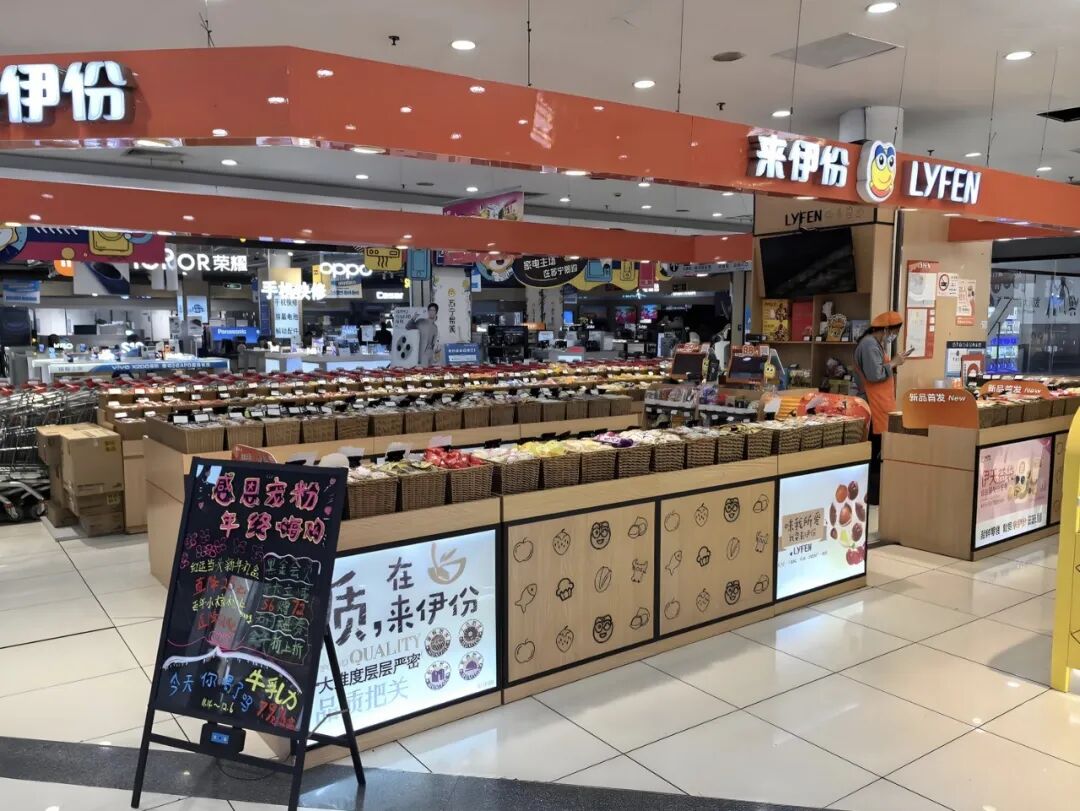
来伊份

Search documents
来伊份:控股股东减持,权益变动触及1%刻度
Xin Lang Cai Jing· 2025-09-26 12:14
2025年9月24 - 26日,上海来伊份控股股东上海爱屋企业管理有限公司按减持计划,通过集中竞价减持 219.0517万股、大宗交易减持334万股。本次权益变动后,控股股东及其一致行动人合计持股比例由 62.79%降至61.14%,适用权益变动触及1%整倍数情形。本次减持不触及要约收购,与此前计划、承诺 一致,且未执行完毕。此次变动系正常减持,不会使公司控股权或实控人变更,不影响公司治理与经 营,也无损公司及股东利益,公司将持续披露进展。 ...

来伊份:控股股东权益变动减少1.65%
Xin Lang Cai Jing· 2025-09-26 12:09
来伊份公告,公司控股股东上海爱屋企业管理有限公司及其一致行动人持股比例由62.79%减少至 61.14%。本次权益变动通过集中竞价和大宗交易方式进行,集中竞价减持219.05万股,大宗交易减持 334万股。本次权益变动触及1%的整倍数情形,未违反此前披露的减持计划,不触发强制要约收购义 务。本次减持不会导致公司控股股东或实际控制人发生变化,也不会对公司治理结构及持续经营产生影 响。公司将持续关注减持计划进展并履行信息披露义务。 ...
2025年1-8月全国农副食品加工业出口货值为1404.7亿元,累计下滑5.5%
Chan Ye Xin Xi Wang· 2025-09-26 03:47
相关报告:智研咨询发布的《2025-2031年中国农副食品加工专用设备制造行业市场动态分析及发展前 景研判报告》 数据来源:国家统计局,智研咨询整理 知前沿,问智研。智研咨询是中国一流产业咨询机构,十数年持续深耕产业研究领域,提供深度产业研 究报告、商业计划书、可行性研究报告及定制服务等一站式产业咨询服务。专业的角度、品质化的服 务、敏锐的市场洞察力,专注于提供完善的产业解决方案,为您的投资决策赋能。 上市公司:黑芝麻(000716),双汇发展(000895),千味央厨(001215),青岛食品(001219),三 全食品(002216),得利斯(002330),金字火腿(002515),洽洽食品(002557),五芳斋 (603237),安井食品(603345),绝味食品(603517),惠发食品(603536),有友食品 (603697),良品铺子(603719),来伊份(603777),桃李面包(603866) 根据国家统计局数据可知:2025年8月全国农副食品加工业出口货值为168.5亿元,同比下降9.6%;2025 年1-8月全国农副食品加工业累计出口货值为1404.7亿元,累计同比下降5.5%。 ...


万辰集团递表港交所:年营收323亿
2 1 Shi Ji Jing Ji Bao Dao· 2025-09-25 23:08
Core Viewpoint - The snack retail industry is poised to welcome its first A+H share listed company, with Wancheng Biotechnology Group Co., Ltd. (Wancheng Group) applying for a listing on the Hong Kong Stock Exchange, competing closely with its rival Mingming Hen Mang [1][2]. Group 1: Company Performance - Wancheng Group has shown rapid growth, with revenues of RMB 5.49 billion, RMB 9.29 billion, and RMB 32.33 billion for the years 2022, 2023, and 2024 respectively, and a net profit of RMB 0.68 billion, -RMB 1.76 billion, and RMB 6.11 billion for the same years [1]. - In the first half of 2025, Wancheng Group reported a net profit of RMB 4.72 billion, a staggering year-on-year increase of 50,358.8%, with total revenue reaching RMB 22.58 billion, up 106.89% year-on-year [1]. - The company's gross merchandise volume (GMV) saw a year-on-year growth of 282% from 2023 to 2024 [1]. Group 2: Business Model and Market Position - Wancheng Group operates a business model that emphasizes direct procurement from manufacturers, allowing it to offer retail prices 20% to 30% lower than traditional supermarkets, thus providing a competitive pricing advantage [2]. - As of June 30, 2025, Wancheng Group had a network of 15,365 stores, with 99.4% being franchise stores, and a low closure rate of only 1.9% [2]. - The industry is evolving into a "two super, many strong" structure, with Wancheng Group and Mingming Hen Mang as the leading players, while smaller brands like Laiyifen and Tangchao follow closely [2][3]. Group 3: Competitive Landscape - In terms of revenue for 2024, Wancheng Group is projected to achieve RMB 32.33 billion, while Mingming Hen Mang is expected to reach RMB 39.34 billion, indicating a competitive revenue landscape [3]. - Mingming Hen Mang claims to have over 20,000 stores nationwide, surpassing Wancheng Group's 15,365 stores [3]. - Both companies are focusing on expanding their private label products, with Mingming Hen Mang planning to introduce a variety of new products, including high-margin daily necessities and health snacks [4]. Group 4: Financial Health and Future Plans - Wancheng Group's debt has increased to RMB 5.14 billion, with a debt-to-asset ratio of approximately 68.95%, indicating a need for capital to support further expansion [4]. - The company plans to use the funds raised from its Hong Kong listing to enhance its store network, diversify its product offerings, improve logistics efficiency, and upgrade its digital infrastructure [4].
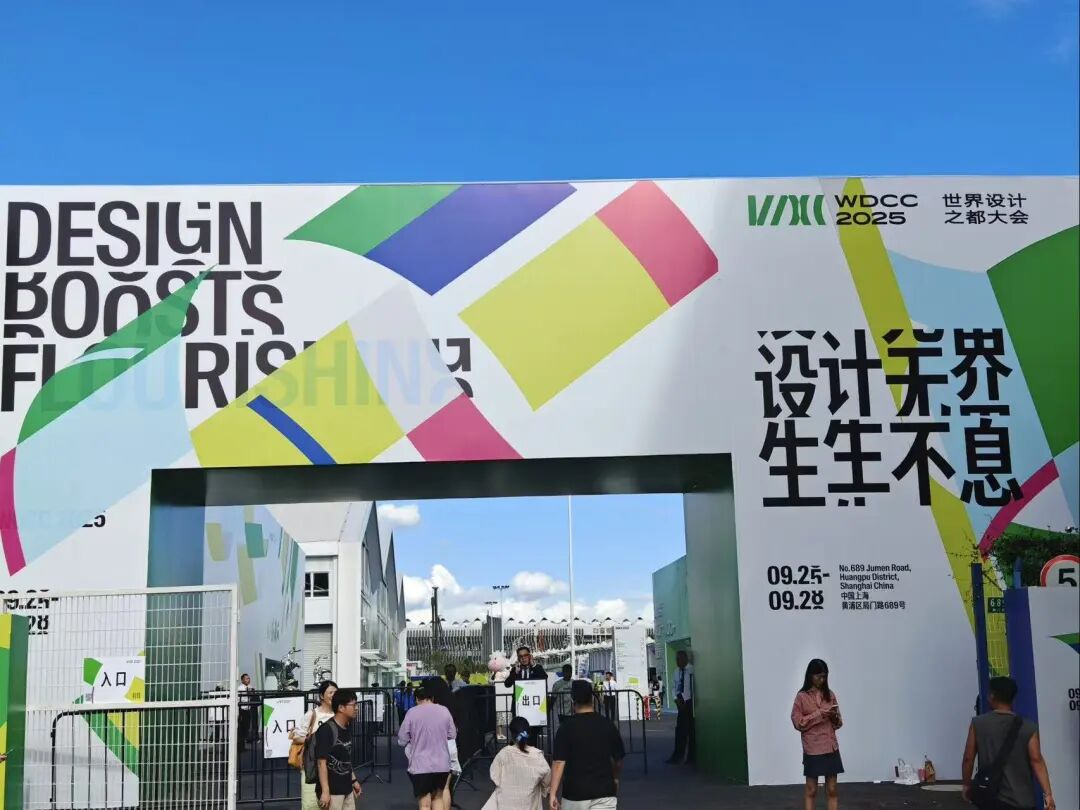
2025世界设计之都大会启幕
Shang Hai Zheng Quan Bao· 2025-09-25 15:53
Group 1: Event Overview - The 2025 World Design Capital Conference (WDCC2025) was inaugurated in Shanghai, co-hosted by the Shanghai Municipal Government and UNESCO, showcasing various industry achievements, policy documents, and important awards [1][4] - The opening ceremony featured the release of the "Shanghai Design Capital 15-Year Achievement Book," highlighting the industrial design sector's growth to over 1.6 trillion yuan, with 21 national industrial design centers and 200 municipal design innovation centers established [4] Group 2: Industry Initiatives - A set of measures to promote high-quality development in Shanghai's cosmetics industry was announced, focusing on technological innovation, service system innovation, and ecological optimization, with 11 specific initiatives [4] - The first "U35" Young Design Talent Plan was launched, recognizing 35 young designers, which strengthens the talent foundation for Shanghai's development as a world-class design capital [6] Group 3: Awards and Competitions - The 2025 "Shanghai Design 100+" global competition awarded four annual prizes, reflecting trends in AI empowerment, cultural heritage, and green sustainability [8] - The "Frontier Design Innovation Award" winners included John Thackara for outstanding contribution and Zhao Yunyang, a student, for future innovation [6] Group 4: Company Participation - Major listed companies such as Bailian Group, Bright Dairy, Laiyifen, and Haier showcased their innovations at the conference, emphasizing their roles in urban renewal and sustainable practices [10][12] - Bright Dairy introduced a new product line focusing on health needs, including four glass bottle dairy products tailored for specific consumer demands [14] - Haier's premium brand Casarte presented innovative home appliances featuring AI technology for food preservation and cooking, demonstrating a commitment to design integration [18]

业绩爆发式增长,年入超300亿,万辰集团强势冲刺“港交所量贩零食第一股”?
Zhi Tong Cai Jing· 2025-09-25 12:55
Core Viewpoint - The competition for the first snack stock on the Hong Kong Stock Exchange is intensifying, with Wanchen Group entering the market after its successful transformation from a mushroom producer to a leading discount snack retailer [1][10]. Company Overview - Wanchen Group, established in 2011, initially focused on the research, cultivation, and sales of edible mushrooms, particularly enoki mushrooms. It became the "mushroom first stock" after listing on the ChiNext in 2021 [1]. - The company has expanded into the discount snack store sector, merging with brands like "Liu Xiaocan" and "Lai Youpin" to form the new Wanchen Food Group, significantly altering the industry landscape [1][9]. Market Position - Wanchen Group holds a leading position in China's snack and beverage market, with its brand "Hao Xiang Lai" being the first discount snack brand in China to exceed 10,000 stores [2]. - The company has achieved rapid growth, with revenue projections for 2022, 2023, and 2024 at RMB 5.49 billion, RMB 92.94 billion, and RMB 323.29 billion, respectively, reflecting year-on-year growth rates of 1592.9% and 247.8% [2][3]. Store Network and Membership - As of June 30, 2025, Wanchen Group's store network has surpassed 15,000 locations across 29 provinces and municipalities in China, with over 1.5 million registered members [3]. - The company reported an average monthly active member spending frequency of 2.9 times as of August 2025 [3]. Competitive Advantages - Wanchen Group emphasizes both scale and efficiency, sourcing approximately 95% of its products directly from brand manufacturers, which allows for competitive pricing—20-30% lower than similar products in supermarkets [5]. - The product range includes 12 core categories, with over 4,000 SKUs selected from a vast inventory, ensuring a diverse offering that meets consumer demand [6]. Industry Growth Potential - The snack and beverage industry is projected to reach RMB 4 trillion by 2024, with discount snack retail expected to grow at a compound annual growth rate of 36.5% from 2024 to 2029 [8]. - Factors such as rising disposable income and the evolving consumer preference for snacks as a "fourth meal" are driving this growth, making the discount snack sector a key focus for retail development [8]. Competitive Landscape - The competitive landscape is characterized by major players like "Ming Ming Hen Mang" and emerging brands such as "Liang Pin Pu Zi" and "Tian Chao," creating a challenging environment for Wanchen Group despite its leading position [10]. - The company plans to use funds from its Hong Kong listing to expand its store network, enhance product offerings, and improve logistics and digital infrastructure [10]. Conclusion - Wanchen Group's successful entry into the discount snack market and its rapid growth position it well to capitalize on the industry's long-term benefits, although it faces ongoing competitive pressures that will test its operational efficiency and profitability [11].
新股前瞻|业绩爆发式增长,年入超300亿,万辰集团强势冲刺“港交所量贩零食第一股”?
智通财经网· 2025-09-25 12:51
Core Viewpoint - The competition for the first snack stock on the Hong Kong Stock Exchange is intensifying, with Wanchen Group and Mingming Hen Mang both vying for market leadership in the snack retail sector [1][10]. Company Overview - Wanchen Group, established in 2011, initially focused on the research, cultivation, and sale of edible mushrooms, becoming the "mushroom first stock" after its A-share listing in 2021 [1]. - The company has transitioned into the snack discount store sector, merging with brands like "Liu Xiaocan" and "Lai You Pin" to form a new entity, Wanchen Food Group, significantly altering the industry landscape [1]. Market Position - Wanchen Group holds a leading position in China's snack and beverage market, with its brand "Hao Xiang Lai" being the first retail brand in China to exceed 10,000 stores [2]. - The company has expanded its store network to over 15,000 locations across 29 provinces and municipalities in China by mid-2025 [3]. Financial Performance - Wanchen Group's revenue has shown explosive growth, with figures of RMB 5.49 billion, RMB 92.94 billion, and RMB 323.29 billion for 2022, 2023, and 2024 respectively, reflecting year-on-year growth rates of 1592.9% and 247.8% [2]. - The company reported a net profit of RMB 8.61 billion in the first half of 2025, a significant increase of 532% year-on-year [2]. Product Strategy - The company maintains a diverse product portfolio across twelve core categories, offering over 4,000 SKUs, with each store typically stocking around 1,800 to 2,000 SKUs [5]. - Wanchen Group's pricing strategy allows it to offer products at 20-30% lower prices than similar products in supermarkets and convenience stores, enhancing its competitive edge [5]. Industry Dynamics - The snack and beverage industry is projected to reach RMB 4 trillion by 2024, with the discount snack retail segment expected to grow at a compound annual growth rate of 36.5% from 2024 to 2029 [8]. - The shift in consumer behavior towards value for money and the expansion into lower-tier cities present significant growth opportunities for Wanchen Group [8][9]. Competitive Landscape - The competitive environment is characterized by major players like "Mingming Hen Mang" and "Liangpin Puzi," with several smaller brands also emerging rapidly [10]. - Despite its leading position, Wanchen Group faces substantial competition, necessitating continuous improvement in operational efficiency and profitability to maintain its market share [11].
休闲食品板块9月25日涨0.74%,盐津铺子领涨,主力资金净流出828.39万元
Zheng Xing Xing Ye Ri Bao· 2025-09-25 08:37
Group 1 - The leisure food sector increased by 0.74% on September 25, with Yan Jin Pu Zi leading the gains [1] - The Shanghai Composite Index closed at 3853.3, down 0.01%, while the Shenzhen Component Index closed at 13445.9, up 0.67% [1] - Key stocks in the leisure food sector showed varied performance, with Yan Jin Pu Zi closing at 70.15, up 2.56% [1] Group 2 - The leisure food sector experienced a net outflow of 8.28 million yuan from main funds, while retail investors saw a net inflow of 22.61 million yuan [2] - Major stocks like Wan Chen Group had a net inflow of 34.23 million yuan from main funds, but a net outflow from retail and speculative funds [3] - The overall trend indicates a mixed sentiment among different types of investors within the leisure food sector [2][3]


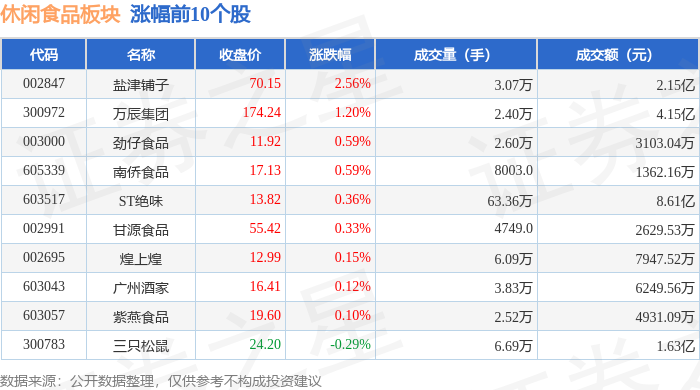
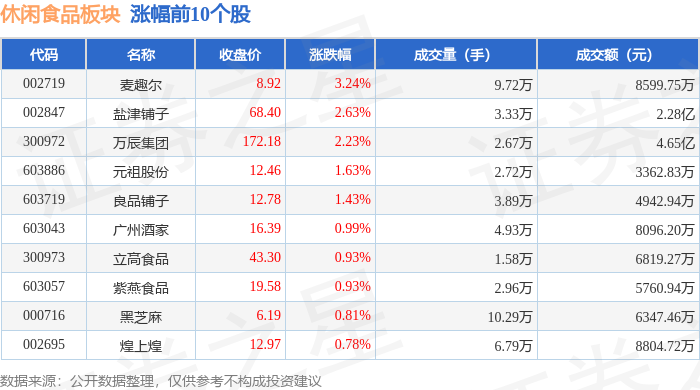
休闲食品板块9月24日跌1.02%,ST绝味领跌,主力资金净流出986.53万元
Zheng Xing Xing Ye Ri Bao· 2025-09-24 08:39
| 代码 | 名称 | 收盘价 | 涨跌幅 | 成交量(手) | 成交额(元) | | --- | --- | --- | --- | --- | --- | | 603517 | ST绝味 | 13.77 | -4.97% | 7730.0 | 1064.42万 | | 603777 | 来伊份 | 13.11 | -0.30% | 6.66万 | 8723.79万 | | 002956 | 西麦食品 | 20.74 | -0.10% | 2.46万 | 5103.40万 | | 603866 | 桃李面包 | 5.46 | 0.37% | 1 14.50万 | 7910.45万 | | 002557 | 治治食品 | 21.66 | 0.37% | 3.66万 | 7918.40万 | | 002820 | 桂发祥 | 12.21 | 0.41% | 5.95万 | 7249.64万 | | 603697 | XD有友食 | 11.45 | 0.53% | 4.43万 | 5089.65万 | | 002991 | 甘源食品 | 55.24 | 0.56% | 4242.6 | 2342.08万 | | ...

零食“折叠”
3 6 Ke· 2025-09-15 04:54
Group 1: Industry Overview - The recent half-year reports of the snack industry reveal significant declines in performance, indicating a systemic issue rather than isolated company problems [1][3] - Major players like Liangpinpuzi and Laiyifen reported substantial revenue drops and losses, with Liangpinpuzi's revenue down 27.21% to 2.829 billion yuan and a net loss of approximately 94 million yuan, marking a 491.59% year-on-year decline [1][3] - The industry's profitability is under pressure due to rising raw material costs and intensified price competition driven by market homogenization [3][9] Group 2: Cost Structure and Profitability - Traditional snack brands are facing a rigid cost structure that has become a burden, with companies like Three Squirrels experiencing a 25.11% increase in sales expenses, amounting to 1.119 billion yuan, while only achieving a 7.94% revenue growth [3][5] - Laiyifen's financial expenses surged by 61.09% due to increased short-term borrowing and rising interest costs, exacerbating its profitability challenges [5][7] - The inability to compress fixed costs, such as marketing and retail expenses, has increased operational risks for these companies [7][9] Group 3: Pricing Power and Market Dynamics - The weakening of pricing power among companies has led to a direct impact on revenue, with Liangpinpuzi's strategy of lowering prices failing to prevent a near 1 billion yuan loss [9][10] - New emerging channels, such as bulk snack stores, are leveraging efficient supply chains to operate profitably at lower margins, further pressuring traditional brands [12][14] - The shift in consumer preferences towards value-for-money products has diminished the effectiveness of traditional high-end branding strategies [9][18] Group 4: Channel Dynamics - Traditional snack brands are losing their influence in the market as channels gain more power, with bulk stores like "Haoxianglai" rapidly expanding and capturing market share [10][12] - Retailers like Sam's Club and Hema are developing their own snack brands, which are gaining traction due to competitive pricing and consumer trust [14][16] - The decline in traditional channels has forced companies to close underperforming stores, reflecting a broader struggle to maintain market presence [16][21] Group 5: Brand and Product Disconnect - The traditional brands are facing a crisis of brand relevance as their marketing narratives fail to resonate with modern consumers [18][19] - The reliance on OEM/ODM systems has led to significant product homogenization, undermining the brands' competitive edge in an era where product differentiation is crucial [19][21] - Companies are beginning to explore new product lines and business models, indicating a recognition of the need for transformation in response to market pressures [21]