古茗

Search documents
古茗4.55亿杭州拿地,一年股价涨超150%
Jin Rong Jie· 2026-01-13 06:07
Core Viewpoint - The new tea beverage brand, Gu Ming (01364.HK), has acquired a commercial land plot in Hangzhou for 455 million yuan, marking its entry into the local real estate market and plans to establish its headquarters there [1][2]. Group 1: Land Acquisition Details - Gu Ming Technology (Zhejiang) Co., Ltd. won the land plot located in the core area of Qianjiang Century City, Hangzhou, with a floor price of 6,100 yuan per square meter [1]. - The land covers approximately 12,400 square meters with a buildable area of about 75,000 square meters and a height limit of 190 meters [1]. - The land is designated for headquarters economy use, requiring the company to meet specific operational targets, including an annual revenue of no less than 1 billion yuan [2]. Group 2: Company Growth and Financial Performance - Gu Ming has not yet established its own headquarters in Hangzhou, currently operating from a location in Xiaoshan District [2]. - The company previously acquired land in May 2022 in Wenling City for a total investment of about 500 million yuan to build its headquarters [3]. - As of mid-2025, Gu Ming reported a revenue of 5.663 billion yuan, a year-on-year increase of 41.2%, and a net profit of 1.625 billion yuan, up 121.5% [4]. Group 3: Expansion Plans and Market Position - Gu Ming aims to expand its store network to 30,000-40,000 locations, targeting untapped markets in lower-tier cities and towns [6]. - The company has a total of 11,179 stores across over 200 cities, reflecting a year-on-year growth of 17.5% [5]. - In 2025, Gu Ming distributed significant dividends totaling approximately 4.1 billion Hong Kong dollars, with the founder holding 72.77% of the shares [6]. Group 4: Market Valuation and Stock Performance - As of January 12, Gu Ming's stock closed at 25.38 HKD per share, representing a more than 150% increase from its IPO price of 9.94 HKD [7]. - The company's market capitalization is approximately 60.36 billion HKD, with a peak valuation exceeding 70 billion HKD in mid-2025 [7].
古茗耗资4.5549亿元在杭州拿地
Cai Jing Wang· 2026-01-13 03:10
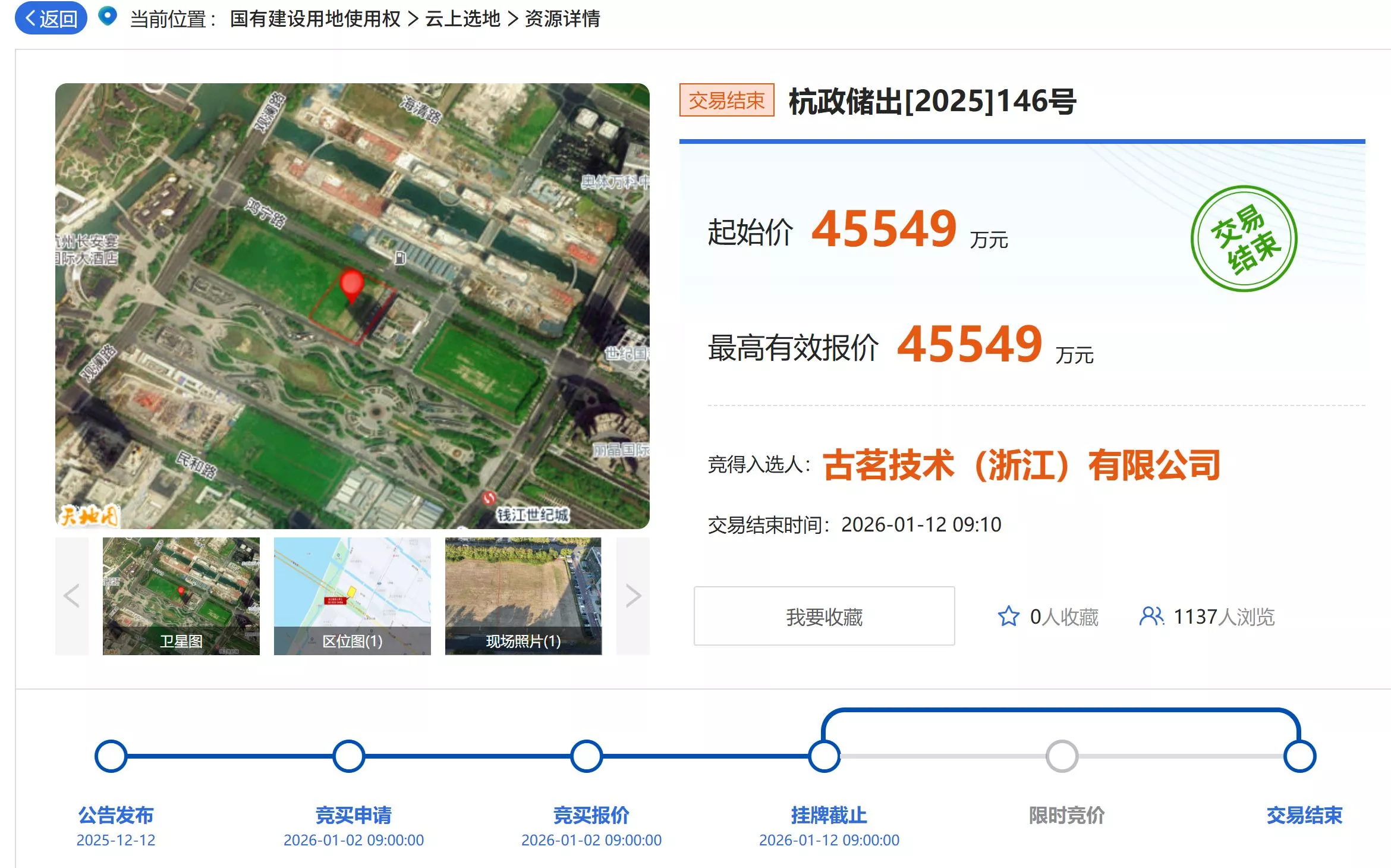
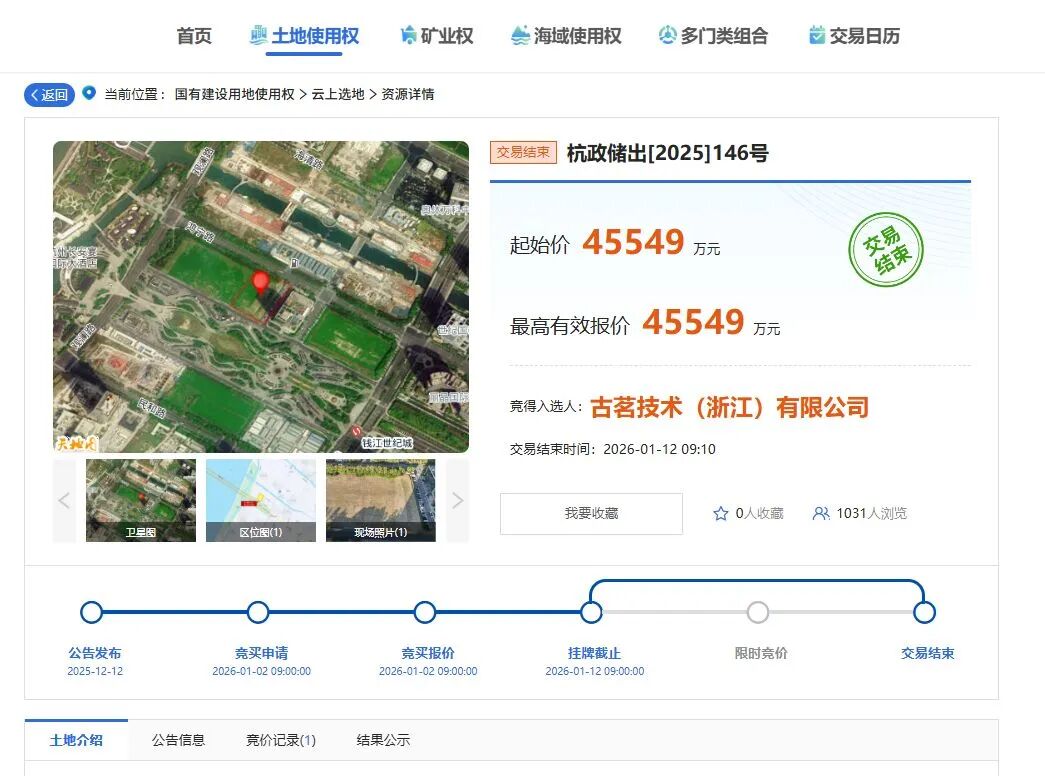
近日,浙江省自然资源网上交易中心官网显示,杭州市萧山区的世纪城核心单元XS010203-04地块,出让面积12445平方米(18.668亩),主用图商务金融用 地,被古茗技术(浙江)有限公司竞得。据悉,该地块最高有效报价为4.5549亿元,竞买保证金为9110万元。位置东至广孚中心,南至秋韵街,西至规划经 二路,北至鸿宁路。出让年限40年。 图片来源:浙江省自然资源网上交易中心官网截图 ...

浙江奶茶巨头为何要花4.55亿元在杭州拿地?
3 6 Ke· 2026-01-13 02:57
Core Insights - The tea beverage industry is witnessing a shift from front-end competition focused on store density and product iteration to back-end competition emphasizing organizational capability, resource integration, and capital strength [2][7]. Group 1: Land Acquisition and Strategic Moves - Gu Ming Technology (Zhejiang) Co., Ltd. acquired a commercial financial land parcel in Hangzhou for 455 million yuan, marking a significant investment in real estate amidst a competitive landscape [2][3]. - The land is suitable for developing a mixed-use commercial and business building, with a total area of 12,445 square meters and a maximum building height of 190 meters [3][5]. - Other leading tea brands, such as Yi He Tang and Nayuki, are also investing in real estate, indicating a trend among top brands to establish headquarters and enhance operational capabilities [6][7]. Group 2: Market Position and Financial Performance - Gu Ming's revenue for the first half of 2025 reached approximately 5.66 billion yuan, reflecting a year-on-year increase of 41.2% [8]. - The company has a significant presence in lower-tier cities, with 81% of its stores located in second-tier and below cities, showcasing its strategy of targeting less saturated markets [9][10]. - The company’s supply chain management and franchisee support systems are highlighted as key competitive advantages, enabling efficient operations and lower costs [10]. Group 3: Long-term Strategy and Confidence - The trend of acquiring land during a downturn in the real estate market reflects the confidence of leading tea brands in their cash flow and long-term value [10]. - The mixed strategy of maintaining light operations while investing in heavy assets is seen as a new anti-cyclical approach, allowing companies to hedge against inflation and secure long-term operational costs [10].
哈梅内伊:伊朗人民粉碎境外敌人实施的阴谋!白宫发声;中国金龙指数大涨4.26%;贵州茅台,下调;金帝巧克力道歉丨每经早参
Mei Ri Jing Ji Xin Wen· 2026-01-12 22:01
Market Overview - US stock indices closed higher, with the Dow Jones up 0.17%, S&P 500 up 0.16% reaching a new closing high, and Nasdaq up 0.26% [3] - Major Chinese stocks saw significant gains, with the Nasdaq China Golden Dragon Index rising 4.26%, Alibaba up over 10%, and other notable increases from Bilibili, Xpeng Motors, and Baidu [3] - International oil prices increased, with WTI crude oil futures for February rising by $0.38 to $59.50 per barrel, and Brent crude for March up $0.53 to $63.87 per barrel [4] Economic Policies and Developments - Canadian Prime Minister Carney is set to visit China from January 14 to 17, following an invitation from Chinese Premier Li Qiang [5] - China's Vice Premier He Lifeng met with former US Treasury Secretary Geithner, emphasizing China's commitment to expanding high-level foreign investment and promoting economic development [6] - The Chinese Ministry of Commerce reported progress in negotiations regarding electric vehicle trade with the EU, aiming to provide guidance for Chinese exporters [7] Industry News - BYD has launched a new brand "Linghui" aimed at the B2B market, featuring four new electric vehicle models, indicating a strategic shift towards high-end offerings [14] - The domestic average price of passenger cars is projected to drop to 170,000 yuan in 2025, marking a decline of 14,000 yuan from the previous year, ending a six-year growth trend [9] - The Chinese tea beverage brand, Guming, acquired a commercial land parcel in Hangzhou for 455 million yuan, reflecting a shift in industry competition towards asset acquisition [22] Technology and Innovation - The "Lihong No. 1" spacecraft successfully completed its first suborbital flight test, marking a significant milestone in China's commercial space sector [13] - The brain-machine interface laboratory at Tianjin University has developed a system for the fifth generation space station, achieving a milestone in space-based brain-machine interaction [23] Corporate Actions - Guizhou Moutai announced significant price reductions for its premium products, with the price of its aged liquor dropping from 5,399 yuan to 3,409 yuan per bottle, indicating a strategic pricing adjustment [18] - The AI robotics company, Zivariable, secured 1 billion yuan in financing, led by ByteDance, highlighting the growing investment interest in the AI sector [16]


浙江奶茶巨头,花4.55亿元在杭州拿地,地块面积超1.2万平方米
Mei Ri Jing Ji Xin Wen· 2026-01-12 14:53
Core Insights - The tea beverage industry is witnessing a shift in competitive dynamics, moving from front-end competition focused on store density and product iteration to back-end competition emphasizing organizational capability, resource integration, and capital strength [2][8] Group 1: Company Developments - Gu Ming (古茗) has acquired a commercial and financial land parcel in Hangzhou for 455 million yuan, indicating a strategic move towards asset-heavy investments [2][3] - The land is suitable for developing a mixed-use commercial and business building, with a minimum plot size of 800 square meters and a self-holding ratio of at least 80% for 40 years [5] - Gu Ming's revenue for the first half of 2025 reached approximately 5.66 billion yuan, reflecting a year-on-year increase of 41.2% [8][10] Group 2: Industry Trends - Major tea brands, including Gu Ming, are increasingly investing in real estate, which signifies a transition to a platform and ecosystem-based business model [8] - The competitive landscape is evolving as companies focus on building headquarters that enhance supply chain management, digital operations, and product development [8][10] - The trend of "building headquarters" is not limited to Gu Ming; other leading brands like Nayuki and Mixue are also engaging in similar asset acquisitions to strengthen their market positions [6][7] Group 3: Market Positioning - Gu Ming's store distribution is heavily concentrated in second-tier and lower cities, with 81% of its outlets located in these areas, showcasing its strategy of targeting less saturated markets [9][10] - The company has a robust supply chain management system, providing efficient cold chain logistics to 97% of its stores, which contributes to lower operational costs [10] - Analysts predict that Gu Ming could potentially expand its store count to over 40,000 nationwide, indicating significant growth potential in the market [11]

【IPO前哨】当海伦司失速,极物思维的“日餐夜酒”故事香吗?
Sou Hu Cai Jing· 2026-01-12 12:21
Core Viewpoint - The company Jiwusiying is attempting to become the first "restaurant and bar stock" in Hong Kong, contrasting with the struggles of Helen's (09869.HK) in the same sector, which is facing declining performance and stock price issues [2][3]. Company Overview - Jiwusiying, established in 2016, has differentiated itself from competitors like Helen's by adopting a full-time operational model, offering diverse food options during the day and transforming into a social drinking venue at night [4]. - As of September 2025, Jiwusiying has established 112 direct stores across 40 cities, with 109 operating under the "COMMUNE" brand, achieving a market share of 7.8% in the restaurant and bar sector by 2024 [4]. Financial Performance - Jiwusiying's revenue grew from 845 million RMB in 2023 to 1.074 billion RMB in 2024, marking a year-on-year increase of 27.1%. For the first nine months of 2025, revenue reached 872 million RMB, reflecting a 14.2% increase [6]. - The company's gross margin has consistently remained above 65%, reaching 68.7% in the first three quarters of 2025, significantly higher than competitors like Mijiu Group and Haidilao [6]. - Alcoholic beverages contributed 45% of Jiwusiying's revenue, with alcoholic drinks accounting for 85% of that segment, driving overall profitability [6]. Market Position and Challenges - Jiwusiying's strategy of full-time coverage provides resilience against market fluctuations, while Helen's struggles with a single low-cost model have led to a 34% revenue drop to 291 million RMB in the first half of 2025 [6][7]. - Despite strong performance, Jiwusiying faces challenges related to its reliance on high-consumption urban markets, with over 90% of its stores located in first and second-tier cities, raising concerns about market saturation [8]. - The company plans to expand into lower-tier cities, but faces challenges due to lower sales and consumer spending power in these markets, which may conflict with its mid-to-high-end positioning [10]. Strategic Outlook - Jiwusiying's upcoming IPO is seen as a test of its full-scenario restaurant and bar model, which has shown competitive strength during a period of market differentiation [10]. - To maintain long-term market recognition, the company must address two key challenges: reversing the decline in same-store sales in first-tier cities and finding a suitable approach for expansion into lower-tier markets without compromising brand integrity [10].
“投资21万,一天卖不到300元”,第一批糖水铺开始关店?
东京烘焙职业人· 2026-01-12 08:33
Core Viewpoint - The sugar water market is experiencing a stark contrast between the rapid expansion of leading brands and the struggles of many single-store operators, leading to a challenging environment for independent businesses [6][10][39]. Group 1: Market Dynamics - The sugar water sector has seen unprecedented heat this year, with major brands like Gu Ming, Cha Bai Dao, and CoCo entering the market, while new brands like Mai Ji and Tang Xu are rapidly expanding, opening nearly 1,000 new stores [9][10]. - Social media has popularized visually appealing sugar water, making it a "social currency" among young consumers, which has encouraged many entrepreneurs to enter the market [11][10]. - Despite the apparent market prosperity, many single-store operators are struggling to maintain their businesses, with reports of daily sales failing to exceed 300 yuan [14][13]. Group 2: Challenges Faced by Single-Store Operators - Operators face four main challenges: 1. **Category Limitations**: Sugar water is not a necessity and has a lower consumption frequency compared to milk tea, making it harder to attract repeat customers [19][20]. 2. **Competition from Chains**: The influx of chain brands has led to price competition, with similar products being offered at lower prices, making it difficult for independent stores to compete [25][26]. 3. **High Operating Costs**: The preparation of sugar water is labor-intensive and time-consuming, leading to high operational costs and low profit margins [31][34]. 4. **Seasonal Fluctuations**: Sugar water sales are highly seasonal, with significant drops in winter, making it challenging for operators to maintain consistent revenue [35]. Group 3: Future Outlook - There is a debate about the future of sugar water, with some believing it aligns with the "light health" trend due to its traditional ingredients, while others argue it cannot replicate the success of milk tea due to its lower consumption frequency [39][41]. - The boundaries between tea drinks and sugar water are blurring, as tea brands introduce sugar water products, suggesting that sugar water may become a supplementary category rather than a standalone one [43][44]. - Despite the challenges, there remains potential in the market, especially in underdeveloped areas, for brands that can differentiate themselves and understand consumer needs [46].
浙商证券:预计25H2绝大多数餐饮头部品牌将实现客流量回正
Zhi Tong Cai Jing· 2026-01-12 06:24
Core Viewpoint - The recovery of the restaurant industry since the beginning of 2023 is driven by demand and paced by supply, with leading tea brands showing signs of recovery in Q1 2025, while Western fast food and casual dining are expected to stabilize in Q2 and Q3 2025 respectively [1][2]. Industry Trends - The restaurant industry is experiencing a survival of the fittest, with top brands becoming stronger. The recovery pace in the tea segment is ahead of Western fast food and casual dining by about 1 to 2 quarters [2]. - As of November 2025, the overall restaurant sector is seeing a net closure of stores, while specific segments like coffee, self-service, light meals, and regional cuisines are showing net openings [2]. - Leading brands such as Heytea, Luckin Coffee, KFC, and Haidilao are demonstrating superior net opening speeds, indicating brand resilience [2]. Performance Outlook - Most leading brands are expected to achieve same-store sales stabilization or growth starting in H2 2025, with a normalization of customer traffic anticipated [3]. - The average transaction value (ATV) for many leading brands is stabilizing or increasing, with brands like Haidilao, McDonald's, and Luckin Coffee showing year-on-year increases in ATV as of November 2025 [3]. - The restaurant sector is viewed as a valuation opportunity, with brands like Haidilao and Yum China expected to show strong recovery and shareholder returns [4]. Specific Company Insights - Haidilao is expected to see improved revenue growth in H2 2025 due to enhanced table turnover rates, with a projected dividend yield of around 5% [4]. - Yum China is accelerating its expansion, with expected system sales growth in the mid-single digits and a total shareholder return of approximately $3 billion for 2025-2026 [4]. - Special mention of Teahouse International as a unique player in the Chinese restaurant sector, with significant growth potential and improving profitability [5]. - Green Tea Group is actively expanding into second and third-tier cities, with an anticipated store opening growth rate of about 30% in H2 2025 [5]. - Dashi Co. is also expected to achieve around 25% revenue growth in H2 2025, benefiting from rapid store openings [6]. - The tea segment is highlighted as a key area for growth, with brands like Gu Ming and Mixue Group expected to continue high growth rates due to strong same-store sales and accelerated openings [6].

华西证券:离岛免税新年开门红 四部门发文鼓励工会开展春秋游
智通财经网· 2026-01-12 02:03
Group 1 - Hainan's duty-free sales achieved a strong start in the new year, with sales exceeding 1.21 billion yuan in the first week, representing an 88% year-on-year increase [2] - The number of duty-free shopping transactions reached 824,000, with 149,000 visitors, reflecting growth of 30.3% and 38.3% respectively [2] - Domestic brands are seeing increased sales due to new policies allowing certain categories of goods to be sold in duty-free stores with tax exemptions, enhancing their competitiveness [2] Group 2 - Four government departments have issued a joint opinion to encourage trade unions to increase cultural and sports activities, aiming to unleash consumer potential and meet the growing cultural needs of workers [3] - The opinion suggests increasing the proportion of union funds allocated to cultural and sports activities and promoting collective negotiations for paid vacations [3] Group 3 - The investment outlook for 2026 suggests focusing on high-growth sectors supported by policies and technology, including duty-free shopping, silver-haired tourism, and parenting consumption [4] - New consumption trends are expected to maintain demand, with leading companies in sectors like trendy toys, tea drinks, and health products positioned for growth [4] - Innovations in retail and international expansion are anticipated to create new growth opportunities, with specific companies identified as beneficiaries [4] - The AI+ application sector is expected to flourish in 2026, with accelerated commercialization and various themes emerging [4]

5家消费公司拿到新钱;古茗2025年超额完成开店计划;泡泡玛特马年盲盒线上一分钟售罄|创投大视野
36氪未来消费· 2026-01-10 15:05
Investment Opportunities - Mu Xiaoma completed nearly 10 million RMB in Pre-A financing, with funds allocated for self-research of core components and new product development [3] - Canmi Bio raised 20 million RMB in angel round financing, focusing on enhancing its supply chain system [4] - Su Man Xiang secured several million RMB in A round financing, aimed at supply chain optimization and brand influence enhancement [6] - Xing Lian Future SATELLAI announced several million RMB in A round financing for AI technology development in pet health [8] - Zhang Bang Food completed 10 million RMB in angel round financing, focusing on capacity expansion and global supply chain network construction [9] Company Expansion Plans - Gu Ming exceeded its 2025 target by opening hundreds of additional stores, reaching a total of 13,000 stores by the end of 2025, with plans to open 4,000 more in 2026 [10][11] - Ming Ming Hen Mang is set to become the first "bulk snack stock" in Hong Kong, achieving a retail sales volume of 66.1 billion RMB, a 74.5% increase year-on-year [14] Market Trends - Disney's "Zootopia 2" became the highest-grossing Hollywood film in China, with box office revenue of approximately 4.25 billion RMB [19] - The domestic travel market saw 142 million trips during the New Year holiday, with total spending of 84.789 billion RMB [22]