Figure AI

Search documents
AI独角兽总估值达27000亿美元,其中100家成立不到2年
量子位· 2025-08-13 04:17
奕然 发自 凹非寺 量子位 | 公众号 QbitAI 好家伙,AI领域独角兽,已经高达498家。 其中100家是在2023年成立,到现在也不到2年。 它们的总估值达到了恐怖的27000亿美元,已经超过谷歌24400亿美元市值。 随之而来的,是数十位新亿万富翁,其中也都是大家熟悉的老面孔了。今天就来盘点盘点都有谁~ 谁是新的亿万富翁 据彭博社估计,四家最大的私营AI公司至少创造了十几位亿万富翁,其总净资产达到380亿美元。自那以后,已有十多家独角兽企业诞生。 先看下亿万富翁总结表。 | 人物名称 | 个人赋历 | 目前所在公司 | 公司估值 | 个人身价 | | --- | --- | --- | --- | --- | | 亚历山大 · 王 (Alexandr Wana) | Scale AI联合创始人,前CEO,现加入Meta AI团队 | Meta Al | Scale AI290亿美元 | 36亿美元 | | 郭露西 (Lucy Guo) | Scale AI联合创始人,现经营Passes | Passes | | 10亿美元以上 | | 次里應 · 阿慕迪 (Dario Amodei) | Anthr ...


中国人形机器人正在“超进化”
3 6 Ke· 2025-08-12 10:02
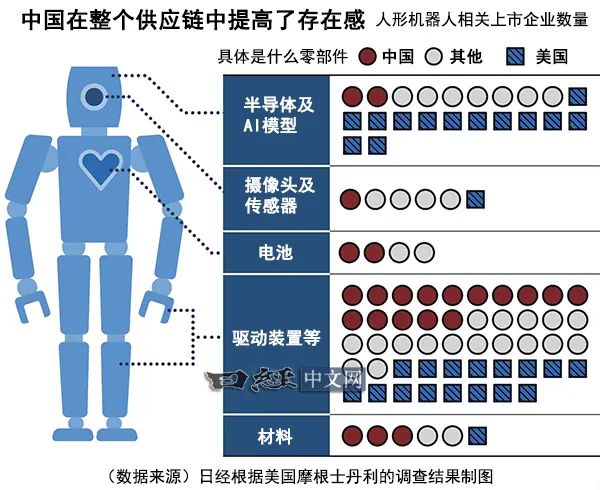
Group 1 - The core viewpoint of the articles highlights the rapid development of humanoid robots in China, showcasing their technological advancements and increasing competitiveness compared to the US and Japan [1][4]. - The World Robot Conference, held in Beijing, featured a significant increase in exhibitors of humanoid robots, with 50 companies showcasing their products, a notable rise from 27 models in 2024 [1]. - Chinese enterprises account for half of the 220 companies globally that have released humanoid robot prototypes and related products, with strong government support driving this growth [4]. Group 2 - The supply chain's robustness is crucial for competitiveness, with 21 Chinese companies listed among the 64 involved in the development and production of humanoid robots, surpassing the 18 from the US [5]. - Chinese companies are leveraging technologies from the electric vehicle (EV) sector to enhance humanoid robot development, significantly reducing costs by utilizing local components [5]. - The global humanoid robot shipment is projected to reach approximately 18,000 units by 2025 and increase to 1 million units by 2030, with a long-term forecast of 3 billion units by 2060 [8].

中国人形机器人正在“超进化”
日经中文网· 2025-08-12 08:00
Core Viewpoint - The humanoid robot industry in China is rapidly developing, showcasing significant advancements at the World Robot Conference, with Chinese companies gaining a competitive edge over their American and Japanese counterparts [2][5]. Group 1: Industry Growth and Competition - The World Robot Conference, held in Beijing, highlighted the presence of advanced humanoid robots, with 50 companies exhibiting humanoid robots, marking a notable increase in interest compared to previous years [4]. - As of the end of 2024, over 220 companies globally have released prototypes and related products of humanoid robots, with Chinese companies accounting for half of this number, significantly outpacing the 20% share of American companies [5]. - The Chinese government has been providing strong support for the humanoid robot industry, aiming for global leadership by 2035, similar to achievements in shipbuilding, solar panels, and electric vehicles [5]. Group 2: Technological Advancements and Supply Chain - Chinese companies are leveraging technology accumulated in the electric vehicle (EV) sector to enhance humanoid robot development, with components like joint modules being developed by companies such as Ningbo Top Group [6]. - Utilizing Chinese components can reduce the cost of humanoid robots to one-third, providing a significant cost advantage in the market [8]. - A report by Morgan Stanley identified 100 global publicly listed companies involved in humanoid robot development, with 21 Chinese companies in the supply chain for critical components, surpassing the 18 American companies [5][8]. Group 3: Global Market Projections - Research from Bank of America predicts that global shipments of humanoid robots will reach approximately 18,000 units by 2025 and increase to 1 million units by 2030, with a projected total of 3 billion units by 2060 [11]. - The United Nations forecasts that by 2060, the global population will approach 10 billion, leading to a ratio of 3 humanoid robots for every human [11]. Group 4: Societal Impact and Data Privacy Concerns - As humanoid robots become more integrated into daily life, concerns arise regarding their potential role as data collection tools due to their extensive use of cameras and sensors, highlighting the need for international data protection standards [13].

WRC 2025聚焦(2):人形机器人临近“CHATGPT时刻” 模型架构成核心突破口
Xin Lang Cai Jing· 2025-08-12 06:33
Core Insights - The humanoid robot industry is on the brink of a "ChatGPT moment," with significant breakthroughs expected within 1-2 years driven by policy and demand [1] - The average growth rate for domestic humanoid robot manufacturers and component suppliers is projected to be between 50-100% in the first half of 2025 [1] - The main challenge in the industry is not hardware but the architecture of embodied intelligent AI models, with the VLA model having inherent limitations [1][4] Short-term Outlook (1-2 years) - The domestic market is expected to maintain rapid growth due to policy subsidies and the expansion of application scenarios, with high visibility of orders for complete machines and core components [2] - Key players like Tesla and Figure AI could accelerate global supply chain division and standardization once they achieve mass production [2] Mid-term Outlook (2-5 years) - The integration of end-to-end embodied intelligent models with world models and RL Scaling Law could become the mainstream architecture, facilitating the transition from prototype to large-scale commercialization [2] - Distributed computing is anticipated to become a critical supporting infrastructure, collaborating with 5G/6G and edge computing providers [2] - Investment opportunities include hardware manufacturers entering the mass production phase, AI companies with video generation world model capabilities, and distributed computing centers and edge cloud service providers [2] Long-term Outlook (5+ years) - If end-to-end embodied intelligence and low-latency distributed computing are realized, the market for household and industrial humanoid robots could expand rapidly, potentially reaching annual shipment volumes in the millions [2] - The focus of competition is expected to shift from technological breakthroughs to cost control and ecosystem development [2] Hardware Status - Current humanoid robot hardware can meet most application needs, although optimization is still required in mass production and engineering [3] AI Model Challenges - The VLA model is considered a "foolproof architecture" but struggles with real-world interactions due to insufficient data, and its effectiveness remains limited even after reinforcement learning training [4] - The video generation/world model approach is seen as more promising, allowing for task simulation before real-world application, which may lead to faster convergence [4] RL Scaling Law - Current reinforcement learning training lacks transferability, requiring new tasks to be trained from scratch, which is inefficient [5] - Achieving a scaling law similar to that of language models could significantly accelerate the learning speed of new skills [5] Distributed Computing Trends - Humanoid robots are limited by size and power consumption, with onboard computing equivalent to a few smartphones [6] - Future developments will rely on localized distributed servers to reduce latency, ensure safety, and lower the cost of individual computing units [6]
WRC2025聚焦(2):人形机器人临近“ChatGPT时刻”,模型架构成核心突破口
Haitong Securities International· 2025-08-12 02:11
Investment Rating - The report indicates a positive outlook for the humanoid robotics industry, suggesting it is on the verge of a significant breakthrough, akin to a "ChatGPT moment" [1][10]. Core Insights - The humanoid robotics industry is expected to experience rapid growth driven by policy support and increasing demand, with domestic manufacturers projected to achieve average growth rates of 50-100% in the first half of 2025 [1][11]. - The main bottleneck in the industry is identified as the architecture of embodied intelligence AI models rather than hardware, with a shift towards video generation models being highlighted as a more promising approach [1][4][14]. - Investment opportunities are identified across hardware, software, and infrastructure sectors, particularly focusing on actuator and sensor manufacturers, AI companies with video generation capabilities, and distributed computing service providers [12][13]. Summary by Sections Industry Growth - The humanoid robotics sector is nearing a commercialization inflection point, with significant technological advancements and compute upgrades expected to reshape market dynamics [2][11]. - In the short term (1-2 years), the domestic market is anticipated to maintain high growth due to subsidies and application expansion, with strong order visibility for OEMs and core component manufacturers [2][11]. Technological Breakthroughs - The integration of end-to-end embodied intelligence models with world models and RL Scaling Law is expected to become the dominant architecture in the medium term (2-5 years), facilitating the transition from prototypes to mass commercialization [12][13]. - Distributed computing is projected to become a critical infrastructure component, enhancing collaboration with 5G/6G and edge computing providers [12][13]. Long-term Outlook - If low-latency distributed computing and embodied intelligence are successfully implemented, the humanoid robot market could expand rapidly, with annual shipments potentially reaching millions [13][14]. - The competitive focus is expected to shift from technological breakthroughs to cost control and ecosystem development in the long term (5+ years) [13][14].
世界机器人大会即将开幕,汽车零件ETF(159306)大涨近2%
Xin Lang Cai Jing· 2025-08-06 05:39
Group 1 - The 2025 World Robot Conference will be held in Beijing, showcasing over 100 new products, nearly double the number from last year [1] - According to Minsheng Securities, humanoid robots have entered an intelligent development stage driven by significant market demand and advancements in artificial intelligence technology [1] - Wanlian Securities highlights that continuous investment from tech giants like Tesla, Huawei, and Figure AI is expected to accelerate industry iteration and breakthroughs, paving the way for mass production and large-scale application of humanoid robots [1] Group 2 - The automotive parts ETF has seen active performance due to the catalyst from the robotics sector, with stocks related to the robotics industry rising nearly 2% [1] - The CSI Automotive Parts Theme Index, which the automotive parts ETF closely tracks, includes 100 listed companies involved in automotive systems, interiors, electronics, and tires, reflecting the overall performance of these companies [1][2] - As of July 31, 2025, the top ten weighted stocks in the CSI Automotive Parts Theme Index account for 40.36% of the index, including companies like Huichuan Technology and Fuyao Glass [2]
机器人概念多数上扬 近期机器人事件催化不断 机构称行业商业化落地可期
Zhi Tong Cai Jing· 2025-08-06 02:30
消息面上,近期,机器人事件催化不断。8月5日,宇树科技发布新款四足机器狗产品Unitree A2 星际猎 影。据悉,A2整机约37KG,空载续航约20KM,最大奔跑速度5米/秒,最大攀爬高度1米。宇树科技表 示,新款机型为行业应用而生,后续将公布产品价格等细节。此外,上海市人民政府办公厅印发《上海 市具身智能产业发展实施方案》。其中提到,建立市区协同培育机制,以浦东张江为核心承载区,加速 具身智能全产业链布局,协同具身智能相关重点区域,形成功能互补、差异化发展的特色产业集群。 机器人概念股多数上扬,截至发稿,微创机器人-B(02252)涨5.21%,报22.22港元;速腾聚创(02498)涨 4.54%,报33.6港元;优必选(09880)涨4%,报101.3港元;三花智控(002050)(02050)涨3.21%,报 27.66港元;越疆(02432)涨2.29%,报55.75港元。 值得关注的是,2025世界机器人大会即将于8月8日在北京经济技术开发区北人亦创国际会展中心启幕。 据悉,此次大会将有100余款新品首发亮相,数量是去年的近2倍。万联证券指出,特斯拉、华为、 Figure AI等科技巨头在人形机 ...

港股异动 | 机器人概念多数上扬 近期机器人事件催化不断 机构称行业商业化落地可期
智通财经网· 2025-08-06 02:25
Group 1 - The majority of robotics concept stocks have risen, with notable increases in companies such as MicroPort Robotics-B (up 5.21% to HKD 22.22), SUTENG (up 4.54% to HKD 33.6), and UBTECH (up 4% to HKD 101.3) [1] - Recent catalysts in the robotics sector include the launch of the new quadruped robot Unitree A2 by Yushu Technology, which weighs approximately 37KG, has a range of about 20KM, a maximum running speed of 5m/s, and a climbing height of 1m [1] - The Shanghai Municipal Government has issued a development plan for the embodied intelligence industry, aiming to establish a collaborative cultivation mechanism and accelerate the layout of the entire industry chain in the Pudong Zhangjiang area [1] Group 2 - The 2025 World Robot Conference is set to open on August 8 in Beijing, featuring over 100 new products, nearly double the number from last year [2] - Major technology companies like Tesla, Huawei, and Figure AI are expected to drive rapid advancements in the humanoid robot sector, with mass production and large-scale applications on the horizon [2]
人形机器人的进化之路|2.5万字圆桌实录
腾讯研究院· 2025-08-04 09:23
Core Viewpoint - The article discusses the evolution of embodied intelligence in robotics, highlighting significant technological breakthroughs, challenges in practical applications, and the potential societal impacts of these advancements. Group 1: Technological Breakthroughs - Embodied intelligence has made notable progress in specific, closed environments, but struggles with complex tasks in open settings [6][10] - The advancement of end-to-end large models has transitioned from L2 to L4 levels, showcasing improved generalization capabilities [7][8] - Data collection techniques have significantly improved, with large-scale projects like AGI Bot World gathering millions of real-world data points [9] - Simulation technology has advanced, enhancing the realism of robotic interactions, although physical interaction simulations still require improvement [9][10] Group 2: Challenges and Limitations - The generalization ability of embodied intelligence is still limited, particularly in out-of-distribution scenarios [10][11] - Safety concerns arise from robots operating in uncontrolled environments, leading to potential hazards [6][10] - Ethical considerations become more prominent as technology matures and integrates into daily life [6][10] Group 3: Societal Impacts - The development of embodied intelligence may lead to a new industrial revolution, independent of traditional AI [5] - It could significantly alter economic structures and influence education and job transitions for humans [5] - The redefinition of human value in the context of advanced robotics and AI capabilities is a critical discussion point [5] Group 4: Future Directions - The integration of tactile feedback into embodied intelligence models is essential for enhancing real-time interaction with the environment [11][16] - The exploration of multi-modal data, including visual, tactile, and other sensory inputs, is crucial for improving predictive capabilities [29][30] - The industry is moving towards establishing standardized interfaces and protocols to facilitate collaboration and data sharing among different robotic systems [28][29]

无人叉车带来叉车行业的新增量
新财富· 2025-08-01 08:05
Core Viewpoint - The article discusses the growth potential and application of autonomous forklifts, emphasizing their integration with existing forklift technology and the increasing demand in logistics and manufacturing sectors [2][5][6]. Group 1: Industry Trends - The robotics industry is evolving along two main paths: vertical development focusing on humanoid robots for industrial and consumer applications, and horizontal development targeting specific applications to enhance efficiency through automation [2]. - In the logistics sector, companies like Amazon have deployed a significant number of robots, optimizing operations and reducing movement time by 10% [3]. Group 2: Market Data - Global forklift sales are projected to reach 2.14 million units in 2024, with a year-on-year growth of 6.5%, and China is expected to account for half of this volume [5]. - In 2023, global sales of autonomous forklifts reached approximately 30,700 units, marking a 46% increase year-on-year, with China leading the market at 19,500 units sold, a 47% increase [10]. Group 3: Technology and Cost - The cost of autonomous forklifts has significantly decreased from 600,000 RMB to around 200,000 RMB per unit since 2018, making them more competitive against traditional electric forklifts [13]. - The integration of advanced navigation and control technologies has enhanced the operational capabilities of autonomous forklifts, allowing for greater efficiency in indoor logistics [12]. Group 4: Company Performance - Toyota Industries reported a decline in forklift sales for FY2025 but expects net sales to grow by 7.7% due to price increases and favorable exchange rates [20]. - Hyster-Yale's Q1 2025 revenue fell by 14% year-on-year, primarily due to a weak European market, while KION Group saw a significant increase in order volume, indicating strong demand in the industrial vehicle sector [22][25]. Group 5: Future Outlook - The forklift industry is anticipated to experience a recovery starting in 2025, driven by growth in emerging markets, while the North American and European markets remain relatively weak [27].